

Comparing asset-allocation ETFs: what’s the right allocation?

I’ve talked about my approach to investing before, which is slavishly devoted to maintaining a constant asset allocation across all my accounts. And as I’ve mentioned, my current targets are:

  • 20% is Canadian Equity, 36% is US Equity, and 24% is International Equity, for a total of 80% equity overall
  • 15% bonds
  • 5% cash

My allocation targets were picked to align with XGRO1, which, over time, will make up more and more of my retirement portfolio2.

As I’ve written elsewhere, these are pretty broad categories and could be sub-divided further. I’ve not bothered with this myself, but I thought it would be an interesting exercise to survey what the major all-equity and high-growth funds have under the hood. And so, I present this comparison:
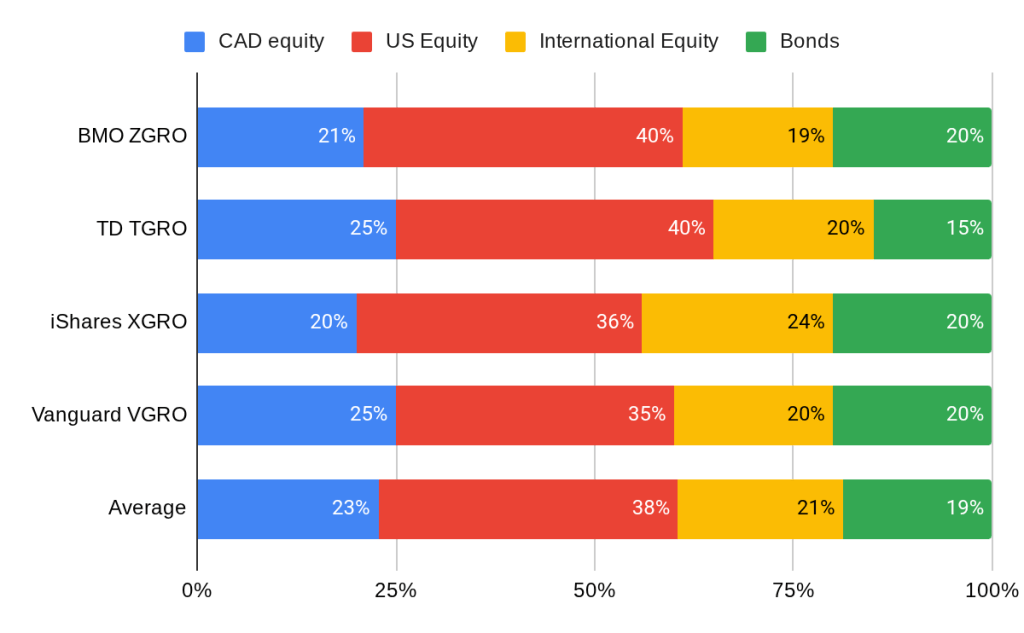
A few notes on the above:

  • Canadian Equity: Some use an all-cap index (TGRO, VGRO) while some use a capped composite index (ZGRO, XGRO).
  • US Equity: VGRO and XGRO use an all-cap index, TGRO sticks to large cap, and ZGRO holds large, mid and small cap indices. TGRO is a bit of an outlier because it doesn’t hold small cap..
  • International Equity: TGRO takes an all countries approach, whereas the other three split between developed and emerging markets. Net effect is pretty much the same thing.
  • Bonds: Here you find the greatest variation; VGRO is the only ETF to hold bonds outside of North America whereas TGRO holds only Canadian bonds. XGRO and ZGRO are pretty similar, with XGRO having a bit more Canadian bond exposure over ZGRO.

The most notable difference between my allocations and the average allocation of the big 4 funds is that I have more international exposure than other funds, and that’s because I’ve chosen to hitch my wagon to the iShares/XGRO family.

The reason? I started investing in the iShares family some time ago because it was the family that my old provider (QTrade) allowed me to trade without fees. With my current provider (Questrade), all of the families are free to trade, and hence my continued devotion to iShares/XGRO no longer holds that attraction — I could buy any of the all-in-ones. (Indeed, I’ve actually been adding some TD all-in-ones because their management fees are a bit lower).

But this exercise has given me food for thought; perhaps I have a bit too much bias to the international equity portion of the portfolio. But honestly, I can’t believe it makes that much of a difference, and churning my portfolio simply to reduce my international exposure a point or two seems unnecessary3.

  1. Why XGRO and not an all-in-one from another company? Read on. ↩︎
  2. I’m slowly converting my main holding (AOA, which trades in USD) to XGRO on a quarterly basis so that I’m never over exposed to foreign exchange variations. I convert a percentage of these holdings annually, corresponding to the percentage at which I’m draining my RRIF. ↩︎
  3. Running some numbers through https://www.dividendchannel.com/drip-returns-calculator/ demonstrates that XGRO is the bottom of the performance pile over the past 5 years or so as compared to TGRO, ZGRO and VGRO. The difference isn’t massive, and the window is short because these funds haven’t been around all that long, but it’s another data point to consider…p.s. the tool above doesn’t (yet?) understand the 3 for 1 reverse split ZGRO undertook in August, so best to end any simulation involving the BMO funds at August 1,2025. ↩︎

What’s the deal with XEQT?

***updated this post to reflect the fact that XEQT has dropped XUS from its portfolio as of July 2, 2025***

This post is inspired by my original on the topic, “What’s the deal with XGRO“? XGRO is great, but since my target asset allocation is only 15% bonds, and XGRO’s bond target is 20%, there’s some tweaking I have to do in order to reduce the bond exposure. That tweak is increasingly being provided by XEQT, part of the same iShares family that produced XGRO.

(As mentioned elsewhere, I rely heavily on all-in-one ETFs in my retirement portolio. New to all-in-ones? Read a bit about them here.)

XEQT, like XGRO, is actually investing in thousands1 of different stocks. Unlike XGRO, it does not hold any bonds at all. I thought it would be interesting to see what, exactly, is underneath every $100 you invest in XEQT. See the results below:

FundWhat is it?How much?Compare with XGRO23
ITOT/ XTOT4Broad US stock coverage that tracks the S&P Total Market Index, about 2529 companies (top holdings: Apple, Nvidia, Microsoft, Amazon, Meta)$43.62 of your $100 investment$36.32 of your $100 investment
XEFBroad international (Europe, Asia, Australia) stock coverage that tracks the MSCI EAFE Investable Market Index, about 2500 holdings$25.25 of your $100 investment
$19.76 of your $100 investment
XICBroad Canadian stock coverage that tracks the S&P/TSX Capped Composite Index, about 223 companies (top holdings: RBC, Shopify, TD, Enbridge, Brookfield)$25.71 of your $100 investment
$20.09 of your $100 investment
XEC3000+ emerging market stocks that track the MSCI Emerging Markets Investable Market Index$5.04 of your $100 investment$4.07 of your $100 investment

The top 10 stocks of XEQT as of today looks like this:

TickerCompanyInvestment for every $100
NVDANvidia$2.99
MSFTMicrosoft$2.70
AAPLApple$2.26
RYRoyal Bank$1.67
AMZNAmazon$1.54
SHOPShopify$1.35
TDTD Bank$1.15
METAMeta$1.09
AVGOBroadcom$0.96
ENBEnbridge$0.88
Total$16.59
Top 10 holdings of XEQT as of July 25, 20255

The top stock holding outside North America belongs to Taiwan Semiconductor, at 46 cents for every $100 invested. Additionally, the geographic exposure looks like this:

Geographic exposure of XEQT as of July 25, 2025

One other little tidbit that might be interesting: the distribution yield of XEQT is 2.94% compared with 2.91% for XGRO. This I find a bit surprising, since I would have expected XGRO’s yield to be quite a bit better.

  1. 8,550 to be precise, as of today ↩︎
  2. As of today, might be different from when I wrote https://moneyengineer.ca/2025/01/30/whats-the-deal-with-xgro/ ↩︎
  3. And, if you’re really paying attention, you’ll see that the dollar amounts of this column add up to roughly $80, in keeping with the 80/20 philosophy of XGRO. ↩︎
  4. i lump these together because they hold exactly the same thing. Some loophole that iShares needs to exploit, I gather. ↩︎
  5. On the date I pulled these numbers, cash cracked the top 10 for a holding of $1.34, which is not usual, so I just dropped it. Not sure why that is…perhaps by the end of the month it will resolve itself. ↩︎

Rebalancing the portfolio: A real-life example

If you adhere to asset-allocation strategies (as I do) then rebalancing your assets to reset them back to your targets is a way to make sure you stay on track1. Some people do this on a regular basis (monthly, quarterly, annually) but I try to do it whenever the drift becomes noticeable (more than 1% off of my targets2). The targets for my portfolio are

  • 5% cash
  • 15% bonds
  • 20% Canadian equity
  • 36% US Equity
  • 24% International equity

Given the week we’ve just had, it’s not really a surprise to see that I’m overweight in cash, and underweight in foreign equity. Some of my cash is untouchable because it’s the built-in cushion that Variable Percentage Withdrawal (VPW) requires3, so that’s out. The majority of the cash in play is found in my RRIF accounts, and most of that is found in USD.

So the problem to solve for is to find a low-cost International Equity ETF that sells on the US market. Let’s walk through the steps I go through for that.

Copy what’s in my USD all-in-one ETF

Long time readers will know that most of my USD holdings are invested in AOA. (What’s the deal with AOA? Asked and answered here.) Since AOA is an all-in-one ETF, and since I know that AOA has international holdings (around 28%), and I know that AOA is inexpensive to hold, I can just do what AOA does, right?

So that is certainly a possibility, but as it turns out, AOA invests in TWO international ETFs, namely:

  • IDEV, which is a broad international ETF that tracks the developed world (you can see the Sector and Geographic breakdown here)
  • IEMG, which is a broad international ETF that tracks emerging markets (Sector and Geographic breakdown here)

IDEV and IEMG are both excellent funds, but I don’t really want to buy two funds if I can help it. AOA holds these two in a roughly 3:1 ratio, and I am too lazy to keep that straight.

So time for plan B.

Google for an appropriate ETF

So I type “international ETF USD” into Google and see what I get.

The first hit is linking to etfdb.com which isn’t my favourite website. They always list 100 ETFs when I want to choose from maybe 4. So I skip that link.

Then I get a hit for IXUS, which is an iShares product. This one I’ve heard of, and it has a clever name (ex-US, get it?). On IXUS’ overview page, I see three promising factoids:

  • It provides “exposure to a broad range of international developed and emerging market companies4
  • It has a MER of 0.07%, which is acceptable.
  • It’s not clear to me how much is in emerging markets, but the geographic exposure breakdown includes some non-G7 economies, so that’s good.

So that’s pretty good, but I want to look at least one more ETF to be a good comparison shopper.

A little bit further down I get a hit for VXUS, a Vanguard product. Like IXUS, it has a clever name (ex-US, get it?) and so I feel compelled to look closer.

And I see three factoids again:

  • It provides “Broad exposure across developed and emerging non-U.S. equity markets”
  • Its MER is 0.05%
  • The geographic exposure breakdown looks an awful lot like IXUSes, even though the underlying index it’s tracking is different5

And so, with that, the decision is made: we go with VXUS because it’s 0.02% cheaper than IXUS.

Actually DOING the rebalancing

This will be new ground for me, because it will be using my new provider for the first time (Questrade). My old provider let me sell one ETF and immediately buy another, and I assume that Questrade will also allow this, but until I try it, I’ve learned not to assume things.

Oh, yes, the “cash” in my USD RRIF is actually also an ETF, namely ICSH, which is because Questrade doesn’t provide any other means to earn money on “cash”.

So anyway, on Monday, a few hours after the stock market opens, I’ll take a look and see if trading is still a advisable — has the market suddenly recovered? Is it so volatile it warrants sitting on the sidelines? I’m guessing both of those will be a solid “no”, but I will wait until Monday to follow through.

Rebalancing (Somewhat) Complete

I signed in yesterday to my brokerage account around lunchtime so I missed all the morning’s excitement. After everything I wrote above, I didn’t buy VXUS after all — since my US equity portion was also significantly below target, I bought AOA instead, thus increasing both my US and International equity positions at the same time. I used a limit order since the bid/ask spread was like 20 cents, far higher than I’m used to seeing.

When markets are this nutty, I don’t like making all purchases at once. Since Questrade trading of ETFs is now totally free, I can take my time and incrementally shift the portfolio back to targets.

  1. Long time readers may wonder why rebalancing in my portfolio (which is dominated by asset allocation ETFs) is required at all — one of the reasons to invest in an all-in-one is BECAUSE it rebalances automatically. The answer is simple — although MOST of my portfolio is in all-in-ones, not ALL of it is. As I prepared my portfolio for retirement (read more about that here), I couldn’t justify selling assets and attracting capital gains in my non-registered account just to make the portfolio simpler. ↩︎
  2. I track those targets using the Multi-Asset tracker found here ↩︎
  3. VPW is how I get paid in retirement. You can read about the method here. ↩︎
  4. Closer reading of the product page shows IXUS tracks the MSCI ACWI ex USA IMI Index ↩︎
  5. VXUS tracks the FTSE Global All Cap ex US index ↩︎

Questrade Bonus Capability: Passiv

**** Update: Per email communication on October 24 2025, as of January 31, 2026, Passiv will not be offered at all by Questrade, as they are planning to launch their own integrated portfolio monitoring and rebalancing tools”.

**** Update: As of June 1, 2025, Passiv Elite is no longer offered for free for Questrade Clients. It’s now part of a subscription service called Questrade Plus***

As you may have heard, I’m in the middle of a transition between online brokers1. And so I’ve been spending some more time getting to know what Questrade offers to the DIY investor besides free buying and selling of stocks and ETFs.

One thing I looked into lately was Passiv, a service that is offered for free for all Questrade clients.

In brief, Passiv is a 3rd party web application2 that allows you to track your investments from a single screen, no matter if they are found in multiple investment vehicles (e.g. TFSA, RRSP, RRIF) or if they are found across multiple providers (full list of supported brokers is here)3.

What’s more, it also evaluates your portfolio against a model that you define. For example, if you (like me) have an investment portfolio with a target allocation of 5% cash, 15% bonds, 20% Canadian equity, 36% US equity, and 24% international equity, Passiv can assess your current holdings against these targets, and even do the trades to rebalance the portfolio!

Astute readers will note these are a lot of the same benefits I’m a fan of — and one of the big reasons most of my portfolio is invested in all-in-one asset allocation ETFs. (Are these ETFs unfamiliar? You can read about them here.)

I tried to use Passiv to model my own portfolio, but discovered that all-in-one asset allocation ETFs aren’t really supported by the tool4. Once I thought about it some more, it’s clear why — Passiv really markets itself as an ALTERNATIVE to using all-in-ones. Here’s a clear marketing pitch from Passiv that demonstrates its approach: https://passiv.com/feature-posts/model-portfolios-that-cost-less-than-all-in-one-funds-or-robo-advisors.

So to get the full benefit of Passiv, instead of holding XGRO, you would instead hold the constituent components of XGRO, a fund I’ve broken down previously. This would save you some management fees over time. Passiv helpfully does the math to calculate how much here5.

As a certified cheapskate, I’m always interested in saving a bit of money. But there are some downsides I could see in the Passiv approach:

  • You have to actually DO the rebalancing now and then. Not a big deal, but a fund like XGRO does this as part of their offer6.
  • You have to do the rebalancing no matter what. By this I mean that you have to buy when others are selling, and sell when others are buying. You can’t get overly attached to any one segment of your portfolio, because then you start making bad decisions based on “gut instinct”. Humans are notoriously bad at this7.

On the plus side, you will definitely save on management fees, and you could certainly tweak the contents to avoid products you wouldn’t normally buy (e.g. XGRO has some hedged funds, which I don’t like, typically).

An unknown for me is how foreign exchange is handled. That’s always something I consider since a lot of my retirement savings are in USD. Some experiments required 🙂

Anyway, it’s given me something to think about. I’ll have to see how easy it is to use in practice once all my accounts are back in place. Any Passiv users out there? I’m interested in your take — just drop a line to comments@moneyengineer.ca.

  1. And some (not all) of the funds are now showing up in Questrade, about 3 weeks after starting the process. Switching providers is not for the impatient. ↩︎
  2. WARNING: they don’t have an app. But someone named “Pasiv” does, and it looks very similar. ↩︎
  3. Other benefits include tracking of dividends, performance charts, etc. All stuff Questrade is apparently not very good at. ↩︎
  4. One asset class per stock symbol. My home-grown spreadsheet supports dividing symbols by asset class. ↩︎
  5. The calculation doesn’t include Passiv’s fees for the service, which are waived if you are Questrade client. ↩︎
  6. Per BlackRock “XGRO’s portfolio will be monitored relative to the asset class target weights and will be rebalanced back to asset class target weights from time to time at the discretion of BlackRock Canada and/or BTC. Generally, XGRO’s portfolio is not expected to deviate from the asset class target weights by more than one-tenth of the target weight for a given asset class.” [source] ↩︎
  7. If you’re interested in how behavior shapes investing, https://www.looniedoctor.ca/2024/12/13/etf-investor-behavior/ is a very good introduction to the topic. ↩︎