
Top Five Money Engineer posts of 2025

The Money Engineer launched in January 2025 and according to the WordPress stats, I made 144 posts last year. What were the most viewed posts of 2025?

5th-ranked post of 2025: ZGRO versus ZGRO.T

I got wind of ZGRO.T through Reddit, specifically r/CanadianInvestor. ZGRO and ZGRO.T are both all-in-one asset allocation ETFs from BMO, but with vastly different yield characteristics. I was confused, but in the end, decided that ZGRO.T was probably not a bad pick for use in a RRIF account as it might save you the hassle of selling shares. Their TOTAL returns (assuming all dividends are invested) are effectively identical.

4th-ranked post of 2025: Spousal RRIF Attribution Rules

I think I was first warned about this nuance of spousal RRSPs/RRIFs by my DIY neighbour (thanks, Steve) and is the main reason I’m only drawing RRIF minimum for the next two years1. I think most of the visits to this article were search-driven. Either that, or people came to admire what might be my favourite article thumbnail2 I’ve posted thus far.

3rd-ranked post of 2025: Norbert’s Gambit with Questrade

As someone who holds more USD-denominated assets than might be wise, I do very much appreciate the existence of a cheapskate way of converting between USD and CAD assets. I think I first learned about this trick via The Loonie Doctor’s blog. The #3 blog entry explains how it works if Questrade is your broker. I would also recommend https://moneyengineer.ca/2025/08/21/tracking-norberts-gambit-costs-with-questrade/ for a very clear picture of what it actually costs (in time and fees) to execute the Gambit: in three of four instances, the time delay of executing the gambit has worked in my favor as the FX rate has drifted a bit to my advantage.

2nd-ranked post of 2025: TD versus iShares all-in-ones

I’m a fan of all-in-ones (and am a little sad https://moneyengineer.ca/2025/01/21/why-you-can-fire-your-advisor-asset-allocation-etfs/ didn’t crack the top five last year). I am genuinely puzzled why people seem to get so wound up about which family of all-in-ones to choose3. I examined TD’s only because their cost to own is a bit cheaper than iShares (who I use primarily), and I’m a cheapskate. (I studied the cost of owning an all-in-one here.) Anyway, in the end, the biggest difference is visible in TGRO versus XGRO because TGRO, unlike any other GRO ETF, uses 10% bond allocation and not 20%. This gooses its return a bit, at the cost of additional volatility. Otherwise, it’s a case of tomato/tomahto. Pick one, or pick them all, it doesn’t matter much.

Top ranked post of 2025: Mini-Review of Optiml.ca

This was, as the title implied, a quick review of a made-in-Canada tool to help craft a retirement plan. And again, my DIY neighbour gave me a heads-up about it4. It got a lot of interest, probably because the kind folks at Optiml linked to my review from their website ;-). I was impressed by the completeness of the tool during my test drive, and it seems like a good and fairly priced way for a DIYer to do some validation of their retirement plan. Having validation of my plan was one of the ways I knew I could retire.

Looking forward to seeing what the 2026 list might look like! Got a topic or question? Send it along to comments@moneyengineer.ca, or comment below!

  1. RRIF minimum withdrawals are never subject to spousal attribution ↩︎
  2. Courtesy Pexels free photos, built into WordPress’ editor. ↩︎
  3. iShares, TD, BMO, Vanguard, Global X…. ↩︎
  4. Thinking he should write his own blog, maybe. ↩︎

XEQT, TEQT, VEQT, ZEQT, HEQT Fee Showdown

Summary: Although iShares(XEQT/XGRO) and Vanguard(VEQT/VGRO) get all the love, the all-in-ones from BMO and TD are actually the current winners in the “lowest all-in-one fee award”. Given how similar they are to their competitors, I see no reason not to park money there.

I’m a fan of all-in-one1 ETFs in my retirement portfolio. If you’re new to the world of all-in-ones, you might want to start here. There’s at least five competing families of products out there, courtesy of iShares (XEQT, XGRO, XBAL et al), TD (TEQT, TGRO, TBAL et al), Vanguard(VEQT, VGRO, VBAL et al) BMO(ZEQT, ZGRO, ZBAL et al) and GlobalX2 (HEQT, HGRO, HBAL et al). We’ve taken a look at some of them “under the hood”, so to speak, but didn’t really find super-significant differences.

One facet I haven’t looked at yet is the fees each of these companies charge. As I’ve shown elsewhere, small differences can add up if you have significant investments or are holding them for a significant time.

With the news that iShares is reducing their management fees, (BMO did earlier this year) I figured it was time to do a head-to-head fee comparison for the four major families.

Here you have it:

CompanyRelevant TickersManagement Fee3
iSharesXEQT, XGRO, XBAL et al0.17%, effective Dec 18, 2025
VanguardVEQT, VGRO, VBAL et al0.17%
TDTEQT, TGRO,TBAL et al0.15%
BMOZEQT, ZGRO, ZBAL et al0.15%
Global XHEQT, HGRO, HBAL et al0.18%

TD and BMO are the low fee winners at the moment, but the gap has narrowed significantly from earlier in the year. I like low fees, and so I’ve started to invest in these families.

  1. Technically called “asset allocation” ETFs, which is good, since asset allocation is how I view my own portfolio. ↩︎
  2. Formerly known as Horizons, which explains the stock tickers used here. ↩︎
  3. Most of the time I use MER (Management Expense Ratio) to report on fees, but since a few of these companies have lowered their Management fees this year, and since MER is only calculated annually, the MER values only become relevant again on Jan 1. They are a few basis points higher than the management fee, but just a few. Most of the cost is buried in the management fee. ↩︎

News: HISA Table updated, TD adds free-to-trade ETFs

High Interest Savings Page Updated

As reported last week, the USA cut their prime rates while Canada did not. The latest rates are now reflected in the HISA and short-term bond table (Canada & US). No changes for at least 6 weeks at this rate. Most cash I hold in my retirement savings is invested in an ultra-short-term bond fund, namely ICSH (one of my ETF all-stars) so I can squeeze out a few more basis points on my cash holdings.

TD Cuts Trading fees on 100 ETFs

TD seems to be upping its game. Not only are they throwing free money around, but an observant reader (thanks, big brother 🙂 ) alerted me to a recent change. You can read all about it here, but the skinny is that they cut trading fees on a list of 100 ETFs. Paying trading fees of any kind seems to be a dying business model, so it’s nice to see TDDI join the free club, at least a little bit. Some of these ETFs are even worth holding; I’ll save you the trouble and show you which ones:

NameSymbolWhat it holds
Vanguard S&P 500 IndexVFVLargest US Companies
SPDR S&P 500SPYLargest US Companies in USD
Vanguard 500 IndexVOOSame as SPY
iShares Russell 2000IWMSmall cap US Equity in USD
TD all-in-onesTEQT, TGRO, TBAL, TCON100% Equity, 90% Equity, 60% Equity, 30% Equity. Read more here and here.
TD Aggregate Bond IndexTDBCanadian gov’t and corp bonds.1
TD International EquityTPEDeveloped international market equity.2
TD US EquityTPU/TPU.USimilar to VFV/SPY3
TD Canadian EquityTTP300 Canadian stocks (aka “the Canadian market”)4
TD Cash Management TCSH/TUSD.UUltra short term debt in CAD/USD5
Vanguard all-in-onesVEQT, VGRO, VBAL, VCNS100% Equity, 80% Equity, 60% Equity, 40% Equity
Vanguard Canadian Agg BondVABCanadian gov’t and corp bonds6
Vanguard FTSE GlobalVXCAll equity ex-Canada (65% US Equity)
Vanguard FTSE DevelopedVIUAll developed equity ex-North America7
Vanguard US Total MarketVUN/VTI~3500 US Stocks in CAD/USD (aka “The US Market”)8
Vanguard FTSE Canada VCNTop 200 Canadian Stocks, so similar to TTP9
Newly free-to-trade ETFs at TDDI that are moneyengineer.ca approved

All the above funds would be worthy of consideration since they adhere to my rules about being passively managed, low cost, and aligned with my asset-allocation strategy. The simplest purchases here would be one of the TD or Vanguard all-in-ones (new to all-in-ones? read about them here) best aligned with your risk profile. There’s a bunch of other ones that aren’t of interest to me — bitcoin, leveraged, actively managed, segment-based…nah, I’m good.

  1. Used in TGRO, TBAL, TCON ↩︎
  2. No “emerging” market exposure. Used in TEQT, TGRO, TBAL, TCON ↩︎
  3. TPU is used in TEQT, TGRO, TBAL, TCON ↩︎
  4. Used in TEQT, TGRO, TBAL, TCON ↩︎
  5. Similar to my use of ZMMK/ICSH ↩︎
  6. Used in VGRO, VBAL, VCNS ↩︎
  7. Used in VEQT, VGRO, VBAL, VCNS ↩︎
  8. Used in VEQT, VGRO, VBAL, VCNS ↩︎
  9. Used in VEQT, VGRO, VBAL, VCNS ↩︎

News: Vanguard reduces fees on their all-in-ones

Summary: Vanguard asset allocation funds aka all-in-one funds VEQT, VGRO, VBAL, VCNS. VSIP have reduced their management fees to 0.17%, down from 0.22%, effective November 18, 2025.

It’s a good time to be an all-in-one investor, as I am. New to all-in-ones? Read all about them here.

The summary pretty much says it all. It just got cheaper to own Vanguard’s all-in-one funds. The amount of the reduction amounts to 50 cents for every $10001 invested per year, but compounded over many years, and multiplied by however much you have saved for retirement, it can be a surprisingly large number.

All-in-ones are much cheaper than either roboadvisors or your typical financial advisor, but as we studied before, they’re not without some cost, so fee reductions are always welcomed. Vanguard joins TD and BMO in reducing the cost of their all-in-ones. We looked at the makeup of each of these funds lately; there’s not a huge amount of difference, no matter which one you pick.

Anyway, you may note that Blackrock’s XEQT/XGRO/XINC family is now the most expensive of the lot; there’s no reason for that to be true given the competitive landscape. I would expect Blackrock to follow suit, or if not, I’ll probably be making some moves to get to lower fees, since a lot of my retirement portfolio is currently tied up in XEQT/XGRO. ZEQT/ZGRO I think is the closest in makeup to the XEQT/XGRO family.

  1. Of course, if you only have $1000 saved for retirement, you have other worries. ↩︎

Comparing asset-allocation ETFs: what’s the right allocation?

I’ve talked about my approach to investing before, which is slavishly devoted to maintaining a constant asset allocation across all my accounts. And as I’ve mentioned, my current targets are:

  • 20% is Canadian Equity, 36% is US Equity, and 24% is International Equity, for a total of 80% equity overall
  • 15% bonds
  • 5% cash

My allocation targets were picked to align with XGRO1, which, over time, will make up more and more of my retirement portfolio2.

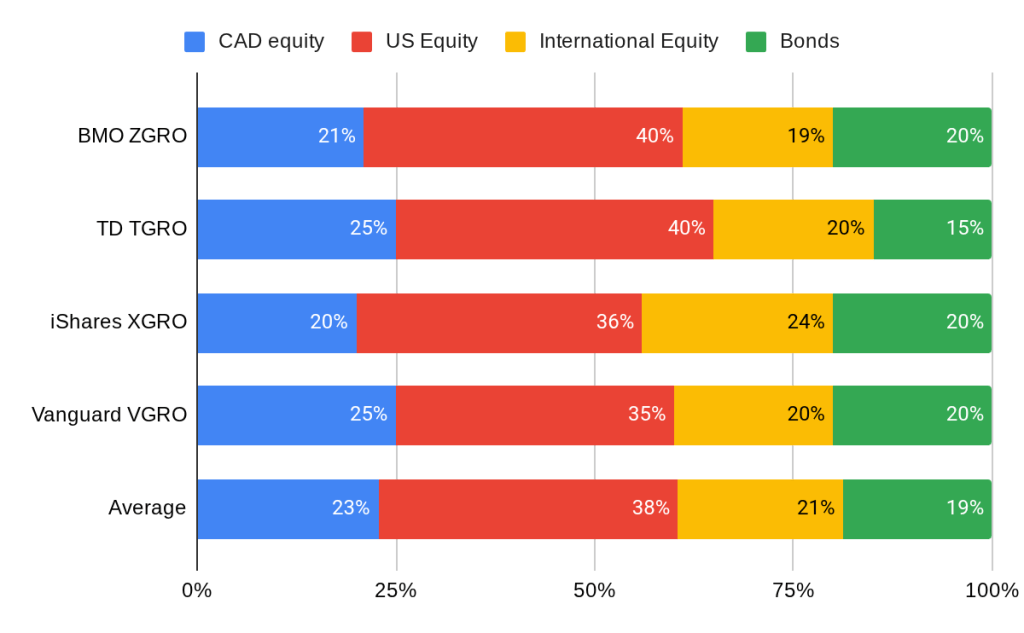
As I’ve written elsewhere, these are pretty broad categories and could be sub-divided further. I’ve not bothered with this myself, but I thought it would be an interesting exercise to survey what the major all-equity and high-growth funds have under the hood. And so, I present this comparison:

A few notes on the above:

  • Canadian Equity: Some use an all-cap index (TGRO, VGRO) while some use a capped composite index (ZGRO, XGRO).
  • US Equity: VGRO and XGRO use an all-cap index, TGRO sticks to large cap, and ZGRO holds large, mid and small cap indices. TGRO is a bit of an outlier because it doesn’t hold small cap..
  • International Equity: TGRO takes an all countries approach, whereas the other three split between developed and emerging markets. Net effect is pretty much the same thing.
  • Bonds: Here you find the greatest variation; VGRO is the only ETF to hold bonds outside of North America whereas TGRO holds only Canadian bonds. XGRO and ZGRO are pretty similar, with XGRO having a bit more Canadian bond exposure over ZGRO.

The most notable difference between my allocations and the average allocation of the big 4 funds is that I have more international exposure than other funds, and that’s because I’ve chosen to hitch my wagon to the iShares/XGRO family.

The reason? I started investing in the iShares family some time ago because it was the family that my old provider (QTrade) allowed me to trade without fees. With my current provider (Questrade), all of the families are free to trade, and hence my continued devotion to iShares/XGRO no longer holds that attraction — I could buy any of the all-in-ones. (Indeed, I’ve actually been adding some TD all-in-ones because their management fees are a bit lower).

But this exercise has given me food for thought; perhaps I have a bit too much bias to the international equity portion of the portfolio. But honestly, I can’t believe it makes that much of a difference, and churning my portfolio simply to reduce my international exposure a point or two seems unnecessary3.

  1. Why XGRO and not an all-in-one from another company? Read on. ↩︎
  2. I’m slowly converting my main holding (AOA, which trades in USD) to XGRO on a quarterly basis so that I’m never over exposed to foreign exchange variations. I convert a percentage of these holdings annually, corresponding to the percentage at which I’m draining my RRIF. ↩︎
  3. Running some numbers through https://www.dividendchannel.com/drip-returns-calculator/ demonstrates that XGRO is the bottom of the performance pile over the past 5 years or so as compared to TGRO, ZGRO and VGRO. The difference isn’t massive, and the window is short because these funds haven’t been around all that long, but it’s another data point to consider…p.s. the tool above doesn’t (yet?) understand the 3 for 1 reverse split ZGRO undertook in August, so best to end any simulation involving the BMO funds at August 1,2025. ↩︎