
RRIF Support Showdown: Wealthsimple, Questrade, QTrade

I’m currently holding RRIF accounts at three different online providers (QTtrade, Questrade and Wealthsimple)1. So I am perhaps uniquely positioned to comment on the relative goodness and badness of the support of this kind of account at these three brokers. I also have some experience with BMO Investorline in this regard, but that experience is getting a bit long in the tooth now.

So without further ado, let’s take a look:

Wealthsimple

Wealthsimple now provides support for both RRIFs and (relatively recently) Spousal RRIFs. And although Wealthsimple supports USD accounts, they do not (for whatever reason) support USD RRIFs2, which, for many readers, isn’t a big deal, but to me it is.

But for all that, I still hold a CAD RRIF with Wealthsimple. It started last year, when I realized my DPSP couldn’t be immediately converted to a RRIF, and Wealthsimple was offering a shiny new Macbook to win the business. How could a certified cheapskate refuse?

Since I only opened the RRIF last year, this year is the first year where I’m obliged to take out RRIF-minimum payments. Wealthsimple makes this stupidly easy on many levels:

  • They clearly display what your minimum payment for the year is right on the account screen, and they also show how much you have left to go against that minimum
  • They make it easy to create a “recurring withdrawal” from the RRIF, which is something I do every month, and I can easily change this whenever I want, although I’m not planning on doing that.
  • And — bonus — they support XGRO fractional shares AND the ability to place a sell trade in dollars and cents rather than # of units. This means I can sell EXACTLY the number of XGRO units I need to every month, with no excess dead-money cash floating around.

You have to set up your bank account for EFT withdrawals before this works, of course.

QTrade

I still hold 3 RRIF accounts at QTrade, although I’ve been trying to move them to Questrade since late November. Seems that there is an industry-wide freeze on moving RRIF accounts in the month of December.

QTrade supports USD and CAD RRIF accounts, and they keep them completely separate — different account numbers, even. They are linked, however, because the TOTAL value of the 2 accounts is used to determine your CAD RRIF minimum payment. I’ve only withdrawn RRIF funds in Canadian dollars, because I couldn’t get a straight answer whether I could withdraw USD funds natively to my USD account.

QTrade also supports Norbert’s Gambit, which is important if you want to convert between USD and CAD cheaply.

With QTrade, you have to send in a form to set up your RRIF withdrawals, either monthly/quarterly/annually. And per their fee schedule, if you deviate from this, you owe them $503.

Once the schedule is in place, the withdrawals happen automatically. You have to make sure you sell your assets in advance of the withdrawal date. What happens if you don’t have enough funds? Not sure, cannot find any documentation that addresses this. There is also no indication online as to what your RRIF minimum payment is; you have to contact support if you want the exact amount.

Questrade

The majority of my RRIF holdings are here. As mentioned above, I’m trying to move 3 RRIF accounts from QTrade to Questrade. The delay from end of November to beginning of January seems like it’s explainable by the aforementioned industry-wide freeze. But since then, I lay the blame fully on Questrade for dragging their feet on getting the right forms in QTrade’s hands.

Questrade supports USD RRIFs, and combines them with CAD holdings. Same account for both, and they do a nice job of providing you with multiple views so you can see your portfolio in either currency.

Questrade also supports Norbert’s Gambit, and I’ve used it multiple times already to convert USD holdings into CAD holdings.

Questrade requires a form to set up RRIF payments, and like anything involving a form at Questrade, you have to sit on top of support to make sure someone actually reads the form.

Like QTrade, Questrade treats RRIF minimum payments as some sort of secret, forcing you to contact support if you don’t know what the value is.

You can also exceptionally get “extra” payments using the “Move Money” menu. I am not sure how withholding tax would work if you did this. It appears that you could also withdraw USD from this menu. The “Move Money” menu is one that seems to be rather fragile — bank accounts previously linked have a habit of disappearing from this screen.

As I write this, Questrade is only batting .500 in delivering the first RRIF payment. I got mine, but my spouse did not. Unclear why this may be, the support person I spoke to also seemed perplexed.

The Verdict

If you have USD in your RRIF, I would probably pick Questrade over QTrade. Questrade’s support of “on demand” payments is a nice flexibility. The one downside is that Questrade charges a flat fee to execute Norbert’s Gambit, whereas QTrade, as far as I can tell, does not.

But once Wealthsimple supports USD in RRIFs and Norbert’s Gambit4, they would be my #1 pick for managing the RRIF payments. High degree of automation, high degree of flexibility, high degree of transparency. If you don’t have USD in your RRIF, then I could recommend Wealthsimple over the other two.

  1. Mishaps and greed have contributed to this current situation. I don’t condone it. ↩︎
  2. Proof: https://help.wealthsimple.com/hc/en-ca/articles/17933575404315-Open-a-RRIF#h_01H8Y8853951RYHHA80S11T5Y9:~:text=Can%20I%20hold%20USD%20cash%20in%20my%20self%2Ddirected%C2%A0RRIF%3F ↩︎
  3. I’ve never had the need, but be forewarned! ↩︎
  4. Coming this quarter per this PR. ↩︎

What’s in my retirement portfolio (Jan 2026)?

This is a monthly look at what’s in my retirement portfolio. The original post is here.

Portfolio Construction

The retirement portfolio is spread across a bunch of accounts:

  • 6 RRIF accounts
    • 3 for me (Questrade, QTrade, Wealthsimple)
    • 3 for my spouse (Questrade, QTrade)
  • 2 TFSA accounts (Questrade)
  • 4 non-registered accounts, (1 for me, 1 for my spouse, 2 joint, all at Questrade)

The view post-payday

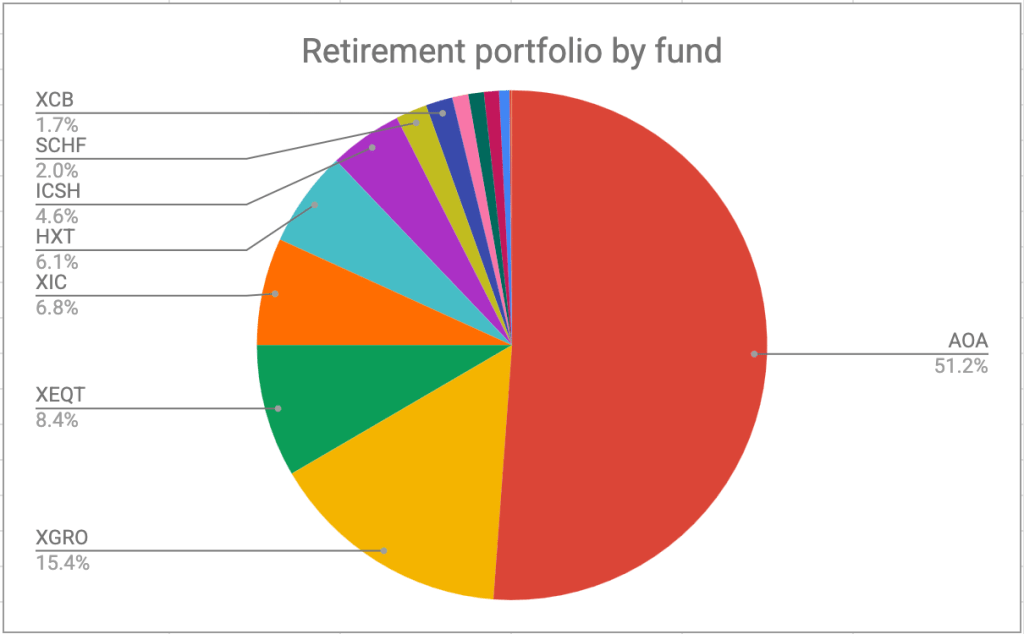
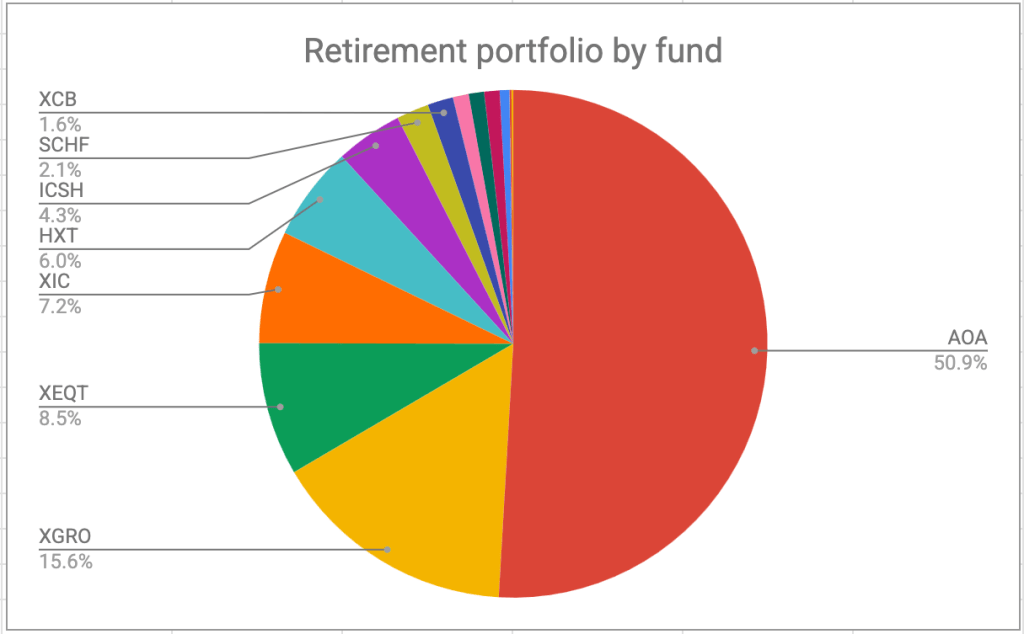
I pay myself monthly in retirement, so that’s a good trigger to update this post. On January 26, this is what it looks like:

The portfolio is dominated by my ETF all-stars, but if you’ve been following along, you’ll see a few changes.

  • As mentioned in a previous post, I did some shifting around and you now see XAW and XIC increasing their contribution to the portfolio at the expense of XGRO.
  • I also tidied up some extra funds that aren’t needed — VCN was replaced with XIC1, and I turfed some small holdings.
  • I sold more HXT than I needed to for my monthly paycheque, and when I discovered the mistake2, I just bought XIC instead.
  • And, I did my quarterly Norbert’s Gambit to shift some AOA to XGRO. And again, I came out ahead!

Plan for the next month

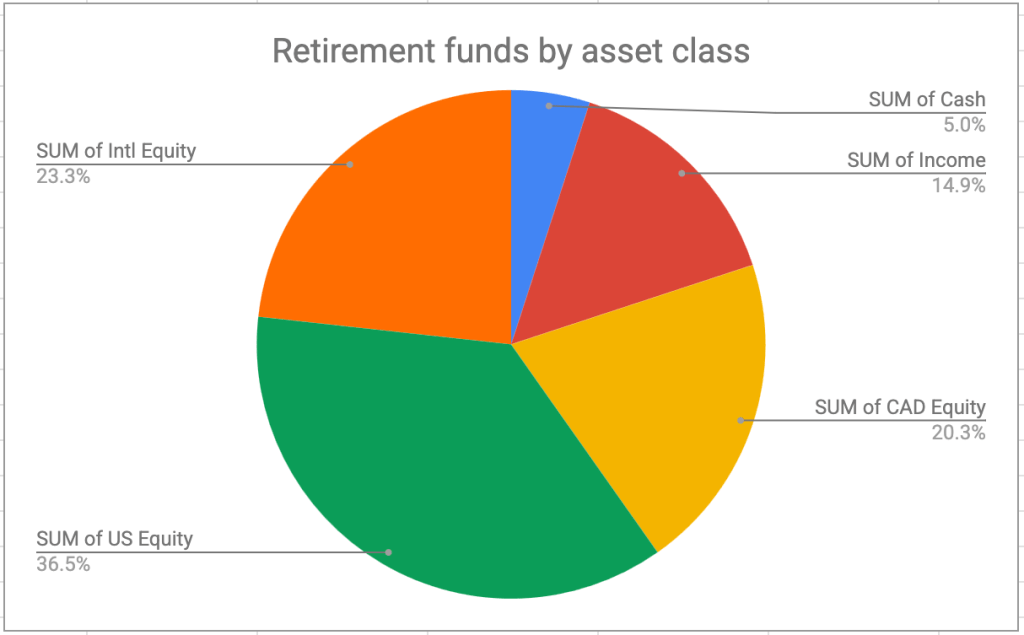
The asset-class split looks like this; you can read about my asset-allocation approach to investing over here.
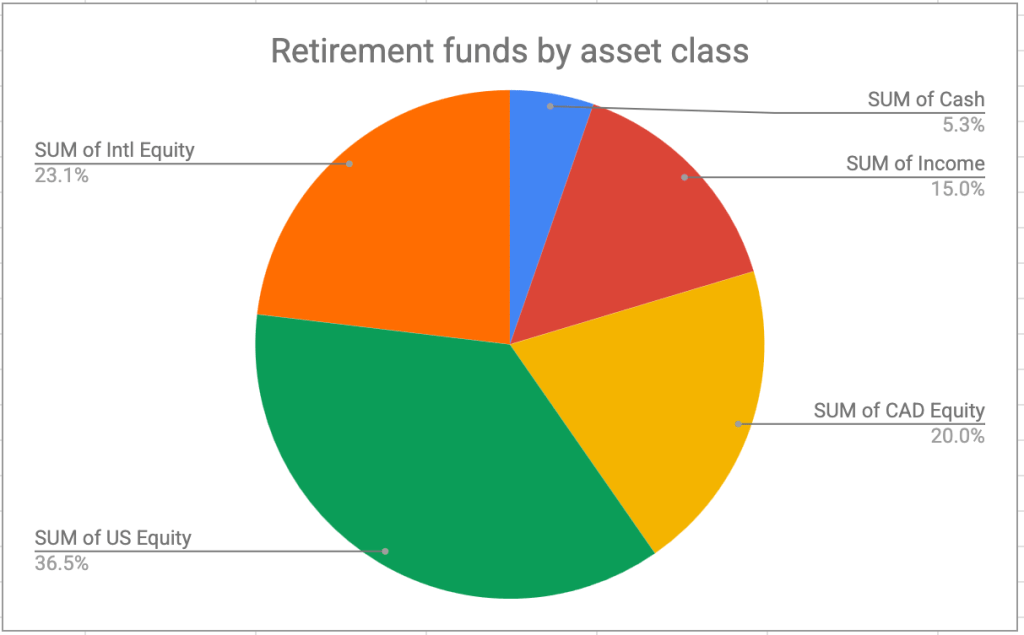
It’s looking pretty close to the targets I have, which are unchanged:

  • 5% cash or cash-like holdings like ICSH and ZMMK
  • 15% bonds (most are buried in XGRO and AOA, some are in XCB)
  • 20% Canadian equity (mostly based on ETFs that mirror the S&P/TSX)
  • 36% US equity (dominated by ETFs that mirror the S&P 500)
  • 24% International equity (mostly, but not exclusively, developed markets)

Overall

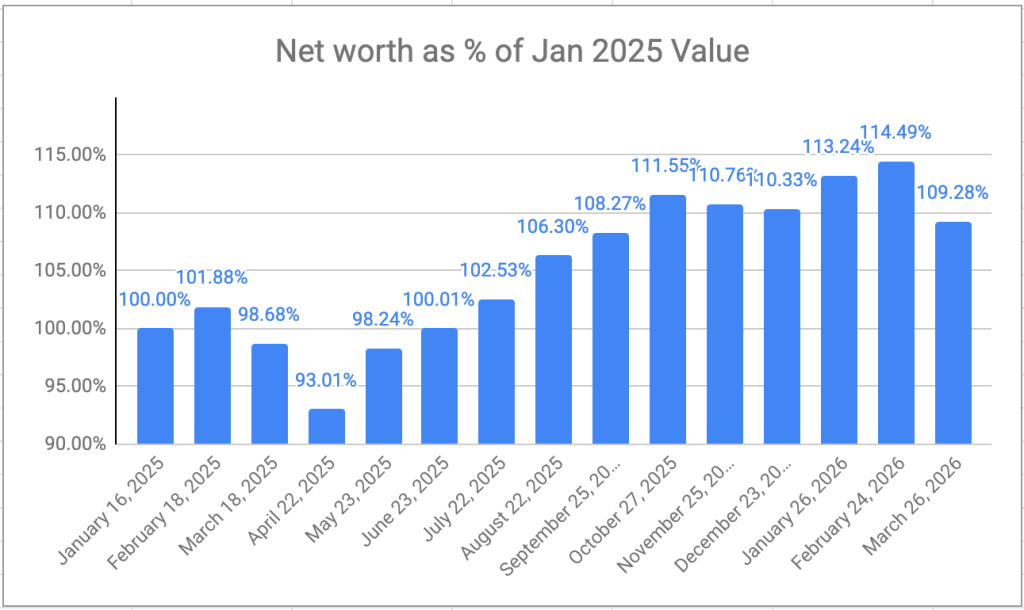
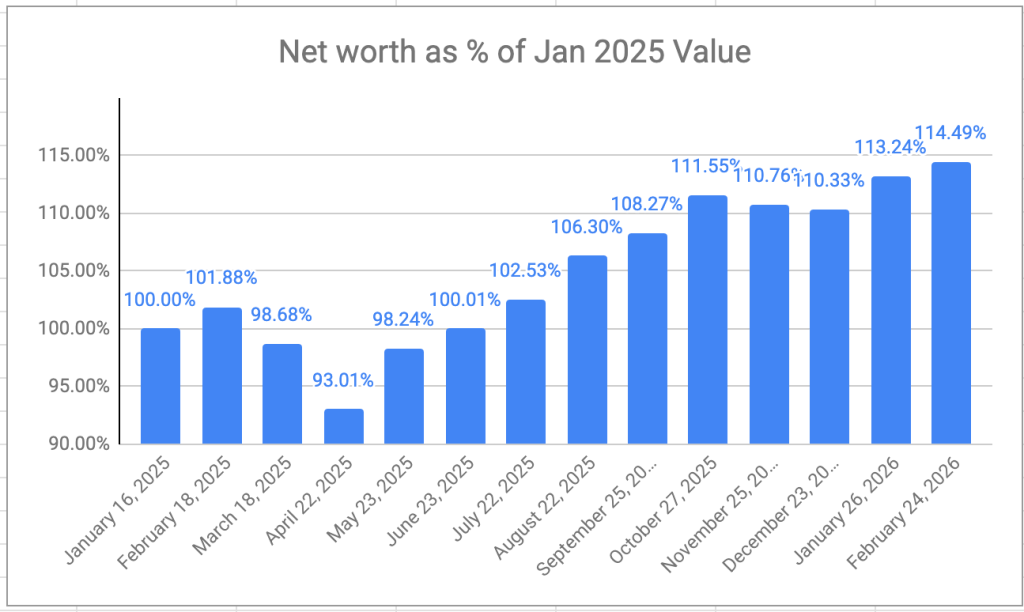
Net worth overall is up month over month, reversing a 2 month losing streak and hitting a new all-time-high:

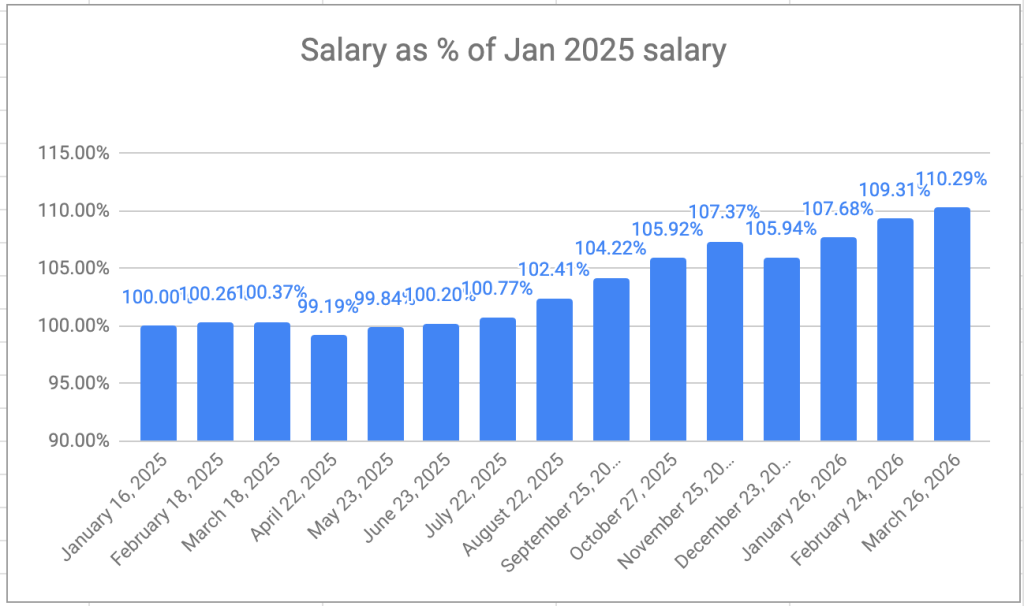
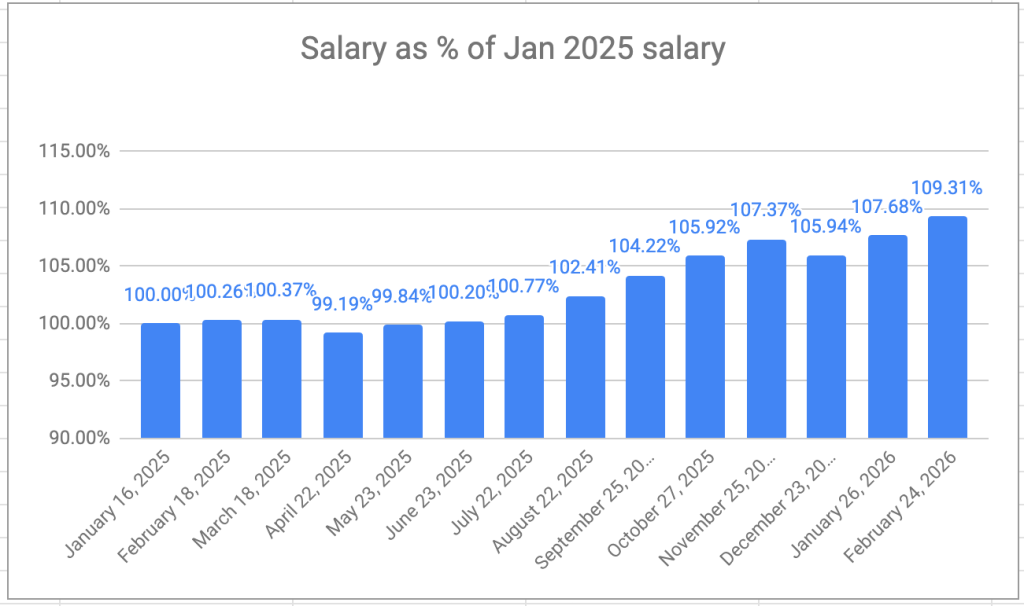
My VPW-calculated salary resumed its upward trend, also hitting an all-time high.

My QTrade RRIFs should move perhaps this week, but I’m no longer confident about that. More on that once resolved.

  1. Which, in my mind, are equivalent. This post goes in lots more detail. ↩︎
  2. I had to do some quick manual calculations because I had already updated my auto-calculating spreadsheet to reflect fewer RRIF accounts. My RRIF transfers are 2 months in progress and counting. I guess trying to move a RRIF near the end of the year was a bad idea. ↩︎

Portfolio Optimization In Practice

My retirement portfolio is spread across multiple brokers and multiple accounts. And although I treat the portfolio as a unified entity when it comes to asset allocation (the concept is discussed here), different accounts have different allocations. The reasons are varied, but I would rank inertia as one of the big contributors — sticking with what’s there seems like a lot less effort than the other options.

What I think in important to point out is that the portfolio is still dealing with inflows and outflows every single month:

  • I pay myself RRIF minimum from my RRIF accounts, and this usually means selling some shares of XGRO
  • If RRIF minimum isn’t sufficient for my expenses (and it hasn’t been), then I have to liquidate shares from my non-registered account.
  • I contribute to our TFSAs every month
  • Questrade gives me free money every month as a reward for shifting assets their way (see how I did it here). This money shows up in my non-registered accounts1.
  • Dividends show up every month2; every quarter there is an even bigger distribution
  • And quarterly I convert some of my AOA holdings to XGRO within my RRIF using Norbert’s Gambit3. When I do this, it reduces my US and international equity holdings and replaces it with Canadian equity4.

So given all these ins and outs, there are always opportunities to tweak the asset allocations so that they remain close to my targets.

The targets, as always, are unchanged:

  • 5% Cash (mostly ultra short-term bonds)
  • 15% bonds
  • 20% Canadian Equity
  • 36% US Equity
  • 24% International Equity

Last week, a reader’s question (please send questions or comments to comments@moneyengineer.ca) led me to take a different look at what was in each of my retirement accounts (RRIFs, TFSAs, non-registered), and this week I acted on correcting a flaw in the way the accounts were structured.

The reader was actually asking about foreign withholding tax implications since the rules are different depending on whether the asset is held in non-registered, TFSA or RRIF but after spending a lot of time looking at it, I decided that, from a tax perspective, the portfolio was actually in reasonable shape. (If you want to dive into this yourself5, you can read https://www.finiki.org/wiki/Foreign_withholding_taxes and https://pwlcapital.com/wp-content/uploads/2024/08/2017-12_Ben-Felix_WP_Asset-Location-Uncertainty.pdf).

But this study did make me realize that the small allocation I had of bonds in my TFSA was wrong-headed. Since in my planning the TFSA is the LAST place I’ll head to fund my retirement, it follows that it should have the longest-timeline investments. So, for me, that means 100% equity is the correct allocation for the TFSA accounts. So what did I do?

  • I sold the bonds in my TFSA (XSH was the ETF), and put them in my RRIF (choosing instead to use XCB, a longer-duration corporate bond fund)
  • Of course, since you can’t add money to a RRIF, something had to be sold there. XGRO was plentiful, so that’s how I funded the bond purchase. From an asset allocation perspective, selling XGRO meant that I reduced my Canadian, International and US Equity exposure at the same time.
  • To compensate, the cash I generated in my TFSA by selling XSH was used to buy a combination of XIC (Canadian Equity) and XAW (US and International equity combined). XIC was already in the TFSA6. XAW is new but gives back the US Equity and International Equity I lost by selling XGRO7.

This is how the two accounts break down now, both from an ETF and an asset-allocation perspective. (In the asset allocation charts “Income” is the nomenclature I use for “bonds” and “Cash” means actual money as well as ultra-short-term bond funds like ICSH and ZMMK).

The result is my TFSA is now 100% equity, and the lower-growth cash-generating bonds are now all in my RRIF accounts. More efficient all around!

  1. Leaving the free money as part of the retirement portfolio was a conscious decision. I could have just as easily decided to withdraw the money every month. ↩︎
  2. Both ZMMK and ICSH pay monthly. They are both featured in my ETF all-stars. ↩︎
  3. You can read about it here. ↩︎
  4. AOA is 50% US equity, 28% International equity. XGRO is 36% US Equity, 24% International Equity. ↩︎
  5. It’s not a straightforward topic. In the end, the foreign withholding tax isn’t huge but as a cheapskate, it’s noticeable and can be higher than MERs of the ETFs you hold. ↩︎
  6. XIC helps tilt the overall Canadian equity allocations in the right direction. AOA tilts it in the wrong direction. ↩︎
  7. The current numbers don’t allow me to use an XEQT/XIC combination. Over time, this will change. ↩︎

“My parent has more money than they’ll ever need!”

Disclaimer: I’m not a tax expert, accountant or lawyer. My only expertise comes from being the financial caregiver to my late parents.

Say you’re the financial caregiver for your parent1. And you have come to the realization that they are going to die with a large estate. Maybe they have a good work pension. Maybe they have sold their principal residence and their monthly expenses would take 86 years to eat through the assets. Maybe they have both.

I’m going to make the assumption that your assessment is sound. That your parent does, in fact, have more money that they will need for what is left of their life2. I’ll go one further and make the assumption that your parent isn’t so keen on leaving a big legacy to the CRA. So what should you look out for?

Asset = part of estate = subject to estate tax

Anything of value (property, stocks/ETFs, GICs, art, furniture, cars, cash) owned by the parent at time of death becomes part of the estate, and is therefore subject to the “estate administration tax3” aka “probate tax”. And this money becomes frozen until the courts grant probate, something that takes months, if not years.

One way to dodge some of this probate tax is to name beneficiaries for TFSAs and RRIFs. Assets inside accounts set up this way will not be subject to the estate administration tax, and will not get tied up in probate court. But do be careful — a RRIF that flows to beneficiaries will still attract the same tax time bomb mentioned below, and this has to be taken into account because in my case, no tax was withheld!

RRIFs are a tax time bomb

Recall that RRIFs4 are just RRSPs in reverse: the RRSP is the growth phase, the RRIF is how you shrink it. And recall that RRSP contributions subtract from your taxable income in the year you make them. Did you think the government was going to let you pay no tax forever on that subtracted income? Of course not. That’s why RRIF income is treated as, you guessed it, income in the hands of the RRIF owner, and is taxed the same way as any income5.

Annual RRIF payments can be as large as the RRIF owner likes. Payments above the minimum6 attract witholding tax, which is normal, if you think about it. Taking out more the minimum can allow for some tax avoidance. Why? Taking a small tax hit for a few years is almost certainly preferable to the big tax bomb that happens when a parent dies with a large RRIF remaining. The parent in this situation will be assumed to have taken the entire RRIF as income on the day of death. If the RRIF is large, then you’ll be dealing with tax at the top rates7. By spreading out the RRIF income over a few tax years, you should be able to make the income small enough to avoid the top tax bracket; otherwise you’re not really saving much of anything. That will take some finessing.

Donate shares from non-registered accounts to charity

If there are ETFs or stocks held in non-registered accounts, the tax treatment of donated shares is quite generous. Not only do you get the charitable credit based on the market value of the donated shares, you avoid any capital gains tax. Larger charities accept stock donations, but if they don’t, you can also make use of a service like Canada Helps.

Give money away

Giving money to a charity generates a tax credit, which is good. Giving money to children, friends, relatives, strangers — also good. Gifts are tax-free for the giver and the recipient. Gifting houses or stocks is less good since doing this results in what CRA calls a “deemed disposition” meaning that CRA treats the gift as though your parent had sold the asset first, attracting the usual capital gains.

Of course, to give money away, you either have to have cash on hand, or you have to take it from the RRIF (where it’s treated as income to the parent who owns the RRIF), or you have to take it from non-registered accounts (where you may have to sell assets and attract capital gains), or you have to take it from the TFSA (which is effectively problem-free, other than you can’t put the money back in the same calendar year).

  1. I’m going to make this article simpler by assuming there’s one parent remaining. ↩︎
  2. Getting this wrong would be catastrophic on so many levels. Take care here. ↩︎
  3. In Ontario estates <$50k pay nothing. After that it’s $15 of tax per $1000. ↩︎
  4. I covered RRIFs over here. ↩︎
  5. Yeah, ok, you can split RRIF income with your spouse and this can help you avoid higher tax brackets. In my case, my spouse and I have RRIFs that are about the same size, and therefore generate about the same annual income. ↩︎
  6. The mimimum is calculated at the start of the year based on the size of the RRIF and the age of the RRIF owner. ↩︎
  7. in Ontario, in 2026, you hit the top rate of 53.53% for income over $258,482 per https://www.taxtips.ca/taxrates/on.htm ↩︎

Questrade and RRIFs: Annoying

It’s January 2026 and so I’m about to undertake my first withdrawals from my Questrade RRIFs. For the entirety of 2025, I’ve only had to deal with QTrade’s methodology for RRIF payout, which looked something like this:

  • Determine what my monthly RRIF-minimum amount would be. (For QTrade, I had to call support to get this number…why, I don’t know). Once this was established, it didn’t change for the year, so that was easy.
  • Before the end of the month, I had to sell assets to make sure I could cover the monthly payment
  • The minimum payment was taken from available cash and deposited into my linked chequing account without any action on my part on the last business day of the month.

So for Questrade, I’m trying to do the same thing, but so far, no joy.

  • Determine what my monthly payment is. When I talked to an agent on January 2, they could not tell me as they claimed that it wasn’t available yet. Or they didn’t understand my question.
  • Today, I got an email from Questrade, reminding me that my payment was due shortly and to make sure I had enough cash to cover the payment. And if I didn’t know what the payment was, I had to call support.
  • I also learned that if I don’t have the cash to cover the payment, they’ll just skip it.1

Now, of course I know how to work out what my RRIF payment for any RRIF account will be — all you have to do is know the RRIF value at the start of the year and know how old you are2, and presto. But because my Questrade RRIFs have USD components, knowing the exact exchange rate is also necessary, and that’s where uncertainty creeps in.

Anyway, I have a pretty good idea what the minimums will be, but I’m not going to hang out for an hour waiting to talk to an agent3 to get it penny-accurate. I’ll have a little extra cash for the first month, at which point it should be clear enough what my monthly payments will be.

This is yet another example of small, but rather irritating shortcoming from the provider of my choice. One that you wouldn’t know about until you experienced it firsthand. Would it really be so hard to report the amount on my account screen4? Anyway, something to ponder if you’re nearing retirement or are starting a RRIF with a new provider…

  1. QTrade would’ve sold things on my behalf and charged me for the privilege, so I suppose this is a better option ↩︎
  2. What the CRA refers to as a “prescribed factor”. You can’t make this stuff up. Their charts only show the factors starting at age 71, but believe me, you can take payments from a RRIF well before that age. ↩︎
  3. Word to the wise: avoid talking to Questrade support when they have a promotion running, it will seriously test your patience… ↩︎
  4. I note that Wealthsimple and BMO Investorline both do ↩︎