RRIF Support Showdown: Wealthsimple, Questrade, QTrade

I’m currently holding RRIF accounts at three different online providers (QTtrade, Questrade and Wealthsimple)1. So I am perhaps uniquely positioned to comment on the relative goodness and badness of the support of this kind of account at these three brokers. I also have some experience with BMO Investorline in this regard, but that experience is getting a bit long in the tooth now.

So without further ado, let’s take a look:

Wealthsimple

Wealthsimple now provides support for both RRIFs and (relatively recently) Spousal RRIFs. And although Wealthsimple supports USD accounts, they do not (for whatever reason) support USD RRIFs2, which, for many readers, isn’t a big deal, but to me it is.

But for all that, I still hold a CAD RRIF with Wealthsimple. It started last year, when I realized my DPSP couldn’t be immediately converted to a RRIF, and Wealthsimple was offering a shiny new Macbook to win the business. How could a certified cheapskate refuse?

Since I only opened the RRIF last year, this year is the first year where I’m obliged to take out RRIF-minimum payments. Wealthsimple makes this stupidly easy on many levels:

  • They clearly display what your minimum payment for the year is right on the account screen, and they also show how much you have left to go against that minimum
  • They make it easy to create a “recurring withdrawal” from the RRIF, which is something I do every month, and I can easily change this whenever I want, although I’m not planning on doing that.
  • And — bonus — they support XGRO fractional shares AND the ability to place a sell trade in dollars and cents rather than # of units. This means I can sell EXACTLY the number of XGRO units I need to every month, with no excess dead-money cash floating around.

You have to set up your bank account for EFT withdrawals before this works, of course.

QTrade

I still hold 3 RRIF accounts at QTrade, although I’ve been trying to move them to Questrade since late November. Seems that there is an industry-wide freeze on moving RRIF accounts in the month of December.

QTrade supports USD and CAD RRIF accounts, and they keep them completely separate — different account numbers, even. They are linked, however, because the TOTAL value of the 2 accounts is used to determine your CAD RRIF minimum payment. I’ve only withdrawn RRIF funds in Canadian dollars, because I couldn’t get a straight answer whether I could withdraw USD funds natively to my USD account.

QTrade also supports Norbert’s Gambit, which is important if you want to convert between USD and CAD cheaply.

With QTrade, you have to send in a form to set up your RRIF withdrawals, either monthly/quarterly/annually. And per their fee schedule, if you deviate from this, you owe them $503.

Once the schedule is in place, the withdrawals happen automatically. You have to make sure you sell your assets in advance of the withdrawal date. What happens if you don’t have enough funds? Not sure, cannot find any documentation that addresses this. There is also no indication online as to what your RRIF minimum payment is; you have to contact support if you want the exact amount.

Questrade

The majority of my RRIF holdings are here. As mentioned above, I’m trying to move 3 RRIF accounts from QTrade to Questrade. The delay from end of November to beginning of January seems like it’s explainable by the aforementioned industry-wide freeze. But since then, I lay the blame fully on Questrade for dragging their feet on getting the right forms in QTrade’s hands.

Questrade supports USD RRIFs, and combines them with CAD holdings. Same account for both, and they do a nice job of providing you with multiple views so you can see your portfolio in either currency.

Questrade also supports Norbert’s Gambit, and I’ve used it multiple times already to convert USD holdings into CAD holdings.

Questrade requires a form to set up RRIF payments, and like anything involving a form at Questrade, you have to sit on top of support to make sure someone actually reads the form.

Like QTrade, Questrade treats RRIF minimum payments as some sort of secret, forcing you to contact support if you don’t know what the value is.

You can also exceptionally get “extra” payments using the “Move Money” menu. I am not sure how withholding tax would work if you did this. It appears that you could also withdraw USD from this menu. The “Move Money” menu is one that seems to be rather fragile — bank accounts previously linked have a habit of disappearing from this screen.

As I write this, Questrade is only batting .500 in delivering the first RRIF payment. I got mine, but my spouse did not. Unclear why this may be, the support person I spoke to also seemed perplexed.

The Verdict

If you have USD in your RRIF, I would probably pick Questrade over QTrade. Questrade’s support of “on demand” payments is a nice flexibility. The one downside is that Questrade charges a flat fee to execute Norbert’s Gambit, whereas QTrade, as far as I can tell, does not.

But once Wealthsimple supports USD in RRIFs and Norbert’s Gambit4, they would be my #1 pick for managing the RRIF payments. High degree of automation, high degree of flexibility, high degree of transparency. If you don’t have USD in your RRIF, then I could recommend Wealthsimple over the other two.

  1. Mishaps and greed have contributed to this current situation. I don’t condone it. ↩︎
  2. Proof: https://help.wealthsimple.com/hc/en-ca/articles/17933575404315-Open-a-RRIF#h_01H8Y8853951RYHHA80S11T5Y9:~:text=Can%20I%20hold%20USD%20cash%20in%20my%20self%2Ddirected%C2%A0RRIF%3F ↩︎
  3. I’ve never had the need, but be forewarned! ↩︎
  4. Coming this quarter per this PR. ↩︎

Top Five Money Engineer posts of 2025

The Money Engineer launched in January 2025 and according to the WordPress stats, I made 144 posts last year. What were the most viewed posts of 2025?

5th-ranked post of 2025: ZGRO versus ZGRO.T

I got wind of ZGRO.T through Reddit, specifically r/CanadianInvestor. ZGRO and ZGRO.T are both all-in-one asset allocation ETFs from BMO, but with vastly different yield characteristics. I was confused, but in the end, decided that ZGRO.T was probably not a bad pick for use in a RRIF account as it might save you the hassle of selling shares. Their TOTAL returns (assuming all dividends are invested) are effectively identical.

4th-ranked post of 2025: Spousal RRIF Attribution Rules

I think I was first warned about this nuance of spousal RRSPs/RRIFs by my DIY neighbour (thanks, Steve) and is the main reason I’m only drawing RRIF minimum for the next two years1. I think most of the visits to this article were search-driven. Either that, or people came to admire what might be my favourite article thumbnail2 I’ve posted thus far.

3rd-ranked post of 2025: Norbert’s Gambit with Questrade

As someone who holds more USD-denominated assets than might be wise, I do very much appreciate the existence of a cheapskate way of converting between USD and CAD assets. I think I first learned about this trick via The Loonie Doctor’s blog. The #3 blog entry explains how it works if Questrade is your broker. I would also recommend https://moneyengineer.ca/2025/08/21/tracking-norberts-gambit-costs-with-questrade/ for a very clear picture of what it actually costs (in time and fees) to execute the Gambit: in three of four instances, the time delay of executing the gambit has worked in my favor as the FX rate has drifted a bit to my advantage.

2nd-ranked post of 2025: TD versus iShares all-in-ones

I’m a fan of all-in-ones (and am a little sad https://moneyengineer.ca/2025/01/21/why-you-can-fire-your-advisor-asset-allocation-etfs/ didn’t crack the top five last year). I am genuinely puzzled why people seem to get so wound up about which family of all-in-ones to choose3. I examined TD’s only because their cost to own is a bit cheaper than iShares (who I use primarily), and I’m a cheapskate. (I studied the cost of owning an all-in-one here.) Anyway, in the end, the biggest difference is visible in TGRO versus XGRO because TGRO, unlike any other GRO ETF, uses 10% bond allocation and not 20%. This gooses its return a bit, at the cost of additional volatility. Otherwise, it’s a case of tomato/tomahto. Pick one, or pick them all, it doesn’t matter much.

Top ranked post of 2025: Mini-Review of Optiml.ca

This was, as the title implied, a quick review of a made-in-Canada tool to help craft a retirement plan. And again, my DIY neighbour gave me a heads-up about it4. It got a lot of interest, probably because the kind folks at Optiml linked to my review from their website ;-). I was impressed by the completeness of the tool during my test drive, and it seems like a good and fairly priced way for a DIYer to do some validation of their retirement plan. Having validation of my plan was one of the ways I knew I could retire.

Looking forward to seeing what the 2026 list might look like! Got a topic or question? Send it along to comments@moneyengineer.ca, or comment below!

  1. RRIF minimum withdrawals are never subject to spousal attribution ↩︎
  2. Courtesy Pexels free photos, built into WordPress’ editor. ↩︎
  3. iShares, TD, BMO, Vanguard, Global X…. ↩︎
  4. Thinking he should write his own blog, maybe. ↩︎

News: Wealthsimple now supports spousal RRIFs

Well, that figures.

Right after the final, final deadline of Wealthsimple’s last free money offer, it appears that Wealthsimple is now offering spousal RRIFs as an account type for the DIY investor (they’ve had them for quite a while in their robo-advisor accounts).

This had always struck me as silly, especially since they have offered spousal RRSPs for a while now.

Full instructions on how to open one found here.

With this development, Wealthsimple is nearly a viable option to host all of my retirement funds1. My needs are pretty simple:

  • support for all the account types I need (RRIF/Spousal RRIF, TFSA, joint non-registered, individual non-registered)
  • zero cost ETF buy/sell
  • support for Norbert’s Gambit (which implies support for USD accounts, naturally)

Norbert’s Gambit is planned in early 2026 for Wealthsimple, per the very limited info found here.

So, if you’ve been on the fence about Wealthsimple, here’s one more reason to consider them. Once Questrade’s free money gravy train ends for me in March 2027, they become a personal serious contender, especially if they are willing to throw free money my way, which, historically, has certainly been a recurring theme. On that note, if any reader wants to give them a whirl, I have referral codes, just shoot me a note at comments@moneyengineer.ca; if you act quickly2, there might be some free Apple gear in it for you too.

  1. QTrade and Questrade both offer all three. There may be others. ↩︎
  2. Register by December 23, 2025 ↩︎

New Wealthsimple Developments

Wealthsimple is a broker who holds some of my retirement assets1. They had a “For Nerds Only” (recording here) event on October 22 where they announced a bunch of new features. The most exciting development for me was the pending availability of Norbert’s Gambit. Here’s my take.

$0 Options

Of no personal interest to me as I don’t trade them. There are an increasing number of ETF products that use “Covered Call” strategies in an effort to eke some (or more) yield out of held equities, but I don’t bother with products like that2. I like my investments simple.

Trade Gold; Crypto trading fees reduced

I lump these two together since I have the same amount of interest in both of these developments: none. Although people have made huge profits on gold and crypto, I’d rather make money off of companies that make things or provide services.

Direct Indexing

An interesting product that allows you to buy into the entire index3 (TSX all-cap4 or S&P 5005) and hold individual stocks. The main benefit of this is automated tax-loss harvesting which should reduce your tax bill in a non-registered account. The idea is logical, but it will come down to how well it is executed — how closely will Direct Indexing actually track the underlying index, and how much tax savings can be realized? The benefit will have to be more than the 0.5% MER being charged for investing in the index this way. Of possible interest in a non-registered account, but not otherwise. I’m not actively adding to my non-registered investments, so I don’t think this is for me either, although I’ve often wondered about how many stocks you actually have to hold in order to get “close enough” to the performance of the TSX 60 / S&P 500.

Dedicated Wealth Management

Sounds like an offer ripped from the pages of CIBC, BMO, or RBC. Dedicated advisors, tailored advice. Wealthsimple’s differentiator appears to be in the fee structure. From https://www.wealthsimple.com/en-ca/advice:

Our fees start at 0.75% and drop to 0.4% for clients who have $10M or more with us.

https://www.wealthsimple.com/en-ca/advice FAQ

I am not a fan of percentage-of-net-worth-based wealth management. It implies that larger portfolios are more complex. Anyway, this might be the kind of offer future, less-capable-me might be interested in, but at the moment, no thanks.

“Coming Soon”

The other features announced on the event are not available yet. But here’s a view all the same:

  • Summit Portfolio: sounds like a robo-advisor that also includes private equity. Since I like my investments to be liquid, this is another development that doesn’t really interest me.
  • Retirement Accelerator: cheap loans to help you with RRSP contributions. Leveraged investing doesn’t fit my risk profile, and, oh, by the way, I’m already retired 🙂
  • Norbert’s Gambit: This is something I use all the time given that i have a large amount of USD holdings in my retirement portfolio. The best thing about the Wealthsimple webinar is that they actually trotted out Norbert6 himself to talk about it! This is one feature missing from the Wealthsimple portfolio that was a “must have” for me given my current holdings.
  • AI Trading Features, Advanced Options Strategies: Yawn.

Wealthsimple continues to be a broker I like to watch as they keep the new features rolling out. They are still not a serious contender to be my #1 broker until they support self-directed spousal RRIFs, something they inexplicably still lack.

  1. Mostly because of the DPSP debacle and the fact I needed a new Macbook. ↩︎
  2. You can read a bit more here: https://www.proshares.com/browse-all-insights/insights/covered-call-etfs-the-myth-of-downside-protection ↩︎
  3. On the webcast, it sounded more like they held “a representative sample” of these indices, which makes sense to me; you couldn’t hold ALL the members of the index AND do tax-loss harvesting at the same time. Their FAQ at https://www.wealthsimple.com/en-ca/portfolios/direct-indexing confirms this. ↩︎
  4. VCN is an ETF that holds the same index, as far as I can tell. ↩︎
  5. VFV is an ETF that holds the same index priced in CAD. IVV is the same index priced in USD. I presume the Wealthsimple product is traded in USD, but they don’t explicitly say. ↩︎
  6.  Norbert Schlenker, to be precise. ↩︎

News: Norbert’s Gambit Tracking Update

If you have no idea what Norbert’s Gambit is, it’s a way to cheaply convert USD/CAD in your online brokerage account. Most brokers support it1.

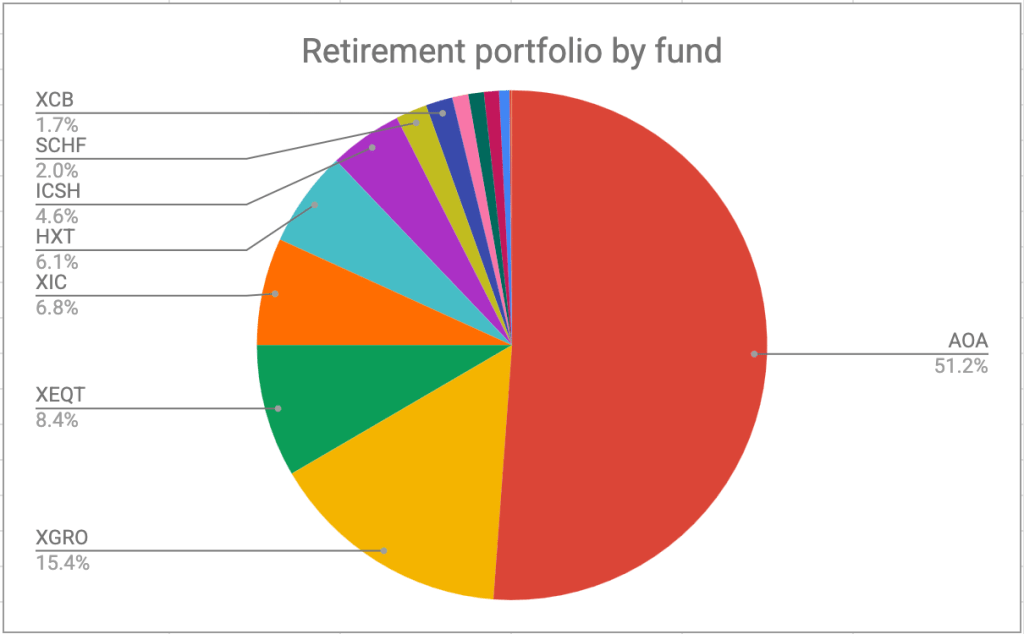
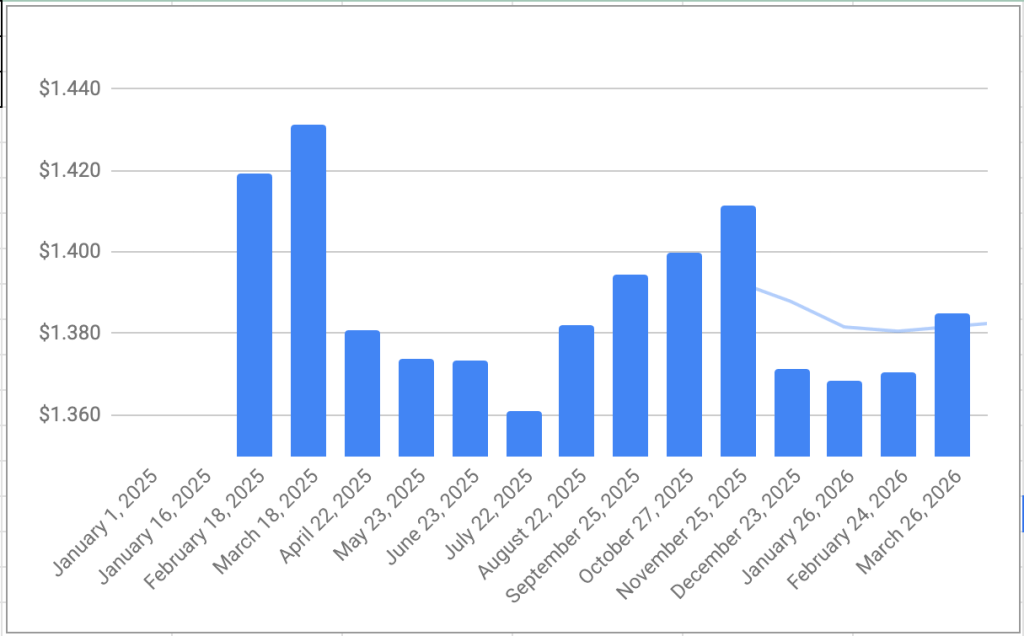
Because I hold a lot of USD assets in my retirement savings, and since I live and spend most of my money in Canada, I need a way cheaply convert to Canadian funds in my RRIF. So last week, I had to convert some of my AOA holdings into XGRO holdings and so I updated the log I’m keeping. So far, I’ve done the Gambit three times this year, and twice I’ve lucked out on the FX rate changes and actually made money2 on the transaction.

  1. And many people expect Wealthsimple to join this club soon. ↩︎
  2. What I mean: if the funds had converted instantaneously with no fees rather than waiting around for the 3-5 business days for the Gambit to complete, I would have received LESS money than by using the Gambit. Over time, I expect this will even out, but right now I’m about $55 CAD ahead. ↩︎