RRIF Support Showdown: Wealthsimple, Questrade, QTrade

I’m currently holding RRIF accounts at three different online providers (QTtrade, Questrade and Wealthsimple)1. So I am perhaps uniquely positioned to comment on the relative goodness and badness of the support of this kind of account at these three brokers. I also have some experience with BMO Investorline in this regard, but that experience is getting a bit long in the tooth now.

So without further ado, let’s take a look:

Wealthsimple

Wealthsimple now provides support for both RRIFs and (relatively recently) Spousal RRIFs. And although Wealthsimple supports USD accounts, they do not (for whatever reason) support USD RRIFs2, which, for many readers, isn’t a big deal, but to me it is.

But for all that, I still hold a CAD RRIF with Wealthsimple. It started last year, when I realized my DPSP couldn’t be immediately converted to a RRIF, and Wealthsimple was offering a shiny new Macbook to win the business. How could a certified cheapskate refuse?

Since I only opened the RRIF last year, this year is the first year where I’m obliged to take out RRIF-minimum payments. Wealthsimple makes this stupidly easy on many levels:

  • They clearly display what your minimum payment for the year is right on the account screen, and they also show how much you have left to go against that minimum
  • They make it easy to create a “recurring withdrawal” from the RRIF, which is something I do every month, and I can easily change this whenever I want, although I’m not planning on doing that.
  • And — bonus — they support XGRO fractional shares AND the ability to place a sell trade in dollars and cents rather than # of units. This means I can sell EXACTLY the number of XGRO units I need to every month, with no excess dead-money cash floating around.

You have to set up your bank account for EFT withdrawals before this works, of course.

QTrade

I still hold 3 RRIF accounts at QTrade, although I’ve been trying to move them to Questrade since late November. Seems that there is an industry-wide freeze on moving RRIF accounts in the month of December.

QTrade supports USD and CAD RRIF accounts, and they keep them completely separate — different account numbers, even. They are linked, however, because the TOTAL value of the 2 accounts is used to determine your CAD RRIF minimum payment. I’ve only withdrawn RRIF funds in Canadian dollars, because I couldn’t get a straight answer whether I could withdraw USD funds natively to my USD account.

QTrade also supports Norbert’s Gambit, which is important if you want to convert between USD and CAD cheaply.

With QTrade, you have to send in a form to set up your RRIF withdrawals, either monthly/quarterly/annually. And per their fee schedule, if you deviate from this, you owe them $503.

Once the schedule is in place, the withdrawals happen automatically. You have to make sure you sell your assets in advance of the withdrawal date. What happens if you don’t have enough funds? Not sure, cannot find any documentation that addresses this. There is also no indication online as to what your RRIF minimum payment is; you have to contact support if you want the exact amount.

Questrade

The majority of my RRIF holdings are here. As mentioned above, I’m trying to move 3 RRIF accounts from QTrade to Questrade. The delay from end of November to beginning of January seems like it’s explainable by the aforementioned industry-wide freeze. But since then, I lay the blame fully on Questrade for dragging their feet on getting the right forms in QTrade’s hands.

Questrade supports USD RRIFs, and combines them with CAD holdings. Same account for both, and they do a nice job of providing you with multiple views so you can see your portfolio in either currency.

Questrade also supports Norbert’s Gambit, and I’ve used it multiple times already to convert USD holdings into CAD holdings.

Questrade requires a form to set up RRIF payments, and like anything involving a form at Questrade, you have to sit on top of support to make sure someone actually reads the form.

Like QTrade, Questrade treats RRIF minimum payments as some sort of secret, forcing you to contact support if you don’t know what the value is.

You can also exceptionally get “extra” payments using the “Move Money” menu. I am not sure how withholding tax would work if you did this. It appears that you could also withdraw USD from this menu. The “Move Money” menu is one that seems to be rather fragile — bank accounts previously linked have a habit of disappearing from this screen.

As I write this, Questrade is only batting .500 in delivering the first RRIF payment. I got mine, but my spouse did not. Unclear why this may be, the support person I spoke to also seemed perplexed.

The Verdict

If you have USD in your RRIF, I would probably pick Questrade over QTrade. Questrade’s support of “on demand” payments is a nice flexibility. The one downside is that Questrade charges a flat fee to execute Norbert’s Gambit, whereas QTrade, as far as I can tell, does not.

But once Wealthsimple supports USD in RRIFs and Norbert’s Gambit4, they would be my #1 pick for managing the RRIF payments. High degree of automation, high degree of flexibility, high degree of transparency. If you don’t have USD in your RRIF, then I could recommend Wealthsimple over the other two.

  1. Mishaps and greed have contributed to this current situation. I don’t condone it. â†Šī¸Ž
  2. Proof: https://help.wealthsimple.com/hc/en-ca/articles/17933575404315-Open-a-RRIF#h_01H8Y8853951RYHHA80S11T5Y9:~:text=Can%20I%20hold%20USD%20cash%20in%20my%20self%2Ddirected%C2%A0RRIF%3F â†Šī¸Ž
  3. I’ve never had the need, but be forewarned! â†Šī¸Ž
  4. Coming this quarter per this PR. â†Šī¸Ž

What’s in my retirement portfolio (Jan 2026)?

This is a monthly look at what’s in my retirement portfolio. The original post is here.

Portfolio Construction

The retirement portfolio is spread across a bunch of accounts:

  • 6 RRIF accounts
    • 3 for me (Questrade, QTrade, Wealthsimple)
    • 3 for my spouse (Questrade, QTrade)
  • 2 TFSA accounts (Questrade)
  • 4 non-registered accounts, (1 for me, 1 for my spouse, 2 joint, all at Questrade)

The view post-payday

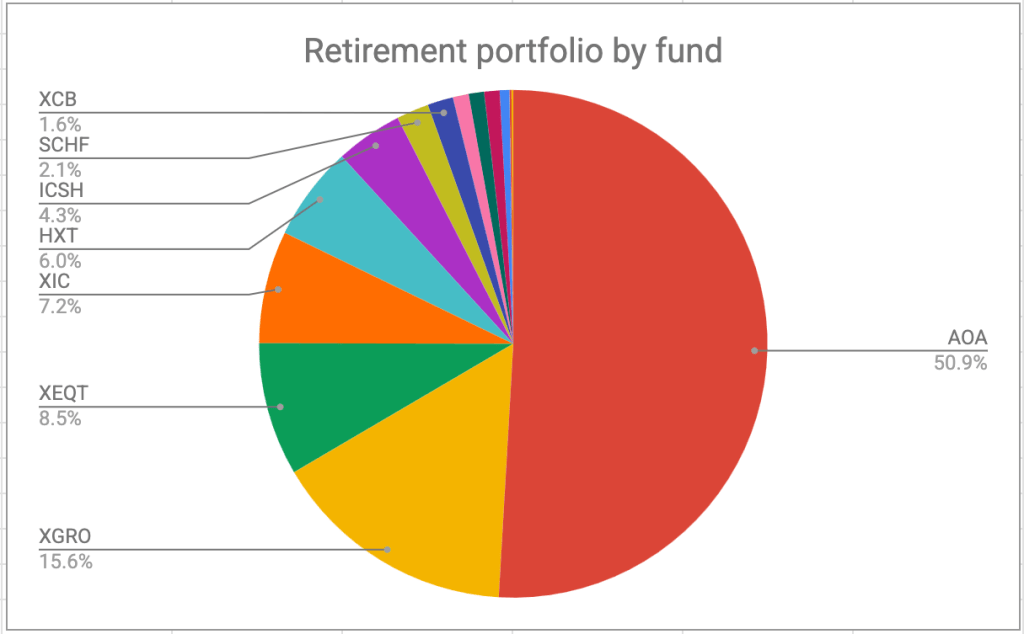
I pay myself monthly in retirement, so that’s a good trigger to update this post. On January 26, this is what it looks like:

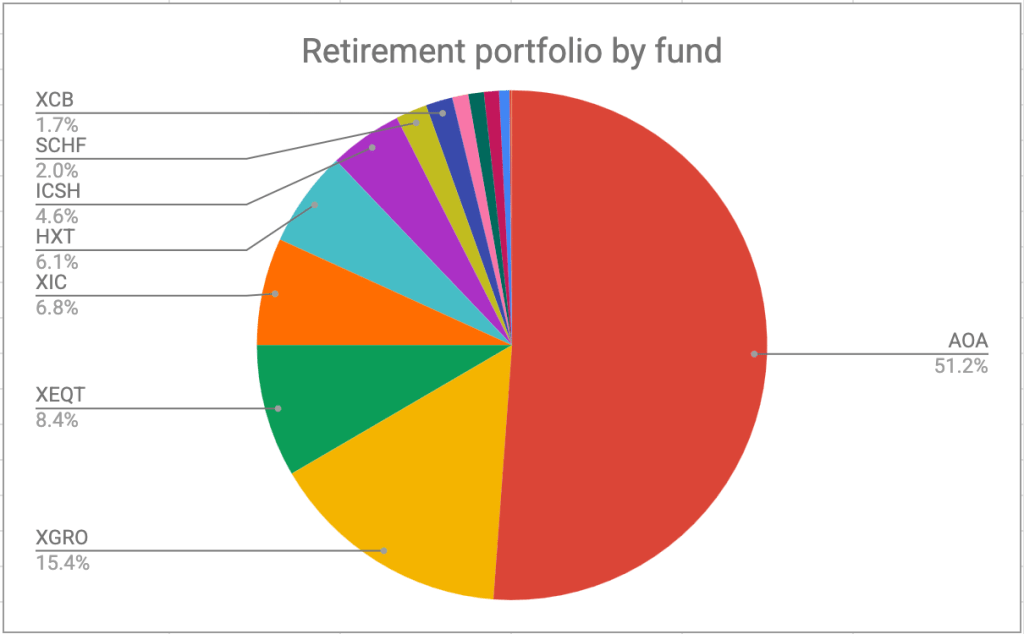
The portfolio is dominated by my ETF all-stars, but if you’ve been following along, you’ll see a few changes.

  • As mentioned in a previous post, I did some shifting around and you now see XAW and XIC increasing their contribution to the portfolio at the expense of XGRO.
  • I also tidied up some extra funds that aren’t needed — VCN was replaced with XIC1, and I turfed some small holdings.
  • I sold more HXT than I needed to for my monthly paycheque, and when I discovered the mistake2, I just bought XIC instead.
  • And, I did my quarterly Norbert’s Gambit to shift some AOA to XGRO. And again, I came out ahead!

Plan for the next month

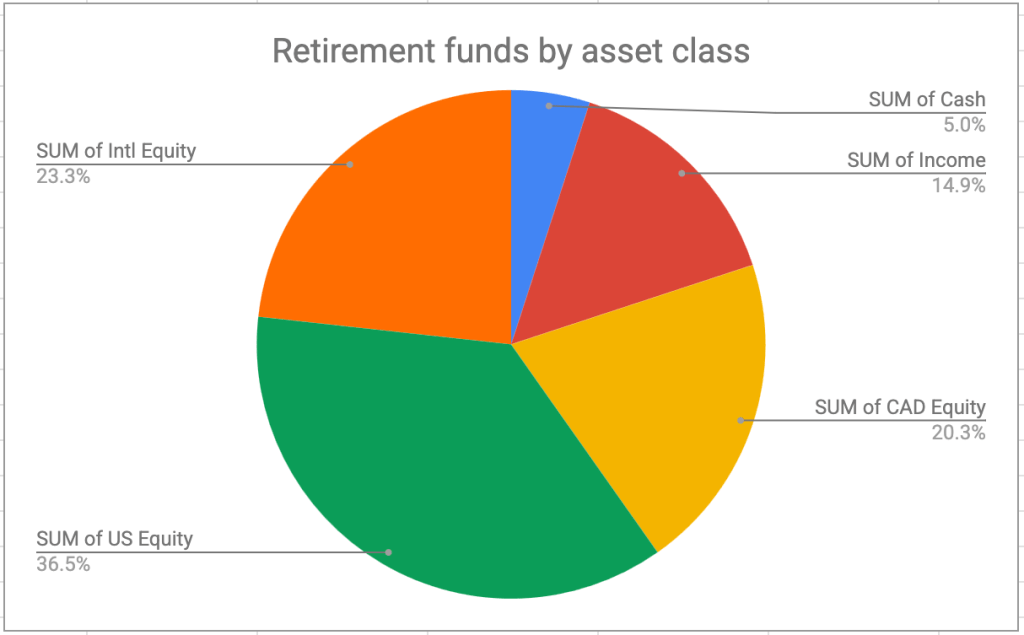
The asset-class split looks like this; you can read about my asset-allocation approach to investing over here.

It’s looking pretty close to the targets I have, which are unchanged:

  • 5% cash or cash-like holdings like ICSH and ZMMK
  • 15% bonds (most are buried in XGRO and AOA, some are in XCB)
  • 20% Canadian equity (mostly based on ETFs that mirror the S&P/TSX)
  • 36% US equity (dominated by ETFs that mirror the S&P 500)
  • 24% International equity (mostly, but not exclusively, developed markets)

Overall

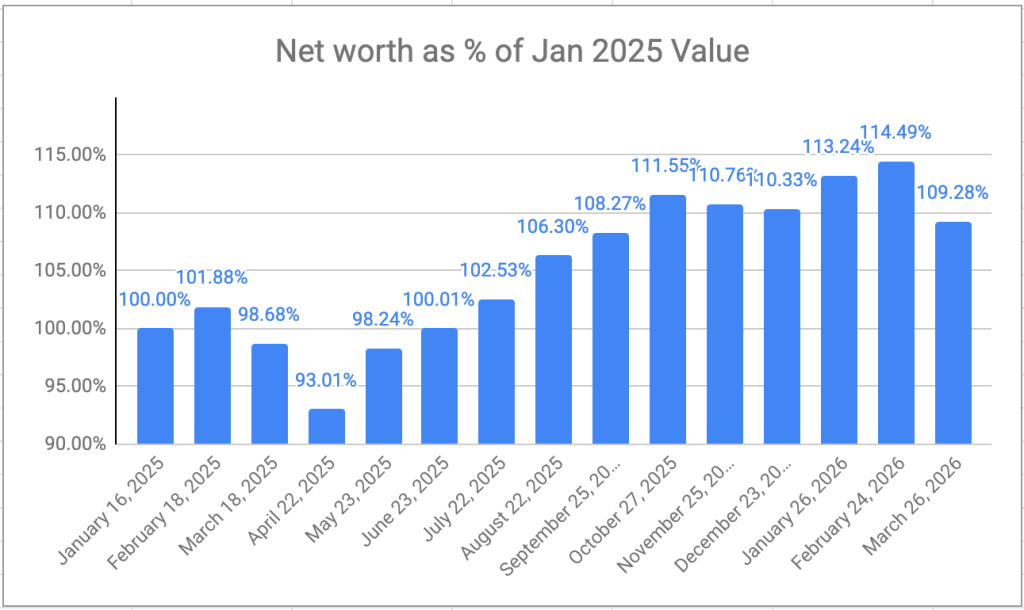
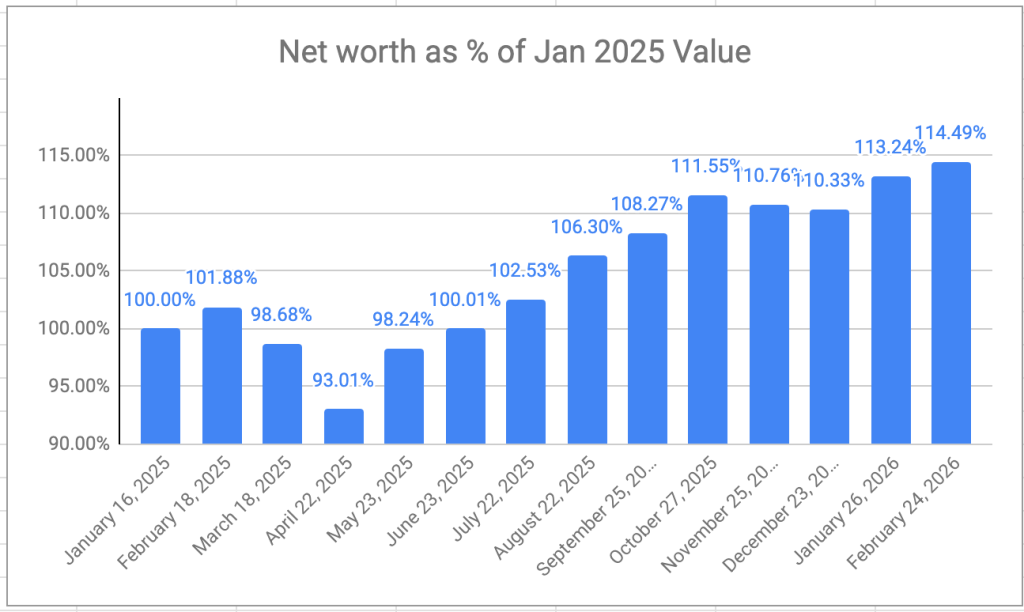
Net worth overall is up month over month, reversing a 2 month losing streak and hitting a new all-time-high:

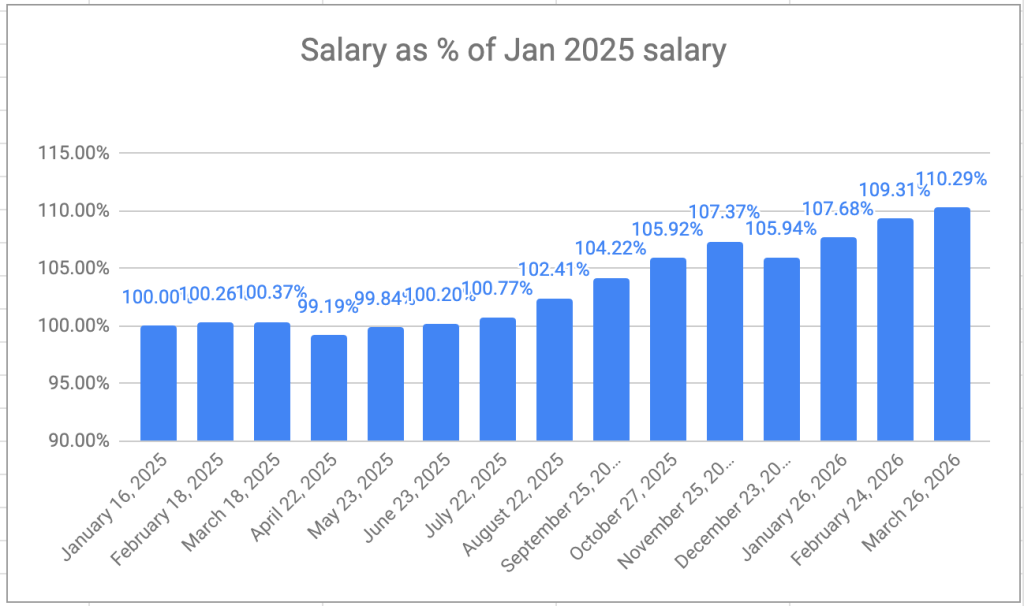
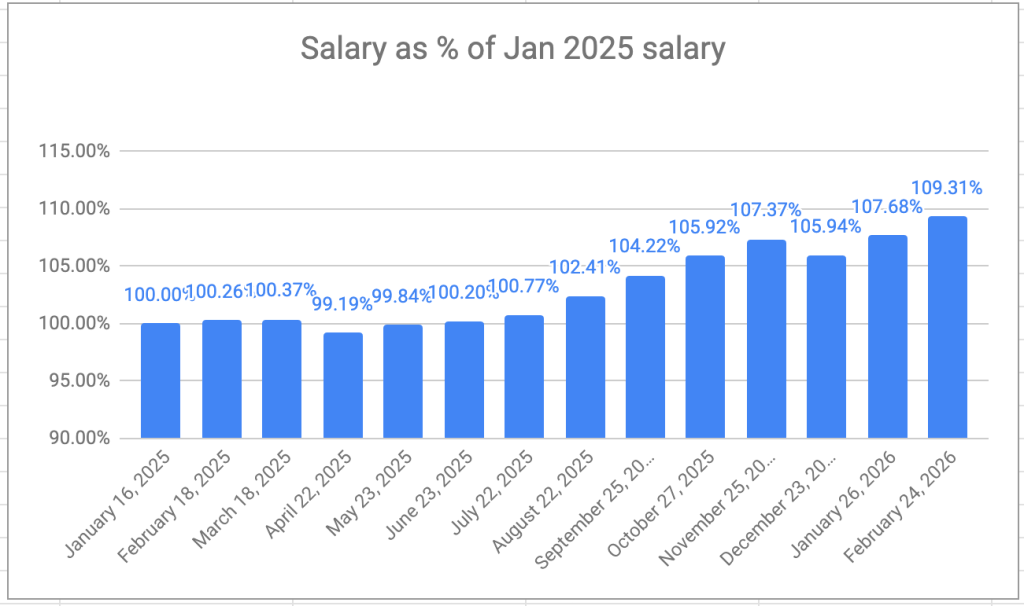
My VPW-calculated salary resumed its upward trend, also hitting an all-time high.

My QTrade RRIFs should move perhaps this week, but I’m no longer confident about that. More on that once resolved.

  1. Which, in my mind, are equivalent. This post goes in lots more detail. â†Šī¸Ž
  2. I had to do some quick manual calculations because I had already updated my auto-calculating spreadsheet to reflect fewer RRIF accounts. My RRIF transfers are 2 months in progress and counting. I guess trying to move a RRIF near the end of the year was a bad idea. â†Šī¸Ž

News: Wealthsimple offering free money

Stop me if you’ve heard this before, but yes, there’s another offer out in the market that demonstrates the seemingly never-ending gravy train for the DIY investor who isn’t too dedicated to any particular broker.

It’s Wealthsimple’s turn, again, with a promotion they are calling “The Un(Real) Deal”. Marketing page here, Ts and Cs here, but step one, as in all Wealthsimple promotions, is a registration for the promotion that is painless, but must be done by March 31, 2026. After registering, you have 30 days to initiate account transfers.

In this promotion, Wealthsimple is trying to keep the rewards modest for the deal-hopper, but are pretty darn attractive for the more loyal investor. When you register for the promotion, you pick a lock-in period for transferred-in funds of one of:

  • 1 year, and get 1% cash back payable over 12 months
  • 2 years, and get 3% cash back payable over 36 months
  • 5 years, and get 3% cash back payable over 60 months1

What is particularly noteworthy about this promotion (besides the 3% cash back) is that the maximum you can earn in free money is 3% of five million dollars2. That’s (checks math) $150,000 possible in free money. That is a nice slice of pizza, if you ask me.

It appears that the usual kinds of accounts count as eligible for the promotion: non-registered, TFSAs, RRSPs, RRIFs, RESPs, LIRAs…One missing is spousal RRIFs, but spousal RRSPs are shown, so not sure about that.

If you’re tired of missing out on the gravy train, this could be an even better deal than the aforementioned Questrade deal.

Anyway, there you have it. This is one that I will take a closer look at. If you want a little extra incentive, you can use my referral code and get some additional free cash.

  1. I (meaning chatGPT) ran the numbers at various discount rates (0%,5%,10%) and the present value of 5 year deal always came out ahead. My MSci prof would be so proud of me. At 10% discount rate, the PV of the three options assuming $200k is moved is $1900, $3350, and $4720. â†Šī¸Ž
  2. Yeah, ok, I know most people aren’t moving that kind of dosh, but normally these promotions are capped at a much lower dollar amount. The aforementioned Questrade deal is capped at a maximum reward of $20k, requiring $750k to be moved across 3 accounts. â†Šī¸Ž

DIY Decumulation: Expect Delays, Plan Accordingly

Something I never paid much attention to when I was building my retirement savings were the delays built into the system when it comes to moving money around. The Mechanics of Getting Paid in Retirement: 2026 Edition shows the steps I use to get a monthly paycheque, but it doesn’t show the delays. When I was working, I could predictably expect a paycheque twice a month. No guesswork. Now that I rely on these money movements to do things like pay bills, I’ve become a lot more attentive to where things slow down. Stressing about them isn’t helpful, but knowing about them in advance means you can build them into your plan so you don’t get caught in a cash flow crunch.

I should preface this by saying that I use Questrade and Wealthsimple for my providers, and how your provider handles things can be quite different, so take these as examples, not as absolutes. So where have I seen things slow down?

Time between selling an asset and having useable cash

Here I’m talking about cash as cash, not cash to immediately do another trade, i.e. sell ETF “a” and then use the proceeds to buy ETF “b”. For that example, I think most brokers allow you to sell to buy immediately after the trade executes, at least in my experience.

Here I’m talking about selling ETF “a” so you have the cash to pay your credit card balance. This is usually a multi-step process. The first step is having access to the cash you gain from the proceeds of a sale. This is generally speaking a business day after the trade executes. So if you sell on Monday, the cash appears in your account on Tuesday. If you have a margin account (which I do for my non-registered holdings), then it has the nice side benefit of providing access to the cash immediately after the trade executes.

So now that the cash is there in your trading account, you then have to get it to a place where you can spend it. And here there will be a lot of variability depending on who your broker is, who you bank with, and how you actually move the money (EFT, wire transfer, physical cheque).

For me, I use EFT withdrawals to my CIBC chequing account. And this has delays too.

As an example, I executed a trade in my Questrade non-registered account to help fund my December paycheque.

  • December 23rd: sold some HXT in the morning, immediately requested a withdrawal to my CIBC account using an EFT. The money was available instantly because I have margin in that account.1
  • December 29th: deposit received to my chequing account
  • # of business days: Dec 23rd (0.5) Dec 24th(1), December 29th (2)= 2.5 days to get my $$$

I also sold some funds in my Wealthsimple account on December 23rd. I wasn’t able to withdraw anything until the following day since this account isn’t a margin account. But on the 24th, when I made the request via EFT, the money appeared in my chequing account in minutes. This was 1.1 days2 to get my $$$$.

I do recall when I managed my parent’s BMOI account cash in a non-registered account could immediately be used for bill pay, cheque writing, eTransfers or ATM withdrawals, thanks to their “AccountLInk” service.

Delays in moving money between accounts at the same brokerage

In my VPW-driven decumulation methodology, I have a non-registered Questrade account that is exclusively used as the “cash cushion” — about 5 months of rolling average salary, invested in ZMMK and ICSH, two funds that are on my ETF All-Stars page. Every month, I either get paid from this account or I move money into it from my non-registered account. Getting paid undergoes the same delays as I mentioned above: about 2.5 days, but moving money into this account from another account (one would think) is instantaneous, no? No, not with Questrade.

Typically, it takes a day before the money becomes useable in the destination account. Not so with Wealthsimple, where transfers are instantaneous.

Delays in getting dividend payments

All ETFs publish their dividend schedule. For example, here’s what ICSH’S looks like:

“Ex-Date”, at least for my provider (Questrade) is the date used to indicate a “dividend event” notification. But “ex-date” isn’t when you should look for your dividend payment; you have to own the ETF in question by ex-date to take part in the next dividend payment. And so “Payable Date” is the one of interest, and the lag between the ex-date and the payable date is highly dependent on the ETF in question. Since most of my ETFs pay out either quarterly or monthly, often declaring ex-dividend on the last business day of the month, the first week of January will be active with new dividend funds rolling into my various accounts.

Delays: Just Roll with it

While I do find it irritating that my own money gets tied up for days at a time for no discernible reason, I’ve adapted my expectations accordingly and don’t worry about it. In the early days of retirement, be aware that things may not happen as quickly as you expect, so it’s probably a good idea to have a bit of cash flow leeway in the first month or two as you work out the kinks in your own decumulation system.

  1. And no, I don’t get charged interest when I do this. I’m not sure why, but if I did, I would simply wait a day. I just like being able to make the move in the moment — still logged in, the amounts are fresh in my mind…. â†Šī¸Ž
  2. Fast transfers seem to be part of the Wealthsimple ethos. â†Šī¸Ž

What’s in my retirement portfolio (Dec 2025)?

This is a monthly look at what’s in my retirement portfolio. The original post is here.

Portfolio Construction

The retirement portfolio is spread across a bunch of accounts:

  • 6 RRIF accounts (2 for me, 3 for my spouse, 1 for me at an alternative provider as a test)
  • 2 TFSA accounts
  • 4 non-registered accounts, (1 for me, 1 for my spouse, 2 joint)

The target for the overall portfolio is unchanged:

  • 80% equity, spread across Canadian, US and global markets for maximum diversification
  • 15% Bond funds, from a variety of Canadian, US and global markets
  • 5% cash, held in savings-like ETFs.

You can read about my asset-allocation approach to investing over here.

The view post-payday

I pay myself monthly in retirement, so that’s a good trigger to update this post. On December 23, this is what it looks like:

Retirement holdings, December 2025

The portfolio is dominated by my ETF all-stars; anything not on that page is held in a non-registered account and won’t be fiddled with unless it’s part of my monthly decumulation. Otherwise I’ll rack up capital gains for no real benefit.

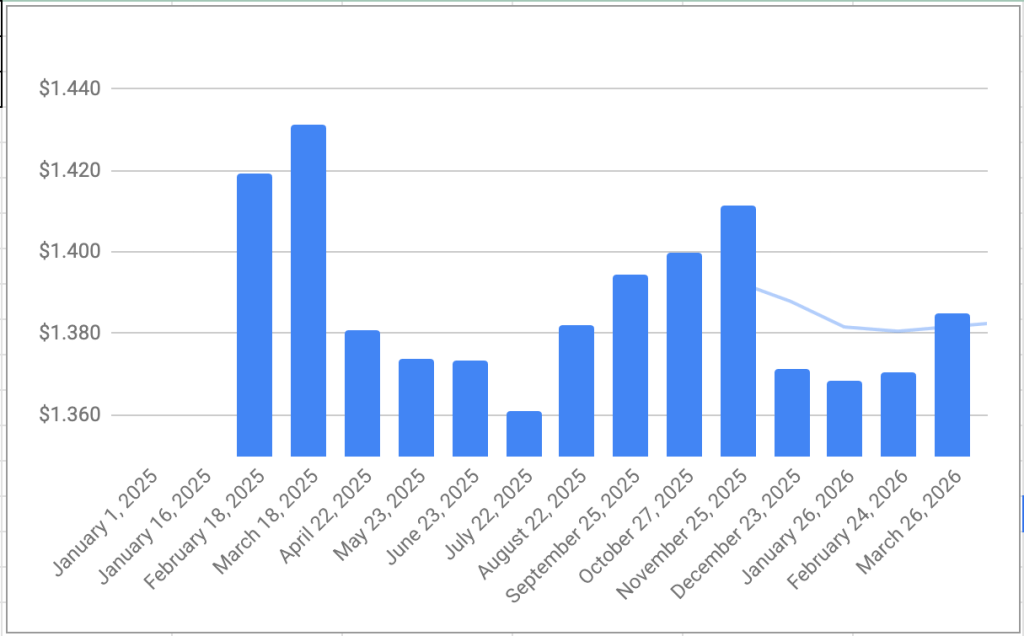
There aren’t really any notable changes this month — AOA’s contribution was down a bit this month, largely due to an unfavourable change in the USD/CAD exchange rate (down about 3% month over month, back down to a level not seen since around May this year). I recalculate the FX rate every month1 since I track my net worth in CAD so I always have an apples-to-apples comparison. I don’t stress too much about the FX rate as it tends to cut both ways. Sometimes it’s a lift to my numbers, sometimes not. In the end, I suppose it all evens out. I tracked my snapshot FX rates starting in February2, just for illustration:

Monthly USD/CAD rates on payday day

Plan for the next month

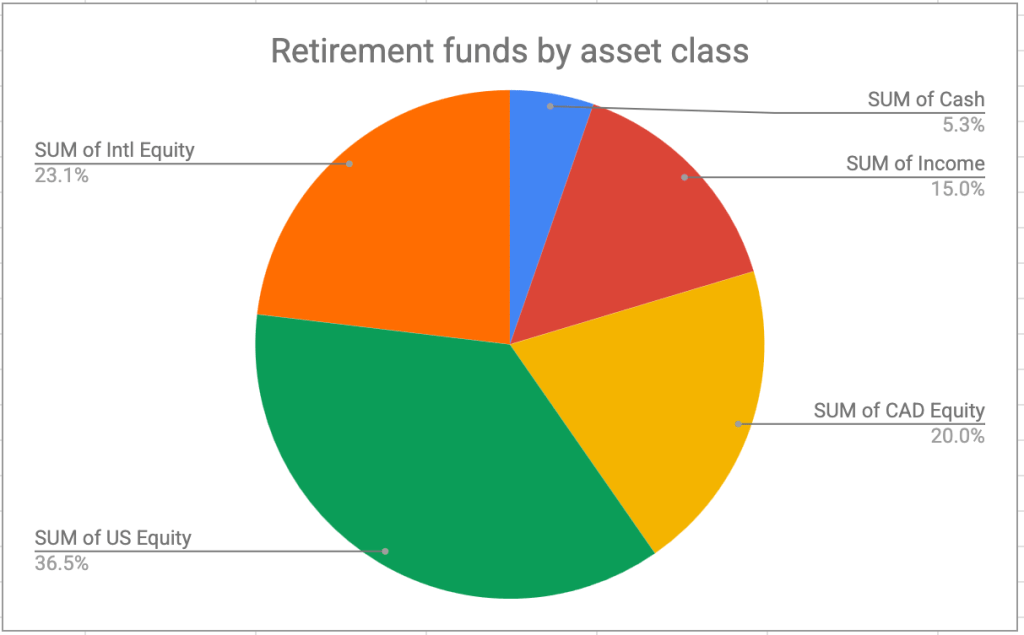
The asset-class split looks like this

Retirement portfolio by asset class, December 2025

It’s looking pretty close to the targets I have, which are unchanged:

  • 5% cash or cash-like holdings like ICSH and ZMMK
  • 15% bonds (almost all are buried in XGRO and AOA)
  • 20% Canadian equity (mostly based on ETFs that mirror the S&P/TSX)
  • 36% US equity (dominated by ETFs that mirror the S&P 500)
  • 24% International equity (mostly, but not exclusively, developed markets)

The end of the year will mean more distributions from my holdings; in my RRIF accounts they are set to DRIP since I only hold AOA/XGRO/ICSH in these accounts. The rest I redeploy to the asset classes that are short funds; typically this means investing in one of the *EQT funds since the bond complement of the portfolio frequently moves above the 15% target.

Overall

Net worth overall is down slightly month over month, but up a little over 10% from the start of the year. Hard to be unhappy about that.

My VPW-calculated salary took a slight decline, breaking the 7 month growth streak. It ends the year a shade under 6% larger than my first paycheque. Not bad. I don’t recall many years where I got a 6% raise 😉

Next month will end my relationship with QTrade as I move the final 3 RRIF accounts to Questrade; I had thought December would be the final month, but as you’ll see in my next post, a (hopefully) small wrinkle has delayed this.

  1. Using =googlefinance(“USDCAD”) of course â†Šī¸Ž
  2. February because I only thought to start tracking that a month in. January’s rate will be lost to the sands of time. Or I could add it back using the official FX rates, I suppose. â†Šī¸Ž