What’s in my retirement portfolio (March 2026)?

This is a monthly look at what’s in my retirement portfolio. The original post is here.

Portfolio Construction

The retirement portfolio is spread across a bunch of accounts:

  • 5 RRIF accounts
    • 3 for me (Questrade, Wealthsimple)
    • 2 for my spouse (Questrade)
  • 2 TFSA accounts (Questrade)
  • 4 non-registered accounts, (1 for me, 1 for my spouse, 2 joint, all at Questrade)

The view post-payday

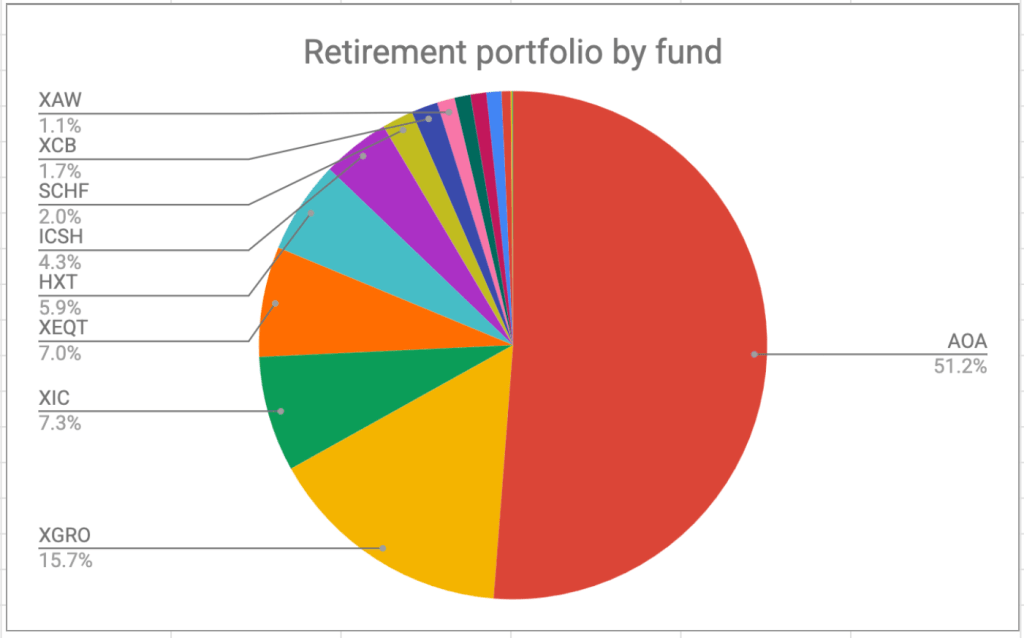
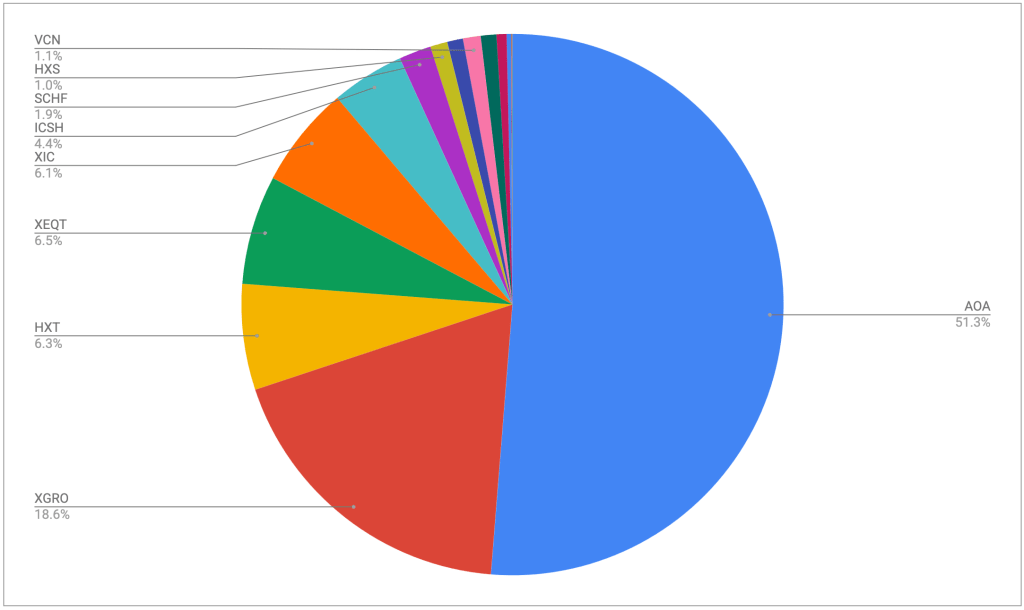
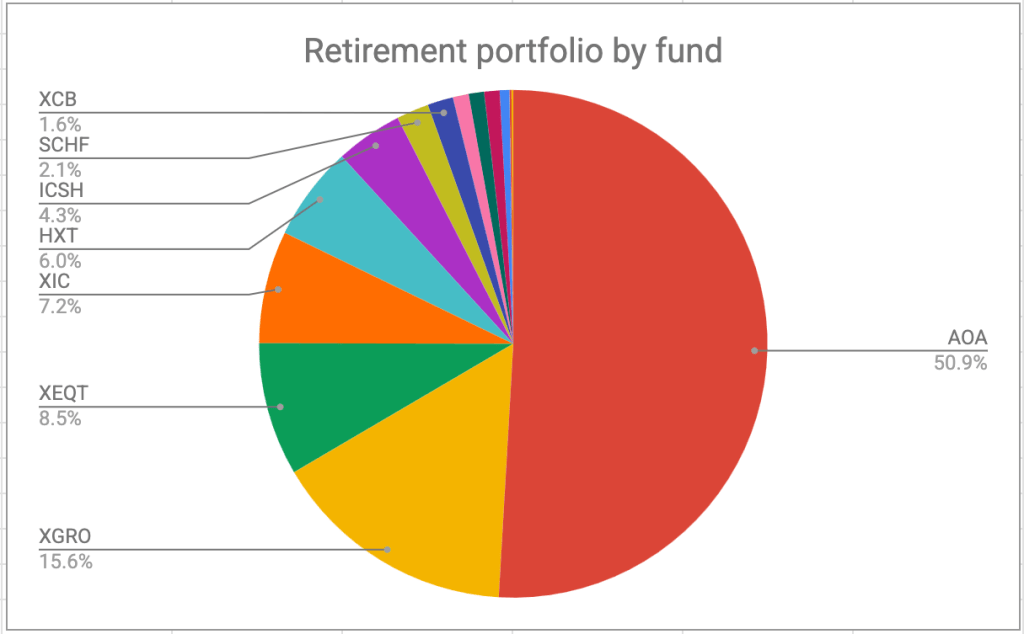
I pay myself monthly in retirement, so that’s a good trigger to update this post. On March 30, this is what it looks like:
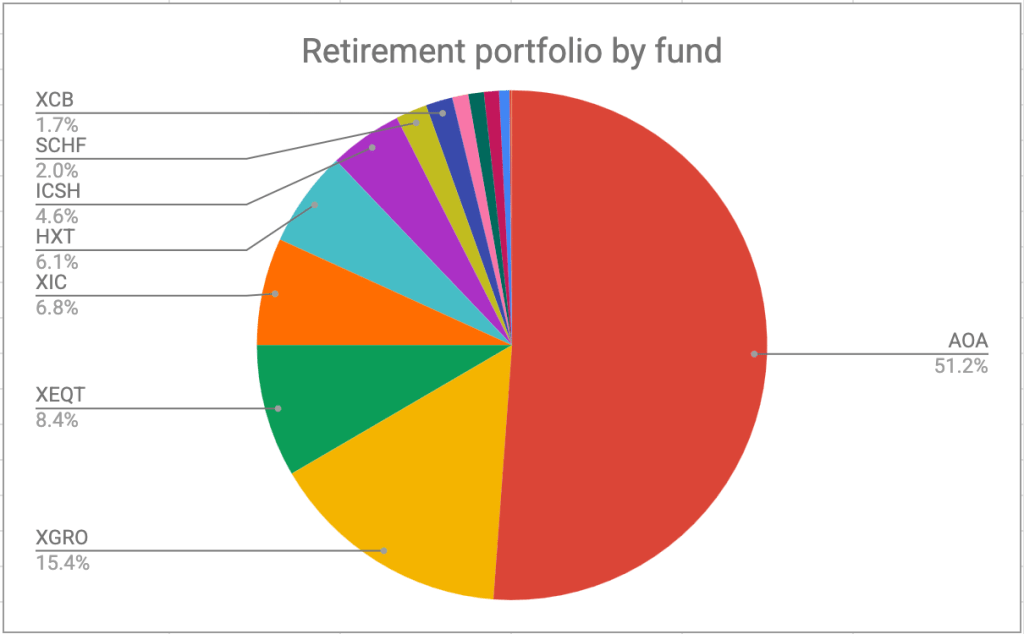
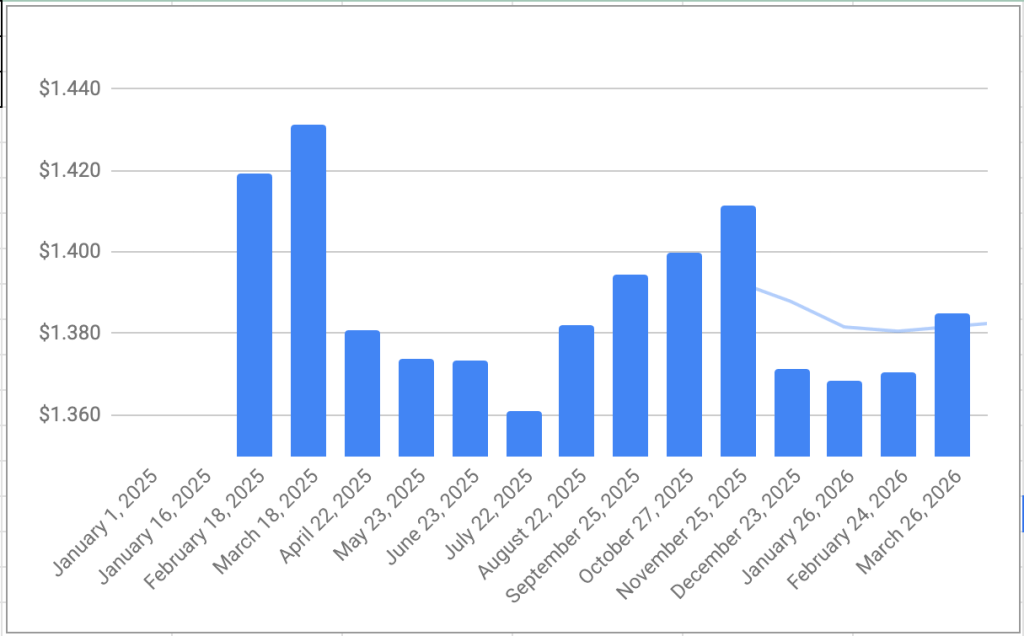
The portfolio is dominated by my ETF all-stars, (and if not an all-star, they are probably on the Magnificent Seven ETFs list). This split is before all the quarterly dividends have paid out. AOA, XGRO, XEQT, XIC all have a quarterly payment that collectively might skew the numbers a bit — I have all these investments on DRIP so I just buy more of the same. All that to say that there weren’t big changes month to month; my USD holdings got a bit of a boost this month thanks to a favourable exchange rate. (A lot of my retirement holdings are in USD, so the FX rates matter somewhat). Here’s what the USD has looked like in CAD since my retirement:
Plan for the next month

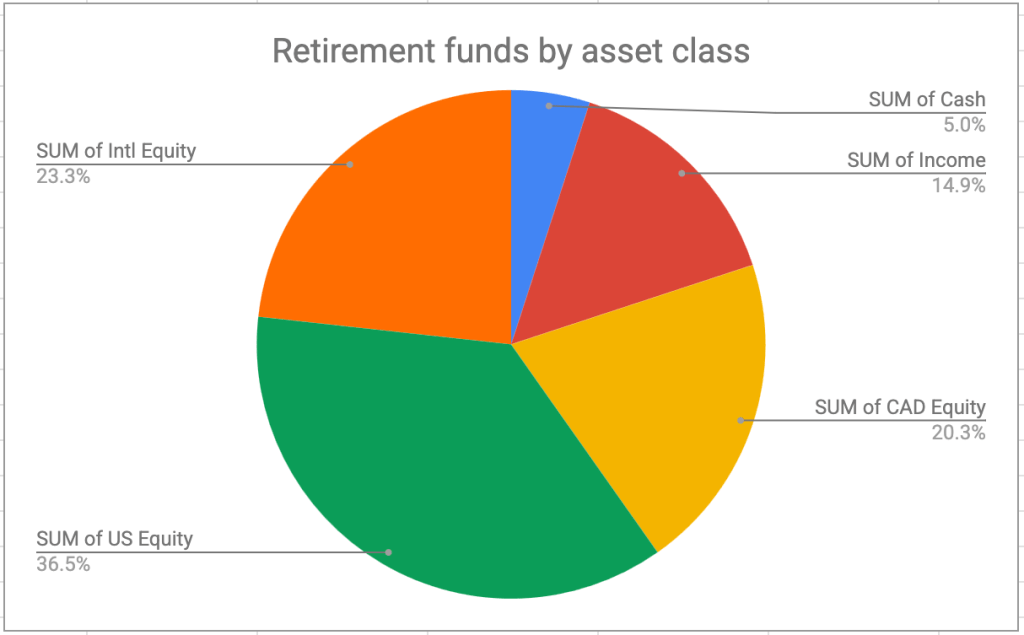
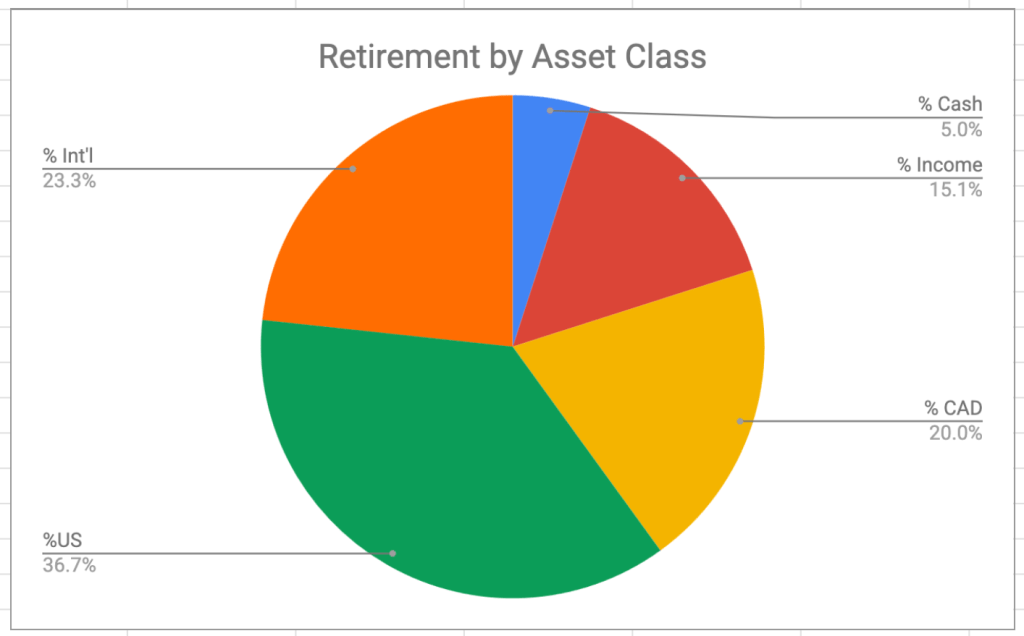
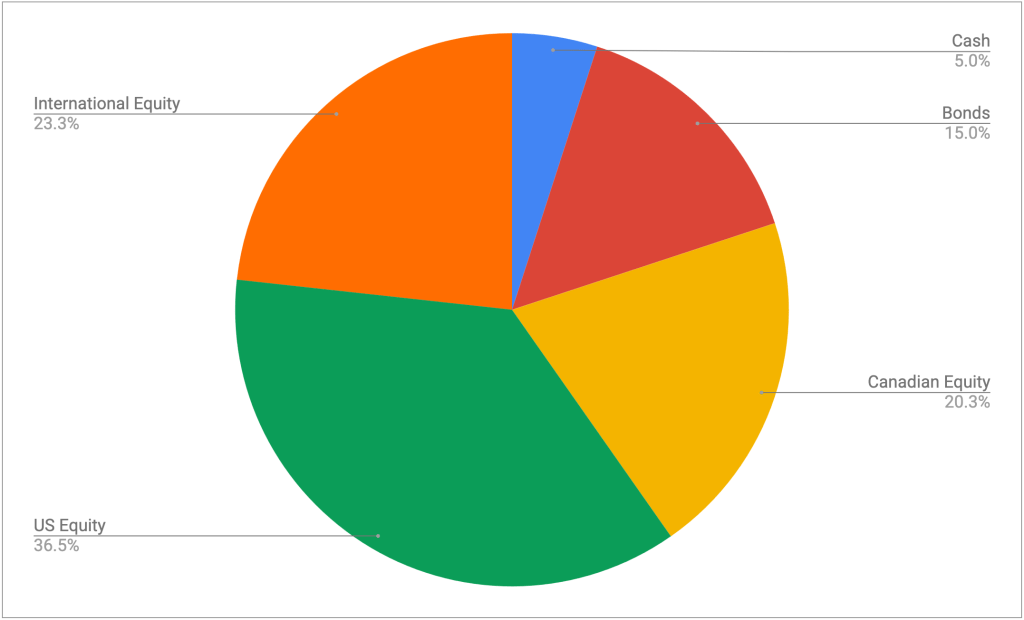
The asset-class split looks like this; you can read about my asset-allocation approach to investing over here.
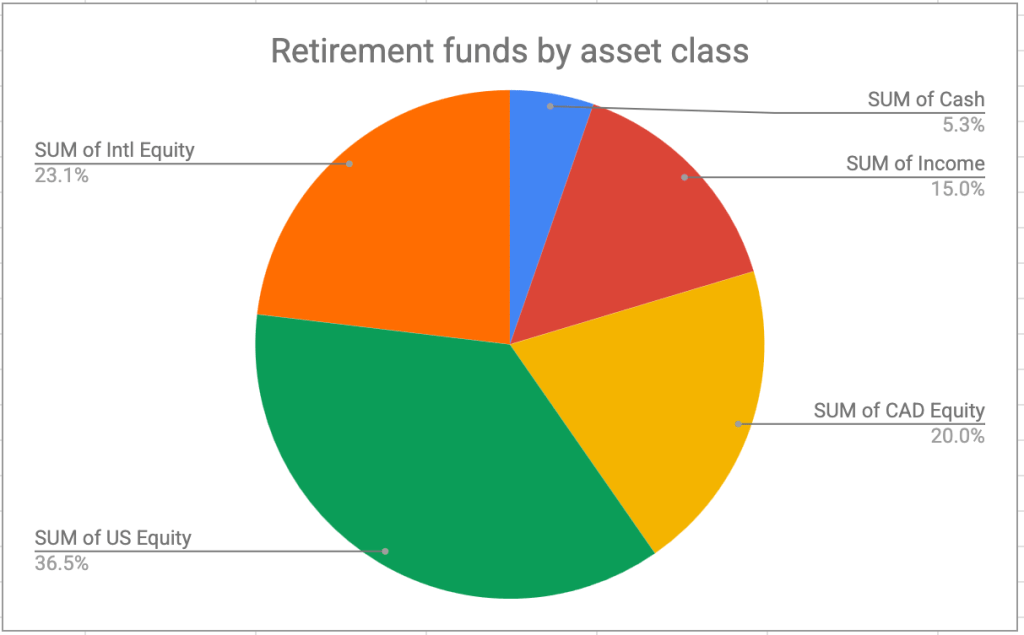
It’s looking pretty close to the targets I have, which are unchanged:

  • 5% cash or cash-like holdings like ICSH and ZMMK
  • 15% bonds/income (most are buried in XGRO and AOA, rest are in XCB)
  • 20% Canadian equity (mostly based on ETFs that mirror the S&P/TSX — HXT and XIC)
  • 36% US equity (dominated by ETFs that mirror the S&P 500)
  • 24% International equity (mostly, but not exclusively, developed markets)

The alignment with target is what drives my investment decisions; seeing the chart above tells me there’s no movements needed, which makes things simpler.

Since we’re just about in to the 2nd quarter of the year, it’s time for me to move some AOA into XGRO using Norbert’s Gambit1. The Gambit has worked out pretty well for me so far; I track my effective FX rate every time I do it, and it’s always less than relying on the instant (and relatively expensive) FX conversions offered by my broker2.

Overall

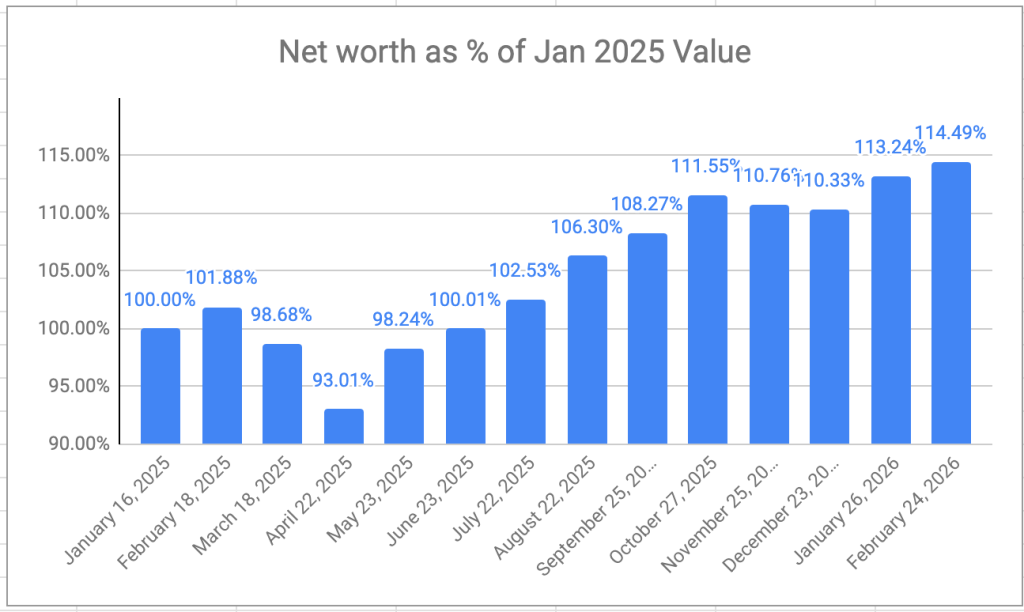
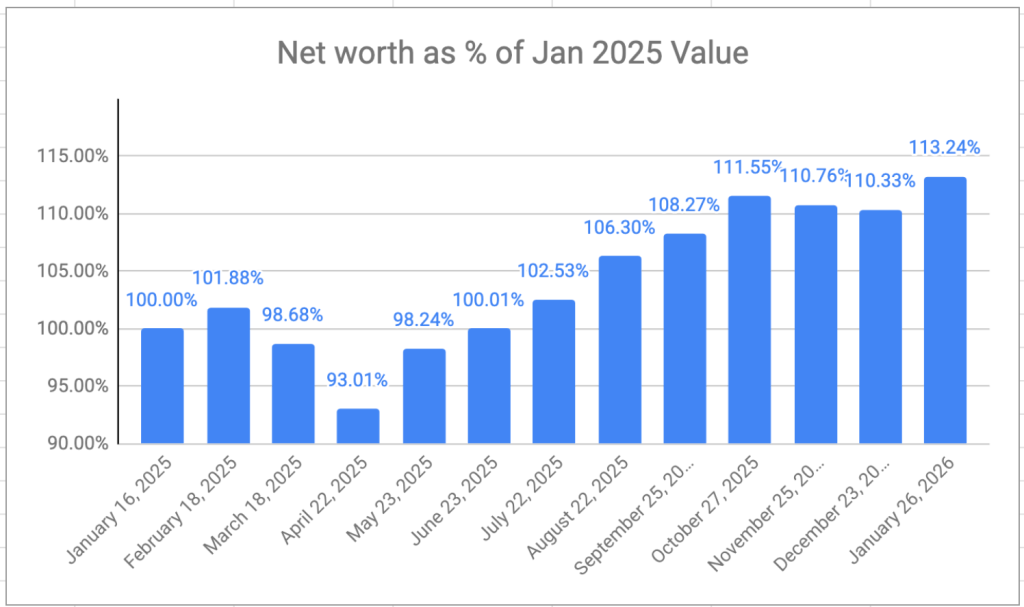
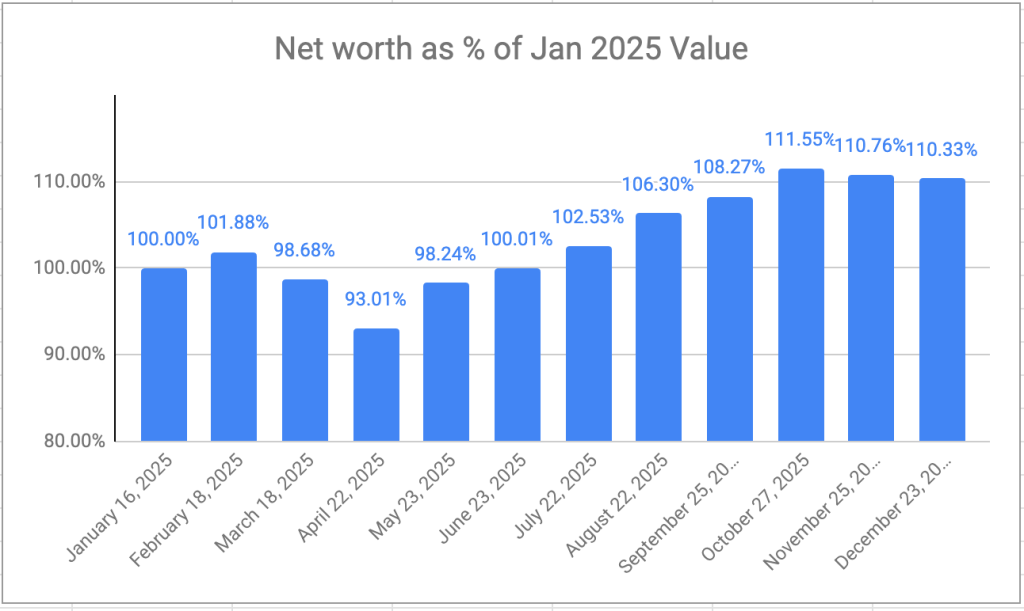
Part of using VPW3 as a strategy is the need to calculate your retirement net worth on a monthly basis. As you can see below, the most recent market gyrations have had a bit of an impact on the bottom line, taking me back to a value I haven’t seen since September last year:
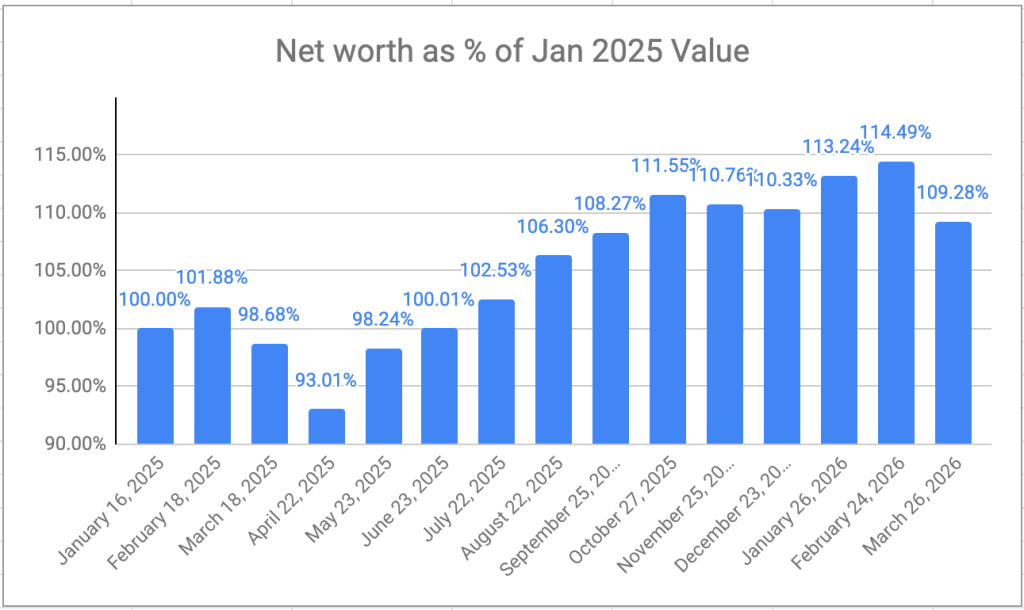
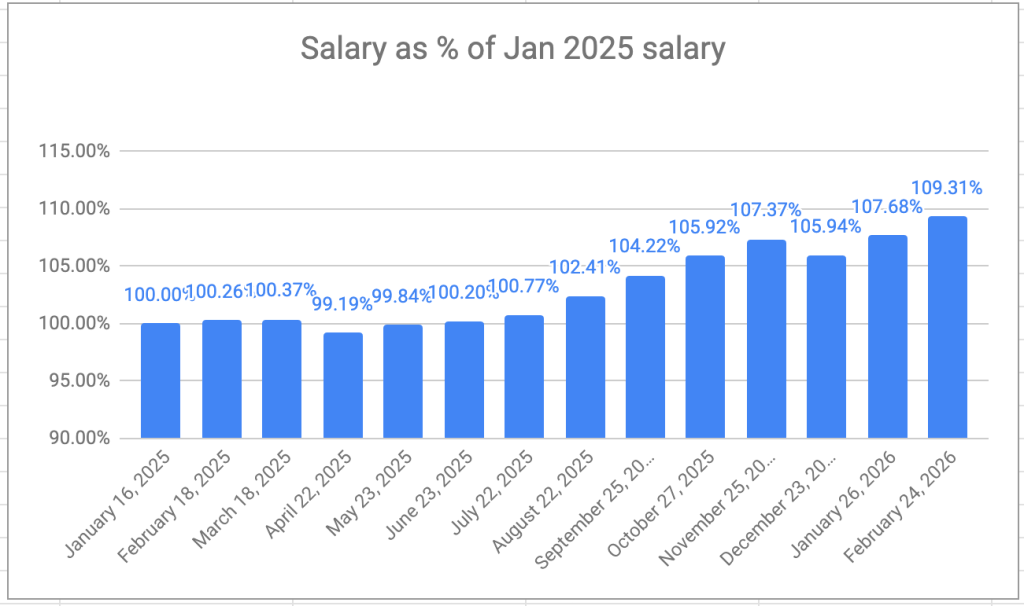
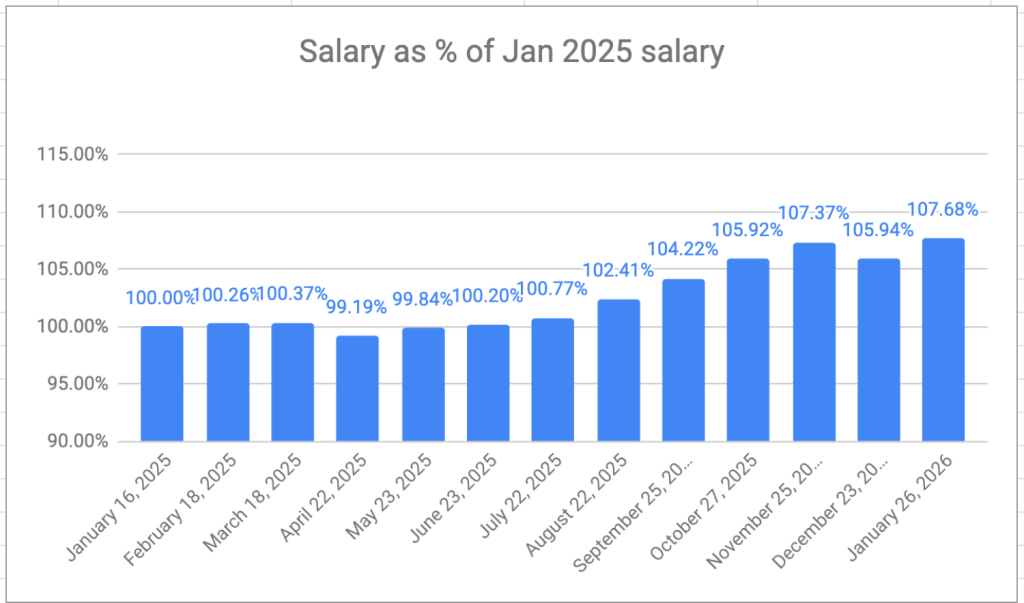
But my VPW-calculated salary, which has a built in shock absorber (aka cash cushion), continued its upward trend nonetheless:
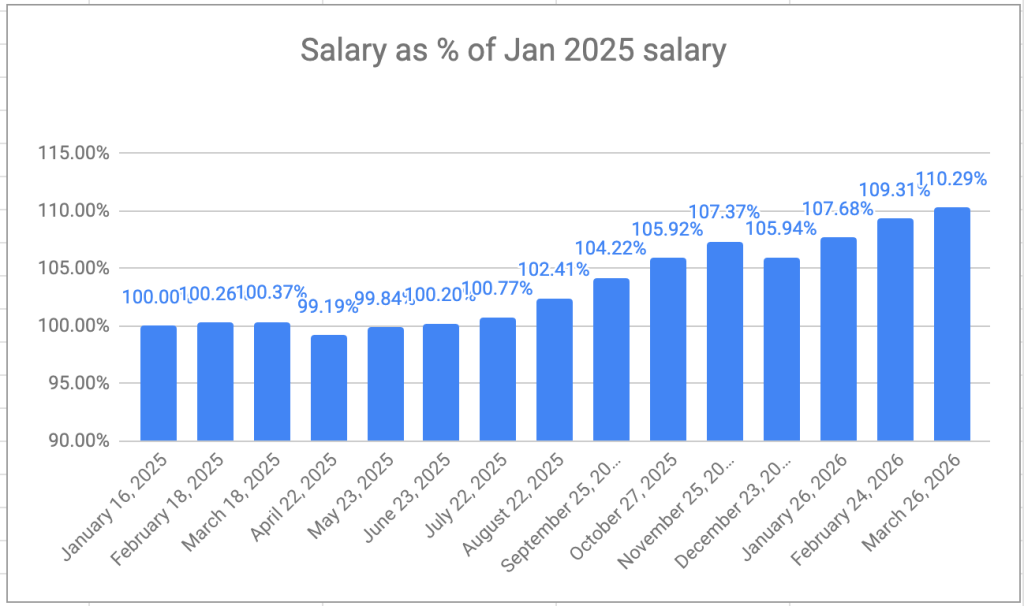
I’m expecting to take a pay cut at some point if the markets fail to recover, but pay cuts are an expected outcome of using VPW as a strategy. The “V” is for “variable”, after all. At this point, I’m still taking over 10% more than I did a year ago, so no matter how you slice it, things are more than on track.

  1. Of late, my need for spending in USD seems not so critical anymore. ↩︎
  2. Typically 1.5% of the amount converted. ↩︎
  3. Variable Percentage Withdrawal, my chosen decumulation strategy. ↩︎

What’s in my retirement portfolio (Feb 2026)?

This is a monthly look at what’s in my retirement portfolio. The original post is here.

Portfolio Construction

The retirement portfolio is spread across a bunch of accounts:

  • 5 RRIF accounts
    • 3 for me (Questrade, Wealthsimple)1
    • 2 for my spouse (Questrade)
  • 2 TFSA accounts (Questrade)
  • 4 non-registered accounts, (1 for me, 1 for my spouse, 2 joint, all at Questrade)

You will notice that QTrade is no longer in the mix. I successfully moved the last RRIF accounts during the month; I learned a lot in the process. QTrade was the victim in the chase for free money offered by Questrade last year; based on current offerings, I’d say that QTrade still has an edge in terms of user experience over Questrade. I’ll go into more detail in a future post.

The view post-payday

I pay myself monthly in retirement, so that’s a good trigger to update this post. On February 28, this is what it looks like:

The portfolio is dominated by my ETF all-stars, (and if not an all-star, they are probably on the Magnificent Seven ETFs list) but if you’ve been following along, you’ll see a few changes.

  • I dropped XAW since I realized I didn’t need it if I was smarter the ratios of holdings I already owned (XEQT/XIC/XCB). Less is more.
  • I sold XIC instead of HXT in my non-registered account this month to help pay the bills because I reasoned that eliminating its dividend payouts would be better from a tax perspective2.

Plan for the next month

The asset-class split looks like this; you can read about my asset-allocation approach to investing over here.

It’s looking pretty close to the targets I have, which are unchanged:

  • 5% cash or cash-like holdings like ICSH and ZMMK
  • 15% bonds3 (most are buried in XGRO and AOA, rest are in XCB)
  • 20% Canadian equity (mostly based on ETFs that mirror the S&P/TSX — HXT and XIC)
  • 36% US equity (dominated by ETFs that mirror the S&P 500)
  • 24% International equity (mostly, but not exclusively, developed markets)

I am mulling over making a small tweak to these percentages, increasing US equity exposure at the expense of International equity based on some calculations I’ve done4 but this is neither urgent nor will it be massively impactful to the overall picture.

Overall

There is a bit of an anomaly this month that I should mention. A number of readers have questioned my wisdom of contributing monthly to a TFSA in retirement. From a tax-free growth perspective, it would be far better to make the contribution at the beginning of the year. And many studies have shown that lump sum investing provides better returns than spacing them out. And so, I have taken their advice5 and made all my TFSA contributions for the year this month. And since my TFSA is part of my net worth, there’s a bump being caused by that contribution.

And so, net worth overall is up month over month, a two month winning streak.

My VPW-calculated salary also continues its upward trend.

  1. One spousal, one individual. One at Wealthsimple because (a) I like their user experience and may consider them as my primary broker in the future and (b) they offered me free money and a laptop to move some fees their way. I can be bought. ↩︎
  2. HXT does not pay dividends and instead uses swap contracts to convert them into capital gains, which receive better tax treatment for me ↩︎
  3. Referred to as “Income” on the chart above ↩︎
  4. I’ll share those in a future post ↩︎
  5. With thanks to Steven and Sylvain ↩︎

What’s in my retirement portfolio (Jan 2026)?

This is a monthly look at what’s in my retirement portfolio. The original post is here.

Portfolio Construction

The retirement portfolio is spread across a bunch of accounts:

  • 6 RRIF accounts
    • 3 for me (Questrade, QTrade, Wealthsimple)
    • 3 for my spouse (Questrade, QTrade)
  • 2 TFSA accounts (Questrade)
  • 4 non-registered accounts, (1 for me, 1 for my spouse, 2 joint, all at Questrade)

The view post-payday

I pay myself monthly in retirement, so that’s a good trigger to update this post. On January 26, this is what it looks like:

The portfolio is dominated by my ETF all-stars, but if you’ve been following along, you’ll see a few changes.

  • As mentioned in a previous post, I did some shifting around and you now see XAW and XIC increasing their contribution to the portfolio at the expense of XGRO.
  • I also tidied up some extra funds that aren’t needed — VCN was replaced with XIC1, and I turfed some small holdings.
  • I sold more HXT than I needed to for my monthly paycheque, and when I discovered the mistake2, I just bought XIC instead.
  • And, I did my quarterly Norbert’s Gambit to shift some AOA to XGRO. And again, I came out ahead!

Plan for the next month

The asset-class split looks like this; you can read about my asset-allocation approach to investing over here.

It’s looking pretty close to the targets I have, which are unchanged:

  • 5% cash or cash-like holdings like ICSH and ZMMK
  • 15% bonds (most are buried in XGRO and AOA, some are in XCB)
  • 20% Canadian equity (mostly based on ETFs that mirror the S&P/TSX)
  • 36% US equity (dominated by ETFs that mirror the S&P 500)
  • 24% International equity (mostly, but not exclusively, developed markets)

Overall

Net worth overall is up month over month, reversing a 2 month losing streak and hitting a new all-time-high:

My VPW-calculated salary resumed its upward trend, also hitting an all-time high.

My QTrade RRIFs should move perhaps this week, but I’m no longer confident about that. More on that once resolved.

  1. Which, in my mind, are equivalent. This post goes in lots more detail. ↩︎
  2. I had to do some quick manual calculations because I had already updated my auto-calculating spreadsheet to reflect fewer RRIF accounts. My RRIF transfers are 2 months in progress and counting. I guess trying to move a RRIF near the end of the year was a bad idea. ↩︎

What’s in my retirement portfolio (Dec 2025)?

This is a monthly look at what’s in my retirement portfolio. The original post is here.

Portfolio Construction

The retirement portfolio is spread across a bunch of accounts:

  • 6 RRIF accounts (2 for me, 3 for my spouse, 1 for me at an alternative provider as a test)
  • 2 TFSA accounts
  • 4 non-registered accounts, (1 for me, 1 for my spouse, 2 joint)

The target for the overall portfolio is unchanged:

  • 80% equity, spread across Canadian, US and global markets for maximum diversification
  • 15% Bond funds, from a variety of Canadian, US and global markets
  • 5% cash, held in savings-like ETFs.

You can read about my asset-allocation approach to investing over here.

The view post-payday

I pay myself monthly in retirement, so that’s a good trigger to update this post. On December 23, this is what it looks like:

Retirement holdings, December 2025

The portfolio is dominated by my ETF all-stars; anything not on that page is held in a non-registered account and won’t be fiddled with unless it’s part of my monthly decumulation. Otherwise I’ll rack up capital gains for no real benefit.

There aren’t really any notable changes this month — AOA’s contribution was down a bit this month, largely due to an unfavourable change in the USD/CAD exchange rate (down about 3% month over month, back down to a level not seen since around May this year). I recalculate the FX rate every month1 since I track my net worth in CAD so I always have an apples-to-apples comparison. I don’t stress too much about the FX rate as it tends to cut both ways. Sometimes it’s a lift to my numbers, sometimes not. In the end, I suppose it all evens out. I tracked my snapshot FX rates starting in February2, just for illustration:

Monthly USD/CAD rates on payday day

Plan for the next month

The asset-class split looks like this

Retirement portfolio by asset class, December 2025

It’s looking pretty close to the targets I have, which are unchanged:

  • 5% cash or cash-like holdings like ICSH and ZMMK
  • 15% bonds (almost all are buried in XGRO and AOA)
  • 20% Canadian equity (mostly based on ETFs that mirror the S&P/TSX)
  • 36% US equity (dominated by ETFs that mirror the S&P 500)
  • 24% International equity (mostly, but not exclusively, developed markets)

The end of the year will mean more distributions from my holdings; in my RRIF accounts they are set to DRIP since I only hold AOA/XGRO/ICSH in these accounts. The rest I redeploy to the asset classes that are short funds; typically this means investing in one of the *EQT funds since the bond complement of the portfolio frequently moves above the 15% target.

Overall

Net worth overall is down slightly month over month, but up a little over 10% from the start of the year. Hard to be unhappy about that.

My VPW-calculated salary took a slight decline, breaking the 7 month growth streak. It ends the year a shade under 6% larger than my first paycheque. Not bad. I don’t recall many years where I got a 6% raise 😉

Next month will end my relationship with QTrade as I move the final 3 RRIF accounts to Questrade; I had thought December would be the final month, but as you’ll see in my next post, a (hopefully) small wrinkle has delayed this.

  1. Using =googlefinance(“USDCAD”) of course ↩︎
  2. February because I only thought to start tracking that a month in. January’s rate will be lost to the sands of time. Or I could add it back using the official FX rates, I suppose. ↩︎

Mini-Review: ValueInvesting.io Backtesting

“Backtesting” is a commonly-used tactic to see how well the portfolio you have (or are considering) would have performed historically. While “past performance does not guarantee future results” it’s better than not knowing.

I stumbled upon valuetesting.io when I was trying to backtest…something, I don’t really remember what I was up to. Anyway, my random internet walk found valueinvesting.io, which seems to be chock full of all kinds of tools that I haven’t looked at, so I’m just going to focus on the backtesting tools, which I did spend a few hours playing around with. You have to navigate to https://valueinvesting.io/backtest-portfolio to access this portion, and if you want to save portfolios, you have to create an account.

So what, in a nutshell, does this tool do? In their words:

Our portfolio backtesting tool allows you to evaluate the historical performance of up to 3 portfolios. We support 2 portfolio types: asset classes and tickers (stock, ETF, mutual funds). Multiple backtesting scenarios are supported such as periodic capital inflows or outflows, allocation rebalancing frequency and leverage type. Our tool provides historical returns, risk metrics, drawdowns and rolling returns information about your selected portfolios.

https://valueinvesting.io/backtest-portfolio

Let’s take a look at the two kinds of portfolio types they support: asset classes and tickers.

Backtesting using asset classes

The downside of this tool as a Canadian investor is pretty obvious when you try to build a portfolio using asset classes. (Asset classes are integral to the way I think about my retirement portfolio — you can read more about my approach here.) There’s no “Canadian Equity” category to choose (boo!).

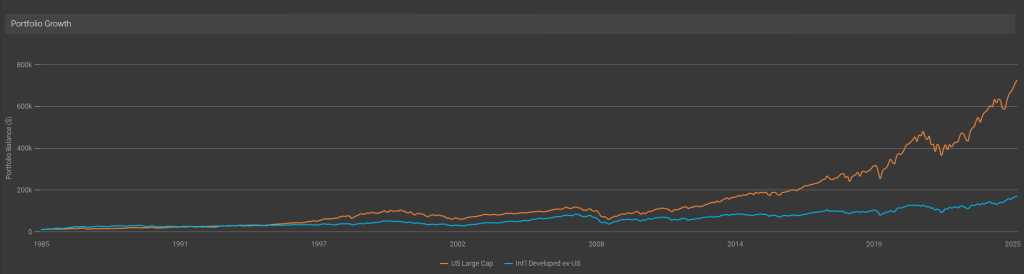
The class that would hold the most Canadian equity would be “Intl Developed ex-US Market”1, so let’s compare that to say the “US Large Cap” (which I take to be a good proxy for the S&P 500).

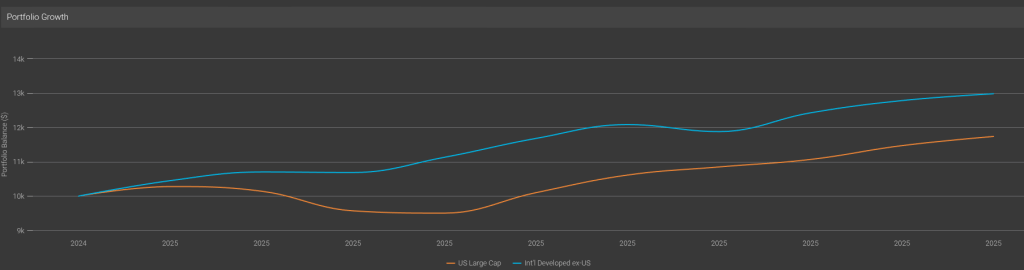
The good old S&P has left the rest of the developed world in the dust, it seems…Well, except for THIS year:

Anyway, the asset classes are good fun and all, but without a Canadian index to track, it’s not too useful to me. (And, inexplicably, nowhere could I find a definition of any of these in the tool, and an email to the support address remained unanswered at the time of publication). So let’s move on to something more interesting, namely the ticker backtesting!

Ticker Backtesting

As the name implies, this portion allows you to enter tickers, and there’s full and complete support for Canadian ETFs that I tried.

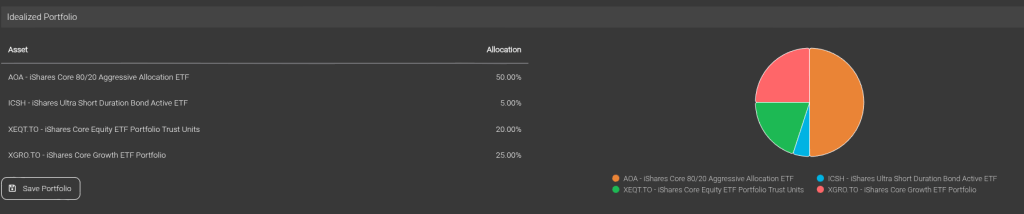
So of course I immediately tried to build my idealized portfolio, which is what my “What’s in my Retirement Portfolio” would look like without the non-registered assets2.

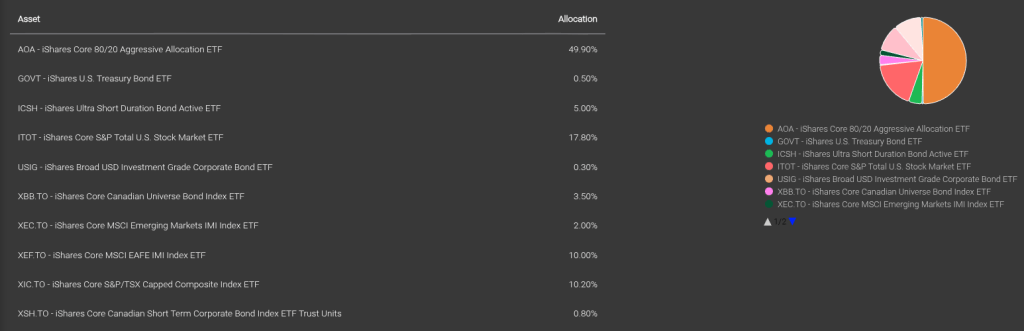
The problem? XEQT and XGRO (two of my ETF all-stars) haven’t been around all that long, and so I can’t backtest very far. No matter, by looking at the composition of XEQT and XGRO and doing some clever math, I can create the equivalent decomposed portfolio:

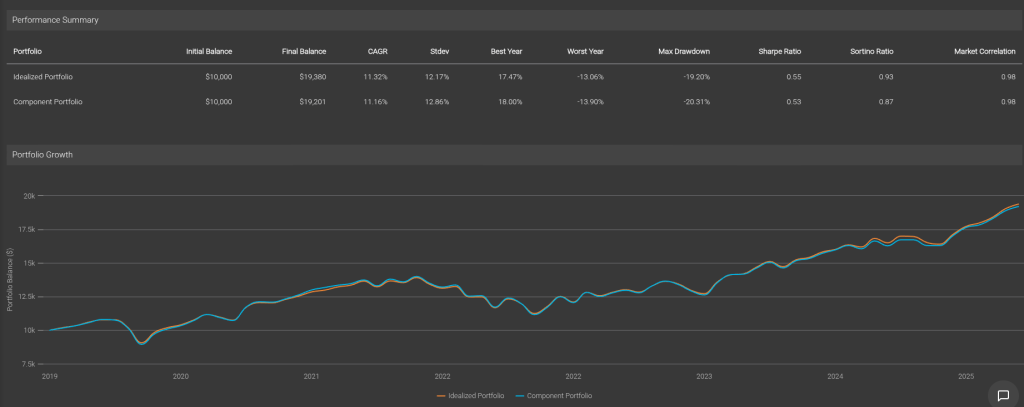
And I can prove that I got it right by backtesting the two against each other. Pretty good, eh?

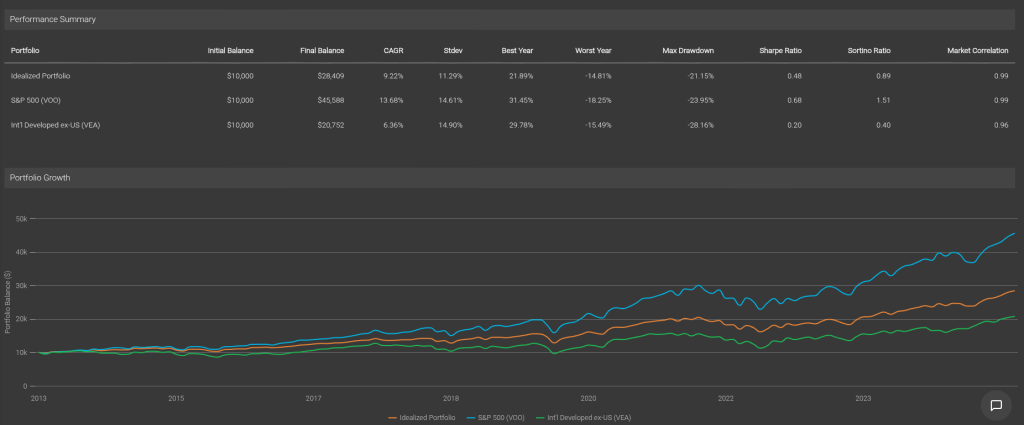
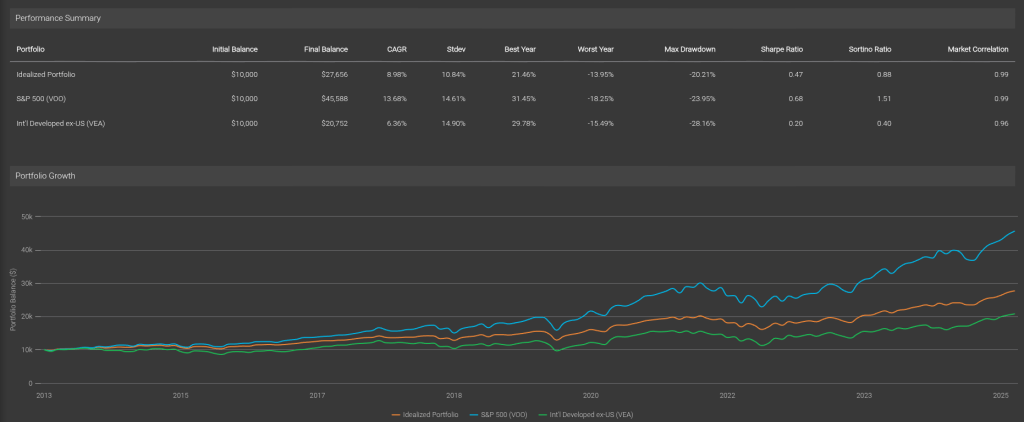
So with my decomposed portfolio at the ready, I can compare its performance long-term against (for example) just buying the S&P 500 index (VOO) or the International Developed ex-US index (VEA).

As expected, my portfolio has quite a bit poorer performance than the S&P, but better than the International ex-US. The bond/cash component smooths out the standard deviations (that’s “volatility”) so my worst years (although still a bit scary) are still a bit less than experience of owning 100% equity.

One more thing to look at — this backtesting assumes we don’t rebalance anything. That’s not correct, since that’s one of the benefits of holding ETFs like AOA, XGRO and XEQT — they automatically rebalance periodically. valueinvesting.io lets you choose monthly, quarterly, semiannually and annually. I know for a fact that AOA rebalances twice a year, so we will assume XGRO/XEQT do the same. This is what the result looks like:

This reduces the volatility and the return a bit, which if you stop and think about it, makes sense: equities consistently outperform bonds and cash over time so the rebalancing exercise makes sure the equities remain at an 80% contribution to the portfolio.

Conclusion

The backtesting portion of valueinvesting.io is a good tool to test various combinations of ETFs / stocks you may be interested in. There’s not very much documentation on the site, but it’s easy enough to use. The free account (which requires registration) is enough to get you that far.

  1. Did a bunch of tests and determined that VEA was the ETF that matched the performance of this index most closely. This ETF is about 11% Canadian Equity. ↩︎
  2. The non-registered assets are being sold off, little by little, to fund my retirement. This year, they have provided about 2/3 of my “salary” (RRIF minimum payments gave me the other 1/3), so I am –slowly– drifting toward the ideal portfolio. The AOA percentage in the ideal portfolio will get smaller over time as I transmogrify it as needed to XGRO using Norbert’s Gambit. ↩︎