(Quick aside: as a retiree, I did have to make sure this coming weekend was, in fact, a long weekend 🙂 )
What’s the deal with AOA?: updated
While many Canadians are familiar with all-in-one products that trade on the Canadian exchanges (XEQT/XGRO, VEQT/VGRO, TEQT/TGRO, ZEQT/ZGRO), there is also a USD product that I use quite heavily in my retirement portfolio. That ETF is AOA. In this updated post, I break down what’s inside it. TL/DR: lots of US Equity, lots of International Equity, a tiny slice of Canadian equity, and broad coverage of the US and international bond markets.
Rob Carrick is back in (digital) print
One of my favourite ex-Globe And Mail staffers was Rob Carrick, the keyboard behind such valuable assets as the ETF Buyer’s Guide. He retired last year, but it seems he’s back doing the same job in a different way. He’s now writing on Substack, and you can find his words of wisdom over here: https://substack.com/@robcarrick1.
PWL on Retirement: “Finding and Funding a Good Life”
Not a new publication, but new to me…It’s penned by Ben Felix, a certified Canadian financial rockstar. Looks like a good read over a cup of coffee. Finding and Funding a Good Life.
Since my investment strategy is to own the market via passive index investing, I know that some of my retirement savings are tied up in those famous seven tech stocks1. But that’s not what I’m talking about.
For a year or so I’ve been talking about my ETF All-Stars, but I’ve come to the realization that the list isn’t complete. I discovered that I could do better in terms of where I hold certain assets, I’ve now also realized that I need 7 total ETFs to achieve my investment objectives across non-registered, TFSA and RRIF accounts. These seven ETFs are 90% of my retirement portfolio. The other 10% are found in the non-registered account and are legacy investments. Over the next 5 years, these legacy investments will disappear altogether.
AOA is an 80% Equity / 20% bond ETF. It’s roughly 50% of my retirement savings, and it’s exclusively held in my RRIF accounts. I’ve invested in USD ETFs for quite a long time now, and this one holding locks up most of my USD funds. The problem with AOA is that it tilts too far into US Equities (50%) and has very little exposure to the Canadian stock market (about 2.67%). So I have to compensate elsewhere.
XGRO is an 80% Equity/ 20% bond ETF, about 15% of my retirement savings. It’s the Canadian sibling of AOA in every way. It holds 20% Canadian equity and 36% US equity, so it helps take down the US bias of AOA a bit. It’s held exclusively in my RRIF accounts.
XEQT: An all-in-one Canadian ETF
XEQT4 is from the same family as XGRO but doesn’t hold any bonds. It helps take down the bond percentage of my overall portfolio from 20% to 15%. Since equities tend to grow faster than equity/bond combinations, and since my TFSA is the last account to be touched in my retirement income planning, XEQT is held only in my TFSA accounts.
XIC: A low-cost Canadian Equity ETF
XIC5 holds only Canadian Equities and helps fix the lack of Canadian content in AOA. As a 100% equity ETF, it lives mostly in my TFSA. Historically, I also hold this in my non-registered accounts but this will be reduced as I dip into my non-registered funds to pay my bills.
ICSH: A USD money-market fund
Technically, ICSH is an ultra-short-term bond fund, but I treat it the same way as I would treat a HISA. Cash is 5% of my portfolio in retirement, and it’s mostly in ICSH since US Interest rates are much higher than Canadian ones at present. I’d switch this holding to ZMMK if the opposite was true. ICSH lives both in my RRIF and my non-registered accounts. It’s only in my non-registered accounts because my decumulation strategy (VPW) requires a “cash cushion” to smooth out my monthly salary.
XCB: A Canadian Corporate bond fund
The way the math works at present, I’m a little short in bonds, and so I have a bit of XCB sitting in the RRIF to keep my asset targets in line. XCB is a nice low-cost corporate bond fund; I chose corporate because AOA and XGRO give me plenty of exposure to government bonds.
ZMMK: A CAD money market fund
ZMMK is a small portion of the cash cushion which is mostly invested in ICSH. If Canadian interest rates exceed US rates, then my holdings here would grow accordingly.
My retirement portfolio is about 36% US equity, and the mag 7 make up about 10% of the US market, so say 4% of my retirement savings. ↩︎
I thought I was going to need XAW as well, but worked out a plan to eliminate it ↩︎
You could also consider ZGRO, TGRO, VGRO from BMO, TD, and Vanguard respectively. They are all pretty similar. ↩︎
You could also consider ZEQT, TEQT, VEQT. Tomato, Tomahto. ↩︎
VCN is another good choice; it’s pretty much the same thing. ↩︎
Summary: Although iShares(XEQT/XGRO) and Vanguard(VEQT/VGRO) get all the love, the all-in-ones from BMO and TD are actually the current winners in the “lowest all-in-one fee award”. Given how similar they are to their competitors, I see no reason not to park money there.
I’m a fan of all-in-one1 ETFs in my retirement portfolio. If you’re new to the world of all-in-ones, you might want to start here. There’s at least five competing families of products out there, courtesy of iShares (XEQT, XGRO, XBAL et al), TD (TEQT, TGRO, TBAL et al), Vanguard(VEQT, VGRO, VBAL et al) BMO(ZEQT, ZGRO, ZBAL et al) and GlobalX2 (HEQT, HGRO, HBAL et al). We’ve taken a look at some of them “under the hood”, so to speak, but didn’t really find super-significant differences.
One facet I haven’t looked at yet is the fees each of these companies charge. As I’ve shown elsewhere, small differences can add up if you have significant investments or are holding them for a significant time.
TD and BMO are the low fee winners at the moment, but the gap has narrowed significantly from earlier in the year. I like low fees, and so I’ve started to invest in these families.
Technically called “asset allocation” ETFs, which is good, since asset allocation is how I view my own portfolio. ↩︎
Formerly known as Horizons, which explains the stock tickers used here. ↩︎
Most of the time I use MER (Management Expense Ratio) to report on fees, but since a few of these companies have lowered their Management fees this year, and since MER is only calculated annually, the MER values only become relevant again on Jan 1. They are a few basis points higher than the management fee, but just a few. Most of the cost is buried in the management fee. ↩︎
In a previous post, I took a look at the major fund companies’ all-in-one-funds with a focus on what passive indices each of them folllowed with regards to Canadian equity, US equity, International equity, and bonds. That assessment found that iShares and BMO were very similar, but TD and Vanguard looked very different.
But do different indices really make a difference in terms of what each of these companies hold when it comes to equities? That’s what we’re trying to find out. Let’s take a look at each of the categories in turn.
Canadian Equity
Let’s take a look at the top Canadian equity holdings of TEQT, XEQT, ZEQT and VEQT1:
Stock
TEQT %
XEQT %
ZEQT%
VEQT%
RBC
1.65
1.73
1.62
1.80
Shopify
1.55
1.69
1.62
1.49
TD
1.12
1.16
1.10
1.16
Enbridge
0.84
0.88
0.85
0.92
Brookfield
0.82
0.82
0.78
0.81
BMO
0.74
0.77
0.72
0.77
Agnico
0.66
0.69
0.68
0.63
Scotiabank
0.64
0.67
0.63
0.68
CIBC
0.60
0.63
0.60
0.63
CP KC
0.57
0.58
0.57
0.62
# held
292
215
215
156
Top 10 %
9.19
9.62
9.17
9.51
Top Canadian Equity Holdings for TEQT, XEQT, ZEQT, VEQT per ETF factsheets, October 2025
VEQT has fewer holdings than the others, and this indicates slightly more concentration/slightly less diversification than the other funds. TEQT is at the top of the heap when it comes to the number of companies held, with XEQT and ZEQT looking pretty similar. My take here is that the differences between TEQT/XEQT/ZEQT/VEQT are pretty slight when it comes to Canadian equity. The Canadian equity indices these funds track may be different, but the differences are pretty minor, and might simply be attributable to tracking errors; how often and when these funds rebalance their holdings may explain the differences shown here.
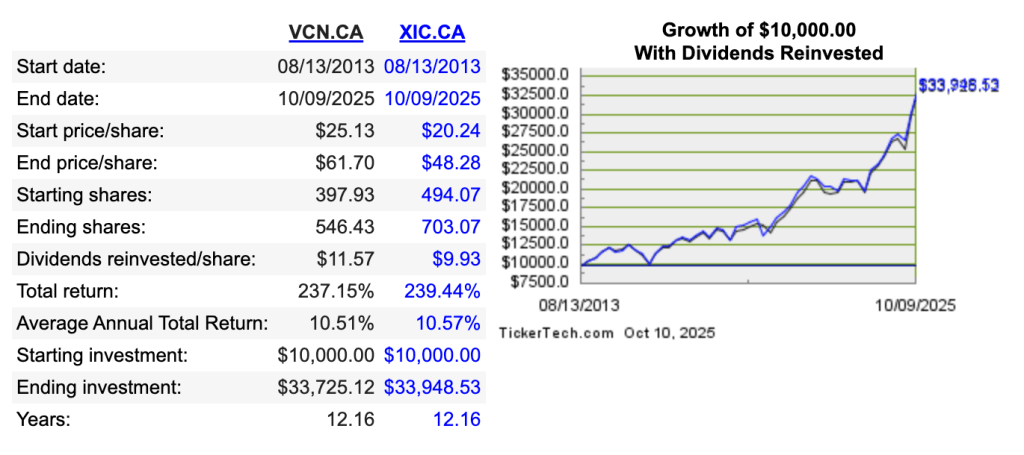
But just for fun, I looked at comparing VCN (which is underneath VEQT, and tracks the FTSE Canada all cap) to XIC (which is underneath XEQT, and tracks the S&P/TSX Capped Composite) and found this using https://www.dividendchannel.com/drip-returns-calculator/ (which is also listed in Tools I Use).
This indicates a tiny advantage to XIC aka the capped composite index, but there’s not a lot of daylight between these two returns!
On the Canadian Equity front, I declare the 4 funds EQUIVALENT!
US Equity
The US weighting is NOT the same for each of these funds, so making a one-to-one comparison is a bit tricky.
TEQT: 55% US
ZEQT: 50% US
XEQT, VEQT: 45% US
What I show in the table below is the percentage of the US portion held by the fund. So in other words if stock XYZ makes up 5% of the US holdings of TEQT and XEQT, it means that TEQT actually holds more of XYZ because 55 cents of every dollar of TEQT is invested in XYZ as compared to 45 cents for XEQT et al.
Stock
TEQT: TPU %
XEQT: XTOT %
ZEQT: ZSP/ZMID/ZSML%
VEQT: VUS%
NVIDIA
7.81
6.91
7.35
6.45
Microsoft
6.62
5.71
6.26
6.02
Apple
6.38
5.53
5.99
5.54
Amazon
3.73
3.24
3.45
3.49
Broadcom
2.75
2.38
2.51
2.23
Meta
2.74
2.33
2.51
2.56
Alphabet Cl A
2.43
2.07
2.26
1.97
Alphabet Cl C
2.13
1.67
1.82
1.59
Tesla
2.12
1.80
1.91
1.46
JP Morgan
1.46
1.24
1.36
1.29
Eli Lilly
1.25
1.00
1.09
1.00
Berkshire
1.15
1.33
1.47
1.43
# held
504
2494
1511
3524
Top 10 %
38.17
32.97
35.54
32.74
Top US Equity Holdings for TEQT, XEQT, ZEQT, VEQT per ETF factsheets, October 2025
What’s clear here is that TEQT is an outlier insofar as it only focuses on the largest US companies, with the other three funds including smaller companies. This also impacts how much money is found in the top 10 US holdings of TEQT, with 38% of holdings invested in names like NVIDIA, Microsoft, Apple et al.
This has proven beneficial of late since smaller US companies have not kept pace with the larger ones. Per spglobal.com, the 10 year performance as of Oct 13, 2025 of the three US market segments has been:
S&P SmallCap 600 = 7.65%
S&P MidCap 400 = 8.49%
S&P 500 = 12.75%
Meaning that any fund that holds smallcap and midcap US stocks has had their returns dragged down in the past 10 years.
So my conclusion for US Equities is that TEQT is the performance champion, but this comes with a less diversification than the alternatives: not only does TEQT focus on the highest-performing portion of the US equity market, it also puts more money overall into the US equity market. This has worked well for the last ten years, but it’s anybody’s guess as to whether this is a good idea for the future.
International Equity
The International2 weighting is NOT the same for each of these funds, so making a one-to-one comparison is a bit tricky.
TEQT: 20% International
VEQT: 25% International
ZEQT: 25% International
XEQT: 30% International
BMO gets the “lack of transparency” award from me for their complex structure. ZEQT holds ZEA which holds European stocks as well as IEFA, which is their USD fund holding the same things. It also holds ZEM which holds emerging markets stocks as well as EEM, which holds similar things in USD. Nowhere can you find a BMO/ZEQT consolidated view like what I’m showing below.
Like in the previous examples, what I show in the table below is the percentage of the International portion held by the fund.
Stock
TEQT: TPE %
XEQT: XEF/XEC %
ZEQT: ZEA/IEFA/ZEM/EEM%
VEQT: VIU/VEE%
Taiwan Semi
0
1.73
5.88
4.19
ASML
1.98
1.43
2.11
1.59
SAP
1.43
1.03
1.37
1.14
Nestle
1.30
0.93
1.24
0.96
Roche
1.24
0.87
1.12
0.95
Novartis
1.24
0.90
1.17
0.98
AstraZeneca
1.24
0.93
1.26
0.94
HSBC
1.15
0.83
1.22
1.02
Shell
1.11
0.80
1.09
0.87
Toyota
1.06
0.70
0.97
0.85
Siemens
1.02
0.77
1.08
0.82
Tencent
0
0.80
2.75
2.10
Samsung
0
0.37
2.03
1.16
Alibaba
0
0.40
1.87
1.59
# held
893
5626
3864
3524
Top 10 %
12.77
10.25
20.89
15.68
Top International Equity Holdings for TEQT, XEQT, ZEQT3, VEQT per ETF factsheets, October 2025
Here you see some pretty significant differences. BMO and Vanguard (especially BMO’s ZEQT) have a much heavier emphasis on “emerging” markets than XEQT does; TD’s TEQT has NO exposure to emerging markets at all.
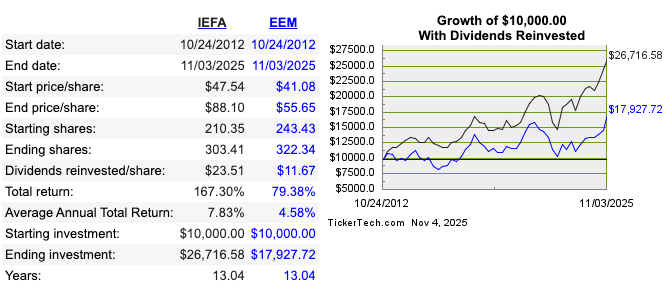
That’s an interesting strategic choice being made here. Let’s compare emerging market performance to mature international markets. We cand do that by looking at IEFA (mature markets) versus EEM (emerging markets)4:
Emerging markets have been a serious lag to global performance, so perhaps TD is on to something here. I played with this chart quite a bit and it’s only very lately (last 2 years or so) that emerging markets have outperformed the established ones. Long term trend? ZEQT certainly hopes so.
So on the international front, you have choices
TEQT only focuses on mature markets
XEQT allows some (not much) exposure to emerging markets
ZEQT and VEQT make much bigger bets on emerging markets
Which is the correct call? TEQT historically has made the right choice, but as the old adage goes “past performance does not guarantee future results” (or something like that).
I’m using the all-equity versions of these to make the comparison more apples-to-apples. VEQT has a larger Canadian percentage (30%) than the other 3 (25%), so I muliplied VEQT’s holdings by 25/30 to make the comparison meaningful. ↩︎
In this analysis, I’m not making a distinction between “mature” and “emerging” markets. Some of the funds do. In all cases, “International” means “no US, no Canada”. ↩︎
(New to asset allocation ETFs aka all-in-ones? Here’s a good place to start.)
Asset allocation ETFs can be purchased from any number of companies. In this article, we look at 4 of the biggest names:
TD, with TEQT, TGRO, TBAL et al
Blackrock/iShares with XEQT, XGRO, XBAL et al
BMO with ZEQT, ZGRO, ZBAL et al
Vanguard with VEQT, VGRO, VBAL et al
The blueprint for each of these ETFs are similar: pick Canadian, US, International and (where applicable1) bond indices, pick a target percentage allocation for each slice of the pie, and carry on…
I previously talked about the variations in percentage allocation (the size of the pie slices) between the major funds over here.
But what about the indices that each of the major fund families track? What’s in the pie? Are there significant differences? Here’s a summary of what I found:
Bloomberg Global Aggregate Canadian Float Adjusted Bond
So there is variation in the pie recipes (the underlying indices), but is it really of any significance? At a glance, I wonder how different the offerings from iShares and BMO actually are — the same index providers show up in each. Without looking at what stocks are actually found in each of these, here’s a quick take, simply based on the names of the indices:
Canadian Equity: All of these funds hold the broad Canadian market, over three different index providers23. iShares and BMO use a capped index, which, in theory, should limit exposure to the very largest Canadian businesses somewhat.
US Equity: Three different index providers seen here (Solactive, S&P and CRSP). TD only holds large US companies, the others hold smaller and midsized US companies. In the last ten years, this has been a winning strategy, but it’s not always been that way.
International Equity: Three different index providers: Solactive, MSCI, FTSE. TD excludes emerging markets (e.g. Brazil, Russia, Taiwan, China, India). The others don’t.
Bonds: Hard to tell just based on the names, but three of them use the same FTSE index. Vanguard uses a Bloomberg index. So I’ll say that it’s likely that Vanguard’s bond portfolio will look different from the other three.
In a future post, I’ll delve into what the main holdings of each of these funds are in each of these categories to see what differences emerge. And whether these differences actually matter!
This excludes 100% equity funds like XEQT, naturally ↩︎
The “composite” in “Capped Composite” means “all the stocks of the TSX”. ↩︎






 The Money Engineer