What’s in my retirement portfolio (March 2026)?

This is a monthly look at what’s in my retirement portfolio. The original post is here.

Portfolio Construction

The retirement portfolio is spread across a bunch of accounts:

  • 5 RRIF accounts
    • 3 for me (Questrade, Wealthsimple)
    • 2 for my spouse (Questrade)
  • 2 TFSA accounts (Questrade)
  • 4 non-registered accounts, (1 for me, 1 for my spouse, 2 joint, all at Questrade)

The view post-payday

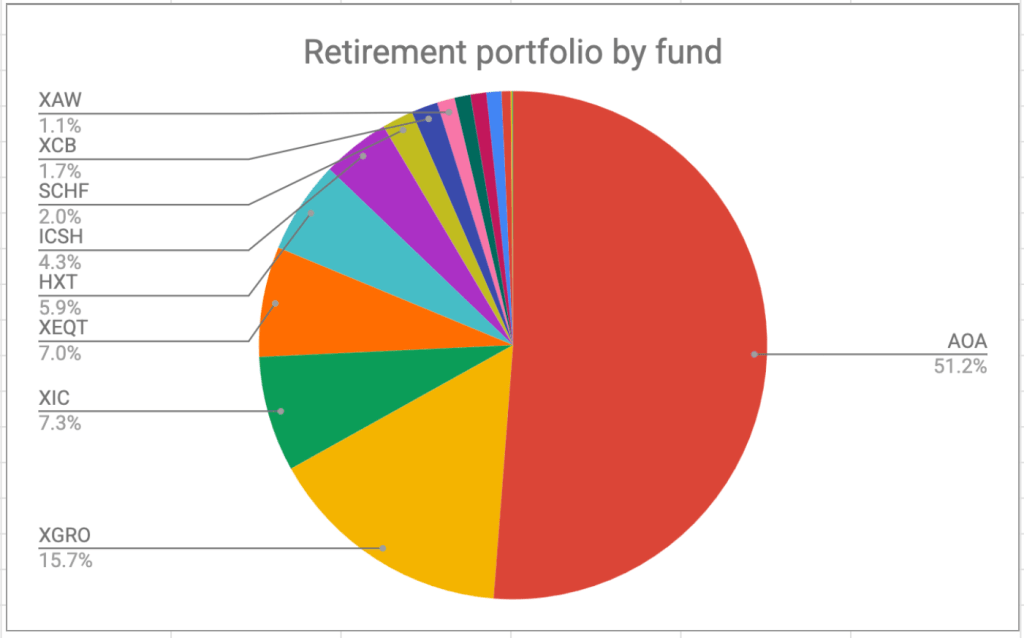
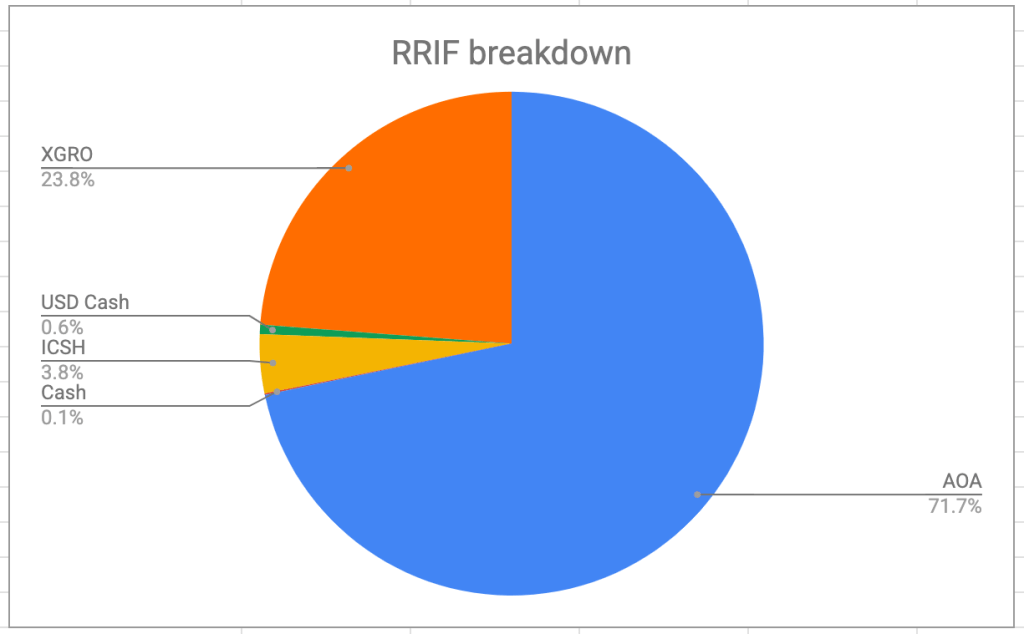
I pay myself monthly in retirement, so that’s a good trigger to update this post. On March 30, this is what it looks like:
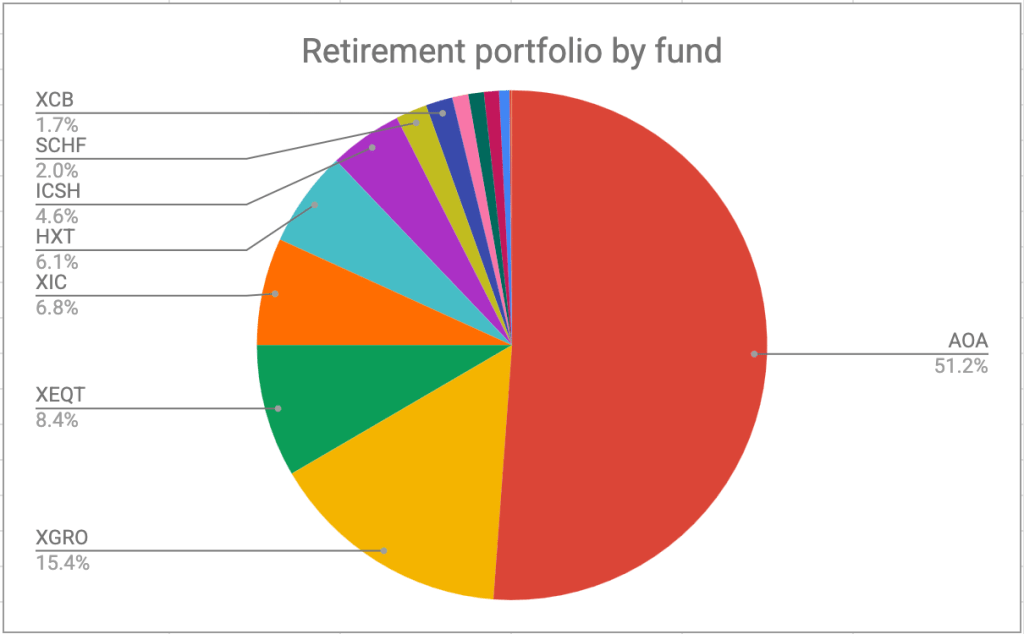
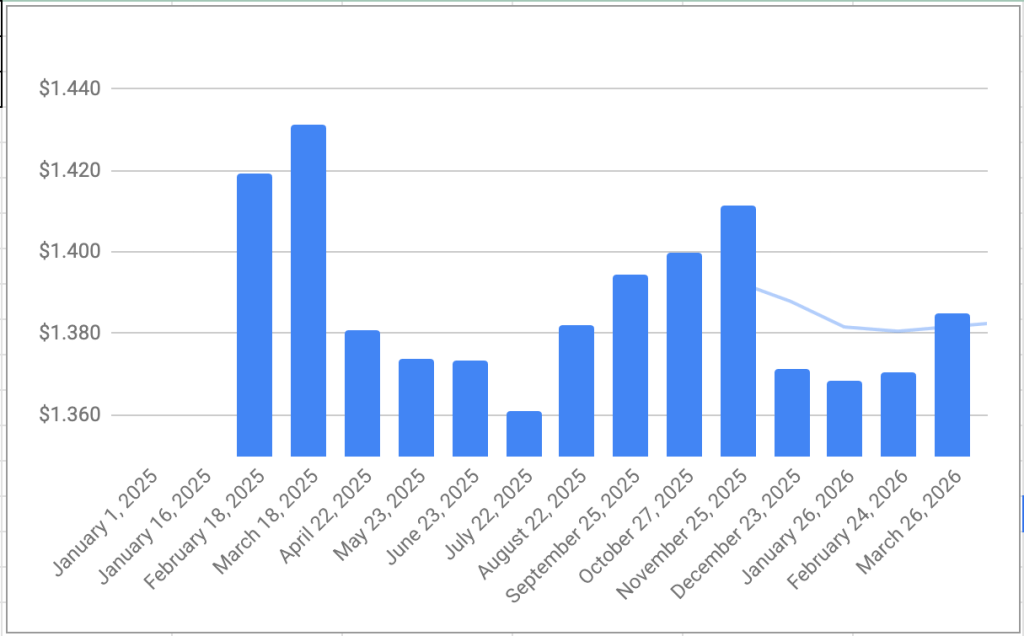
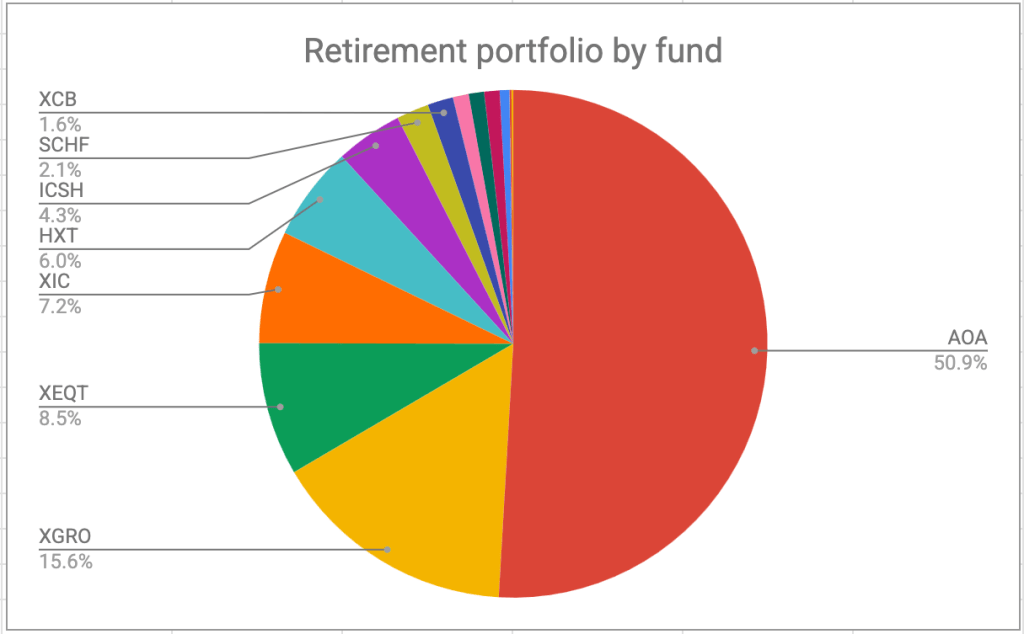
The portfolio is dominated by my ETF all-stars, (and if not an all-star, they are probably on the Magnificent Seven ETFs list). This split is before all the quarterly dividends have paid out. AOA, XGRO, XEQT, XIC all have a quarterly payment that collectively might skew the numbers a bit — I have all these investments on DRIP so I just buy more of the same. All that to say that there weren’t big changes month to month; my USD holdings got a bit of a boost this month thanks to a favourable exchange rate. (A lot of my retirement holdings are in USD, so the FX rates matter somewhat). Here’s what the USD has looked like in CAD since my retirement:
Plan for the next month

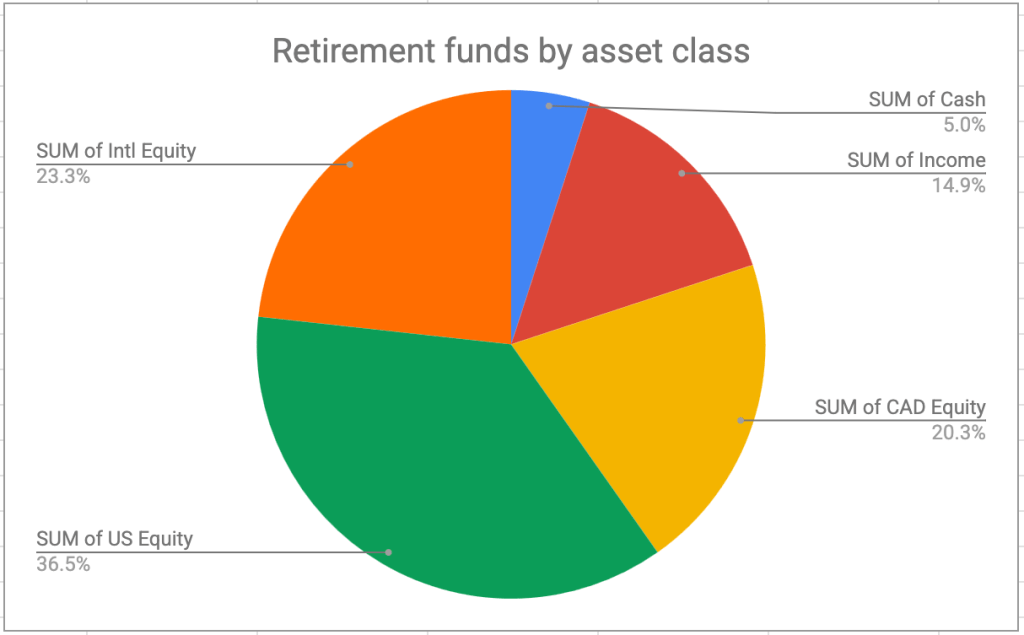
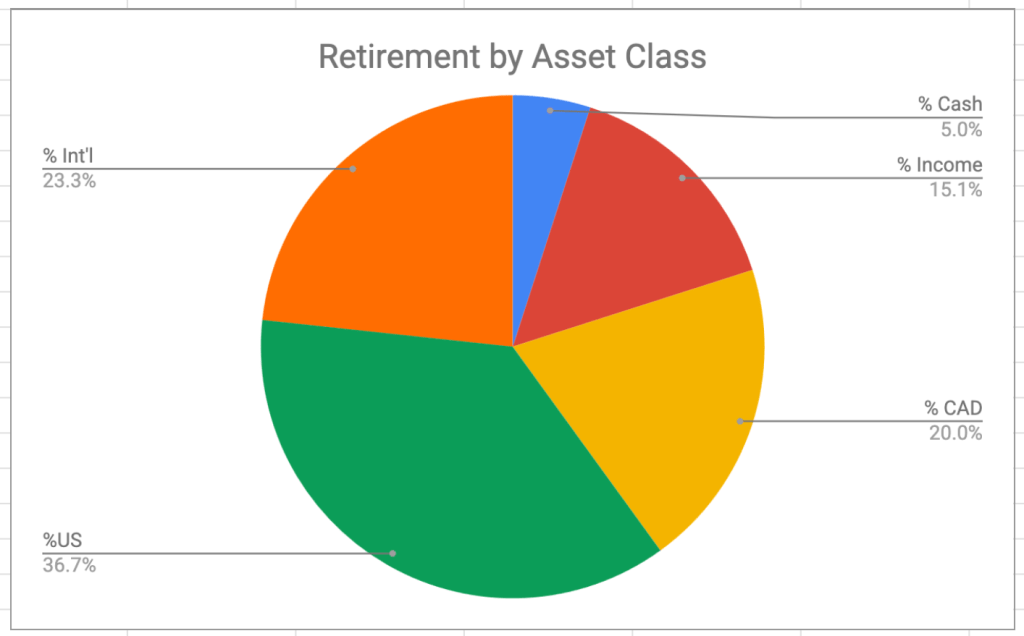
The asset-class split looks like this; you can read about my asset-allocation approach to investing over here.
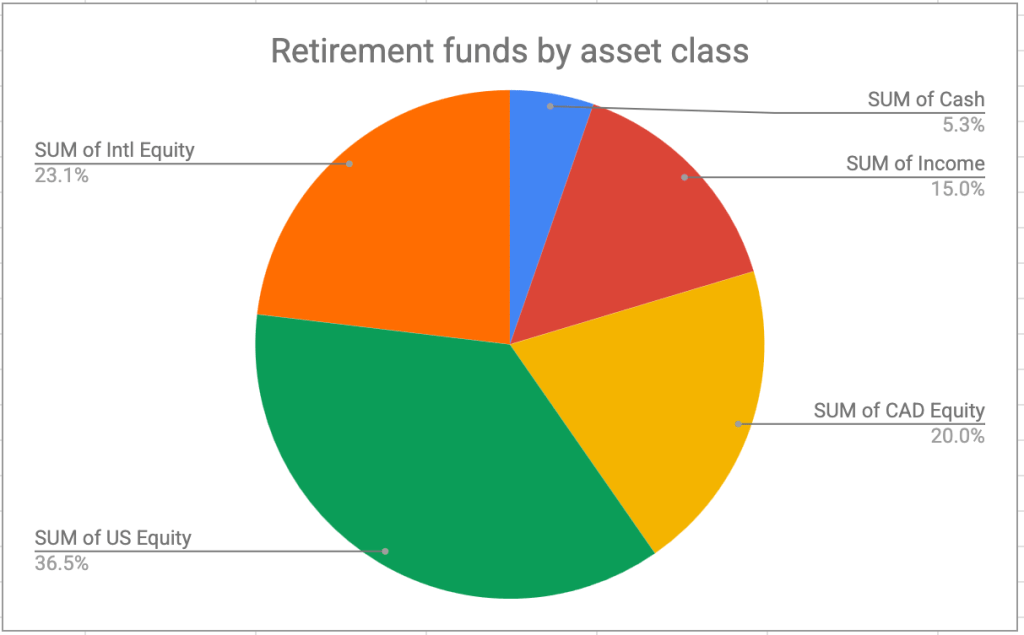
It’s looking pretty close to the targets I have, which are unchanged:

  • 5% cash or cash-like holdings like ICSH and ZMMK
  • 15% bonds/income (most are buried in XGRO and AOA, rest are in XCB)
  • 20% Canadian equity (mostly based on ETFs that mirror the S&P/TSX — HXT and XIC)
  • 36% US equity (dominated by ETFs that mirror the S&P 500)
  • 24% International equity (mostly, but not exclusively, developed markets)

The alignment with target is what drives my investment decisions; seeing the chart above tells me there’s no movements needed, which makes things simpler.

Since we’re just about in to the 2nd quarter of the year, it’s time for me to move some AOA into XGRO using Norbert’s Gambit1. The Gambit has worked out pretty well for me so far; I track my effective FX rate every time I do it, and it’s always less than relying on the instant (and relatively expensive) FX conversions offered by my broker2.

Overall

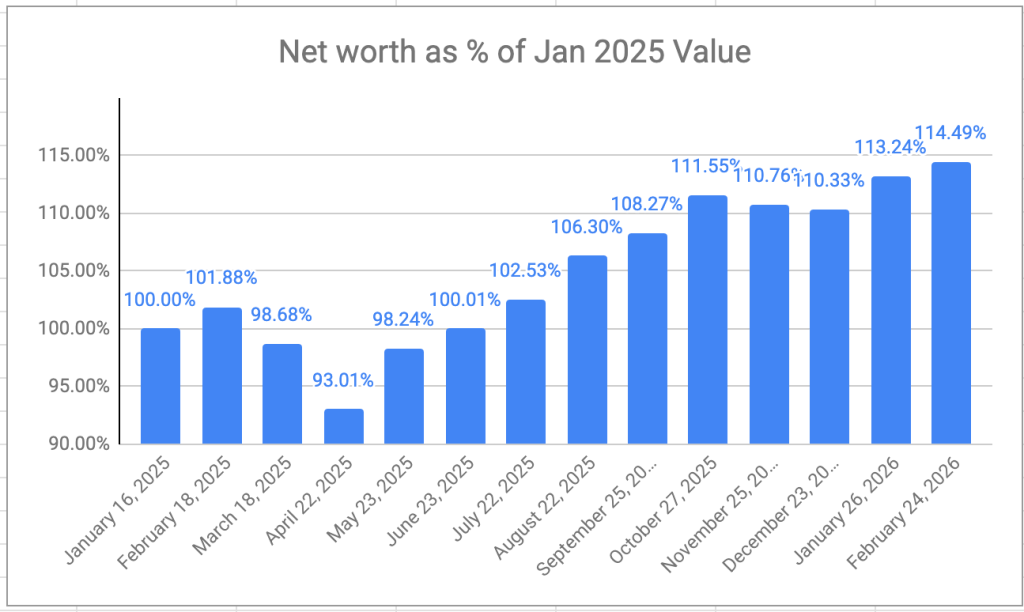
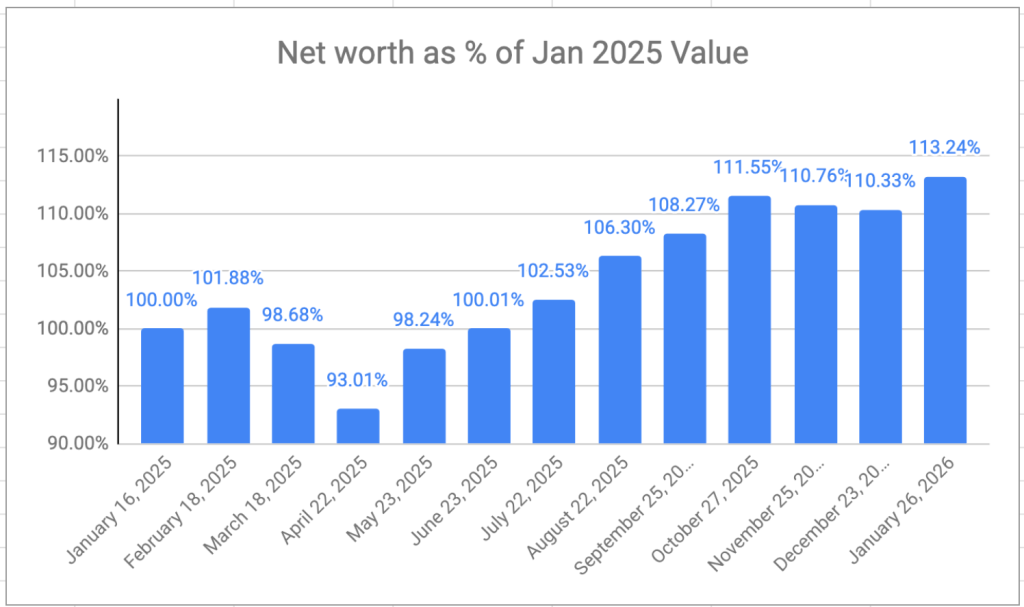
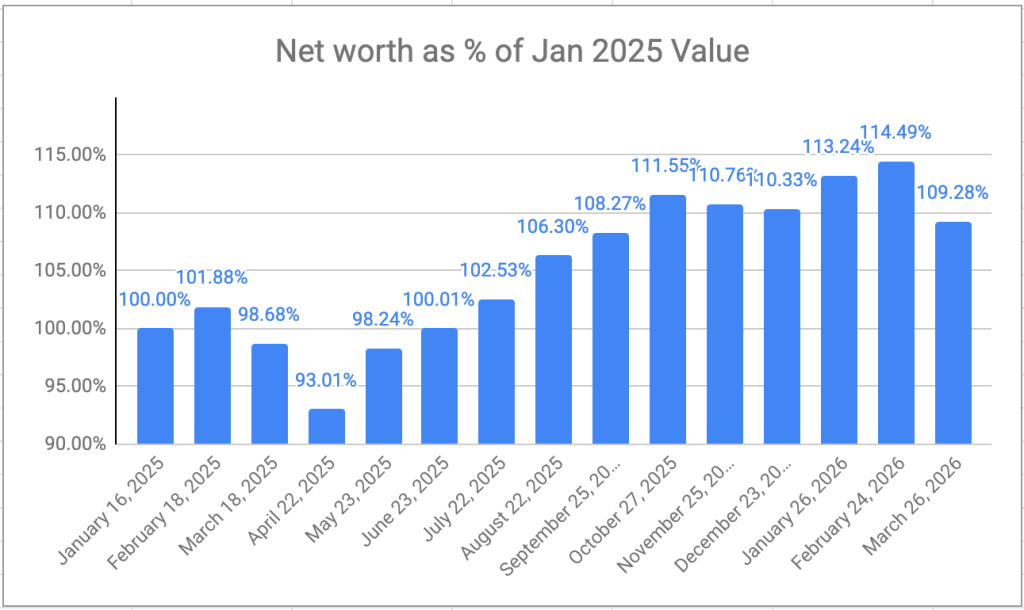
Part of using VPW3 as a strategy is the need to calculate your retirement net worth on a monthly basis. As you can see below, the most recent market gyrations have had a bit of an impact on the bottom line, taking me back to a value I haven’t seen since September last year:
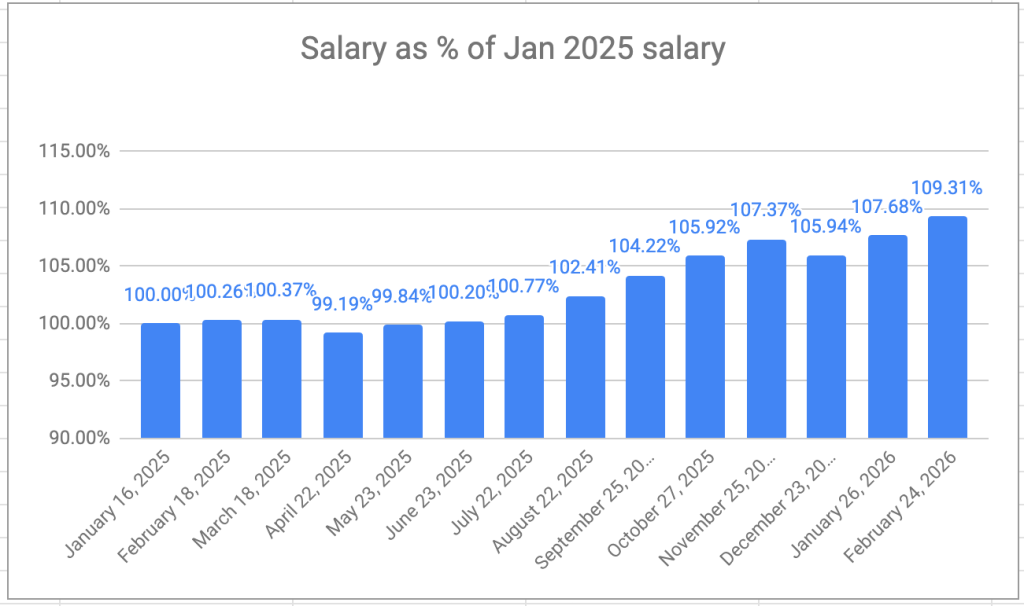
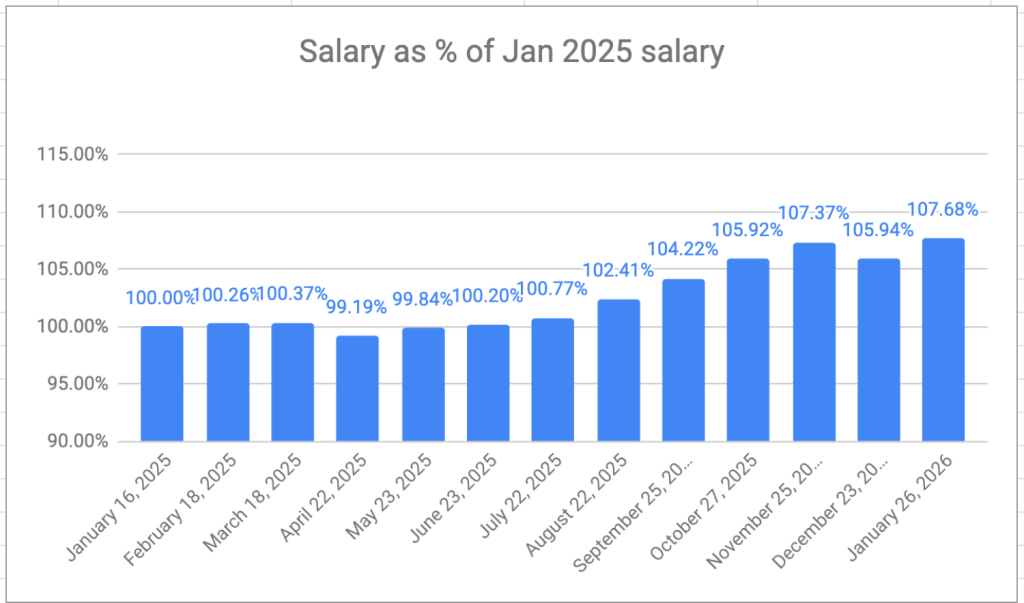
But my VPW-calculated salary, which has a built in shock absorber (aka cash cushion), continued its upward trend nonetheless:
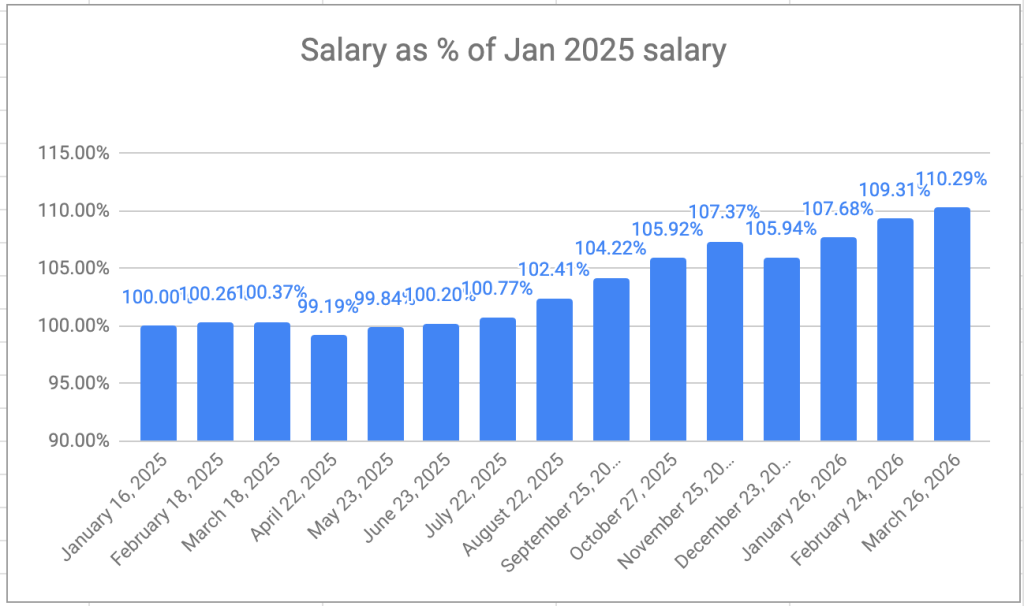
I’m expecting to take a pay cut at some point if the markets fail to recover, but pay cuts are an expected outcome of using VPW as a strategy. The “V” is for “variable”, after all. At this point, I’m still taking over 10% more than I did a year ago, so no matter how you slice it, things are more than on track.

  1. Of late, my need for spending in USD seems not so critical anymore. ↩︎
  2. Typically 1.5% of the amount converted. ↩︎
  3. Variable Percentage Withdrawal, my chosen decumulation strategy. ↩︎

What’s in my retirement portfolio (Feb 2026)?

This is a monthly look at what’s in my retirement portfolio. The original post is here.

Portfolio Construction

The retirement portfolio is spread across a bunch of accounts:

  • 5 RRIF accounts
    • 3 for me (Questrade, Wealthsimple)1
    • 2 for my spouse (Questrade)
  • 2 TFSA accounts (Questrade)
  • 4 non-registered accounts, (1 for me, 1 for my spouse, 2 joint, all at Questrade)

You will notice that QTrade is no longer in the mix. I successfully moved the last RRIF accounts during the month; I learned a lot in the process. QTrade was the victim in the chase for free money offered by Questrade last year; based on current offerings, I’d say that QTrade still has an edge in terms of user experience over Questrade. I’ll go into more detail in a future post.

The view post-payday

I pay myself monthly in retirement, so that’s a good trigger to update this post. On February 28, this is what it looks like:

The portfolio is dominated by my ETF all-stars, (and if not an all-star, they are probably on the Magnificent Seven ETFs list) but if you’ve been following along, you’ll see a few changes.

  • I dropped XAW since I realized I didn’t need it if I was smarter the ratios of holdings I already owned (XEQT/XIC/XCB). Less is more.
  • I sold XIC instead of HXT in my non-registered account this month to help pay the bills because I reasoned that eliminating its dividend payouts would be better from a tax perspective2.

Plan for the next month

The asset-class split looks like this; you can read about my asset-allocation approach to investing over here.

It’s looking pretty close to the targets I have, which are unchanged:

  • 5% cash or cash-like holdings like ICSH and ZMMK
  • 15% bonds3 (most are buried in XGRO and AOA, rest are in XCB)
  • 20% Canadian equity (mostly based on ETFs that mirror the S&P/TSX — HXT and XIC)
  • 36% US equity (dominated by ETFs that mirror the S&P 500)
  • 24% International equity (mostly, but not exclusively, developed markets)

I am mulling over making a small tweak to these percentages, increasing US equity exposure at the expense of International equity based on some calculations I’ve done4 but this is neither urgent nor will it be massively impactful to the overall picture.

Overall

There is a bit of an anomaly this month that I should mention. A number of readers have questioned my wisdom of contributing monthly to a TFSA in retirement. From a tax-free growth perspective, it would be far better to make the contribution at the beginning of the year. And many studies have shown that lump sum investing provides better returns than spacing them out. And so, I have taken their advice5 and made all my TFSA contributions for the year this month. And since my TFSA is part of my net worth, there’s a bump being caused by that contribution.

And so, net worth overall is up month over month, a two month winning streak.

My VPW-calculated salary also continues its upward trend.

  1. One spousal, one individual. One at Wealthsimple because (a) I like their user experience and may consider them as my primary broker in the future and (b) they offered me free money and a laptop to move some fees their way. I can be bought. ↩︎
  2. HXT does not pay dividends and instead uses swap contracts to convert them into capital gains, which receive better tax treatment for me ↩︎
  3. Referred to as “Income” on the chart above ↩︎
  4. I’ll share those in a future post ↩︎
  5. With thanks to Steven and Sylvain ↩︎

The magnificent seven ETFs

Since my investment strategy is to own the market via passive index investing, I know that some of my retirement savings are tied up in those famous seven tech stocks1. But that’s not what I’m talking about.

For a year or so I’ve been talking about my ETF All-Stars, but I’ve come to the realization that the list isn’t complete. I discovered that I could do better in terms of where I hold certain assets, I’ve now also realized that I need 7 total ETFs to achieve my investment objectives across non-registered, TFSA and RRIF accounts. These seven ETFs are 90% of my retirement portfolio. The other 10% are found in the non-registered account and are legacy investments. Over the next 5 years, these legacy investments will disappear altogether.

Here’s how the seven2 break down:

AOA: An all-in-one USD ETF

AOA is an 80% Equity / 20% bond ETF. It’s roughly 50% of my retirement savings, and it’s exclusively held in my RRIF accounts. I’ve invested in USD ETFs for quite a long time now, and this one holding locks up most of my USD funds. The problem with AOA is that it tilts too far into US Equities (50%) and has very little exposure to the Canadian stock market (about 2.67%). So I have to compensate elsewhere.

XGRO: An all-in-one Canadian ETF3

XGRO is an 80% Equity/ 20% bond ETF, about 15% of my retirement savings. It’s the Canadian sibling of AOA in every way. It holds 20% Canadian equity and 36% US equity, so it helps take down the US bias of AOA a bit. It’s held exclusively in my RRIF accounts.

XEQT: An all-in-one Canadian ETF

XEQT4 is from the same family as XGRO but doesn’t hold any bonds. It helps take down the bond percentage of my overall portfolio from 20% to 15%. Since equities tend to grow faster than equity/bond combinations, and since my TFSA is the last account to be touched in my retirement income planning, XEQT is held only in my TFSA accounts.

XIC: A low-cost Canadian Equity ETF

XIC5 holds only Canadian Equities and helps fix the lack of Canadian content in AOA. As a 100% equity ETF, it lives mostly in my TFSA. Historically, I also hold this in my non-registered accounts but this will be reduced as I dip into my non-registered funds to pay my bills.

ICSH: A USD money-market fund

Technically, ICSH is an ultra-short-term bond fund, but I treat it the same way as I would treat a HISA. Cash is 5% of my portfolio in retirement, and it’s mostly in ICSH since US Interest rates are much higher than Canadian ones at present. I’d switch this holding to ZMMK if the opposite was true. ICSH lives both in my RRIF and my non-registered accounts. It’s only in my non-registered accounts because my decumulation strategy (VPW) requires a “cash cushion” to smooth out my monthly salary.

XCB: A Canadian Corporate bond fund

The way the math works at present, I’m a little short in bonds, and so I have a bit of XCB sitting in the RRIF to keep my asset targets in line. XCB is a nice low-cost corporate bond fund; I chose corporate because AOA and XGRO give me plenty of exposure to government bonds.

ZMMK: A CAD money market fund

ZMMK is a small portion of the cash cushion which is mostly invested in ICSH. If Canadian interest rates exceed US rates, then my holdings here would grow accordingly.

  1. My retirement portfolio is about 36% US equity, and the mag 7 make up about 10% of the US market, so say 4% of my retirement savings. ↩︎
  2. I thought I was going to need XAW as well, but worked out a plan to eliminate it ↩︎
  3. You could also consider ZGRO, TGRO, VGRO from BMO, TD, and Vanguard respectively. They are all pretty similar. ↩︎
  4. You could also consider ZEQT, TEQT, VEQT. Tomato, Tomahto. ↩︎
  5. VCN is another good choice; it’s pretty much the same thing. ↩︎

What’s in my retirement portfolio (Jan 2026)?

This is a monthly look at what’s in my retirement portfolio. The original post is here.

Portfolio Construction

The retirement portfolio is spread across a bunch of accounts:

  • 6 RRIF accounts
    • 3 for me (Questrade, QTrade, Wealthsimple)
    • 3 for my spouse (Questrade, QTrade)
  • 2 TFSA accounts (Questrade)
  • 4 non-registered accounts, (1 for me, 1 for my spouse, 2 joint, all at Questrade)

The view post-payday

I pay myself monthly in retirement, so that’s a good trigger to update this post. On January 26, this is what it looks like:

The portfolio is dominated by my ETF all-stars, but if you’ve been following along, you’ll see a few changes.

  • As mentioned in a previous post, I did some shifting around and you now see XAW and XIC increasing their contribution to the portfolio at the expense of XGRO.
  • I also tidied up some extra funds that aren’t needed — VCN was replaced with XIC1, and I turfed some small holdings.
  • I sold more HXT than I needed to for my monthly paycheque, and when I discovered the mistake2, I just bought XIC instead.
  • And, I did my quarterly Norbert’s Gambit to shift some AOA to XGRO. And again, I came out ahead!

Plan for the next month

The asset-class split looks like this; you can read about my asset-allocation approach to investing over here.

It’s looking pretty close to the targets I have, which are unchanged:

  • 5% cash or cash-like holdings like ICSH and ZMMK
  • 15% bonds (most are buried in XGRO and AOA, some are in XCB)
  • 20% Canadian equity (mostly based on ETFs that mirror the S&P/TSX)
  • 36% US equity (dominated by ETFs that mirror the S&P 500)
  • 24% International equity (mostly, but not exclusively, developed markets)

Overall

Net worth overall is up month over month, reversing a 2 month losing streak and hitting a new all-time-high:

My VPW-calculated salary resumed its upward trend, also hitting an all-time high.

My QTrade RRIFs should move perhaps this week, but I’m no longer confident about that. More on that once resolved.

  1. Which, in my mind, are equivalent. This post goes in lots more detail. ↩︎
  2. I had to do some quick manual calculations because I had already updated my auto-calculating spreadsheet to reflect fewer RRIF accounts. My RRIF transfers are 2 months in progress and counting. I guess trying to move a RRIF near the end of the year was a bad idea. ↩︎

RRIF, TFSA, non-Registered…what do you do with each?

My retirement fund is divided amongst a bunch of different accounts: RRIFs, TFSAs, non-registered. And although I present them as a monolith in my monthly updates (latest one here), I don’t treat them the same way and they have rather different things inside them.

I don’t claim to have a fully optimized portfolio; a thoughtful reader was asking me questions about tax implications of my current holdings, and I admittedly haven’t given a ton of thought to that. But I will in a future post 🙂 .

So, in other words, you’re getting my current thinking for what I hold where. It may not be ideal. But at least you see why things are the way they are.

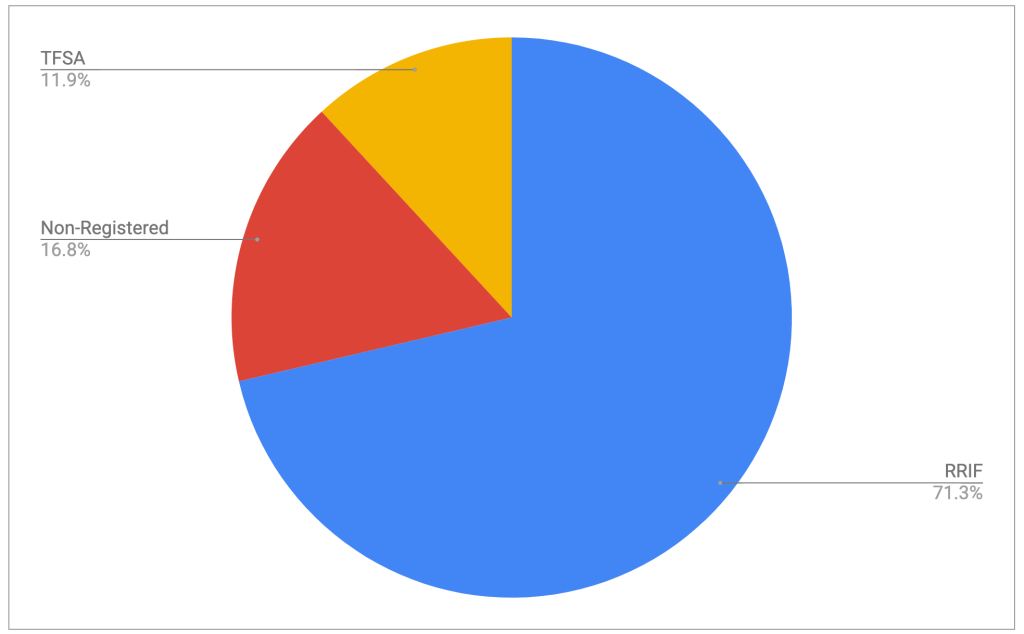
Below you can see how my retirement funds are divided amongst my various investment vehicles. This one is accurate as of January 8, 2026, and is greatly facilitated by tracking my stuff in Google Sheets. There’s a basic template of what I use over here1.

Retirement portfolio, divided by account type, January 2026

So that’s where it’s at. How do I treat the three main segments of the pie?

RRIF

So the RRIF is clearly the largest piece of the retirement pie and will be around for some time, possibly for the rest of my life. At this point in time, I’m only taking RRIF minimum payments which are recalculated every year and are based on my age and the value of my RRIF on December 31 of the previous year.

I am taking RRIF minimum primarily because I want to avoid the hassle of spousal RRSP/RRIF attribution that I talk about here. RRIF minimum is quite a bit less than the expected return of this account given the holdings therein, mostly AOA and XGRO:

I periodically (once a quarter) shift funds from AOA to XGRO using Norbert’s Gambit2. How much? Well, at the beginning of the year, I see how much of my RRIF is in USD. I then multiply that by my RRIF age factor3, divide by four, and presto, I have a quarterly amount I should move.

All of my many RRIF accounts4 have XGRO, and on the day I make my payday calculations, I have a spreadsheet that calculates how many shares of XGRO I need to sell in each account given the current price of XGRO and the amount of CAD happens to be kicking around in a given account. In very rare circumstances, I might (as well/instead) sell AOA if I had a need for US cash5.

The small contribution of ICSH here is because I have a 5% “cash” asset allocation in my portfolio, and I needed someplace to keep this monthly income. RRIF seems as good a place as any, especially since all those monthly dividends are completely tax-free as a result.

In the coming years, the RRIF will take on more and more of my monthly spending needs. Once the attribution time period has lapsed, I’ll probably take more than RRIF minimum from here in an effort to reduce taxes for older me — once I start collecting CPP/OAS as well as RRIF payments, I could find myself in a taxation world of hurt. Making my RRIF smaller will help, but there is no free lunch. You either pay taxes while you’re alive, or your estate will pay them when you’re not.

Non-Registered Accounts

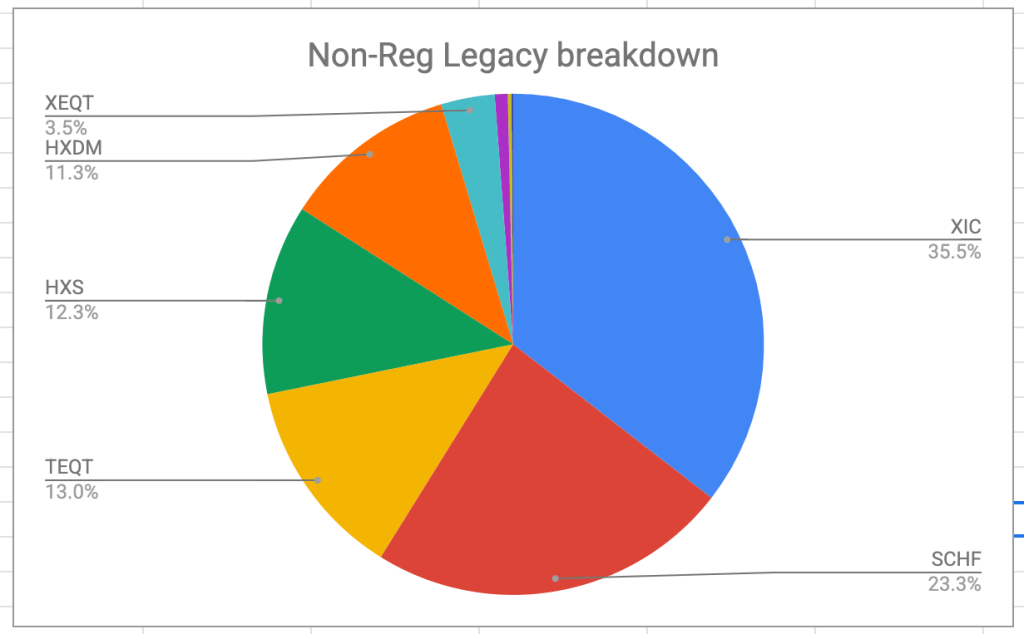
I really have two kinds of non-registered accounts in my retirement calculations, and they have very distinct usages. Let’s see the difference:

The “legacy” non-registered accounts are long-standing accounts that have grown over the years of accumulation. They are held in my name and my spouse’s name and taxed accordingly. These accounts, specifically the one in my name, account for probably 2/3 of my current income. Every time I withdraw from these accounts, I have to account for capital gains, which is fine, since the taxation treatment of capital gains is generous. You’ll also notice that this account is 100% equity. And as previously noted, the dividends thrown off these investments is not particularly noteworthy (not zero, but nothing a dividend-focused investor would get excited about). That’s why you see funds like HXDM and HXS here, to explicitly avoid dividends. This portion of my non-registered funds is targeted to eventually go to zero in the next few years, probably before I start collecting CPP. That’s a tax avoidance strategy, no idea if it will work out in my favour.

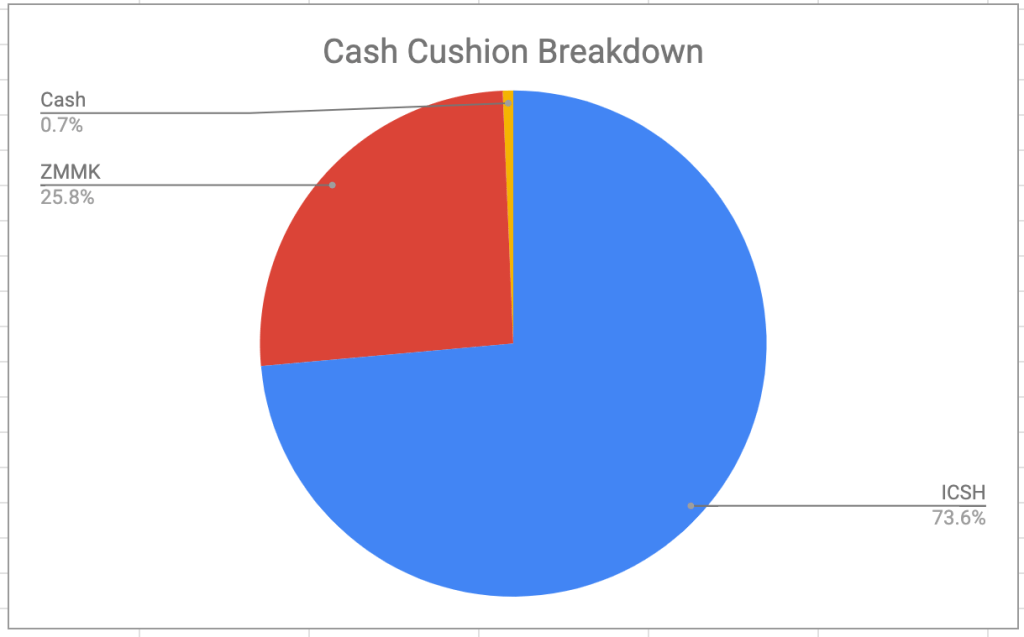
The “cash cushion” non-registered holdings are 100% in ultra-short term bond funds, which to my way of thinking, is equivalent to cash. This account exists because I use VPW as a decumulation strategy, and the cash cushion helps smooth out my monthly salary. Sometimes I add to the cash cushion (directly from my other non-registered account) and sometimes I pay myself from the cash cushion. You can read all about how it works at The Mechanics of Getting Paid in Retirement. Here I keep a bit of uninvested cash floating around in an effort to reduce the number of buys/sells I have to do here. The capital gains are quite minimal in these funds since both ICSH and ZMMK stay close to $50/share6 but it’s possible to make minor gains/losses7 depending on the exchange rate and day of month I make the purchase/sale.

TFSA

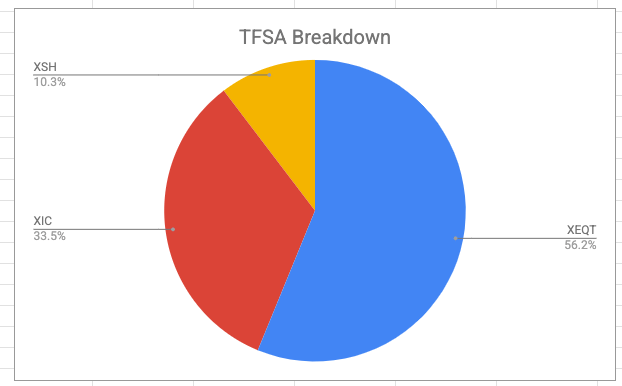
The TFSA, per the plan prepared for me by my fee-based advisor, (part of the steps I took to figure out that I had enough to retire) is the last account to decumulate. I continue to contribute to my TFSA monthly, like I have ever since TFSAs were a thing. That would be an “expense” I could cut if needed, I suppose. It tilts heavily towards equities8:

Besides XEQT, you currently see XSH, a bond fund9. This exists in order to keep my target asset allocations in line, and because I don’t really want the monthly distributions landing in a taxable account. Perhaps that holding would be better in my RRIF? There’s also XIC here, which is a Canadian equity fund, necessary to offset the heavy US equity contribution made by AOA.

  1. Over the holidays I’ve started on a new template that makes heavy use of pivot tables, which I do like quite a bit. ↩︎
  2. You can track my progress over at Tracking Norbert’s Gambit Costs with Questrade ↩︎
  3. Per https://www.canada.ca/en/revenue-agency/services/tax/businesses/topics/completing-slips-summaries/t4rsp-t4rif-information-returns/payments/chart-prescribed-factors.html, it’s “1 divided by (90 minus my age)” until I turn 70. ↩︎
  4. Hopefully in a week or two it will be down to five. ↩︎
  5. I do have a USD bank account (via CIBC) and a US credit card (ditto) to avoid FX charges, but my shiny new Rogers Red card also provides sufficient cashback on USD transactions to wipe out the extortionate FX rates charged by credit card companies. ↩︎
  6. Reverts to around $50 on its ex-dividend date, late in the calendar month. Except January, where ICSH doesn’t distribute at all, instead distributing twice in December. ↩︎
  7. Losses are unlikely because I trade frequently enough to fall under superficial loss rules. Best explanation of how this works at https://www.adjustedcostbase.ca/blog/what-is-the-superficial-loss-rule/ ↩︎
  8. Longer timeframe = higher risk acceptable = more equities ↩︎
  9. Here is a bit of problem. XSH is a short term bond fund; by rights, this should be a long term bond fund since the timeline of the investment is longer. Sigh. I picked this one because (a) it had corporate bonds and (b) it had a very low MER. ↩︎