What are the best credit cards?

The best credit cards for me are not necessarily the best cards for you. I don’t find I’ve changed my spending habits much in retirement, but being retired has meant I can spend a bit more time trying to optimize my credit card holdings to maximize benefits to me. One thing that I value above all else is cold, hard, cash. I don’t like “points” cards because understanding what kind of ROI I’m getting is nearly impossible, and always subject to the whims of a points to dollar conversion rate that can be changed at any time. I’m now holding three different credit cards, all of whom pay cash back, and all of them have their place in my spending universe.

Primary Card: Rogers Red World Elite Mastercard

Read about it here. As a Rogers customer1, this card is really the best possible card for my needs:

  • No fees
  • 2% cash back on everything, paid as a reward credit that you then immediately apply to subsequent card purchases; this reward credit is multiplied by 1.5 if you apply it to a subsequent card purchase for a Rogers service.
  • 3% cash back on USD purchases, which erases the 1.5% FX fee charged, and then some
  • Travel insurance, purchase insurance, etc etc
  • Free supplementary cards

The problem with this card is that its credit limit is a bit low; I even asked for an increase and was denied2.

The other problem with this card is that it’s not tied to my normal banking, so I have to pay it manually3. And it only offers a login for the primary card holder, which isn’t ideal.

Secondary Card: CIBC Costco Mastercard

Read about that one here. This one is actually a conversion from another CIBC card I had. Converting a card from one kind to another means you don’t lose your credit limit, which was the main appeal here. I am a Costco member, so this is a good second choice for my needs:

  • no fees
  • 1% cash back on everything except 2% back on gas and Costco.ca, and 3% back on Costco gas4 and restaurants5
  • Cashback paid annually in the form of a Costco gift certificate
  • Travel insurance, purchase insurance etc etc
  • Free supplementary cards

The travel card: Wealthsimple Visa

I’ve been on the waitlist (like many people) for quite a few months for this card now. I finally got my card when I called their support line to query about why a transaction on their prepaid Mastercard6 failed to complete. (Turns out there’s a daily limit on that card that can’t be modified). Anyway, the helpful agent offered to put in a good word for me and a few days later, I was able to successfully apply for the card and immediately download it to my phone7.

The Wealthsimple Visa’s features are a lot like the others:

  • no fee (if you have enough assets with Wealthsimple)
  • 2% cash back on everything, paid into your account every month
  • travel insurance, purchase insurance, etc etc
  • and…most importantly for me, NO foreign exchange fees for any currency

With no foreign exchange fees, Wealthsimple’s Visa becomes the go-to card anytime I’m travelling to a non-US destination. It also becomes my primary card in the event that I cut ties with Rogers, since the only thing the Rogers card does better than the Wealthsimple card is paying for Rogers services.

The Wealthsimple card had a better credit limit than the Rogers card right out of the gate (I guess it helps that I had hard assets with them) but inexplicably does not have the concept of a secondary card, so my spouse is currently locked out of that benefit.

The card that got cut: the CIBC Aventura USD Gold Visa

This was a card I had for a few years when US travel was a more frequent (desirable?) option. It’s not a bad card, especially if you frequently transact in USD, but with two other cards that offered “good enough” coverage on USD purchases, I felt it was no longer needed. And (I forgot this) when I canceled my almost-never-used CIBC USD checking8 account, I lost the “no-fee” aspect of this card. At a cost of zero I might have been convinced to hang on to it “just in case”, but with a $35 annual fee (USD) it was no longer required. An hour long wait on hold with CIBC telephone banking was all it took9.

What card is used when?

  • For foreign currency transactions, Wealthsimple Visa card is best. Rogers card also a good option if USD.
  • For Costco gas and restaurants, Costco card is best.
  • Anything else, Rogers
  1. Internet, television, home phone, if you’re curious. 2 year contract which I’ll probably break at the earliest opportunity 😉 ↩︎
  2. Admittedly, this hurt my feelings a bit. ↩︎
  3. I could set up a PAD, but I trust Rogers about as much as they trust me, it seems. ↩︎
  4. There’s no advantage to actually shopping at a Costco store with this card, which seems weird. My weekly Costco grocery run is paid for with my Rogers Mastercard, since I get 2x the cash back <shrug>. What’s more, the Costco I usually frequent doesn’t have a gas station, and I’m not really willing to make a special trip to go get it — my CAA/Shell combination is about as good. ↩︎
  5. These 2% and 3% rewards have annual caps, but I got bored trying to memorize them ↩︎
  6. Part of Wealthsimple’s chequing account, a good product, in my view ↩︎
  7. Great timing too, since I was in a foreign country at the time. ↩︎
  8. I use American spelling here because (a) that’s how CIBC spells it and (b) it really is a US-domiciled account ↩︎
  9. Writing that sentence has confirmed for me how low my standards for customer service have become. ↩︎

What’s in my retirement portfolio (March 2026)?

This is a monthly look at what’s in my retirement portfolio. The original post is here.

Portfolio Construction

The retirement portfolio is spread across a bunch of accounts:

  • 5 RRIF accounts
    • 3 for me (Questrade, Wealthsimple)
    • 2 for my spouse (Questrade)
  • 2 TFSA accounts (Questrade)
  • 4 non-registered accounts, (1 for me, 1 for my spouse, 2 joint, all at Questrade)

The view post-payday

I pay myself monthly in retirement, so that’s a good trigger to update this post. On March 30, this is what it looks like:

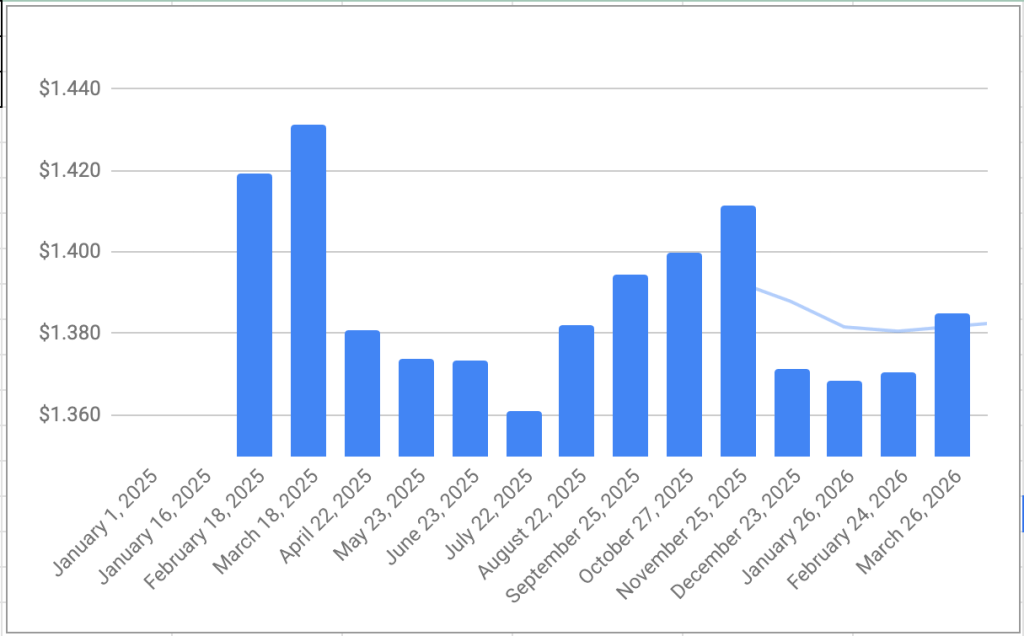
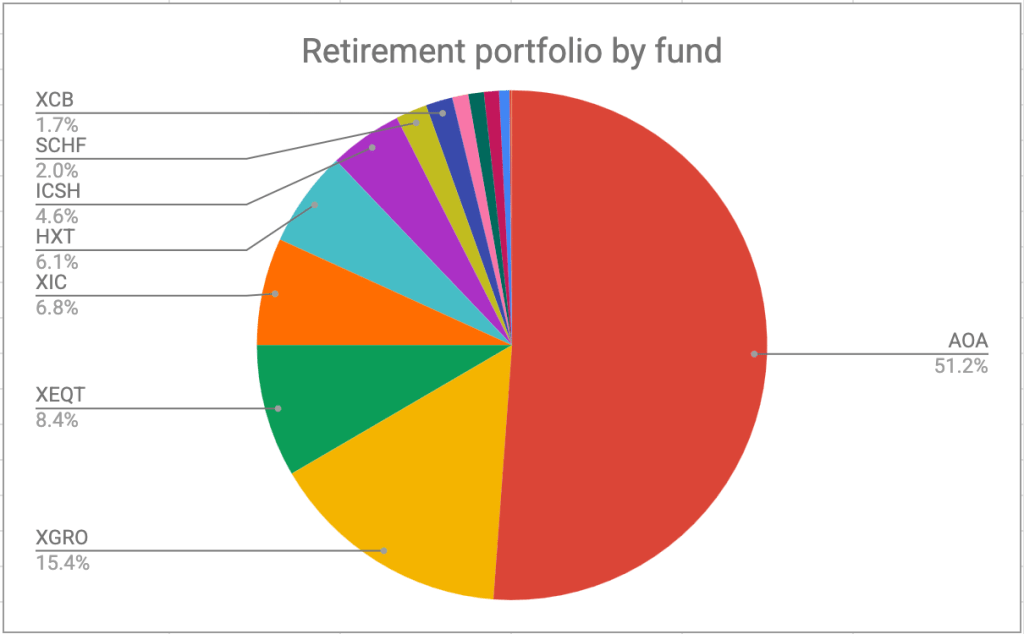
The portfolio is dominated by my ETF all-stars, (and if not an all-star, they are probably on the Magnificent Seven ETFs list). This split is before all the quarterly dividends have paid out. AOA, XGRO, XEQT, XIC all have a quarterly payment that collectively might skew the numbers a bit — I have all these investments on DRIP so I just buy more of the same. All that to say that there weren’t big changes month to month; my USD holdings got a bit of a boost this month thanks to a favourable exchange rate. (A lot of my retirement holdings are in USD, so the FX rates matter somewhat). Here’s what the USD has looked like in CAD since my retirement:

Plan for the next month

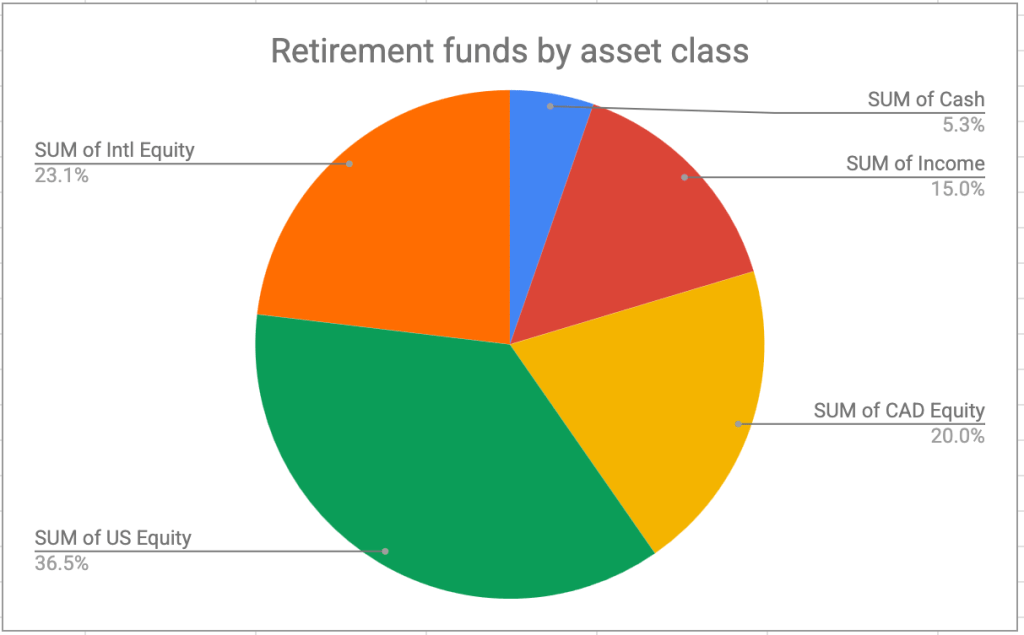
The asset-class split looks like this; you can read about my asset-allocation approach to investing over here.

It’s looking pretty close to the targets I have, which are unchanged:

  • 5% cash or cash-like holdings like ICSH and ZMMK
  • 15% bonds/income (most are buried in XGRO and AOA, rest are in XCB)
  • 20% Canadian equity (mostly based on ETFs that mirror the S&P/TSX — HXT and XIC)
  • 36% US equity (dominated by ETFs that mirror the S&P 500)
  • 24% International equity (mostly, but not exclusively, developed markets)

The alignment with target is what drives my investment decisions; seeing the chart above tells me there’s no movements needed, which makes things simpler.

Since we’re just about in to the 2nd quarter of the year, it’s time for me to move some AOA into XGRO using Norbert’s Gambit1. The Gambit has worked out pretty well for me so far; I track my effective FX rate every time I do it, and it’s always less than relying on the instant (and relatively expensive) FX conversions offered by my broker2.

Overall

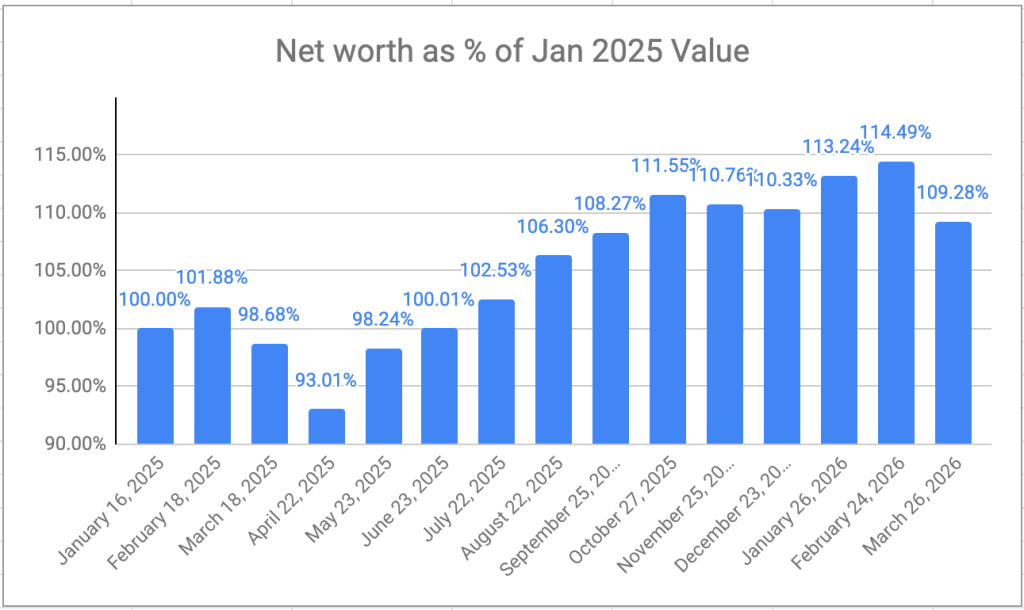
Part of using VPW3 as a strategy is the need to calculate your retirement net worth on a monthly basis. As you can see below, the most recent market gyrations have had a bit of an impact on the bottom line, taking me back to a value I haven’t seen since September last year:

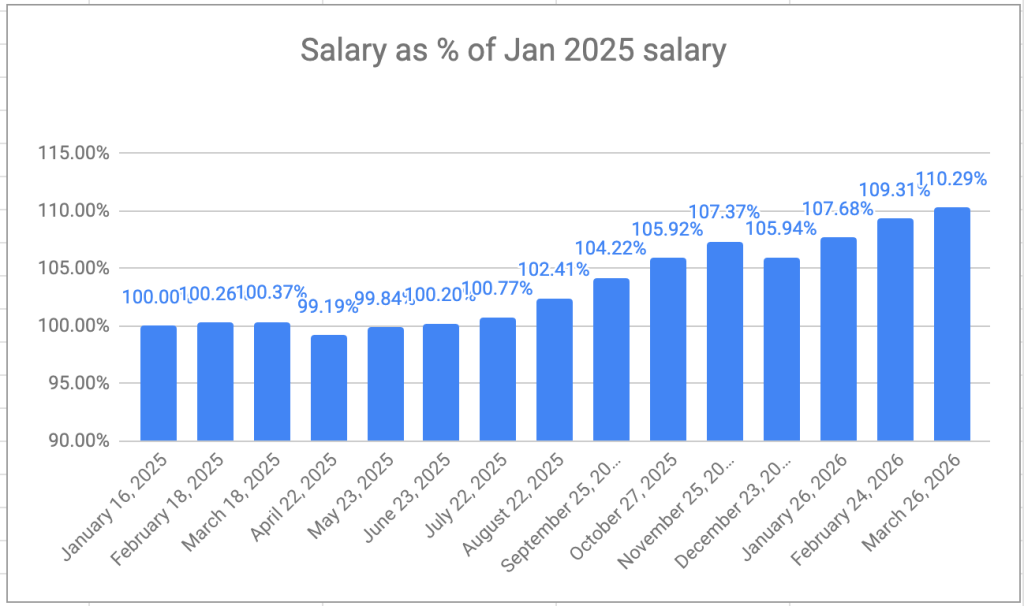
But my VPW-calculated salary, which has a built in shock absorber (aka cash cushion), continued its upward trend nonetheless:

I’m expecting to take a pay cut at some point if the markets fail to recover, but pay cuts are an expected outcome of using VPW as a strategy. The “V” is for “variable”, after all. At this point, I’m still taking over 10% more than I did a year ago, so no matter how you slice it, things are more than on track.

  1. Of late, my need for spending in USD seems not so critical anymore. ↩︎
  2. Typically 1.5% of the amount converted. ↩︎
  3. Variable Percentage Withdrawal, my chosen decumulation strategy. ↩︎

News: Wealthsimple Norbert’s Gambit in Beta

Norbert’s Gambit is a way to save money on USD/CAD conversions. (Want to learn more? I’ve written about it here). Most brokers take extra margin points on these conversions, hidden in the relatively crappy exchange rate you actually get. Since a lot of my retirement holdings are in USD, and since I am a cheapskate, I’ve used Norbert’s Gambit at three different brokerages (BMO Investorline, QTrade and Questrade1) over the years.

And now, Wealthsimple has joined the fray. It’s not open to the general public quite yet, but I did get a notification that I can now perform the Gambit on this platform. This brings Wealthsimple agonizingly close to being a contender for my retirement savings business. They only lack (puzzlingly) USD support in RRIF accounts. Otherwise, they check the other boxes in my “need to have” list for any broker:

  • $0 trading commissions
  • Support for USD accounts in non-registered, RRIF, and spousal RRIF2
  • Norbert’s Gambit3

Wealthsimple’s implementation of the Gambit seems to mirror that of Questrade insofar as they charge a $9.95 plus tax fee for journaling shares, a necessary step of performing the Gambit. There are a few oddball wrinkles documented on their website, none of them show-stoppers in my view:

  • Not available on the Wealthsimple app
  • You can only journal DLR/DLR.U. Other cross-listed shares aren’t supported4.
  • The journaling fee is always charged in Canadian dollars, and by the language used on the website, it sounds like you are blocked from doing the journaling unless you have the cash in your account at the time of the request5

Normally I’d give the feature a whirl to see if it’s comparable to the Questrade/QTrade experience, but I only hold CAD assets at Wealthsimple at the moment. It’s not really a complicated thing to do, the only way Wealthsimple could make the experience better is to do the journaling faster. I’ve documented the timelines involved with doing the Gambit at Questrade here.

  1. Other brokers also support it, but I just have no personal experience with it. ↩︎
  2. Wealthsimple doesn’t support this per their website ↩︎
  3. People (especially on Reddit) frequently cite Interactive Brokers as the best game in town to do currency conversions. I did at one time have an IB account, and I can confirm that their currency conversion rates across the board are a pittance, and in most cases will be cheaper (and faster) than even Norbert’s Gambit. HOWEVER, if you want to actually get hold of the cash you’re converting, then you can expect VERY long delays before you are allowed to withdraw the funds. ↩︎
  4. Most people use DLR/DLR.U to do the Gambit but it isn’t obligatory. At BMO Investorline, if you didn’t want to place a phone call, you had to use some other share combination (I usually chose a Canadian bank stock like RY). Not sure this is still true. ↩︎
  5. Questrade lets you carry a negative balance, but of course they will charge interest on that. ↩︎

News: Norbert’s Gambit Tracking Update

If you have no idea what Norbert’s Gambit is, it’s a way to cheaply convert USD/CAD in your online brokerage account. Most brokers support it1.

Because I hold a lot of USD assets in my retirement savings, and since I live and spend most of my money in Canada, I need a way cheaply convert to Canadian funds in my RRIF. So last week, I had to convert some of my AOA holdings into XGRO holdings and so I updated the log I’m keeping. So far, I’ve done the Gambit three times this year, and twice I’ve lucked out on the FX rate changes and actually made money2 on the transaction.

  1. And many people expect Wealthsimple to join this club soon. ↩︎
  2. What I mean: if the funds had converted instantaneously with no fees rather than waiting around for the 3-5 business days for the Gambit to complete, I would have received LESS money than by using the Gambit. Over time, I expect this will even out, but right now I’m about $55 CAD ahead. ↩︎

Can I take advantage of higher US interest rates?

I have a dedicated non-registered account in my retirement portfolio that is the cash cushion for VPW’s decumulation strategy. You can read about the details of how I currently get paid in retirement here.

That non-registered account holds about 85% Canadian dollars, invested in ZMMK, with the remaining 15% invested in ICSH. Both of these ETFs are very short-term bond funds and give me a slight advantage over investing in zero-risk HISAs. ZMMK and ICSH are part of my ETF all-stars lineup, and I track HISA rates on a monthly basis.

The fact is that US interest rates are a lot higher than Canadian interest rates, almost 2% higher as of July 2025. It seems to me that I should take advantage of that fact. Taking advantage of this situation would mean selling some ZMMK, performing Norbert’s Gambit with the resultant cash, and then buying ICSH. There are costs involved at every step of the way1:

  • Selling ZMMK means I’ll get dinged with the bid/ask spread2
  • Performing Norbert’s Gambit costs $9.95 plus HST on Questrade to do the necessary journaling
  • There will be bid/ask spreads to pull off the Gambit…once when buying DLR, once when selling DLR.U
  • Buying ICSH means another bid/ask spread

So at what point is it worth it? Let’s do a bit of math using the following assumptions:

  • The delta between US and Canadian rates is 1.8% in favor of the US rate. That’s an annual rate, and I’ll just divide by 12 to get a monthly rate3.
  • The bid/ask spread for DLR per the ETF fact sheet is 0.1% on the CAD side and 0.07% on the USD side
  • The bid/ask spread for ZMMK is 0.02% per its fact sheet
  • …and the bid/ask spread for ICSH is 0.02% as well per its fact sheet
  • No change in the FX rate for the duration of this exercise4
  • No fees to trade DLR, DLR.U, ZMMK or ICSH5

So for various amounts, the time to profitability6 of doing the Gambit looks like this.

$ CAD changedJournaling Fee7DLR Spread Fee8ZMMK/ICSH spreadTotal costTTP9
$1k$12$1.70$0.40$14.10~10 months
$10k$12$17.10$4$33.10~10 weeks
$100k$12$170$40$222~6 weeks

So clearly, for amounts around $1k this isn’t such an attractive proposition as the costs will take a fair bit of time to be negated by the bump in interest rates. For larger amounts, I’d say it’s worth it. Given ZMMK hasn’t yet paid out its dividend for the month, I guess I’ll wait until I’m ex-dividend (July 30, 2025, per the fact sheet) before doing this transaction.

  1. I’m also ignoring the tax on any capital gains I might pull off. It will be quite small, and will be close to 0. ↩︎
  2. Bid/ask spread is the difference between what the price holders are willing to sell at versus the price offered by a buyer. For ZMMK this is typically 1 cent. ↩︎
  3. Whether this delta continues to hold is anybody’s guess. ↩︎
  4. Which, admittedly, has no hope of being correct. If you do this sort of thing frequently enough, it ought to even out over time. ↩︎
  5. This is true at Questrade. YMMV with your broker. ↩︎
  6. Henceforth “TTP”, naturally ↩︎
  7. Adding HST and rounding ↩︎
  8. Buying DLR is 0.1% and selling it is 0.07% ↩︎
  9. Investing all holdings at 1.8% annual rate of return ↩︎