
News: Wealthsimple Norbert’s Gambit in Beta

Norbert’s Gambit is a way to save money on USD/CAD conversions. (Want to learn more? I’ve written about it here). Most brokers take extra margin points on these conversions, hidden in the relatively crappy exchange rate you actually get. Since a lot of my retirement holdings are in USD, and since I am a cheapskate, I’ve used Norbert’s Gambit at three different brokerages (BMO Investorline, QTrade and Questrade1) over the years.

And now, Wealthsimple has joined the fray. It’s not open to the general public quite yet, but I did get a notification that I can now perform the Gambit on this platform. This brings Wealthsimple agonizingly close to being a contender for my retirement savings business. They only lack (puzzlingly) USD support in RRIF accounts. Otherwise, they check the other boxes in my “need to have” list for any broker:

  • $0 trading commissions
  • Support for USD accounts in non-registered, RRIF, and spousal RRIF2
  • Norbert’s Gambit3

Wealthsimple’s implementation of the Gambit seems to mirror that of Questrade insofar as they charge a $9.95 plus tax fee for journaling shares, a necessary step of performing the Gambit. There are a few oddball wrinkles documented on their website, none of them show-stoppers in my view:

  • Not available on the Wealthsimple app
  • You can only journal DLR/DLR.U. Other cross-listed shares aren’t supported4.
  • The journaling fee is always charged in Canadian dollars, and by the language used on the website, it sounds like you are blocked from doing the journaling unless you have the cash in your account at the time of the request5

Normally I’d give the feature a whirl to see if it’s comparable to the Questrade/QTrade experience, but I only hold CAD assets at Wealthsimple at the moment. It’s not really a complicated thing to do, the only way Wealthsimple could make the experience better is to do the journaling faster. I’ve documented the timelines involved with doing the Gambit at Questrade here.

  1. Other brokers also support it, but I just have no personal experience with it. ↩︎
  2. Wealthsimple doesn’t support this per their website ↩︎
  3. People (especially on Reddit) frequently cite Interactive Brokers as the best game in town to do currency conversions. I did at one time have an IB account, and I can confirm that their currency conversion rates across the board are a pittance, and in most cases will be cheaper (and faster) than even Norbert’s Gambit. HOWEVER, if you want to actually get hold of the cash you’re converting, then you can expect VERY long delays before you are allowed to withdraw the funds. ↩︎
  4. Most people use DLR/DLR.U to do the Gambit but it isn’t obligatory. At BMO Investorline, if you didn’t want to place a phone call, you had to use some other share combination (I usually chose a Canadian bank stock like RY). Not sure this is still true. ↩︎
  5. Questrade lets you carry a negative balance, but of course they will charge interest on that. ↩︎

Caution: Transferring RRIFs between brokers

DIY investors include a growing number of RRIF holders (like me). If you want a primer on RRIFs, you can read that here. There are some strange nuances involved with moving RRIFs between brokers which may not be obvious and are not documented anywhere — or if they are, I have yet to find where.

I’ve covered parts of this topic before, (here and here) but this post attempts to summarize the weirdness so you don’t get caught unaware. It is my belief that the cautions outlined below are applicable to ALL brokers, but happy to learn otherwise, just drop me a line at comments@moneyengineer.ca, I read all my mail.

For simplicity, I’m going to refer to the “sending” broker (the broker that currently manages the RRIF) and the “receiving” broker (the broker to whom you’re transferring those same assets).

Caution 1: A sending broker cannot transfer a RRIF unless it has fully paid out RRIF minimum for that year.

As RRIF aficionados will know, at the end of the calendar year, a new “RRIF minimum” amount is calculated by the broker based on the market value of the RRIF at that time and the age of either the RRIF owner or the spouse of the RRIF owner. This is a well-known fact. What is perhaps not so well known is that the broker who holds the RRIF at the start of the year is obligated to pay out the full amount of the RRIF minimum, even if that RRIF is transferred in the course of the year1.

This has implications, especially if you attempt the transfer early in a calendar year:

  • You are going to end up with “extra” cash that you weren’t expecting. You’ll have to be prepared to do something with that money, but what? Leave it as cash? Invest it in a HISA? Invest it in an all-in-one?
  • This early windfall also means that your potential tax-free growth2 is lost.

Caution 2: Waiting past end of November to initiate a RRIF transfer runs the risk of tying up your RRIF funds for multiple months

“Fine”, you think, “if I wait until late in the year to transfer my RRIF, I can avoid the problems inherent in Caution 1”. This is what I thought, too. I was, again, wrong.

There seems to be an industry-wide pause on RRIF transfers that starts in late November and lasts until January of the following year. I’ve seen more than one mention of it. Questrade’s message when I attempted to transfer-in my RRIF to them was

Please be advised that RRIF/LIF account transfers are subject to the industry-wide cut-off date, November 28, 2025. This cut-off date is not specific to Questrade, but is arranged and agreed upon by all Canadian financial institutions to ensure yearly payments are made in an orderly and timely manner to all account holders.”

It appears I got extremely unlucky: the transfer STARTED before November 28th, but failed to fully complete before the deadline. Performing a transfer is a multi-step process using a service called “ATON”34. You can read all about how ATON works over here.

In my case, it took until mid-February for the transfer to complete. During that time, the account was in limbo, and no payments could be made. For someone who expects to be paid monthly from a RRIF, this was a bit of a problem.

Advice: Initiate RRIF transfers before November 1.

This ought to give enough time for the transfer to complete before the cut-off date. And minimizes the amount and time you have “extra” money floating around. You can help make sure your transfer goes as expected:

  • Make sure the assets you hold are supported at both institutions. GICs are a frequent problem. So are bank-backed HISAs. If you hold assets like that, do yourself a favour and sell them before you initiate the transfer so that they are just cash.
  • If you hold fractional shares in your account5, get rid of them by selling off the fractions or buy more so that you have whole shares. From what I’ve read, fractional shares are a construct that is broker-specific and will cause issues when you attempt to transfer them.
  • Make sure you have enough cash in your RRIF so that the sending broker can pay out your RRIF minimum before the transfer begins.

Happy investing. If a transfer really goes astray, it looks like OBSI can help.

  1. This CRA link seems to be the one that states this. ↩︎
  2. Since the average gains of the market are positive, I’m always going to make the assumption that it’s better to be invested than not. You could of course get lucky and avoid a big market downturn because your RRIF cashed early, but that’s not how I think about investing. Time in the market is always better than timing the market, per Ken Fisher ↩︎
  3. “Account Transfer Online Notification”, apparently per https://cffim-fcmfi.ca/wp-content/uploads/aton-best-practices-guide-Jan-15-2021-v9.9.pdf ↩︎
  4. I am indebted to Financial Wisdom Forum users NorthernRaven and OptsyEagle for their help in understanding what went wrong in my case ↩︎
  5. Wealthsimple (for all shares/ETFs) and Questrade (for some US shares/ETFs) both offer this option. There may be others. ↩︎

Achievement: Down to two providers

I am trying to keep my retirement investments as simple as possible, really I am. And this week, I finally reduced the number of providers I use from three to two. Most of my retirement investments (RRIFs, TFSAs, non-registered) are now held with Questrade, excepting one RRIF account I hold with Wealthsimple.

I had intended to be down to two providers back in March 2025, but then I uncovered a wrinkle in how providers deal with RRIFs and I ended up keeping 4 RRIF accounts over at QTrade during 2025. These 4 accounts funded my RRIF minimum payments in 2025.

One RRIF was moved to Wealthsimple in early November 2025 and this was an altogether painless experience, and I’ve been enjoying free money every month from Wealthsimple for my troubles. A good deal.

I waited until late November 2025 (November 26th, to be exact) before starting the transfer exercise from QTrade to Questrade for the remaining three RRIFs. And it took until this week (February 6th, 2026) before the assets finally showed up. That’s 72 days, a little over 10 weeks. Here’s a timeline:

  • November 26th: Submitted paperwork electronically to Questrade
  • On December 2nd, QTrade charged me the $150 transfer out fee on each account (plus tax).
  • On December 8th, I got the following message from Questrade: “Please be advised that RRIF/LIF account transfers are subject to the industry-wide cut-off date, November 28, 2025. f you would like to proceed with your transfer request, we require a document showing that the RRIF/LIF minimum payment was made for the year 2025.”
  • I submitted this proof (which, as I mentioned previously, was more than a little annoying) but nothing happened. After many calls to both Questrade and QTrade, I gathered that transfers at this point in the year were impossible. Of course, QTrade had already charged me the $150 plus tax transfer out fee.
  • In the new year, I resumed hassling Questrade and QTrade support for updates. This was made more complicated by a free money promotion offered by Questrade, which meant their support desk, shaky at the best of times, became completely overwhelmed. I saw a series of cryptic messages in my transfer update that indicated somebody wasn’t responding to a followup. These cryptic messages disappeared from my status update last week, which I either took to mean progress or an attempt to cover up inept practices, I haven’t decided which yet.
  • Anyway, without much fanfare, the assets appeared in my RRIF accounts on Friday, February 6th. My transfer status still shows “in progress”, for what it’s worth.

Anyway, I’m happy this latest transfer is done, but there’s still some tidying up I have to do:

  • I have to make sure I know what Questrade will use for RRIF minimum for the newly moved accounts. That’s another call to support, regrettably. And since I missed a month of payments, I have to figure out how to catch up.
  • I have to make sure Questrade refunds me the transfer out fees. I uploaded the documentation (which, I note, Wealthsimple does not require) to “prove” I was charged $1501.
  • I will check (again) to ensure all these RRIF accounts have a properly documented successor. That’s really important.

This last go-round was especially unsatisfactory since I got no free money out of it, which is really quite galling given how much is being thrown around these days2.

Anyway, it’s nice to have a simpler view of my portfolio; Passiv gives me a unified view across Wealthsimple and Questrade, but since the relationship between Questrade and Passiv has come to an end, I’m not sure what that will entail once my free “elite” subscription ends in March.

  1. Since every broker does this, this is 100% an exercise to prevent refunds to the unwary. . ↩︎
  2. Just search this site for “free money” if you don’t believe me. ↩︎

RRIF Support Showdown: Wealthsimple, Questrade, QTrade

I’m currently holding RRIF accounts at three different online providers (QTtrade, Questrade and Wealthsimple)1. So I am perhaps uniquely positioned to comment on the relative goodness and badness of the support of this kind of account at these three brokers. I also have some experience with BMO Investorline in this regard, but that experience is getting a bit long in the tooth now.

So without further ado, let’s take a look:

Wealthsimple

Wealthsimple now provides support for both RRIFs and (relatively recently) Spousal RRIFs. And although Wealthsimple supports USD accounts, they do not (for whatever reason) support USD RRIFs2, which, for many readers, isn’t a big deal, but to me it is.

But for all that, I still hold a CAD RRIF with Wealthsimple. It started last year, when I realized my DPSP couldn’t be immediately converted to a RRIF, and Wealthsimple was offering a shiny new Macbook to win the business. How could a certified cheapskate refuse?

Since I only opened the RRIF last year, this year is the first year where I’m obliged to take out RRIF-minimum payments. Wealthsimple makes this stupidly easy on many levels:

  • They clearly display what your minimum payment for the year is right on the account screen, and they also show how much you have left to go against that minimum
  • They make it easy to create a “recurring withdrawal” from the RRIF, which is something I do every month, and I can easily change this whenever I want, although I’m not planning on doing that.
  • And — bonus — they support XGRO fractional shares AND the ability to place a sell trade in dollars and cents rather than # of units. This means I can sell EXACTLY the number of XGRO units I need to every month, with no excess dead-money cash floating around.

You have to set up your bank account for EFT withdrawals before this works, of course.

QTrade

I still hold 3 RRIF accounts at QTrade, although I’ve been trying to move them to Questrade since late November. Seems that there is an industry-wide freeze on moving RRIF accounts in the month of December.

QTrade supports USD and CAD RRIF accounts, and they keep them completely separate — different account numbers, even. They are linked, however, because the TOTAL value of the 2 accounts is used to determine your CAD RRIF minimum payment. I’ve only withdrawn RRIF funds in Canadian dollars, because I couldn’t get a straight answer whether I could withdraw USD funds natively to my USD account.

QTrade also supports Norbert’s Gambit, which is important if you want to convert between USD and CAD cheaply.

With QTrade, you have to send in a form to set up your RRIF withdrawals, either monthly/quarterly/annually. And per their fee schedule, if you deviate from this, you owe them $503.

Once the schedule is in place, the withdrawals happen automatically. You have to make sure you sell your assets in advance of the withdrawal date. What happens if you don’t have enough funds? Not sure, cannot find any documentation that addresses this. There is also no indication online as to what your RRIF minimum payment is; you have to contact support if you want the exact amount.

Questrade

The majority of my RRIF holdings are here. As mentioned above, I’m trying to move 3 RRIF accounts from QTrade to Questrade. The delay from end of November to beginning of January seems like it’s explainable by the aforementioned industry-wide freeze. But since then, I lay the blame fully on Questrade for dragging their feet on getting the right forms in QTrade’s hands.

Questrade supports USD RRIFs, and combines them with CAD holdings. Same account for both, and they do a nice job of providing you with multiple views so you can see your portfolio in either currency.

Questrade also supports Norbert’s Gambit, and I’ve used it multiple times already to convert USD holdings into CAD holdings.

Questrade requires a form to set up RRIF payments, and like anything involving a form at Questrade, you have to sit on top of support to make sure someone actually reads the form.

Like QTrade, Questrade treats RRIF minimum payments as some sort of secret, forcing you to contact support if you don’t know what the value is.

You can also exceptionally get “extra” payments using the “Move Money” menu. I am not sure how withholding tax would work if you did this. It appears that you could also withdraw USD from this menu. The “Move Money” menu is one that seems to be rather fragile — bank accounts previously linked have a habit of disappearing from this screen.

As I write this, Questrade is only batting .500 in delivering the first RRIF payment. I got mine, but my spouse did not. Unclear why this may be, the support person I spoke to also seemed perplexed.

The Verdict

If you have USD in your RRIF, I would probably pick Questrade over QTrade. Questrade’s support of “on demand” payments is a nice flexibility. The one downside is that Questrade charges a flat fee to execute Norbert’s Gambit, whereas QTrade, as far as I can tell, does not.

But once Wealthsimple supports USD in RRIFs and Norbert’s Gambit4, they would be my #1 pick for managing the RRIF payments. High degree of automation, high degree of flexibility, high degree of transparency. If you don’t have USD in your RRIF, then I could recommend Wealthsimple over the other two.

  1. Mishaps and greed have contributed to this current situation. I don’t condone it. ↩︎
  2. Proof: https://help.wealthsimple.com/hc/en-ca/articles/17933575404315-Open-a-RRIF#h_01H8Y8853951RYHHA80S11T5Y9:~:text=Can%20I%20hold%20USD%20cash%20in%20my%20self%2Ddirected%C2%A0RRIF%3F ↩︎
  3. I’ve never had the need, but be forewarned! ↩︎
  4. Coming this quarter per this PR. ↩︎

News: QTrade Offers Free Money

New year, new promotions! QTrade (different from Questrade, don’t mix them up) is offering free money to new clients. It’s featured prominently here.

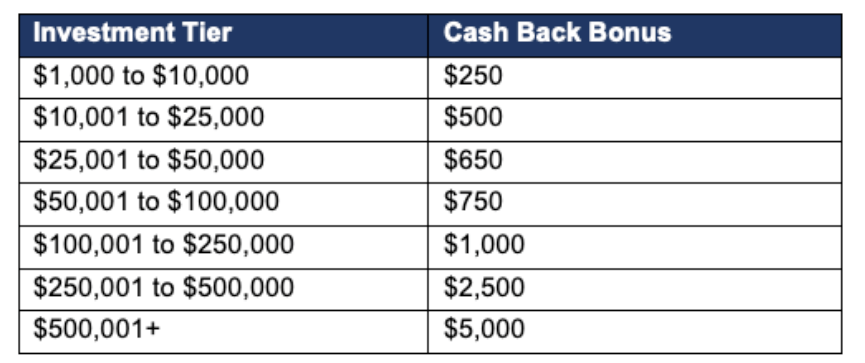
Detailed terms and conditions are here, but it’s pretty straightforward: register for the promotion with promo code CASHBACK26 and fund your account by April 30th. Keep it there for a year, and this is what you can expect your payout to be in May 2027:

The higher tier amounts aren’t particularly noteworthy as compared to others out there. But you’d be hard pressed to find a better ROI than $250 for a $1000 investment.