
Top Five Money Engineer posts of 2025

The Money Engineer launched in January 2025 and according to the WordPress stats, I made 144 posts last year. What were the most viewed posts of 2025?

5th-ranked post of 2025: ZGRO versus ZGRO.T

I got wind of ZGRO.T through Reddit, specifically r/CanadianInvestor. ZGRO and ZGRO.T are both all-in-one asset allocation ETFs from BMO, but with vastly different yield characteristics. I was confused, but in the end, decided that ZGRO.T was probably not a bad pick for use in a RRIF account as it might save you the hassle of selling shares. Their TOTAL returns (assuming all dividends are invested) are effectively identical.

4th-ranked post of 2025: Spousal RRIF Attribution Rules

I think I was first warned about this nuance of spousal RRSPs/RRIFs by my DIY neighbour (thanks, Steve) and is the main reason I’m only drawing RRIF minimum for the next two years1. I think most of the visits to this article were search-driven. Either that, or people came to admire what might be my favourite article thumbnail2 I’ve posted thus far.

3rd-ranked post of 2025: Norbert’s Gambit with Questrade

As someone who holds more USD-denominated assets than might be wise, I do very much appreciate the existence of a cheapskate way of converting between USD and CAD assets. I think I first learned about this trick via The Loonie Doctor’s blog. The #3 blog entry explains how it works if Questrade is your broker. I would also recommend https://moneyengineer.ca/2025/08/21/tracking-norberts-gambit-costs-with-questrade/ for a very clear picture of what it actually costs (in time and fees) to execute the Gambit: in three of four instances, the time delay of executing the gambit has worked in my favor as the FX rate has drifted a bit to my advantage.

2nd-ranked post of 2025: TD versus iShares all-in-ones

I’m a fan of all-in-ones (and am a little sad https://moneyengineer.ca/2025/01/21/why-you-can-fire-your-advisor-asset-allocation-etfs/ didn’t crack the top five last year). I am genuinely puzzled why people seem to get so wound up about which family of all-in-ones to choose3. I examined TD’s only because their cost to own is a bit cheaper than iShares (who I use primarily), and I’m a cheapskate. (I studied the cost of owning an all-in-one here.) Anyway, in the end, the biggest difference is visible in TGRO versus XGRO because TGRO, unlike any other GRO ETF, uses 10% bond allocation and not 20%. This gooses its return a bit, at the cost of additional volatility. Otherwise, it’s a case of tomato/tomahto. Pick one, or pick them all, it doesn’t matter much.

Top ranked post of 2025: Mini-Review of Optiml.ca

This was, as the title implied, a quick review of a made-in-Canada tool to help craft a retirement plan. And again, my DIY neighbour gave me a heads-up about it4. It got a lot of interest, probably because the kind folks at Optiml linked to my review from their website ;-). I was impressed by the completeness of the tool during my test drive, and it seems like a good and fairly priced way for a DIYer to do some validation of their retirement plan. Having validation of my plan was one of the ways I knew I could retire.

Looking forward to seeing what the 2026 list might look like! Got a topic or question? Send it along to comments@moneyengineer.ca, or comment below!

  1. RRIF minimum withdrawals are never subject to spousal attribution ↩︎
  2. Courtesy Pexels free photos, built into WordPress’ editor. ↩︎
  3. iShares, TD, BMO, Vanguard, Global X…. ↩︎
  4. Thinking he should write his own blog, maybe. ↩︎

The Cost of Asset Allocation ETFs

Readers will know that I’m a fan of the asset-allocation ETF. In fact, the vast majority of my retirement savings are dedicated to them. (New to the concept of asset allocation ETFs? Here’s an intro.)

Owning asset-allocation ETFs means you can quite literally invest and forget. The target asset allocations are maintained automatically for you, eliminating the all-too-common desire to tinker/experiment/play and mess with your returns in the process.

As with all things investing, there’s no such thing as a free lunch. This automatic asset re-allocation is reflected in the MER1 of the asset-allocation ETFs. So what’s this automatic management actually costing the holder of the all-in-one?

To work out the answer to that question, you have to look at how the asset-allocation ETF in question is built. Some people refer to asset allocation ETFs as “funds of funds” and this is actually quite an apt description, since most asset-allocation ETFs are just constructed by buying up index ETFs issued by the same company.

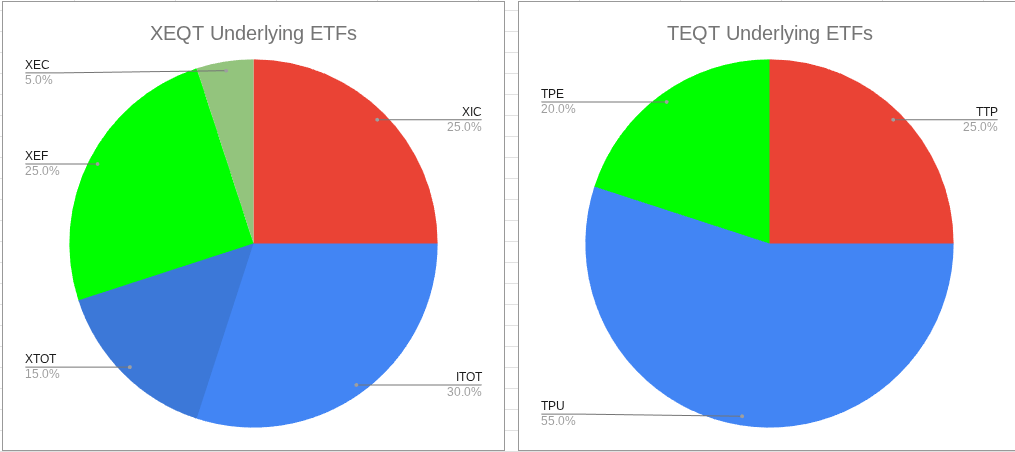
For example, iShares and TD each have an all-equity asset allocation ETF, named XEQT and TEQT2, respectively. Here’s what’s actually under the hood of each of them:

(I tried to keep the colours consistent between the two: red is Canadian equity, blue is US Equity, and other colours are international equity).

The thing about the MER of an all-in-one is that it already includes the MERs of the funds from which it is built. The tip-off is phrases like this one in iShares’ literature:


MER includes all management fees and GST/HST paid by the fund for the period, and includes the fund’s proportionate share of the MER, if any, of any underlying fund in which the fund has invested

https://www.blackrock.com/ca/investors/en/literature/product-brief/core-etf-portfolios-product-brief.pdf3

What this means is you can work out what the MER would be if you decided to simply manage the underlying funds yourself, and in so doing, figure out the premium that the all-in-one is adding to the mix.

I did this exercise, and here’s what I found:

XEQTTEQT
MER of component parts40.103%0.089%
All-in-one MER50.20%0.17%
MER premium for all-in-one60.097%0.081%
Annual premium cost per $1000 invested7$0.97$0.81

I offer a few takeaways from this analysis:

  • The MER costs I’m talking about here are lower than a factor of 10 (at least) that what’s charged by typical investment advisors and bank-backed mutual funds
  • The cost premium of the all-in-one is small, but it’s higher than I expected; even small percentage differences are greatly amplified when you work out (say) the 10 year cost of using these products.

The alternative of managing the constituent parts can be a cheapskate alternative and can save real money over time8, but one must beware of

  • The added complexity inherent in managing a portfolio of multiple ETFs. The XEQT/TEQT example is the simplest one; if you add bonds to the mix (e.g. XBAL/TBAL) you will need to add a few more ETFs to replicate the all-in-one. I used to manage my portfolio without using all-in-ones. I enjoyed it (you may have noticed I have a deep interest in investing). In retirement I have chosen to be practical and have attempted to create an environment that won’t be cognitively overwhelming as I get older.9
  • The greater likelihood of straying from the plan due to inaction or emotion kicking in. I myself didn’t put a lot of credence to this argument, but people smarter than me have pointed out that this is probably the one biggest factor that derails investment plans.
  1. The MER (Management Expense Ratio) is the cost of operating the ETF, expressed as a percentage. You don’t directly pay MER fees, but they reduce the overall returns of your investments. Lower MERs = more money for you. ↩︎
  2. No points for originality here ↩︎
  3. In teeny tiny letters at the bottom of page 1 ↩︎
  4. Weighted MER of each of the component ETFs. ↩︎
  5. You can find these on the ETF pages for XEQT and TEQT ↩︎
  6. Subtract 2 previous rows ↩︎
  7. Just multiply. Watch those decimal points, though. ↩︎
  8. I’m ignoring trading costs which aren’t zero but ought to be very small. Rebalancing assets is necessary of course but is perhaps a monthly, quarterly or annual exercise. ↩︎
  9. And even a portfolio just based on all-in-ones may prove to be too much to handle at some point. I’ve started to pay a bit more attention to the services offered by robo-advisors. ↩︎

News: BMO reduces fees on all-in-one ETFs

Summary: BMO has reduced fees on its family of asset-allocation ETFs (ZCON, ZBAL, ZGRO, ZEQT) to put its Management Expense Ratio (MER) in the same realm as competing families from GlobalX, iShares and TD.

If you’re a fan of all-in-one ETFs (as I am)1, then there is a new low-cost competitor2 to consider in BMO. BMO announced a reduction in their fees last week, and per Rob Carrick, it’s a win for everyone concerned. If you’re new to the idea of all-in-one ETFs (aka asset allocation ETFs), here’s a good place to start: https://moneyengineer.ca/2025/01/21/why-you-can-fire-your-advisor-asset-allocation-etfs/.

It’s probably worth taking a quick scan of the four lowest-cost families out there. Here’s the overview.

ProviderFund Symbols
TD3TEQT, TGRO,TBAL,TCON
BMO4ZEQT, ZGRO, ZBAL, ZCON
GlobalX5HEQT, HGRW, HBAL, HCON
iShares6XEQT, XGRO, XBAL, XCNS, XINC
Low-cost all-in-one ETF providers, and the symbols you can use to buy them

In my view, any of these families are worthy of your investment dollars. Which particular fund you pick within a family depends on your tolerance for volatility and/or your timeline for needing the money you’re investing. Each list of fund symbols in the table above is listed in order of amount of equity — so for TD, you can see that TEQT has the most equity (100%) whereas TCON has the least (40%). You might want to give https://moneyengineer.ca/2025/05/06/investment-basics-asset-allocation/ a read to get more familiar with the concepts.

  1. XGRO and XEQT are both members of the coveted “ETF All Stars” slot. ↩︎
  2. There are other all-in-one families (Vanguard, Fidelity, Mackenzie), the ones shown here are the least expensive of the lot at 0.20% MER or less. TD is the current winner of the lot with a rock-bottom 0.17% MER. ↩︎
  3. TEQT launched in April 2025. ↩︎
  4. There’s also an ESG asset allocation fund, ZESG. ↩︎
  5. There’s also a bunch of covered call variations that are of no interest to me. ↩︎
  6. iShares is the family I work within. I started with them over the others because they could be traded for free on my former provider (QTrade). My current provider (Questrade) allows free trading for any ETF. ↩︎