
Questrade Example: Exchanging USD/CAD with Norbert’s Gambit

Norbert’s Gambit is a way to change USD to CAD or vice-versa cheaply. (Most brokers take 1.5% off of such transactions). I talked a bit about the Gambit previously, and a very up-to-date blow by blow account of how to do it is found here, but I figured I’d show the practical benefits of doing it.

On April 14th, I decided it was time to covert some of my USD RRIF holdings into CAD. I did this by selling some of my AOA shares. I then immediately purchased DLR.u on the TSX, using the US dollars from the AOA sale. (DLR is the usual ETF people use to do the Gambit, but any inter-listed stock/ETF will do.)

After making sure I had sufficient cash in my account to cover the journaling fees ($9.95 plus HST = $11.24 CAD), I submitted the journal request on the Questrade website.

Two days later (April 16th), the journaling fee was charged to my account.

And then one day later, April 17, DLR showed up in my account, replacing the DLR.u that had been there.

I immediately sold the DLR shares to create CAD in my account, which I then used to buy XEQT.

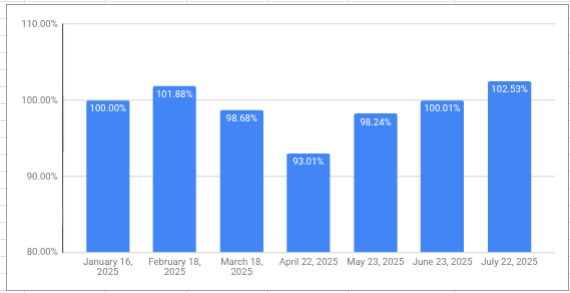
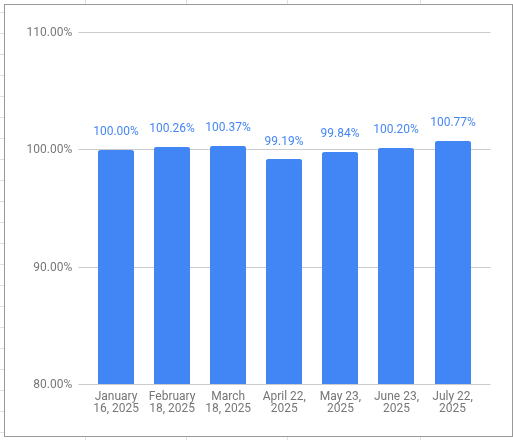
After subtracting the fees, my effective conversion rate was 1.385. Compare this to the Bank of Canada’s published rates, and I think you’ll agree that it’s a pretty sweet deal:

I’m tracking all my Gambit transactions over here, so I can see how often I come out ahead.

Switching online brokers recap

Switching online brokers is a time-consuming process; I just lived through moving from QTrade to Questrade to take advantage of Questrade’s 3% cash-back promotion. I covered the basic steps you need to take to switch brokers here. It took even longer than I expected, and here I break down some of the reasons it took as long as it did1.

Form filling was error-prone

The Questrade process to request a transfer looks something like this:

  1. You navigate to the Questrade account that is going to get the transfer (e.g. your TFSA)
  2. You initiate the transfer request by hitting a link. This, behind the scenes, creates a formal Transfer Request ticket that is processed by the front and back office.
  3. You are asked a series of questions online (sending broker, account numbers, kind of transfer)
  4. A pdf is automatically created2 that you then have to print, sign, and then…
  5. Upload.

The first problem was unique to the dying days of the promotion as me and every other person on the planet was trying to complete the same steps. Step 5 sometimes did not work, and you were left with a generic error message which encouraged you to try, try, again. Which I dutifully did. Unfortunately, this meant there was an explosion in the number of Transfer Request tickets that I mentioned in step 2, which I am sure completely overwhelmed the humans on the other side of the ticket.

The second problem was a bit more subtle. Sometimes, it seemed that the answers provided in step 3 were not populated on the resultant pdf. And hence, in some cases, forms were submitted with some mandatory fields missing. This would have been prevented had I bothered to carefully review the pdfs from step 4, but when you’re asking for a dozen different account transfers, it’s easy to miss a radio button that’s not filled out.

This problem was particularly noticeable on the RESP transfer forms, which are different from all of the others since there is a CRA form that also needs to be filled out. I believe I attempted to fill out the form correctly 3 times before getting it right. Rejection of an incorrectly filled form takes DAYS to process so timelines rapidly extend.

There’s not a lot of transparency in transfer progress

It took me a while to figure out where the transfer requests are hidden on the Questrade portal (you have to go to Move Money: Move Money History: Transfer: Transfer account to Questrade history)3 and here you see one of three states: Transfer Complete, Transfer in Progress, Action Required. There’s no detail beyond that.

  • “Action Required” is code for “call us, there’s a problem”; the old broker probably rejected the transfer for some reason. One reason is specific to RRIFs, but I covered that previously.
  • “Transfer in Progress” means one of:
    • Your filled out your transfer form correctly
    • We are initiating the request to your old broker
    • Your old broker is working on the request
    • Your old broker has accepted the request, but we don’t have it yet

Questrade also helpfully provides automated emails indicating when the Transfer starts and is nearing completion (they have your stuff, it’s just not showing up in the system yet), but — and this is a major irritant — the automated emails don’t include what account is being discussed. When you’re moving as many accounts as I did, this is not much better than noise.

One other small clue I had that my old provider got the request from Questrade is that they were usually pretty fast to charge their $150 transfer-out fee, plus HST4. So when I saw that I knew that my old provider was the one holding up the process…and if I didn’t see a transfer-out fee, I could safely assume that Questrade was to blame.

Did I say it was done? Well, almost…

I noted in a few cases that not 100% of the funds moved to Questrade. Unfortunately, the timing of the transfers meant that the likelihood of a quarterly dividend payout overlapping with the process was high. And yes, I see some residual cash left in my old broker in some cases for this reason. I suppose i’ll have to chase that down at some point, but the vast majority of stuff is now taken care of…well, except for my Canadian dollar RRIF, which is going to stay with QTrade a little longer until more of my mandatory RRIF payments have been made.

  1. My TFSA was the fastest, with the transfer request being accepted on February 26 and the holdings showing up on March 21. The joint investment account was the last to be processed, with holdings showing up in my Questrade account on April 15. ↩︎
  2. Whether a pdf is created or not I think is partially dependent on who the sending institution is. Not sure about that. ↩︎
  3. And although I show this as a menu structure, it’s not really. Move Money is a menu, but Move Money History is included on the page about halfway down. I’m not a big fan of how Questrade structures their web experience; it’s useable but it took a while to figure out where to find things and then remember where those things were… ↩︎
  4. Covered by Questrade, except for the HST part. But that’s another document submission to prove that the old provider charged the transfer out fee. Which is a bit ridiculous since ALL providers do this. ↩︎

Useful: Trading Authorization for online accounts

Having Trading Authorization (often called “TA”) is useful in a number of scenarios, but it doesn’t cover every angle either. It’s a minor hassle to set up, but altogether a useful endeavour.

What is Trading Authorization?

Well, you can start with a formal definition here: https://www.investopedia.com/terms/t/trading-authorization.asp. In essence, it gives you control and visibility over another person’s investment accounts (non-registered, TFSA, RRSP, RRIF, it doesn’t matter what kind).

Wait, what? Isn’t that what is normally called “Power of Attorney”?

Well, sort of. Power of Attorney (a handy — and free — guide can be found here) gives you the right to have this sort of control over any sort of account (bank, investment) but most institutions will still require you to fill in THEIR paperwork.

Trading Authorization forms normally require you to specify which accounts, specifically, are being authorized, meaning it’s entirely possible to have TA for a person’s TFSA but NOT their RRSP.

Here are some links describing the process for a number of brokers1:

Scenarios Where I’ve used Trading Authorization

Managing Family Finances

Since I’m the prime manager of our family’s retirement funds, I have trading authorization over my spouse’s accounts. The prime reason to do this is so I can see all the accounts from my login3 — even if they are held exclusively in my spouse’s name. This just makes things faster and simpler to do portfolio rebalancing, or even more practically, to get paid in retirement.

My spouse still needs her own login, since things like account statements and tax forms are only available from her login since she is ultimately the owner of those accounts, not me.

Managing My Parents’ Finances

As my parents aged, they passed on management of their retirement assets to me. I sat with them in a BMO branch as they filled in the paperwork4 to open their self-directed BMO Investorline accounts. This included filling in BMO Investorline’s paperwork designating me as the Trading Authority over their RRIFs, their TFSAs, and their joint non-registered account.

Having trading authorization on my parents’ accounts gave me my own login to the BMO Investorline platform, and from that screen I could see all the accounts and make trades. It also allowed me to call their support line myself and seek help doing things like in-kind RRIF payments to my folks’ non-registered account.

Limitations of Trading Authorization

Trading authorization isn’t an identity-based concept; rather, it’s an account-based concept. This means, for example, if you have trading authorization over three of your spouse’s accounts, and your spouse opens a fourth account, you do not automatically get trading authorization over the new account. The paperwork has to be filled in for the new account.

Trading authorization is only good for people who are alive. Trading authorization has no meaning if the account holder dies. Once that happens, you lose access to the account. Getting it back usually involves going through the probate process.

Different platforms treat accounts managed by trading authorization differently. In QTrade and BMO Investorline, there was no distinction at all between my and my spouse’s accounts. I had to give them nicknames to help me remember whose accounts were whose. In Questrade, I can only get a unified view of accounts from Questrade’s Edge platform, which although powerful, is a bit of an assault on the senses.

  1. all found by googling “trading authorization” <broker name> ↩︎
  2. A pretty interesting gap for a company that doesn’t have too many ↩︎
  3. Interestingly, Passiv doesn’t care who owns a linked account. If you have the login credentials of ANY user from a Passiv-supported broker, you can link them to your Passiv login. ↩︎
  4. One example of only a few where the relationship between BMO and BMO Investorline was useful. ↩︎

News: GlobalX TSX 60 ETF now at 0% MER

This just in!

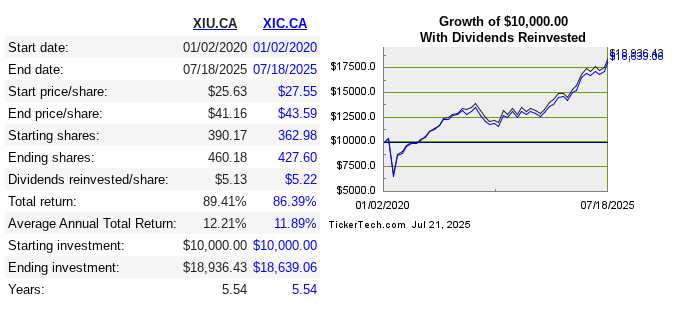
GlobalX just announced that their Canadian Equity fund CNDX will rebate the management fee for the rest of the year. Up until now, I couldn’t recommend this ETF since prior to this news, its MER was a relatively stratospheric 0.13%1. But 0% is a MER I can live with!

They also have a bunch of their segment ETFs doing the same thing, but I don’t do segment bets. Just asset classes.

I don’t currently own any of this ETF.

  1. Compare Vanguard’s VCE or BlackRock XIC at 1/3 the price. Ok, not letter for letter the same thing, but c’mon… ↩︎