Rebalancing the portfolio: A real-life example

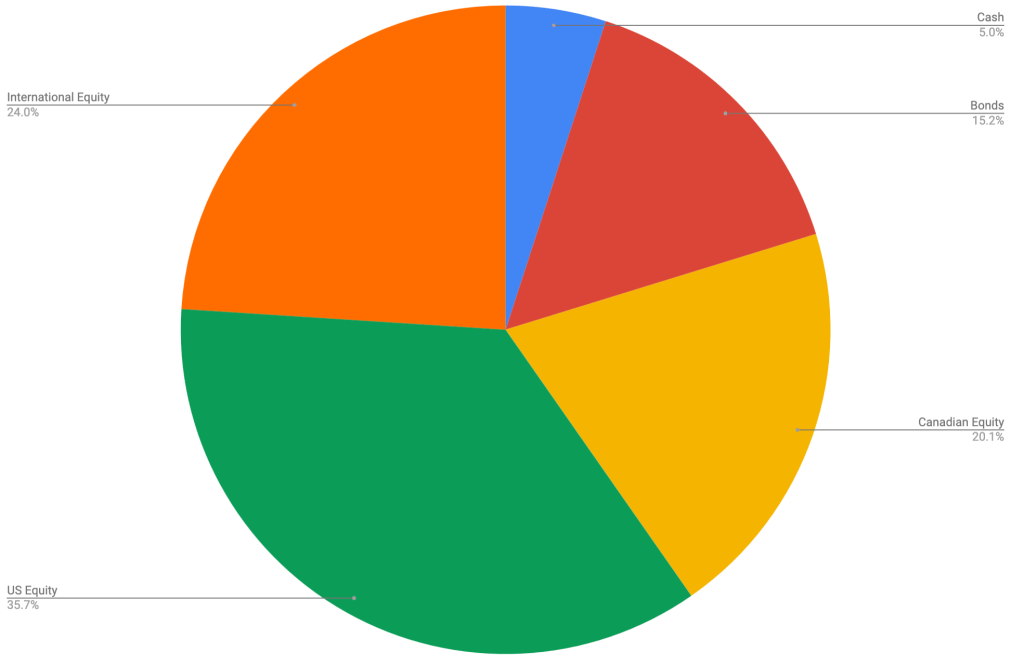
If you adhere to asset-allocation strategies (as I do) then rebalancing your assets to reset them back to your targets is a way to make sure you stay on track1. Some people do this on a regular basis (monthly, quarterly, annually) but I try to do it whenever the drift becomes noticeable (more than 1% off of my targets2). The targets for my portfolio are

  • 5% cash
  • 15% bonds
  • 20% Canadian equity
  • 36% US Equity
  • 24% International equity

Given the week we’ve just had, it’s not really a surprise to see that I’m overweight in cash, and underweight in foreign equity. Some of my cash is untouchable because it’s the built-in cushion that Variable Percentage Withdrawal (VPW) requires3, so that’s out. The majority of the cash in play is found in my RRIF accounts, and most of that is found in USD.

So the problem to solve for is to find a low-cost International Equity ETF that sells on the US market. Let’s walk through the steps I go through for that.

Copy what’s in my USD all-in-one ETF

Long time readers will know that most of my USD holdings are invested in AOA. (What’s the deal with AOA? Asked and answered here.) Since AOA is an all-in-one ETF, and since I know that AOA has international holdings (around 28%), and I know that AOA is inexpensive to hold, I can just do what AOA does, right?

So that is certainly a possibility, but as it turns out, AOA invests in TWO international ETFs, namely:

  • IDEV, which is a broad international ETF that tracks the developed world (you can see the Sector and Geographic breakdown here)
  • IEMG, which is a broad international ETF that tracks emerging markets (Sector and Geographic breakdown here)

IDEV and IEMG are both excellent funds, but I don’t really want to buy two funds if I can help it. AOA holds these two in a roughly 3:1 ratio, and I am too lazy to keep that straight.

So time for plan B.

Google for an appropriate ETF

So I type “international ETF USD” into Google and see what I get.

The first hit is linking to etfdb.com which isn’t my favourite website. They always list 100 ETFs when I want to choose from maybe 4. So I skip that link.

Then I get a hit for IXUS, which is an iShares product. This one I’ve heard of, and it has a clever name (ex-US, get it?). On IXUS’ overview page, I see three promising factoids:

  • It provides “exposure to a broad range of international developed and emerging market companies4
  • It has a MER of 0.07%, which is acceptable.
  • It’s not clear to me how much is in emerging markets, but the geographic exposure breakdown includes some non-G7 economies, so that’s good.

So that’s pretty good, but I want to look at least one more ETF to be a good comparison shopper.

A little bit further down I get a hit for VXUS, a Vanguard product. Like IXUS, it has a clever name (ex-US, get it?) and so I feel compelled to look closer.

And I see three factoids again:

  • It provides “Broad exposure across developed and emerging non-U.S. equity markets”
  • Its MER is 0.05%
  • The geographic exposure breakdown looks an awful lot like IXUSes, even though the underlying index it’s tracking is different5

And so, with that, the decision is made: we go with VXUS because it’s 0.02% cheaper than IXUS.

Actually DOING the rebalancing

This will be new ground for me, because it will be using my new provider for the first time (Questrade). My old provider let me sell one ETF and immediately buy another, and I assume that Questrade will also allow this, but until I try it, I’ve learned not to assume things.

Oh, yes, the “cash” in my USD RRIF is actually also an ETF, namely ICSH, which is because Questrade doesn’t provide any other means to earn money on “cash”.

So anyway, on Monday, a few hours after the stock market opens, I’ll take a look and see if trading is still a advisable — has the market suddenly recovered? Is it so volatile it warrants sitting on the sidelines? I’m guessing both of those will be a solid “no”, but I will wait until Monday to follow through.

Rebalancing (Somewhat) Complete

I signed in yesterday to my brokerage account around lunchtime so I missed all the morning’s excitement. After everything I wrote above, I didn’t buy VXUS after all — since my US equity portion was also significantly below target, I bought AOA instead, thus increasing both my US and International equity positions at the same time. I used a limit order since the bid/ask spread was like 20 cents, far higher than I’m used to seeing.

When markets are this nutty, I don’t like making all purchases at once. Since Questrade trading of ETFs is now totally free, I can take my time and incrementally shift the portfolio back to targets.

  1. Long time readers may wonder why rebalancing in my portfolio (which is dominated by asset allocation ETFs) is required at all — one of the reasons to invest in an all-in-one is BECAUSE it rebalances automatically. The answer is simple — although MOST of my portfolio is in all-in-ones, not ALL of it is. As I prepared my portfolio for retirement (read more about that here), I couldn’t justify selling assets and attracting capital gains in my non-registered account just to make the portfolio simpler. ↩︎
  2. I track those targets using the Multi-Asset tracker found here ↩︎
  3. VPW is how I get paid in retirement. You can read about the method here. ↩︎
  4. Closer reading of the product page shows IXUS tracks the MSCI ACWI ex USA IMI Index ↩︎
  5. VXUS tracks the FTSE Global All Cap ex US index ↩︎

I’m retired and the market is tanking. What do I do?

TL/DR: Look at your asset allocation and rebalance if needed. Otherwise go for a nice run.

Yesterday was pretty ugly. My retirement holdings, dominated by AOA and XGRO took a huge hit this week. And today will likely bring more of the same. Before Friday’s open, AOA is down 3.31% for the week, and XGRO is down 3.64% for the week. No doubt about it, I’m quite a bit poorer than I was on Monday1. What actions am I taking?

As always, I keep an eye on my asset allocations

In market downturns, some asset classes (e.g. Canadian equity, Bonds, International Equity) will suffer more than others, typically. This allows for effective asset rebalancing, possibly. (If you want to better understand how I think about asset allocation, this article might shed a bit of light on that.)

If the asset class allocation drifts too far from my targets, then that’s an indication to make a move out of one class and into another. A 1% drift off my target is usually enough for me to make a move. That hasn’t happened in my portfolio as of this morning, but I notice that the percentage of US equity is quite a bit down from the last time I looked.

As an aside, I track my asset allocations using my own Google Sheets tool, which you can find here.

If you do place trades in markets like this, do it wisely

If prices are swinging wildly, it might make sense to wait for a quieter day. But if not, then do use limit orders so you’re getting a price for the asset you can live with, either on the buy side or the sell side2.

Oh, and if you trade in ETFs (as I do), the start and end of the day are not good times to do that. Read more about why here.

In retirement, use a withdrawal scheme that helps you weather storms

I use “Variable Percentage Withdrawal” (VPW), a scheme that is designed to make sure you only spend what you can afford based on your age, your net worth, and your current (or future) pensions. And it comes with a built-in shock absorber so that even though the market looks like a roller coaster, the payout of VPW is considerably less wild. You can read about VPW over here.

Don’t do anything silly

I read all the time about people “moving to cash” at times like this. This will lock in your losses, and cause you to miss the inevitable gains that will return. Gains have a habit of showing up very quickly, and trying to “time the bottom” is not a winning strategy.

Case in point: per https://en.wikipedia.org/wiki/List_of_largest_daily_changes_in_the_S%26P_500_Index two of the worst days on the S&P 500 in recent history (March 12, 2020 and March 16, 2020) were followed by two of the best days (March 13, 2020 and March 24, 2020).

If all else fails

Step away from the news feed. Go for a nice long walk/run/bike.

  1. I was also going to write something about the USD/CAD exchange rate, which yesterday was really NOT in my favour, but it already appears to be recovering. A lot of my retirement holdings are in USD, so if the CAD gets stronger, those holdings are negatively impacted. ↩︎
  2. During the COVID meltdown of the markets (remember March, 2020?), my online broker started posting warnings on their trade screens to use limit orders. Guess they had too many angry traders. ↩︎

The Money Engineer now on YouTube

Early on when I first launched this blog, one of my friends suggested that video content would be ideal for the topics I wanted to cover. “I’m a visual learner” was her pitch1. I did hesitate because I wasn’t sure what I would post there.

But the hesitation is over, and I’ve launched a YouTube channel which you can find in the top menu (“Videos”) or you can go to it directly: https://www.youtube.com/@MoneyEngineerCA.

The first video2 is a quick intro to the Multi-Asset Tracker, a Google Sheets template that’s based on my personal spreadsheet that I’ve developed over the years.

Today’s video is a quick look at BlackRock’s family of asset-allocation ETFs (XEQT, XGRO, XBAL, XCNS and XINC) and what makes the members of the family different.

My philosophy is to keep the videos short with no window dressing. There’s no big intro, no sponsor plugs3, no big plea to “Like and Subscribe”, and no theme music. We get going right from the opening frame. I reserve the right to jazz things up later, but with 2 views thus far I’m not too worried about going viral anytime soon.

If you have thoughts/comments/ideas about the videos, feel free to drop me a line at comments@moneyengineer.ca.

  1. Although I do love an elegant diagram or chart, as my kids will tell you, I have very little patience for a 3 minute YouTube video telling me how to change a setting on my iPhone. ↩︎
  2. Recorded on April 1st, but it’s no joke ↩︎
  3. At least, none coming from me — YouTube ad insertion is not something I can control, at least as far as I can figure out. ↩︎

Another money saving idea with Fizz

I’m starting my fourth month with Fizz, a newish provider of cellular services, owned by Quebecor/Videotron. I previously talked about my experience with US roaming (TL/DR: it was positive1) but this week, I found another way to save money, if you’re a Fizz user in Ontario or Quebec.

That is thanks to the Fizz Wallet.

In essence, the wallet allows you to pay as you go for services you don’t use a lot. For me, that could be SMS messaging. With the rise of data-based messaging apps (iMessage, Messenger, WhatsApp to name a few) the need for sending2 SMSes3 in my world is diminishing on a daily basis.

Right now I’m paying $20/month for unlimited Canada wide voice/text and 3GB of data. Right now I could choose to change my plan, eliminate texts and save $4/month, but 3GB monthly data is no longer an option — it’s either 1GB (which I’m not sure is sufficient) or 7GB (which is way more than I’d ever need, and $1 higher4 than what I’m paying now).

Fizz isn’t perfect: no 5G, no caller ID and I still haven’t quite figured out the limitations regarding roaming and voicemail, but it certainly is inexpensive: the current low-price offer is $19/month for unlimited Canada-wide calling, SMS, voicemail and 1G of data. Crank that up to 7G and it’s still just $25/month.

My dear wife became a client yesterday to take advantage of the $35 referral bonus; with Fizz eSIM support, the migration to Fizz took about 30 minutes from start to finish. And since I had a bunch of data piling up, I sent her 500M to get started.

If you want to give Fizz a try, my referral code is INSWI — it’s worth $35 to you (and me :-)).

  1. One aspect that I failed to mention is that buying a travel add-on for roaming on Fizz is valid for the current AND NEXT billing cycle, which, on average, means your travel add-on will be valid for 45 days. In my case, my add-on was valid for two trips taken 3 weeks apart, so that was an even bigger savings since I only had to buy the 2G add-on once instead of twice. ↩︎
  2. Receiving SMS is always possible. ↩︎
  3. iPhone users: that’s “green bubble” texts ↩︎
  4. The first rule of subscription services: never willingly pay more a month than what you’re currently paying. Like the proverbial frog in the pot, small increases to monthly costs are easy to ignore until your budget is cooked. ↩︎