
The HISA table April 2025

Summary: High Interest Savings Accounts (HISAs) are a way for cash to earn half-decent, risk-free interest. These “Series F” HISAs are likely available through your online broker, but you may have to ask how to get at them, exactly.

We talked about HISAs in February over here if you need a quick reminder: https://moneyengineer.ca/2025/02/14/earn-money-with-your-cash-the-hisa-table-february-2025/

On March 12, the Bank of Canada reduced their overnight rates by another 0.25%.1 Unsurprisingly, this had a knock-on effect to the interest rates provided by the series F HISAs I track.

Equally unsurprisingly is that the US Federal Reserve didn’t touch their rates, and as a result, there were no changes in the HISA rates paid out for USD accounts. Here’s the full breakdown:

Current HISA rates for HISAs available via QTrade

There’s also a Google Sheets version with a bit more detail (source links) if you prefer.

For Canadian Dollar HISAs, B2B bank remains top of the heap: https://b2bbank.com/advisor-broker-rates/banking-rates.

For those of you who hold US cash in your brokerage accounts, you can benefit from the much higher US interest rates, and you have multiple choices since multiple providers are paying the same rate.

  1. You can also say “25 basis points” if you want to impress your friends ↩︎

How I think about investing: Asset classes

Passive investing while ensuring good diversification has been my strategy for decades. But how do I define “diversification”? For me, it’s always been about paying attention to how much of my total portfolio was invested in each of five1 asset classes and keeping them aligned with my targets:

  • Cash or cash equivalents
  • Bonds2
  • Canadian Stocks
  • US Stocks
  • International Stocks3

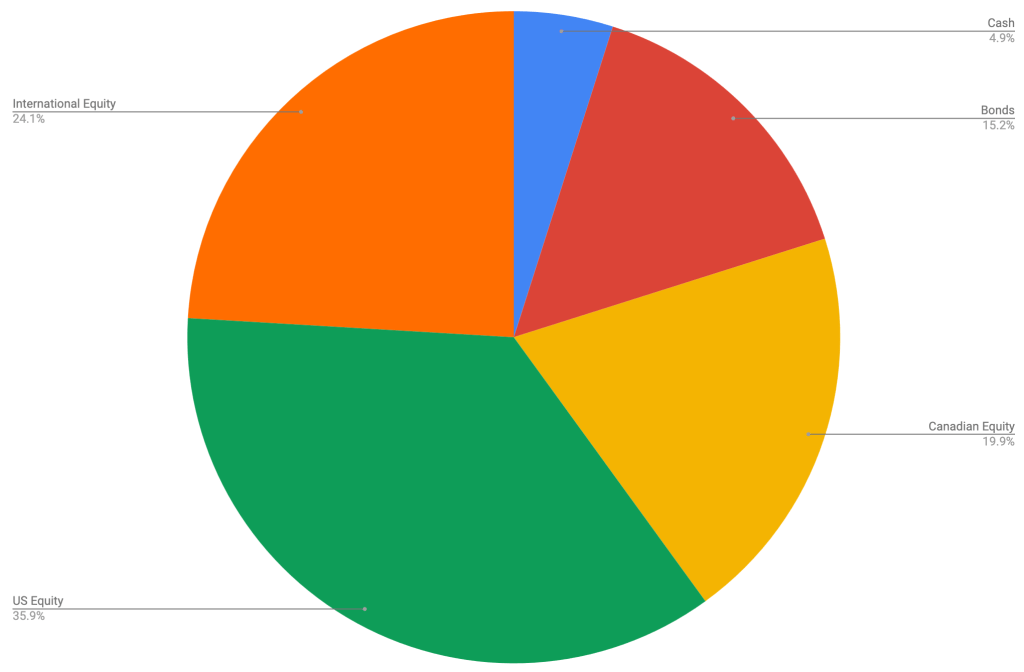
I got this idea from my last financial advisor who provided me with a lovely Cerlox4 bound annual report showing me how hard they were working on my behalf5. The report included a pie chart of how my investments broke down. This is what that pie chart looks like in my portfolio this morning:

Retirement portfolio by asset class, March 28, 2025

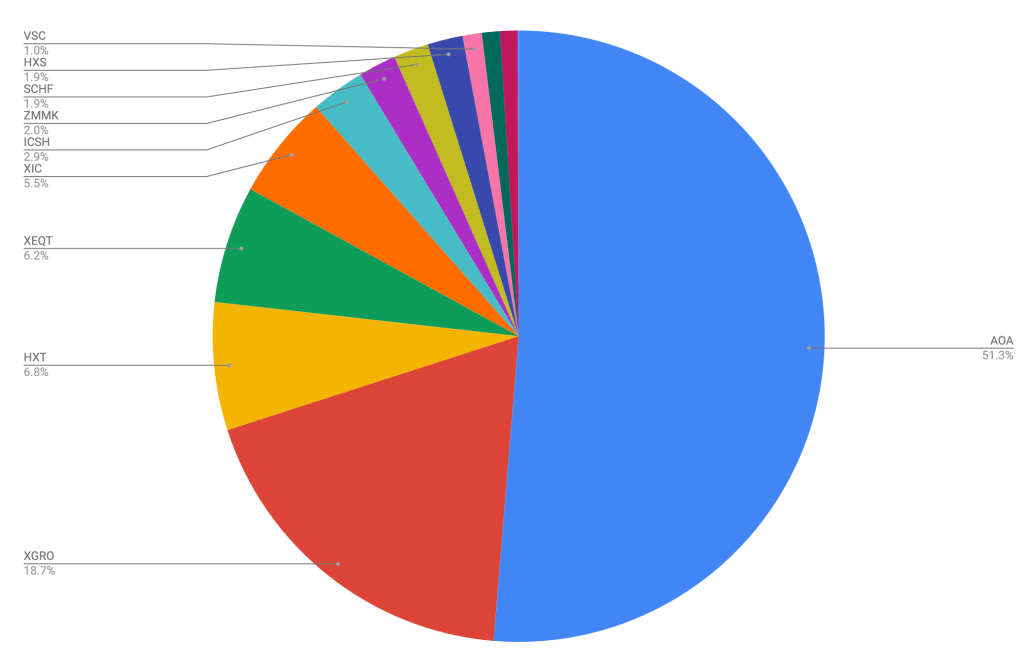
This pie chart has been my guiding principle: have a target percentage for each asset class in mind, and adjust your portfolio as needed to keep the percentages in line. This simple principle has been adopted by so-called asset allocation ETFs aka “all-in-ones” like (my personal favourites) XGRO6 and AOA7.

But are these even the right asset classes? Where are REITs8? Where’s precious metals? Where’s Bitcoin9? What’s your bond duration? Do you have enough exposure to high-growth geographies?

Short answer: just like I’m too lazy to pick stocks, I’m too lazy (and not smart enough) to pick a “winner” of a given asset class. The “periodic table” of investment returns by asset class is a must-read for DIY enthusiasts out there: https://themeasureofaplan.com/investment-returns-by-asset-class/ (go ahead, take a look, I’ll wait).

The folks at Measure of a Plan agree that trying to figure out the “hot” asset class is a very difficult task:

It’s no easy feat to pick the winner in a given year. The asset class rankings appear to be randomly tossed about over time, with the top performer in one year often falling down to the middle or bottom of the table in the next year.

https://themeasureofaplan.com/investment-returns-by-asset-class/

By keeping an eye on the pie chart, and shifting investments to align with my targets, I’m never at risk at being overweight in any one asset-class, and beaten-down asset-classes naturally get more funds to get the percentages right. It’s naturally causing “buy low, sell high” behaviour.

So: what about the asset classes I’m using? Are 5 asset classes too many? Too few? I don’t know. “Good enough” is sort of my philosophy in the spirit of trying to keep things simple.

The spreadsheet I’ve used to help me track my portfolio breakdown is found here. In future posts, I’ll talk a bit about how to make it work for you.

  1. For a long time, “cash” was not part of the consideration. Leading up to retirement, I started to carry a 5% cash weighting to help cushion market swings. ↩︎
  2. In years past, I did try to keep track of short-term versus mid-term versus long-term bonds. I gave up on that. ↩︎
  3. In years past, I did try to keep track of developed markets versus emerging markets. I gave up on that. ↩︎
  4. I had to look up how this was spelled. https://www.collinsdictionary.com/dictionary/english/cerlox ↩︎
  5. The fact that this report looked the same as the reports generated by two other advisors led me to the conclusion that my hard working advisor was perhaps being assisted by commercial software. ↩︎
  6. Overview of XGRO’s asset allocation strategy: https://www.blackrock.com/ca/investors/en/literature/product-brief/ishares-core-etf-portfolios-brochure-en.pdf ↩︎
  7. Overview of AOA’s asset allocation strategy: https://www.ishares.com/us/literature/product-brief/ishares-core-esg-allocation-brief.pdf ↩︎
  8. My first list of asset classes prepared circa 20 years ago did include REITs but I dropped that class, figuring (perhaps incorrectly) that the bond portion of the portfolio was good enough. Doing a bit of digging, I see that both AOA and XGRO hold REITs, and both consider them “equity” investments. ↩︎
  9. It’s actually obligatory for any article on investing to mention one (or more) cryptocurrencies, and/or one (or more) meme stocks 😉 ↩︎

Cautionary Tale: changing brokers when you have a RRIF

Summary: If you’re changing online providers with an active RRIF, the old provider is (apparently) obligated to pay out the ENTIRE RRIF amount for the current year before releasing your funds.

As you may have read previously, I’m (still) in the middle of changing online brokers from QTrade to Questrade1. Things are moving along…glacially2. I’m at step 6 of the guide.

Background

If you’re not that familiar with RRIFs, you may want to give Demystifying RRIFs a read.

At QTrade, I had 3 separate RRIF accounts:

  • One individual RRIF in CAD
  • One individual RRIF in USD
  • One spousal RRIF in CAD

QTrade makes you have different accounts for CAD and USD, whereas Questrade does not (hooray)3.

The individual and spousal RRIFs are set up to pay out RRIF minimum on a monthly basis, on the last day of the month. I expect this is a little unusual, since a lot of people seem to take their payments annually. In a weird QTrade wrinkle, one can only make payments from a CAD RRIF account, even though the USD RRIF account is used to calculate RRIF minimums4.

The RRIF transfer-out requests were initiated the instant the RRIF account was approved by Questrade, in the opening days of March (March 2 or March 3), a day or two after my February RRIF payment was processed by QTrade. Plenty of time, I figured.

Trouble Afoot?

About 2 weeks ago now, I got a cryptic email indicating that my RRIF transfer out request had been rejected by QTrade due to having “insufficient funds for RRIF payout”. Looking at my QTrade account, it looked to me like the US RRIF was moving (QTrade had already kindly charged me the $150 transfer-out fee), but the CAD RRIFs showed no signs of a transfer being initiated.

Thinking a little about it, I realized that perhaps QTrade wouldn’t release the RRIF assets to Questrade unless they could be sure Questrade could make the monthly RRIF minimum payment, which strikes me as silly, but I expect there’s some regulation that makes this mandatory. And so I immediately sold a few shares of XGRO in each of the RRIF accounts to ensure enough cash existed to cover the RRIF minimum payments and re-initiated the transfer out request.

But again, rejection. What?

But that, apparently, was not fully correct.

Current State of Play, and Some Advice

Today, I was informed by QTrade that no, they are obligated to pay out the ENTIRE RRIF payment for the year before they hand off the account to Questrade. Given the state of the market, I’m not exactly jumping up and down at the thought of having to sell 9 months worth of RRIF payments all at once. (This was, after all, EXACTLY why I set up the RRIFs to pay out monthly.)

So, I’ve decided to leave the QTrade RRIFs alone for the time being. This is far from ideal (multiple providers breaks all my rules about retirement investments being simple), but I take solace in the fact that

  • I will fix this at the end of the year, once most of my RRIF has been paid out
  • Maybe there will be another promotion before then 🙂

All this to say that make sure you have sufficient funds to cover any anticipated RRIF payouts BEFORE initiating a transfer-out request!

  1. And in what may be a minor miracle, I had BOTH providers call ME ON THE SAME DAY without prompting. ↩︎
  2. Most of the account transfer requests are 20+ days old at this point. I did struggle with completing the RESP transfer form correctly. The TFSAs moved quickly. The individual investment account moved quickly. The joint investment accounts are taking a lot longer. And the RRIFs longer still. The RESP, no idea. ↩︎
  3. Having filled out 14 different account transfer requests, ANYTHING that will reduce my account count is welcome. ↩︎
  4. This weird treatment was one of the reasons I started looking at other providers. QTrade claimed they could allow USD RRIF payments, but rejected my initial efforts to make that happen. The day before I started moving everything to Questrade, and two months after I complained about it, QTrade support contacted me to tell me that, oops, sorry, you can withdraw USD from your RRIF. Too late! ↩︎

Buying US Stocks or ETFs? Save money on US dollar foreign exchange.

I have a lot of US dollar assets in my retirement portfolio. I’m not really convinced it’s a good idea, but it has taught me the ins and outs of USD foreign exchange rates. Here I’m talking about getting access to (or changing from) US funds for the purposes of investing in your brokerage account. Getting access to US funds to buy things is a different1 animal, one that I covered in a previous post.

Here’s a few things I’ve learned.

Google is your friend for real time foreign exchange (FX) rates

“1000 USD in CAD” is a terrific search term to get an instant FX rate. (also: Euro, GBP, THB…). This is as close as you’ll get for the absolute best FX rate and should serve as your target.

For most brokerages, foreign exchange is a profit center

Meaning: They’re making money every time you convert one currency to another, usually on the order of 1.5% a transaction. Some providers seem to go to great lengths to hide what rate they are using on any given transaction. (I’m looking at you, QTrade2).

There are exceptions in the brokerage community, to be sure.

  • Interactive Brokers comes very close to the ideal rate for any sizable transaction3 and is the big winner when it comes to converting currency for investing purposes45
  • Wealthsimple recently introduced a tiered FX rate depending on how much you’re converting6:
    • Under $10k, 1.5%
    • Up to $25k, 1%
    • Up to $100k, 0.5%
    • Over $100k, 0%

The cheapest way to convert at most brokerages is to use Norbert’s Gambit

Norbert’s Gambit, in a nutshell, involves the following steps.

I must say at this point that although the steps are reasonably straightforward, there are usually delays introduced at each step. For example, you probably have to wait a day for the initial trade to settle before making the journaling request. And journaling may not be instantaneous either11.

With no guarantee that any of these are accurate, here are the specific steps to do the Gambit on a number of popular platforms.

  1. For most people. Since I am a CIBC USD savings account client, using Norbert’s Gambit is also a way for me to fund my USD shopping purchases. ↩︎
  2. When attempting to buy a USD ETF from my Canadian account, the only indication I’m about to get fleeced is the warning message “The account funds do not match the market currency. Currency conversion and foreign exchange rates will apply.” No indication of what the exchange rate they are using. ↩︎
  3. Their posted rates are very close to the google ideal, but there is a small (very small) minimum charge of $2 per trade per https://www.interactivebrokers.com/en/pricing/commissions-spot-currencies.php ↩︎
  4. It’s not ideal for getting cash access for shopping since they have very long hold periods where you cannot withdraw your money. See https://www.interactivebrokers.com/campus/glossary-terms/withdrawable-cash-subject-to-origination-restriction/ for the details. ↩︎
  5. But that web interface, wow is it ever complicated ↩︎
  6. See https://www.wealthsimple.com/en-ca/legal/fees/trade for the details. You’ll need a Wealthsimple USD account to pull this off, of course, and the only kind of USD account Wealthsimple offers is non-registered. ↩︎
  7. Did this at BMO Investorline since you cannot buy DLR online. Apparently you can buy it if you call in your order. At BMO using RY, I was able to get USD on the same day. ↩︎
  8. HOW to do this will vary considerably depending on who your broker is. Best to Google for specific instructions involving your broker. ↩︎
  9. Possibly for buying and selling the ETF, possibly a fee imposed for journaling, something Questrade is doing starting April 1, 2025. ↩︎
  10. And minus (or plus) any changes in the price of the thing you bought. Depending on your broker, each step in the process may take a day or two. If you do the Gambit often enough, I figure this sort of thing just averages out. Sometimes you win, sometimes you lose. ↩︎
  11. Per https://www.questrade.com/learning/investment-concepts/dual-listed-securities/journaling-shares it can take five (!) business days. ↩︎

Questrade Bonus Capability: Passiv

**** Update: Per email communication on October 24 2025, as of January 31, 2026, Passiv will not be offered at all by Questrade, as they are planning to launch their own integrated portfolio monitoring and rebalancing tools”.

**** Update: As of June 1, 2025, Passiv Elite is no longer offered for free for Questrade Clients. It’s now part of a subscription service called Questrade Plus***

As you may have heard, I’m in the middle of a transition between online brokers1. And so I’ve been spending some more time getting to know what Questrade offers to the DIY investor besides free buying and selling of stocks and ETFs.

One thing I looked into lately was Passiv, a service that is offered for free for all Questrade clients.

In brief, Passiv is a 3rd party web application2 that allows you to track your investments from a single screen, no matter if they are found in multiple investment vehicles (e.g. TFSA, RRSP, RRIF) or if they are found across multiple providers (full list of supported brokers is here)3.

What’s more, it also evaluates your portfolio against a model that you define. For example, if you (like me) have an investment portfolio with a target allocation of 5% cash, 15% bonds, 20% Canadian equity, 36% US equity, and 24% international equity, Passiv can assess your current holdings against these targets, and even do the trades to rebalance the portfolio!

Astute readers will note these are a lot of the same benefits I’m a fan of — and one of the big reasons most of my portfolio is invested in all-in-one asset allocation ETFs. (Are these ETFs unfamiliar? You can read about them here.)

I tried to use Passiv to model my own portfolio, but discovered that all-in-one asset allocation ETFs aren’t really supported by the tool4. Once I thought about it some more, it’s clear why — Passiv really markets itself as an ALTERNATIVE to using all-in-ones. Here’s a clear marketing pitch from Passiv that demonstrates its approach: https://passiv.com/feature-posts/model-portfolios-that-cost-less-than-all-in-one-funds-or-robo-advisors.

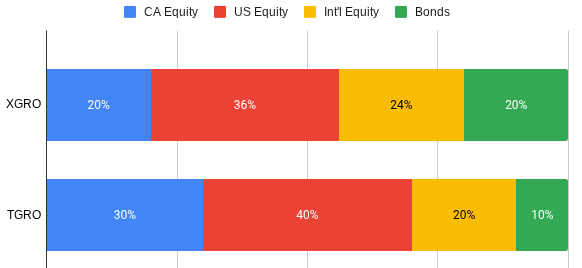
So to get the full benefit of Passiv, instead of holding XGRO, you would instead hold the constituent components of XGRO, a fund I’ve broken down previously. This would save you some management fees over time. Passiv helpfully does the math to calculate how much here5.

As a certified cheapskate, I’m always interested in saving a bit of money. But there are some downsides I could see in the Passiv approach:

  • You have to actually DO the rebalancing now and then. Not a big deal, but a fund like XGRO does this as part of their offer6.
  • You have to do the rebalancing no matter what. By this I mean that you have to buy when others are selling, and sell when others are buying. You can’t get overly attached to any one segment of your portfolio, because then you start making bad decisions based on “gut instinct”. Humans are notoriously bad at this7.

On the plus side, you will definitely save on management fees, and you could certainly tweak the contents to avoid products you wouldn’t normally buy (e.g. XGRO has some hedged funds, which I don’t like, typically).

An unknown for me is how foreign exchange is handled. That’s always something I consider since a lot of my retirement savings are in USD. Some experiments required 🙂

Anyway, it’s given me something to think about. I’ll have to see how easy it is to use in practice once all my accounts are back in place. Any Passiv users out there? I’m interested in your take — just drop a line to comments@moneyengineer.ca.

  1. And some (not all) of the funds are now showing up in Questrade, about 3 weeks after starting the process. Switching providers is not for the impatient. ↩︎
  2. WARNING: they don’t have an app. But someone named “Pasiv” does, and it looks very similar. ↩︎
  3. Other benefits include tracking of dividends, performance charts, etc. All stuff Questrade is apparently not very good at. ↩︎
  4. One asset class per stock symbol. My home-grown spreadsheet supports dividing symbols by asset class. ↩︎
  5. The calculation doesn’t include Passiv’s fees for the service, which are waived if you are Questrade client. ↩︎
  6. Per BlackRock “XGRO’s portfolio will be monitored relative to the asset class target weights and will be rebalanced back to asset class target weights from time to time at the discretion of BlackRock Canada and/or BTC. Generally, XGRO’s portfolio is not expected to deviate from the asset class target weights by more than one-tenth of the target weight for a given asset class.” [source] ↩︎
  7. If you’re interested in how behavior shapes investing, https://www.looniedoctor.ca/2024/12/13/etf-investor-behavior/ is a very good introduction to the topic. ↩︎