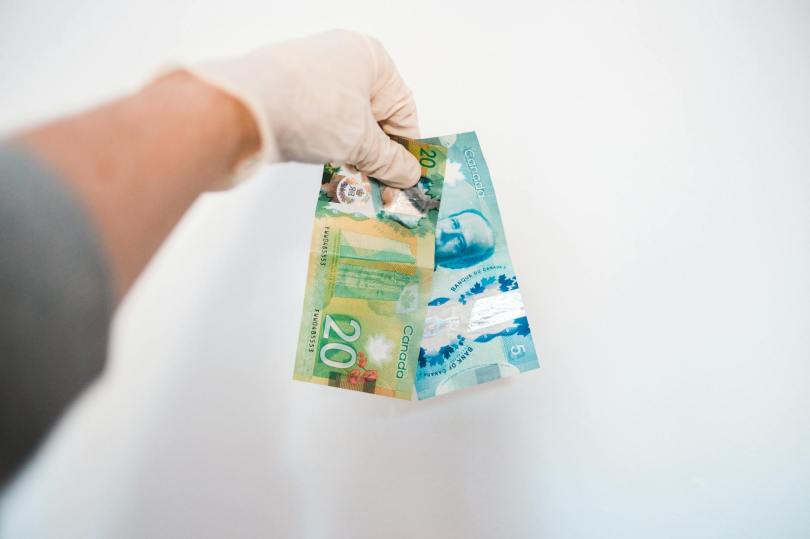
Credit Card Cheapskate

I try to take advantage of free money whenever it is tossed my way. (You will have seen this demonstrated by my chasing of free money from online brokers). A recent visit to Costco triggered a credit card assessment exercise, something I haven’t done for a while. The staffer at Costco suggested that given my affinity for shopping at Costco, perhaps a Costco Mastercard would be a better fit for me?

My current household1 go-to credit card2 is a fee-based cashback Mastercard from CIBC3. I chose this card some time ago because I got tired of points-based cards and their infuriating habit of changing the rules/exchange rates/partners with little notice (I think I had an Aeroplan card at some point and could never seem to book the flights I wanted). The card we use is pretty simple — get cash back with any purchase, no limit, but the percentage of cash one gets back changes as one spends. It starts low (0.5%), then climbs higher and higher (1%, 1.5% and 2%) before hitting a cap and setting all purchases thereafter to 1% cashback4.

Anyway, the Costco card was more complicated, giving various cashback incentives depending on what I bought and where. I ran some numbers5 and yes, without making any changes to my habits, I could get more cash back than I was getting, but it wasn’t a lot more…I could improve the windfall by changing my shopping habits (e.g. buy gas at Costco) but at this point the thought of standing in queues for gasoline felt like unpleasant work and laziness set in.

But the exercise got me wondering…am I really using the best credit card?

It didn’t take long for me to uncover Rogers red Mastercards6, which come in two flavours: the basic and the “World Elite” for those with higher income. These cards look rather interesting:

  • No fees
  • Either 1% (basic) or 1.5%(World Elite) cashback on everything, increasing to 2% cashback if you use a Rogers service of some kind
  • No charge for additional cards
  • A 1.5x multiplier to your cashback if you use your cashback to pay for Rogers services
  • 2% cashback on US dollar transactions, increasing to 3%7 if you have a Rogers service8

What’s more, I’ve been noticing my Bell Fibe service bundle (internet, TV, home phone) getting more expensive with each passing month.

And so, my next cheapskate project is taking shape:

  • Apply for the Rogers card — done October 3rd, took only a few minutes
  • Get my hands on the card — received October 9th9
  • Switch from Bell to Rogers — I did the opposite a little over 2 years ago…It’s mildly painful, but very short lived, especially compared to the long drawn-out affair of switching online brokers. — executed October 9, installation pending
  • Switch preauthorized credit card transactions: numerous charities, Bell bill, Fizz bill, newspapers, Apple Pay… — I think I got them all as of October 10.
  • Cancel my “for fee” CIBC card10
  • Collect more free money
  • Do happy dance

  1. My wife and I both have cards linked to the same account so we both get rewarded for using the cards. ↩︎
  2. And close to 100% of my transactions are paid using credit — only the barber and bike shop I frequent are paid using debit. I don’t run balances on my credit card, ever. ↩︎
  3. This one: https://www.cibc.com/content/dam/personal_banking/credit_cards/agreements_and_insurance/dwe-mc-benguide-en.pdf ↩︎
  4. I didn’t actually remember this tiered model previously, maybe the card changed at some point? I dunno. ↩︎
  5. I actually downloaded all household credit card transactions for the last 12 months. ↩︎
  6. Offered by Rogers Bank, which I didn’t know was a thing… ↩︎
  7. Which wipes out the 2.5% foreign exchange charge, and then some. ↩︎
  8. There’s other travel insurance benefits tied to the World Elite version but I hold an annual travel policy with a third party provider that includes cancellation insurance for any reason. ↩︎
  9. So one problem I see is that the default credit limit is awfully low; unless I can up the limit in the not too distant future, I’ll have to rely on a 2nd card some months… ↩︎
  10. I try to stay with at most two credit cards. Given my Costco habit, having a Mastercard as one of them is mandatory. ↩︎

News: Wealthsimple ends cashback on prepaid Mastercard

Wealthsimple’s prepaid Mastercard (aka the Cash Card) has stopped offering cashback on purchases, effective October 2nd, 2025. Don’t confuse this with Wealthsimple’s Visa card, which is an actual credit card, and still offers a nice 2% cashback reward.

I’ve been a fan of Wealthsimple’s prepaid Mastercard for a while now. I wrote about it over here. My favourite feature of this prepaid Mastercard is that it does not charge the usual 1.5% foreign exchange fees most other credit cards bury in their transaction costs.

The demise of the 1% bonus isn’t a deal-breaker for me but it was nice while it lasted. The card is also noteworthy because it permits ATM access globally with no fees. This isn’t a feature I’ve used, but it might be of interest.

I signed up for the waitlist for Wealthsimple’s Visa card when it was released, but the rollout has been v-e-r-y slow, and I’m still waiting for that to materialize1. Once I get my hands on one, I will have no incentive to use the prepaid card since the Visa card also offers no-charge foreign exchange AND 2% cashback on all purchases. That’s a great deal.

  1. About every third post on Reddit’s Wealthsimple sub is complaining about the slow rollout. ↩︎

HISA and HISA-like ETF Table for October 2025

HISAs are “High Interest Savings Accounts” and offer a nearly zero risk, highly liquid way to earn some interest on your cash holdings. If your broker doesn’t give you access to HISAs (or you have to pay large transaction fees to acquire them), then there’s also ETFs that fit the bill, and some of them are now in this table, too.

Since there’s no central bank meetings until the very end of this month, most of the September 2025 version of this table applies. The exception are the ETFs, which publish new yields monthly, so those figures are updated in the table below:

ProviderFundLinkRate SheetRate
RBCRBF2011, RBF2021, RBF2031, RBF2041RBCLink2.30%
ScotiabankDYN6004, DYN5004, DYN3065, DYN3055, DYN3075ScotiabankLink2.45%
Equitable BankEQB1001, ETR1001Equitable Bankn/a2.30%
TDTDB8151, TDB8156, TDB8158, TDB8160TDn/a2.30%
RenaissanceATL5071Renaissancen/a2.30%
Home TrustHOM101,
HOM201
Home TrustLink2.40%
B2BBTB101B2B Bankn/a2.40%
ManulifeMIP610, MIP810Manulifen/a2.15%
National BankNBC200, NBC6200, NBC8200NBI Altamira CashPerformern/a2.30%
Global XCASHCASH Fact Sheetn/a2.39%1
EvolveHISAHISA Fact Sheetn/a2.39%2
BMOZMMKZMMK Fact Sheetn/a2.76%3
Canadian HISA and HISA-like ETF rates, last updated October 3 2025

ZMMK is a very short-term bond fund that carries more risk than a HISA, but gives a slightly better return as a result. ZMMK appears in my ETF All-Stars list.

Since I hold a substantial amount of USD-denominated ETFs, I also track US interest rates.

ProviderFundLinkRate SheetRate
RBCRBF2015RBCLink3.90%
ScotiabankDYN6005,
DYN5005
ScotiabankLink3.90%
Equitable BankEQB1101,
ETR1101
Equitable Bankn/a3.80%
TDTDB8153TDn/a3.90%
RenaissanceATL5075Renaissancen/a3.90%
ManulifeMIP611Manulifen/a3.05%
National BankNBC201NBI Altamira CashPerformern/a3.90%
Global XUCSHUCSH Fact Sheetn/a3.96%4
EvolveHISUHISU Fact Sheetn/a3.96%5
iSharesICSHICSH Fact Sheetn/a4.48%6
USA HISA and HISA-like ETF rates, last updated October 3, 2025

UCSH and HISU invest in HISAs exclusively; I instead use ICSH which is a rough equivalent of ZMMK in terms of portfolio makeup. Like ZMMK, I enjoy a slight premium in yield as a reward for taking a bit more risk.

  1. September 29 distribution ↩︎
  2. September 25 distribution ↩︎
  3. September 29 distribution ↩︎
  4. September 29 distribution ↩︎
  5. September 25 distribution ↩︎
  6. October 1 distribution ↩︎

What’s in my non-registered portfolio? (Oct 2025)

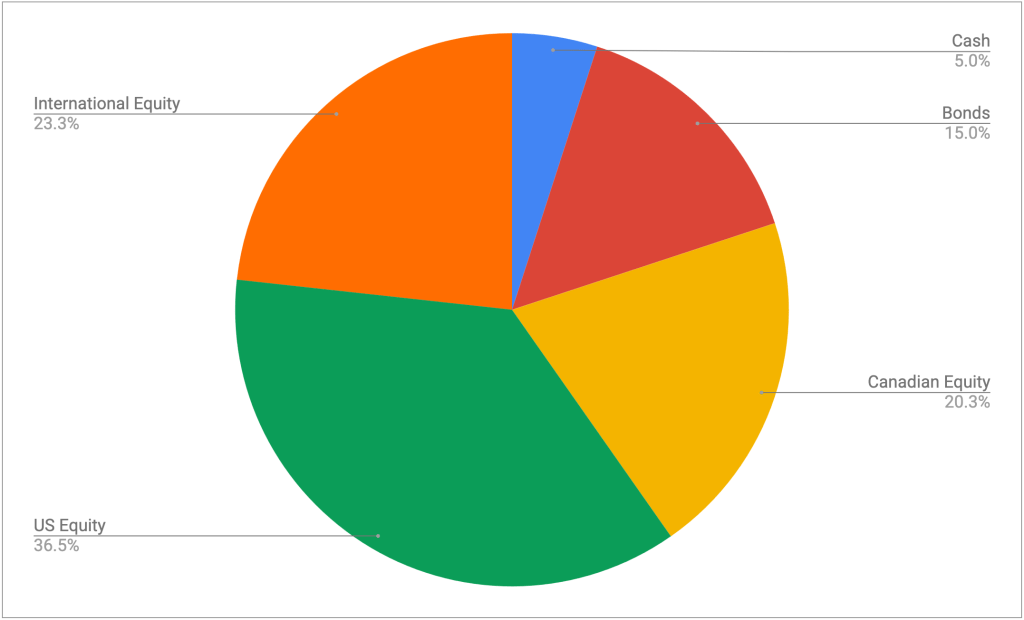
Every month, I try to share with you what’s in my overall retirement portfolio (September 2025 post is here). That retirement portfolio is actually distributed over a bunch of accounts held by me and my spouse and includes RRIFs, TFSAs and non-registered accounts. This is what it looks like at the moment:

Retirement savings as of October 1, 2025 by account type

(My multi-asset tracker is a handy tool to help you quickly create charts that look like the above one).

My current strategy for these three account types looks like this:

  • RRIF: This is 100% invested in my ETF all-stars. I’m currently withdrawing RRIF minimum payments for two main reasons:
    • To avoid problems with attribution. I cover that topic over here.
    • To avoid withholding tax. RRIF minimum payments don’t attract withholding tax, but I am setting aside some of my payments to deal with the unavoidable tax bill come April 2026. I talked about that topic over here.
  • TFSA: This is mostly invested in the ETF all-stars, but there’s a few stragglers in here1 that I really ought to get rid of. Nothing wrong with the funds in there, but it’s a needless complexity. The TFSA continues to get new funds since it’s hard to beat tax-free growth, and I only buy all-stars with those funds. It will get drawn down last in my retirement planning.
  • Non-registered accounts: Here it’s a bit of a dog’s breakfast, with very little invested in the all-stars, mostly because most of the equity found here was bought long ago, and changing what I hold would attract capital gains that I would prefer to take on my own terms. It’s where the majority of my early-retirement decumulation takes place.

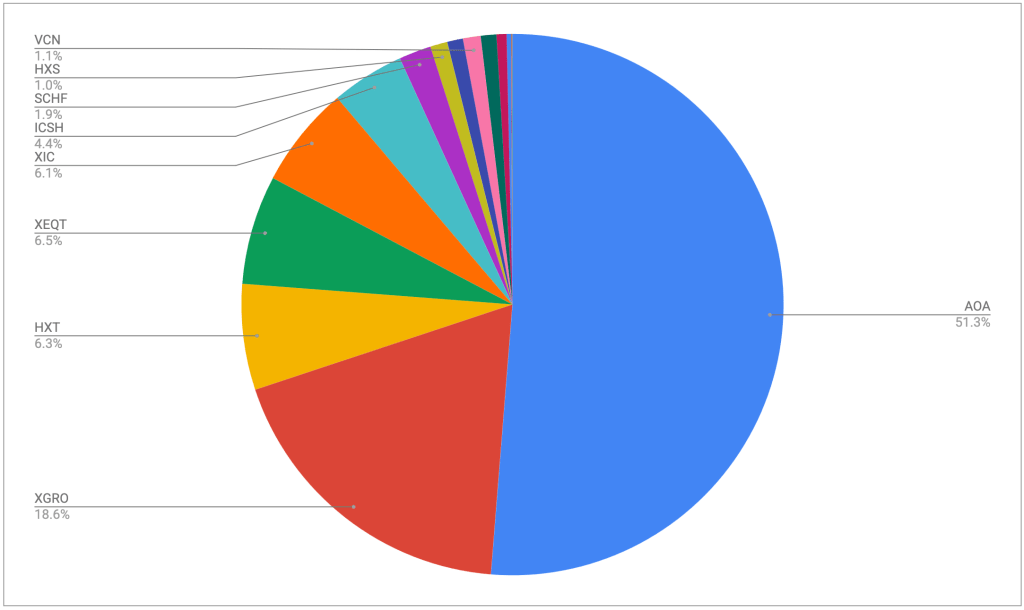
Here’s what that breakfast looks like:

What’s in my non-registered portfolio, October 2025

Here’s a look at each holding, from highest to lowest percentage.

HXT: This is a Canadian equity ETF that does not pay dividends, instead using some wizardry to bury it all in the per-unit price of the ETF. This simplifies taxes, and I have held this fund for a long time. Due to increasing costs of this ETF, it’s among the first to get liquidated as I need funds.

XIC: Canadian equity fund, very popular. I think I bought it to create a bit of dividend income. It will get liquidated after the Horizons funds go (HXS, HXT, HXDM).

SCHF: A very low-cost international equity2 fund in USD that I’ve held for a very long time. It’s funds like SCHF that attracted me to investing in USD, which, at present, adds a lot of complexity.

ICSH: This is one of the all-stars. It is what my VPW cash cushion is invested in3. I use ICSH more than ZMMK in the cash cushion because US interest rates are quite a bit higher than Canadian rates at the moment. I talked about that here.

HXS: Same idea as HXT, except it invests in the S&P 500. This one is held only by my spouse who is still working for a living, so this will just stick around a while, until she stops working and can take on the capital gains.

VSC: A bond fund held by my spouse. I may sell this to harvest some capital gains losses.

HXDM: Same idea as HXT, except international equity. It is on the list to liquidate.

ZMMK: An all-star, held in the same account as ICSH.

The rest (XEQT, TEQT, XGRO) are all new arrivals in the portfolio, purchased using dividends4 from the other funds as well as the bonus payments I keep collecting from Questrade for switching to them.

My non-registered accounts are only a small portion of my retirement holdings, but there’s a fair bit of complexity there. Over time, these accounts will go to zero other than the cash cushion portion (ZMMK, ICSH or whatever replacements I discover) which will remain as long as VPW is my decumulation strategy.

  1. Mostly pure Canadian equity funds. This is to offset AOA that has next-to-no Canadian equity component. ↩︎
  2. 0.03% MER. Cheap! ↩︎
  3. VPW = Variable Percentage Withdrawal, an absolutely brilliant strategy for making sure you don’t run out of money in retirement and don’t leave a lot on the table. Read all about it here. ↩︎
  4. With all ETF trades being free, I hold very little actual cash in any of my accounts. ↩︎