What’s in my non-registered portfolio? (Oct 2025)

Every month, I try to share with you what’s in my overall retirement portfolio (September 2025 post is here). That retirement portfolio is actually distributed over a bunch of accounts held by me and my spouse and includes RRIFs, TFSAs and non-registered accounts. This is what it looks like at the moment:
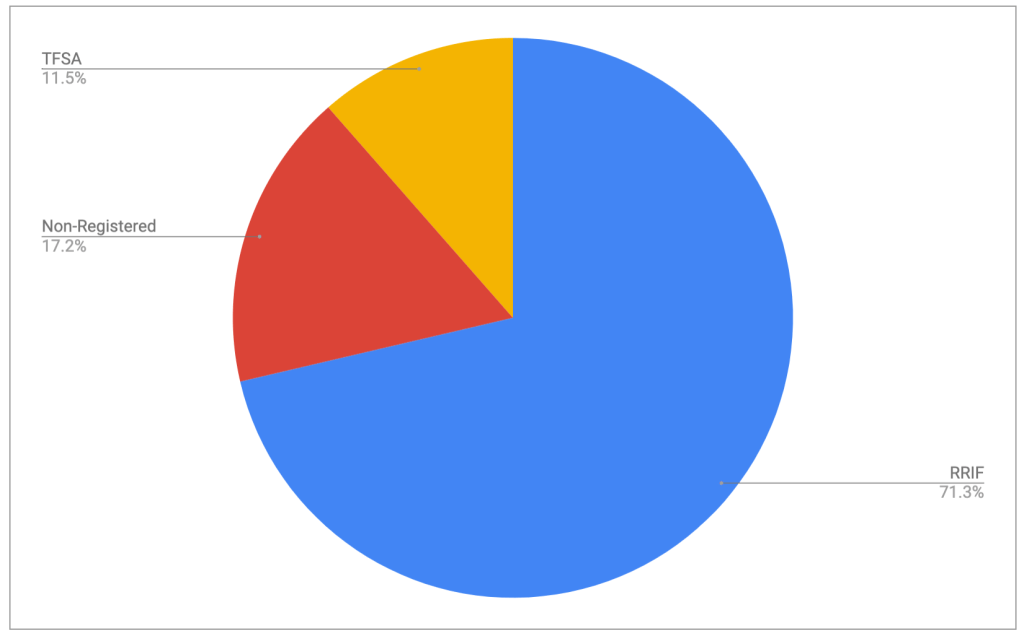
Retirement savings as of October 1, 2025 by account type

(My multi-asset tracker is a handy tool to help you quickly create charts that look like the above one).

My current strategy for these three account types looks like this:

  • RRIF: This is 100% invested in my ETF all-stars. I’m currently withdrawing RRIF minimum payments for two main reasons:
    • To avoid problems with attribution. I cover that topic over here.
    • To avoid withholding tax. RRIF minimum payments don’t attract withholding tax, but I am setting aside some of my payments to deal with the unavoidable tax bill come April 2026. I talked about that topic over here.
  • TFSA: This is mostly invested in the ETF all-stars, but there’s a few stragglers in here1 that I really ought to get rid of. Nothing wrong with the funds in there, but it’s a needless complexity. The TFSA continues to get new funds since it’s hard to beat tax-free growth, and I only buy all-stars with those funds. It will get drawn down last in my retirement planning.
  • Non-registered accounts: Here it’s a bit of a dog’s breakfast, with very little invested in the all-stars, mostly because most of the equity found here was bought long ago, and changing what I hold would attract capital gains that I would prefer to take on my own terms. It’s where the majority of my early-retirement decumulation takes place.

Here’s what that breakfast looks like:
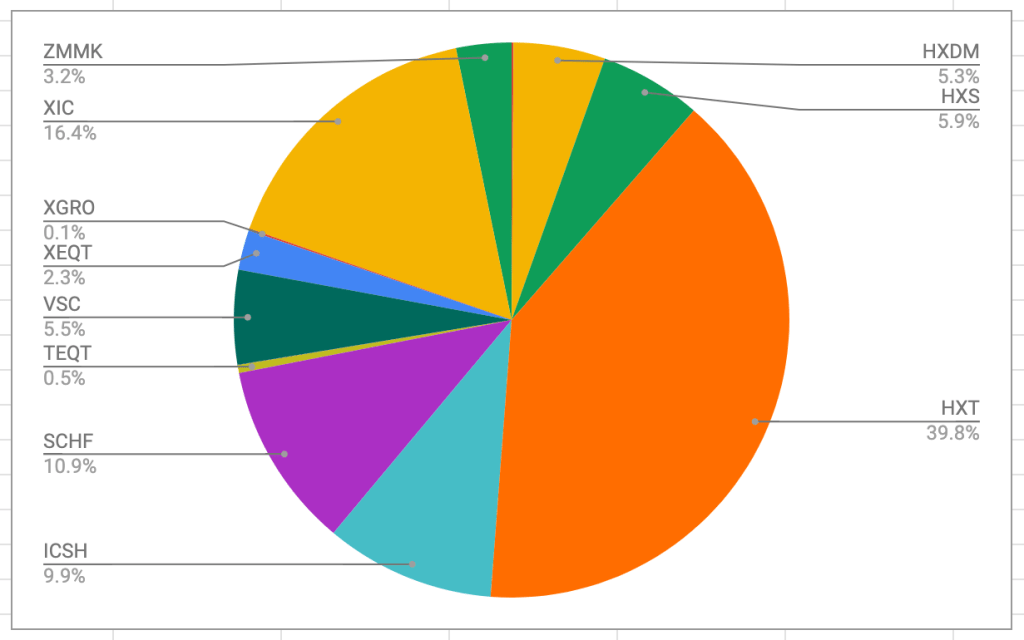
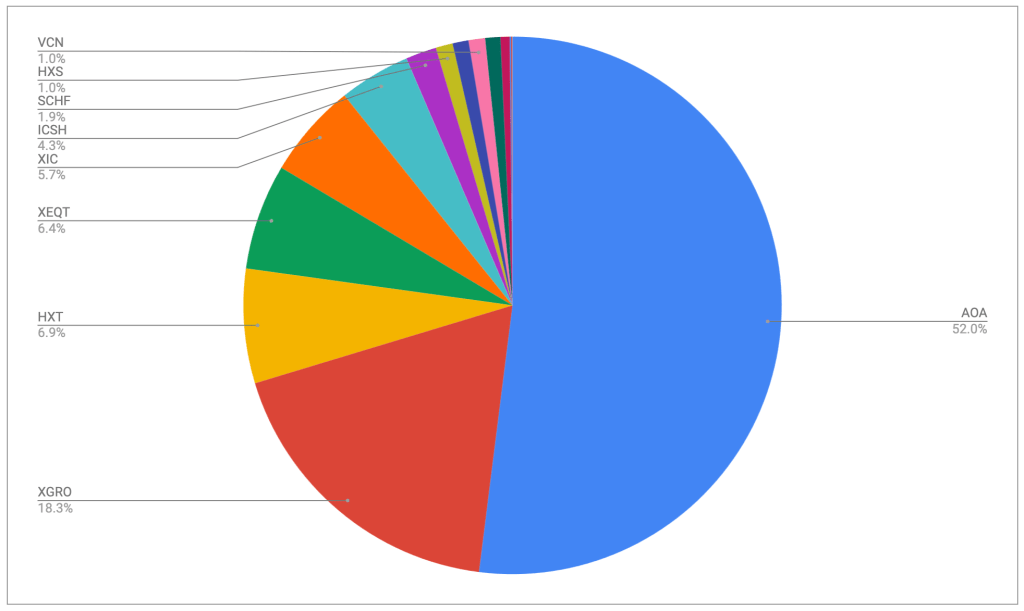
What’s in my non-registered portfolio, October 2025

Here’s a look at each holding, from highest to lowest percentage.

HXT: This is a Canadian equity ETF that does not pay dividends, instead using some wizardry to bury it all in the per-unit price of the ETF. This simplifies taxes, and I have held this fund for a long time. Due to increasing costs of this ETF, it’s among the first to get liquidated as I need funds.

XIC: Canadian equity fund, very popular. I think I bought it to create a bit of dividend income. It will get liquidated after the Horizons funds go (HXS, HXT, HXDM).

SCHF: A very low-cost international equity2 fund in USD that I’ve held for a very long time. It’s funds like SCHF that attracted me to investing in USD, which, at present, adds a lot of complexity.

ICSH: This is one of the all-stars. It is what my VPW cash cushion is invested in3. I use ICSH more than ZMMK in the cash cushion because US interest rates are quite a bit higher than Canadian rates at the moment. I talked about that here.

HXS: Same idea as HXT, except it invests in the S&P 500. This one is held only by my spouse who is still working for a living, so this will just stick around a while, until she stops working and can take on the capital gains.

VSC: A bond fund held by my spouse. I may sell this to harvest some capital gains losses.

HXDM: Same idea as HXT, except international equity. It is on the list to liquidate.

ZMMK: An all-star, held in the same account as ICSH.

The rest (XEQT, TEQT, XGRO) are all new arrivals in the portfolio, purchased using dividends4 from the other funds as well as the bonus payments I keep collecting from Questrade for switching to them.

My non-registered accounts are only a small portion of my retirement holdings, but there’s a fair bit of complexity there. Over time, these accounts will go to zero other than the cash cushion portion (ZMMK, ICSH or whatever replacements I discover) which will remain as long as VPW is my decumulation strategy.

  1. Mostly pure Canadian equity funds. This is to offset AOA that has next-to-no Canadian equity component. ↩︎
  2. 0.03% MER. Cheap! ↩︎
  3. VPW = Variable Percentage Withdrawal, an absolutely brilliant strategy for making sure you don’t run out of money in retirement and don’t leave a lot on the table. Read all about it here. ↩︎
  4. With all ETF trades being free, I hold very little actual cash in any of my accounts. ↩︎

Managing decumulation as one gets older

My approach to investing for the last 20 years or so has been almost exclusively1 DIY. The other popular approach to investing is to have a fee-based advisor who typically charges anywhere from 1% to 2% of your overall holdings. For that princely sum, you probably get an in-person meeting or two annually, all the trades deemed necessary, and some nicely formatted full-colour report once a year. Value for money for a fee-based advisor is too low for me to consider it. Nobody will ever care as much about my own investments as I do.

I am trying to be realistic about the future, however. My current retirement payment scheme is rather labour-intensive, for instance:

  • I have to manually sell RRIF funds every month to make my RRIF-minimum payments. This normally means selling XGRO which makes up the bulk of my RRIF accounts.
  • I have to manually move money around between brokerage accounts to tweak VPW’s cash cushion; excess funds here get invested in ZMMK or ICSH so they generate a return
  • Since RRIF-minimum payments are not currently sufficient to fund my lifestyle, I augment this with sales of non-registered funds…and I have to pick which fund to sell considering capital gains impact as well as asset-allocation2
    • …and I have to manually move the cash resulting from the sale to my bank account
  • I continue to maintain a heavy allocation to USD-denominated funds, and since most of my spending is in Canadian dollars, I have to systematically3 convert my USD holdings to CAD, typically using Norbert’s Gambit
  • And I continue to contribute to a TFSA monthly, so appropriate4 purchases have to made there, too

So I will start looking at alternative (and more costly) arrangements. Right now, I’m thinking robo-advisors5.  Off the top of my head, there are three I want to take a look at:

  • Nest Wealth: They are immediately interesting to me because of their flat fee structure. Most other advisors charge you a percentage based on the size of your portfolio, which strikes me as unfair. Is a 50k portfolio really ten times easier to manage than a 500k portfolio? If you looked at the fees most providers charge, you’d believe it to be the case.
  • Wealthsimple: I do self-directed business with Wealthsimple today, and have actually talked to one of their advisors about this service. I need to understand their service better.
  • Questrade: I do self-directed business with Questrade today. I’ve not investigated their robo-advisor service much.

Is there a robo that you use that I should know about? Let me know at comments@moneyengineer.ca!

  1. Before I retired this year, I did pay for an advice-only advisor to make sure my retirement savings would support my retirement needs. I do recommend doing that, as it’s helpful to have somebody else look at your numbers if only for peace of mind. Beyond that, I don’t pay any management fees except what’s embedded in the ETFs I use, most of which are on my ETF All-Stars list. ↩︎
  2. Meaning, for example: should I sell HXT (a fund fully invested in Canadian equities) or HXS (a fund fully invested in US equities)? Should I sell from MY non-registered account or that of my spouse? ↩︎
  3. Currently quarterly, at a rate consistent with the percentages dictated by RRIF minimum. For example, at age 57, RRIF minimum is 3.03% of RRIF value. So in January, I look at how many USD I have in my RRIF, multiply that by 3.03%, and divide by 4. That determines how much USD I have to convert every quarter. . ↩︎
  4. Relying on my multi-asset tracker spreadsheet ↩︎
  5. This term seems to be falling out of fashion in favour of “managed” portfolios. As long as the fees are low, they will be robo-advisors to me… ↩︎

What’s in my retirement portfolio (Sept 2025)

This is a monthly look at what’s in my retirement portfolio. The original post is here. Last month’s is here.

Portfolio Construction

The retirement portfolio is spread across a bunch of accounts:

  • 7 RRIF accounts (3 for me, 3 for my spouse, 1 at an alternative provider as a test)
  • 2 TFSA accounts
  • 4 non-registered accounts, (1 for me, 1 for my spouse, 2 joint)

The target for the overall portfolio is unchanged:

  • 80% equity, spread across Canadian, US and global markets for maximum diversification
  • 15% Bond funds, from a variety of Canadian, US and global markets
  • 5% cash, held in savings-like ETFs.

You can read about my asset-allocation approach to investing over here.

The view post-payday

I pay myself monthly in retirement, so that’s a good trigger to update this post. At market close, September 25, this is what it looks like:

Retirement holdings by ETF, September 2025

The portfolio is dominated by my ETF all-stars; anything not on that page is held in a non-registered account and won’t be fiddled with unless it’s part of my monthly decumulation. Otherwise I’ll rack up capital gains for no real benefit.

No massive changes this month; the one you might notice is a reduction in HXS, which holds US stocks exclusively. I picked this one to sell out of my non-registered accounts as my US equity allocation was a bit high.

Plan for the next month

The asset-class split looks like this

It’s looking pretty close to the targets I have, which are unchanged:

  • 5% cash or cash-like holdings like ICSH and ZMMK
  • 15% bonds (almost all are buried in XGRO and AOA)
  • 20% Canadian equity (mostly based on ETFs that mirror the S&P/TSX 60)
  • 36% US equity (dominated by ETFs that mirror the S&P 500, with a small sprinkling of Russell 2000)
  • 24% International equity (mostly, but not exclusively, developed markets)

I don’t need to make serious changes at this juncture, but there will be some need to make some noticeable tweaks in the coming month:

  • Q3 dividends will flow in to the account which will make for some movement, especially in XGRO and AOA. (Payout date for XGRO is September 29th , AOA is estimated to be October 8th.
  • I will need to convert some of my US RRIF holdings into CAD. I do this quarterly. Why quarterly? It allows me to smooth out any big swings in the FX rate over the course of the year. This will show up as a reduction in AOA and an increase in XGRO next month.
  • And, at the very end of October, AOA will rebalance. This is not foreseen to be a big deal.
  • All these moves will be tracked through my multi-asset tracker; it may be I have to buy a bit more foreign equity as I see I’m a touch light in that category.

Overall

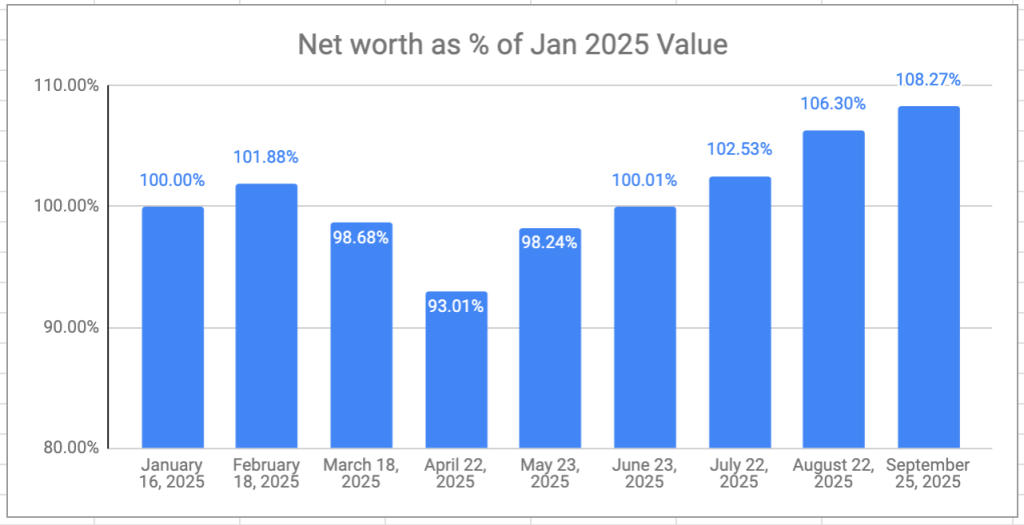
The retirement savings had a great month, again. Overall, I’m now 8% ahead of where I started even though I’ve been drawing a monthly salary since the beginning of the year. This is aligned with what my retirement planner told me to expect, but as you can see, the journey has had some interesting ups and downs already.

Monthly retirement savings, as percentage of Jan 2025 value

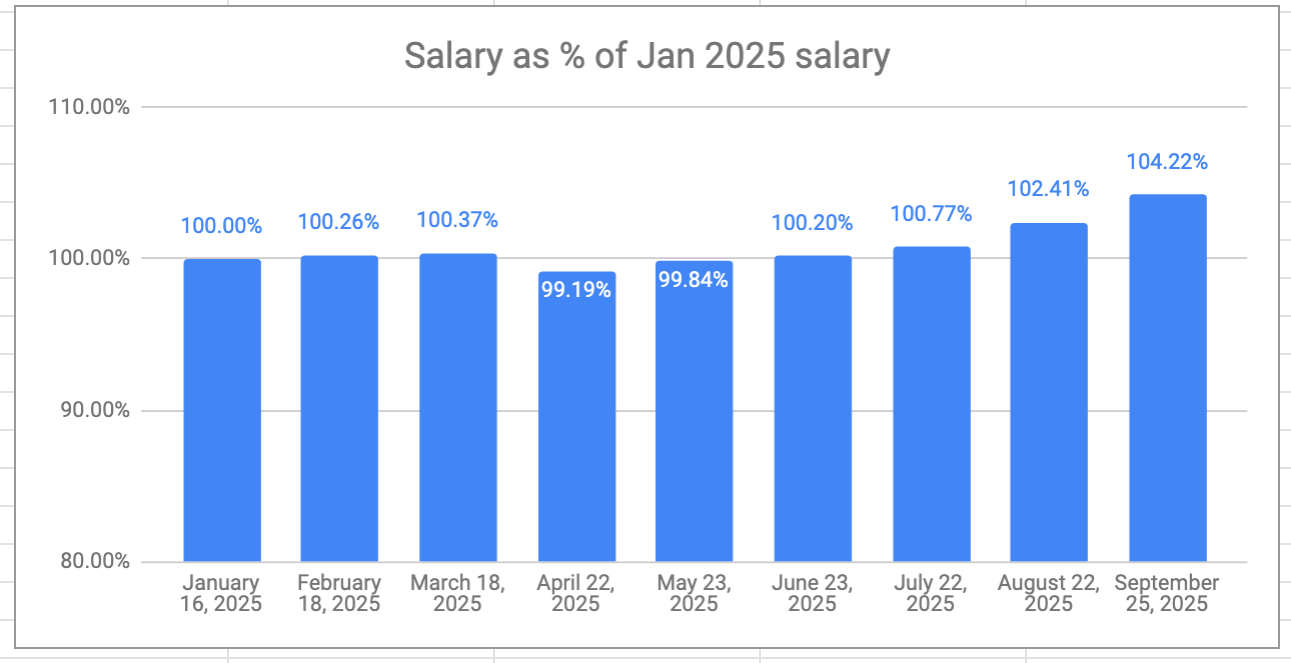
My VPW-calculated salary has hit a new high this year, 4.22% higher than my first draw in January1. This is also expected, since it tracks the value of the retirement portfolio, albeit in a much more controlled way. The VPW “cash cushion” smooths out the ups and downs of the monthly returns. I suppose I really should see an increase in my salary on par with inflation so that I maintain my spending power. I’ll have to think about how to track that2.

Monthly salary, as percentage of Jan 2025 salary

Online brokerage promos: when does the gravy train end?

Online brokers are busily throwing money around to attract new customers; a quick search reveals many active promotions as I write this from Webull Canada, RBC, TD, QTrade, Wealthsimple….All of it has a bit of “if this seems too good to be true, it probably is” flavour to it.

I asked this same question on Reddit and the consensus seemed to be that this is the new normal in the online brokerage world, just like it’s normal for telcos/cablecos/ISPs to throw around big discounts in order to steal customers from one another.

But yet, I feel a little uneasy how money for nothing has become the norm. For DIY investors like me, it’s hard to see how my providers make any money off of me. I did a bit of research into the best proxy I could think of…Robinhood.

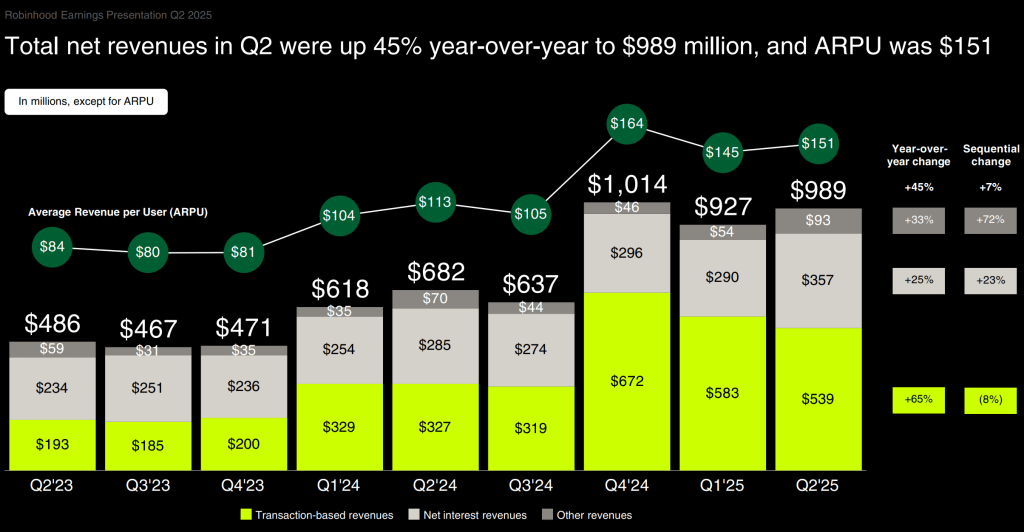
As I mentioned in a previous post, Robinhood is now part of the S&P 500 lineup; this is no fly-by-night company. Their quarterly results are public, and it was quite illuminating. Robinhood’s most recent quarter’s results are shown below.

Robinhood revenue sources: Source Robinhood Q2 2025 Earnings Presentation

So it looks pretty straightforward; revenue is coming from three sources, and their average revenue per user (ARPU) is a pretty healthy $151 dollars. Let’s look a bit further:

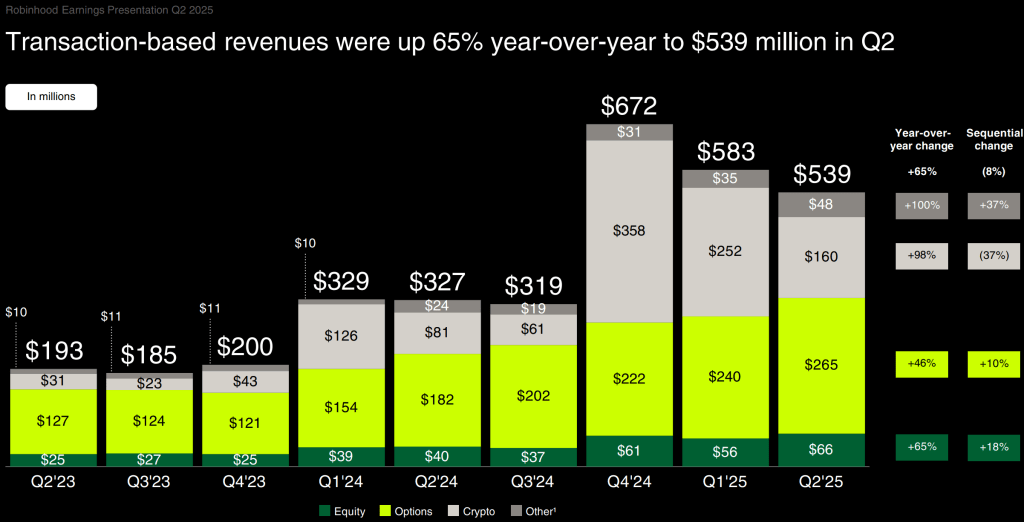
  • Transactions: Options trading and Crypto trading make up the bulk of the revenues here, but roughly 15% of their transaction revenue comes from basic equity trades ($66M in Q2’25).
  • Interest: a large chunk of this is interest made from margin ($114M in Q2’25), but a growing percentage comes from credit card interest charges.
  • “Other”: not elaborated further, but it’s small, so we can ignore it. Perhaps this accounts for the revenue from their 3.5M “Robinhood Gold” subscribers1

The transaction revenue was surprising to me since equity trades are free on Robinhood, yet they are still finding a way to make money. Further reading indicates that the exchanges are sharing some of their bid/ask spread revenue with Robinhood, which seems like a win/win/win: Robinhood makes a tiny bit of revenue on each trade, the exchange gets more volume which allows them to make more spread revenue, and the customer gets free trades2.

Robinhood transaction revenue: Source Robinhood Q2 2025 Earnings Presentation

So, assuming the Wealthsimples and Questrades of the world are following Robinhood’s lead, they are making money off of me every time I place a trade. (Sorry, I don’t trade options, I don’t trade crypto, I don’t trade on margin, and I don’t run a balance on any credit card I use). Since switching to Questrade (and getting free trades) I can tell you that my own behaviour has changed; I have always hated seeing non-productive cash in any of my accounts, and so with free trades, I can freely buy one share of something to clean up the last dribs of cash I may have in any given account. My “getting paid in retirement” strategy also requires a monthly flurry of trades (see the details here).

All this to say I feel less uneasy about the free money being thrown around; Canada’s online brokerage community seems to be following a successful playbook:

  • Get lots of customers, even if you have to pay them to get on board
  • Expand your offers, especially profitable offers, and entice as many of your army of fans to use them (crypto, margin trading, options trading, credit cards, subscription offers)
  • Invest just enough in your platform to not lose too many clients; switching online providers can take a lot of work (I know, I did it: read more here)

So my advice is to absolutely take advantage of the free money out there and enjoy the gravy!

  1. Perhaps serving as the inspiration for Questrade Plus? ↩︎
  2. Not everyone thinks this is a great idea ↩︎