The Mechanics of Getting Paid in Retirement: 2026 Edition

DIY investing also means DIY decumulation. In 2026, I’ll be paying myself from my various RRIFs as well as from non-registered funds. I’ll refer to the letters in the diagram below so you can follow along1:

A: Calculate Net Worth over all retirement accounts

“Retirement accounts” include 3 non registered accounts, 2 TFSAs and 5 RRIF accounts. All of these are at Questrade except for one RRIF account held at Wealthsimple. My net worth calculation ignores my day-to-day spending accounts, and any other assets (my house, for example). In 2026 I could look up this number using Passiv, but I’m not 100% clear on what the fate of my Passiv account will be once Questrade cuts ties with them (March 2026). I still have a spreadsheet with lots of details and pretty graphs based on my multi-asset tracker.

B: Use VPW Methodology to Calculate Monthly “Suggestion”

VPW stands for “Variable Percentage Withdrawal” and it’s the playbook I use to guide my monthly withdrawals from my retirement accounts. I talk a bit about it here. The suggestion is generated by a VPW spreadsheet, but the inputs are pretty simple:

  • current net worth
  • current age
  • current pension amounts2
  • future pension amounts, and age you’ll be when you take them3
  • asset allocation breakdown (%stocks versus %bonds)

This “suggestion” represents the maximum value of the assets I am advised to sell this month. You could take more or you could take less. It’s merely a suggestion. For me, I take the suggestion at face value and sell the assets needed to meet the value of the “suggestion”.

C: Calculate the Salary

The “Suggestion” in step B is NOT your salary. The VPW methodology enforces one more step to calculate that. The VPW methodology requires the use of a “cash cushion”, which has the effect of making sure you don’t need to make drastic month-to-month changes in your salary, either upward or downward. The cash cushion is roughly 5x the “suggestion”4 and your salary is 1/6th of “suggestion” plus “cash cushion”. The “salary” represents the amount that will eventually turn up in your chequing account.

To make things easier to track, my “cash cushion” is a totally separate non-registered joint account that holds one of four things: Canadian dollars, US dollars, ZMMK or ICSH. I keep a little cash floating around in this account to avoid having to do monthly trades. It just makes tax reporting and ACB tracking a bit simpler, at a small loss of interest income. Also, Questrade doesn’t support fractional shares of either ZMMK or ICSH, and since they routinely trade at roughly $50/share, mathematically, I’ll always have $25 CAD and $25 USD on average 🙂

D/D’: Compare the Suggestion to the Salary and act accordingly

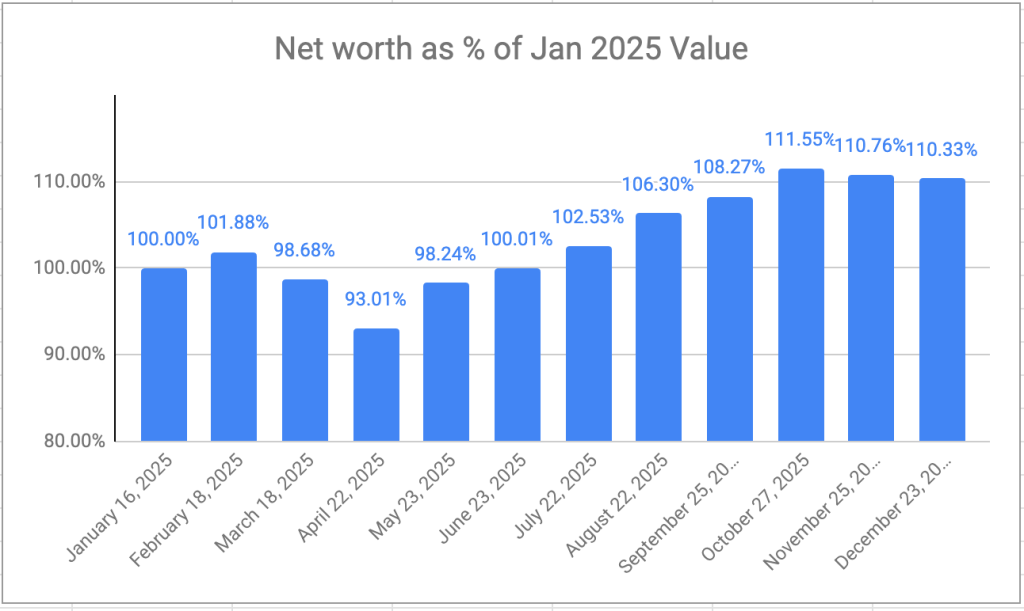
Since the cash cushion is effectively a 5-month moving average Salary, the Suggestion could be more than or less than the Salary. If my net worth is down (or up) month over month, then it follows that the Suggestion will also be down (or up) month over month. My Salary may or may not be down (or up), depending on how long the downturn has lasted. Just to give you a sense of how the cash cushion smooths out the market gyrations, you can see the comparision of net worth versus salary below. (Taken from my most recent monthly “What’s in my Retirement Portfolio” update.) The net worth moves quite a bit month-to-month (generally upward, which is nice), but my salary is much smoother (but also generally upward).

Anyway, what all this means is that I’m either going to move some of the Suggestion money into the cash cushion (because my Salary is less than the Suggestion), or I’m going to pay myself from the cash cushion because my Salary is higher then the Suggestion5. It’s one or the other; as yet, I haven’t had the Salary be equal to the Suggestion, but it is mathematically possible, of course.

E/E’: Make sure the 4 Questrade RRIFs have cash to cover the monthly payment

At the end of 2025, I’m expecting some sort of communication6 from Questrade as to what my minimum monthly7 RRIF withdrawal needs to be for 2026 for each of the four RRIF accounts in my household8. This is a standard “feature” of anyone holding a RRIF — your provider makes a calculation based on the value of your RRIF on the last day of the year and your age (or your spouse’s age) at the end of the year. That’s RRIF minimum — the minimum amount you’re obligated to take. This coming year, I’ll stick with RRIF minimum again to avoid having to deal with spousal attribution rules.

So for 2026, I will know exactly how much cash I will need every month in every Questrade RRIF account. And since I’ve done such a good job in simplifying my RRIFs9 (pats back) I can also calculate exactly how many shares of XGRO need to be sold in each RRIF account every month, in real time10.

So generally, this step involves placing 4 sell orders to put cash in the account.

The E’ step — moving cash from the RRIF to the chequing account — I’m expecting to be automatic, but since I haven’t had to do this with Questrade before, I’m not certain.

F/F’: Generate cash equal to RRIF minimum in the Wealthsimple account and move it to the chequing account

Like with Questrade, I’m expecting Wealthsimple to communicate my RRIF minimum. From what I can see from their website, it appears that they actually make it really obvious.

The same good work I did with my Questrade accounts is even better in my Wealthsimple RRIF account since I hold no USD at Wealthsimple. So here, and thanks to fractional shares, 100% of my RRIF is invested in XGRO, with no additional cash.

Their help article makes it sound like both F and F’ are under my control, which is fine. I’ll just do this step at the same time I do the Questrade step. Maybe I only have to do F’ once and pay out in “Installments”? Not sure.

G/G’: Use the non-registered account(s) to generate cash equal to Suggestion minus all the monthly RRIF payments

I already know my five RRIF minimum payments will fall well short of the VPW “Suggestion”, so every month I have to sell assets from the non-registered accounts to make up the shortfall. This cash will either go 100% to my chequing account or some of it may be diverted to the cash cushion.

Normally this comes from my, not my spouse’s, non-registered account. Since my spouse is still working, I leave hers alone to avoid generating capital gains. Unfortunately, my non-registered accounts are a bit of a dog’s breakfast, and although I’ve made efforts to use spreadsheet formulas to make automated suggestions11, it’s proving a bit more difficult.

In the end, this is again a sale of one or more assets. For step G’, I can then immediately use Questrade’s “Withdraw Money” to move the cash into my chequing account, or “Move Money” to move cash into the Cash Cushion account.

Conclusion

And that, my friends, are the steps I take monthly in retirement. I try to perform these steps in the dying days of every month while allowing enough time for trades to settle to ensure cash is well and truly in hand before I move it to my chequing account.

In my household, a very large portion of this process gets spit out as a step-by-step “do this, do that” set of instructions I’ve built into a macro-enabled spreadsheet. The trades required for Step G are still decided on the fly, manually. Of couse, given that Questrade has APIs, I could conceivably make automatic trades based on the work I’ve done, but I’m not sure I want to take that step. Retirement project?

  1. I don’t really know if any of my readers find this particular articl useful, exasperating or confusing. But for me, it’s useful to write down how it works! ↩︎
  2. For me, zero. ↩︎
  3. For me, CPP, OAS and the OAS supplement. The current plan is to defer CPP/OAS until age 70 to maximize my inflation-indexed income. ↩︎
  4. which, in my case, since I withdraw monthly, is about 5x my salary ↩︎
  5. I’ve run this algorithm ten times so far this year: 3 times I had to pay myself out of the cash cushion and 7 times I added to the cash cushion. That’s the general upward trajectory of this year’s market in action ↩︎
  6. My last provider, I actually called them to check. I had of course calculated it myself (and they were very close) but my numbers don’t matter to the CRA. I’m hoping Questrade makes it a bit more obvious, but I’m pessimistic. ↩︎
  7. I had set it up as monthly. I could’ve chosen quarterly or annually. I like monthly. ↩︎
  8. Individual and spousal RRIFs for each of us. ↩︎
  9. My RRIF accounts hold one of five assets: Canadian and US dollars (because I can’t buy fractional shares), ICSH, AOA, or XGRO. ICSH is held in RRIFs to keep me at 5% cash in my retirement overall, and I routinely convert (quarterly) AOA into XGRO using Norbert’s Gambit. ↩︎
  10. And yes, I have a macro-based spreadsheet that tells you exactly how many shares to sell at that moment based on share price and current cash in the account. ↩︎
  11. The most appropriate thing to sell in any given month is an asset for which I’ve become overweight per my multi-asset tracker. But when you hold all-in-ones in the portfolio, it’s a bit trickier to work that out. I just need to set aside some time to come up with a spreadsheet-based solution. I would much prefer this decision to be made algorithmically. ↩︎

News: Questrade Contest offers free money

Yup, it’s another promotion. Keep that gravy train going! This time, it’s a contest, so no guarantees, but the rewards are pretty nice if you happen to be so lucky.

  • $175k for your TFSA: (Ts and Cs here)
  • $50k for your RESP: (Ts and Cs here)
  • $40k for your FHSA: (Ts and Cs here)

In each case, all you need to do is to open and fund a new TFSA/RESP/FHSA account ($250), or contribute more than $250 to an existing account, or send a postcard with an essay (yes, really) before the end of the year. One entry per client, per investment vehicle. But you can only win ONE of the three prizes (shucks).

I wonder which contest will actually have the best odds? I contribute to my TFSA every month, so I guess I have a shot, too…

Mini-Review: ValueInvesting.io Backtesting

“Backtesting” is a commonly-used tactic to see how well the portfolio you have (or are considering) would have performed historically. While “past performance does not guarantee future results” it’s better than not knowing.

I stumbled upon valuetesting.io when I was trying to backtest…something, I don’t really remember what I was up to. Anyway, my random internet walk found valueinvesting.io, which seems to be chock full of all kinds of tools that I haven’t looked at, so I’m just going to focus on the backtesting tools, which I did spend a few hours playing around with. You have to navigate to https://valueinvesting.io/backtest-portfolio to access this portion, and if you want to save portfolios, you have to create an account.

So what, in a nutshell, does this tool do? In their words:

Our portfolio backtesting tool allows you to evaluate the historical performance of up to 3 portfolios. We support 2 portfolio types: asset classes and tickers (stock, ETF, mutual funds). Multiple backtesting scenarios are supported such as periodic capital inflows or outflows, allocation rebalancing frequency and leverage type. Our tool provides historical returns, risk metrics, drawdowns and rolling returns information about your selected portfolios.

https://valueinvesting.io/backtest-portfolio

Let’s take a look at the two kinds of portfolio types they support: asset classes and tickers.

Backtesting using asset classes

The downside of this tool as a Canadian investor is pretty obvious when you try to build a portfolio using asset classes. (Asset classes are integral to the way I think about my retirement portfolio — you can read more about my approach here.) There’s no “Canadian Equity” category to choose (boo!).

The class that would hold the most Canadian equity would be “Intl Developed ex-US Market”1, so let’s compare that to say the “US Large Cap” (which I take to be a good proxy for the S&P 500).

The good old S&P has left the rest of the developed world in the dust, it seems…Well, except for THIS year:

Anyway, the asset classes are good fun and all, but without a Canadian index to track, it’s not too useful to me. (And, inexplicably, nowhere could I find a definition of any of these in the tool, and an email to the support address remained unanswered at the time of publication). So let’s move on to something more interesting, namely the ticker backtesting!

Ticker Backtesting

As the name implies, this portion allows you to enter tickers, and there’s full and complete support for Canadian ETFs that I tried.

So of course I immediately tried to build my idealized portfolio, which is what my “What’s in my Retirement Portfolio” would look like without the non-registered assets2.

The problem? XEQT and XGRO (two of my ETF all-stars) haven’t been around all that long, and so I can’t backtest very far. No matter, by looking at the composition of XEQT and XGRO and doing some clever math, I can create the equivalent decomposed portfolio:

And I can prove that I got it right by backtesting the two against each other. Pretty good, eh?

So with my decomposed portfolio at the ready, I can compare its performance long-term against (for example) just buying the S&P 500 index (VOO) or the International Developed ex-US index (VEA).

As expected, my portfolio has quite a bit poorer performance than the S&P, but better than the International ex-US. The bond/cash component smooths out the standard deviations (that’s “volatility”) so my worst years (although still a bit scary) are still a bit less than experience of owning 100% equity.

One more thing to look at — this backtesting assumes we don’t rebalance anything. That’s not correct, since that’s one of the benefits of holding ETFs like AOA, XGRO and XEQT — they automatically rebalance periodically. valueinvesting.io lets you choose monthly, quarterly, semiannually and annually. I know for a fact that AOA rebalances twice a year, so we will assume XGRO/XEQT do the same. This is what the result looks like:

This reduces the volatility and the return a bit, which if you stop and think about it, makes sense: equities consistently outperform bonds and cash over time so the rebalancing exercise makes sure the equities remain at an 80% contribution to the portfolio.

Conclusion

The backtesting portion of valueinvesting.io is a good tool to test various combinations of ETFs / stocks you may be interested in. There’s not very much documentation on the site, but it’s easy enough to use. The free account (which requires registration) is enough to get you that far.

  1. Did a bunch of tests and determined that VEA was the ETF that matched the performance of this index most closely. This ETF is about 11% Canadian Equity. ↩︎
  2. The non-registered assets are being sold off, little by little, to fund my retirement. This year, they have provided about 2/3 of my “salary” (RRIF minimum payments gave me the other 1/3), so I am –slowly– drifting toward the ideal portfolio. The AOA percentage in the ideal portfolio will get smaller over time as I transmogrify it as needed to XGRO using Norbert’s Gambit. ↩︎

What’s in my retirement portfolio (Nov 2025)?

This is a monthly look at what’s in my retirement portfolio. The original post is here.

Portfolio Construction

The retirement portfolio is spread across a bunch of accounts:

  • 6 RRIF accounts (2 for me1, 3 for my spouse, 1 at an alternative provider as a test)
  • 2 TFSA accounts
  • 4 non-registered accounts, (1 for me, 1 for my spouse, 2 joint)

The target for the overall portfolio is unchanged:

  • 80% equity, spread across Canadian, US and global markets for maximum diversification
  • 15% Bond funds, from a variety of Canadian, US and global markets
  • 5% cash, held in savings-like ETFs.

You can read about my asset-allocation approach to investing over here.

The view post-payday

I pay myself monthly in retirement, so that’s a good trigger to update this post. On November 25th, this is what it looks like:

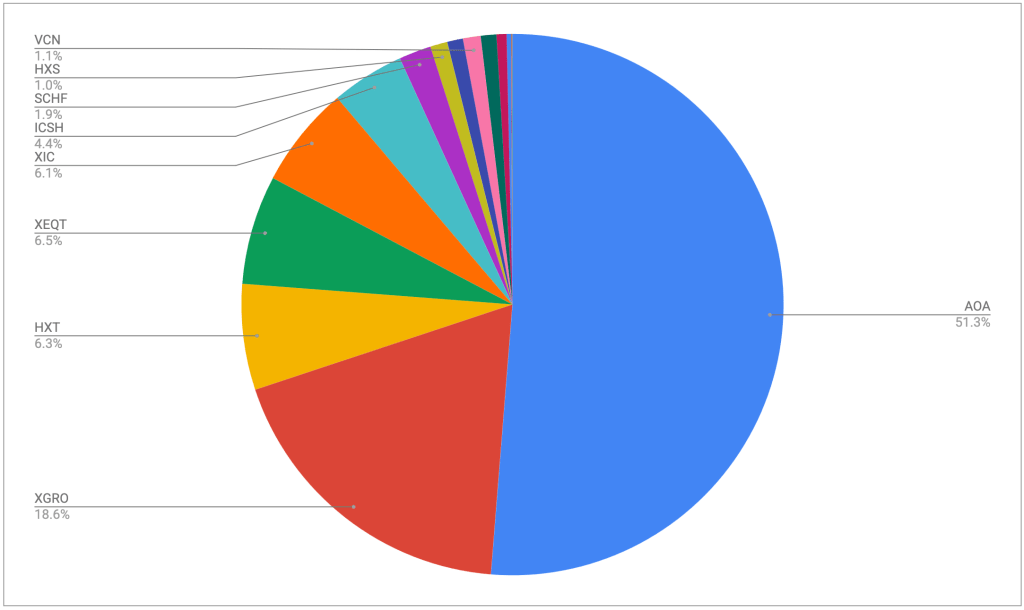
ETF Breakdown of retirement investments, November 2025

The portfolio is dominated by my ETF all-stars; anything not on that page is held in a non-registered account and won’t be fiddled with unless it’s part of my monthly decumulation. Otherwise I’ll rack up capital gains for no real benefit.

No notable changes this month; HXT is down slightly because that’s the fund I sold in my non-registered account this month to help pay the bills. I’ve sold quite a few shares of this fund this year and I’m seeing the capital gains mounting, but it’s around where I expected to be. I try to keep taxes owing reasonable; nonetheless I’m guessing I will certainly be moving to quarterly instalments in FY 2026; that’s the downside of having no withholding tax of any kind this year.

Plan for the next month

The asset-class split looks like this
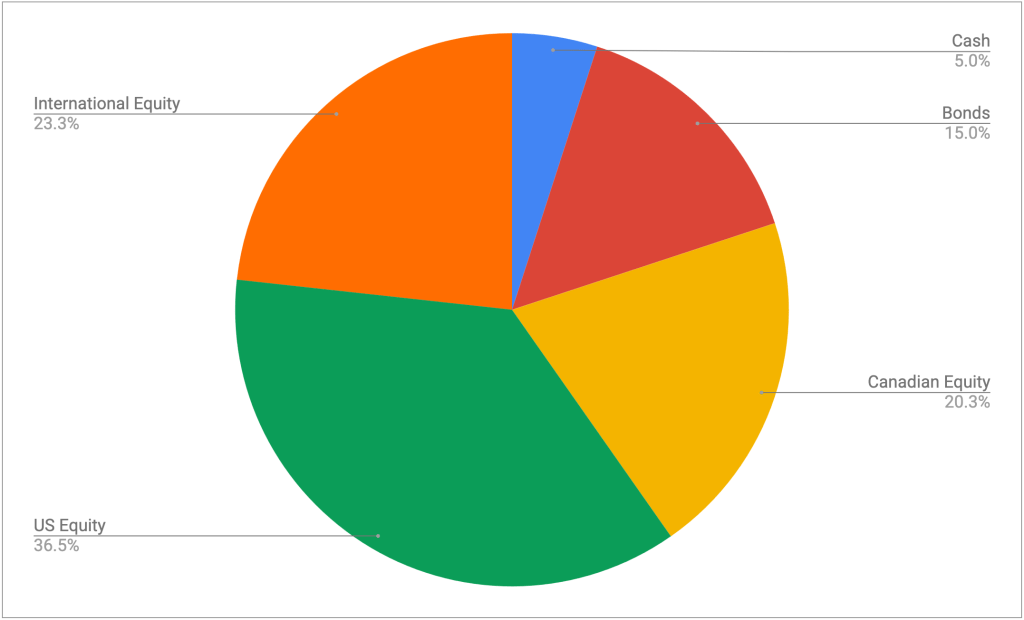
It’s looking pretty close to the targets I have, which are unchanged:

  • 5% cash or cash-like holdings like ICSH and ZMMK
  • 15% bonds (almost all are buried in XGRO and AOA)
  • 20% Canadian equity (mostly based on ETFs that mirror the S&P/TSX)
  • 36% US equity (dominated by ETFs that mirror the S&P 500)
  • 24% International equity (mostly, but not exclusively, developed markets)

All looks to be in order from an asset allocation perspective, no need to do anything here. Cash is slightly elevated as a result of the pending closure of the three remaining QTrade accounts and will drift back to the normal 5% over the coming few weeks, I expect.

Overall

Net worth overall stopped its 6 month winning streak and I’m down slightly month over month. But I will reiterate: my net worth is still growing even though I’m taking a living wage every month. You might think that “decumulation” means “a steady reduction in net worth” but it needn’t be the case. And, in my particular case, my retirement income will include no pensions, so it’s probably a good thing that it keeps increasing overall.

My VPW-calculated salary continues to grow for the 7th straight month in spite of the step back this month in my net worth. That’s a feature of the “cash cushion” that is integral to the VPW withdrawal. It serves as a shock absorber to the monthly ups and downs of the stock market.

Next month will end my relationship with QTrade as I move the final 3 RRIF accounts to Questrade2.

  1. My QTrade one is no more, transferred to Wealthsimple to take advantage of their Summer promotion. ↩︎
  2. I had hoped to move these to Wealthsimple and generate more free money, but alas, they still don’t support self-directed spousal RRIFs, which is very odd indeed. ↩︎