
What’s in my retirement portfolio (Oct 2025)

This is a monthly look at what’s in my retirement portfolio. The original post is here. Last month’s is here.

Portfolio Construction

The retirement portfolio is spread across a bunch of accounts:

  • 7 RRIF accounts (3 for me, 3 for my spouse, 1 at an alternative provider as a test)
  • 2 TFSA accounts
  • 4 non-registered accounts, (1 for me, 1 for my spouse, 2 joint)

The target for the overall portfolio is unchanged:

  • 80% equity, spread across Canadian, US and global markets for maximum diversification
  • 15% Bond funds, from a variety of Canadian, US and global markets
  • 5% cash, held in savings-like ETFs.

You can read about my asset-allocation approach to investing over here.

The view post-payday

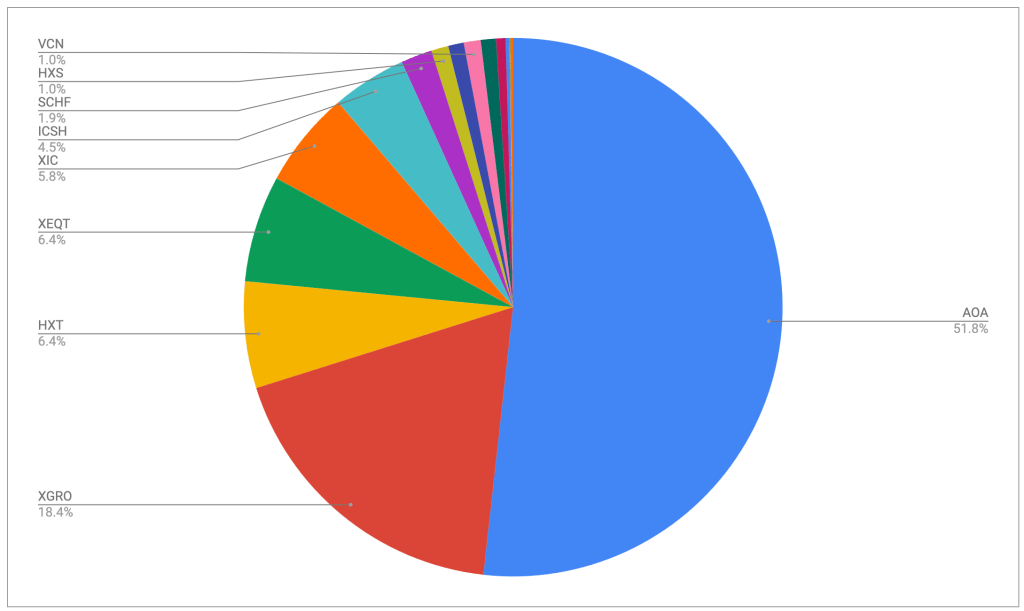
I pay myself monthly in retirement, so that’s a good trigger to update this post. On October 27th, this is what it looks like:

The portfolio is dominated by my ETF all-stars; anything not on that page is held in a non-registered account and won’t be fiddled with unless it’s part of my monthly decumulation. Otherwise I’ll rack up capital gains for no real benefit.

No massive changes this month; the one you might notice is a slight shift from AOA to XGRO. I move some of my USD holdings into CAD every quarter, and last month was when I did it. The majority of my spending is in CAD, so I use Norbert’s Gambit to move funds around.

Plan for the next month

The asset-class split looks like this
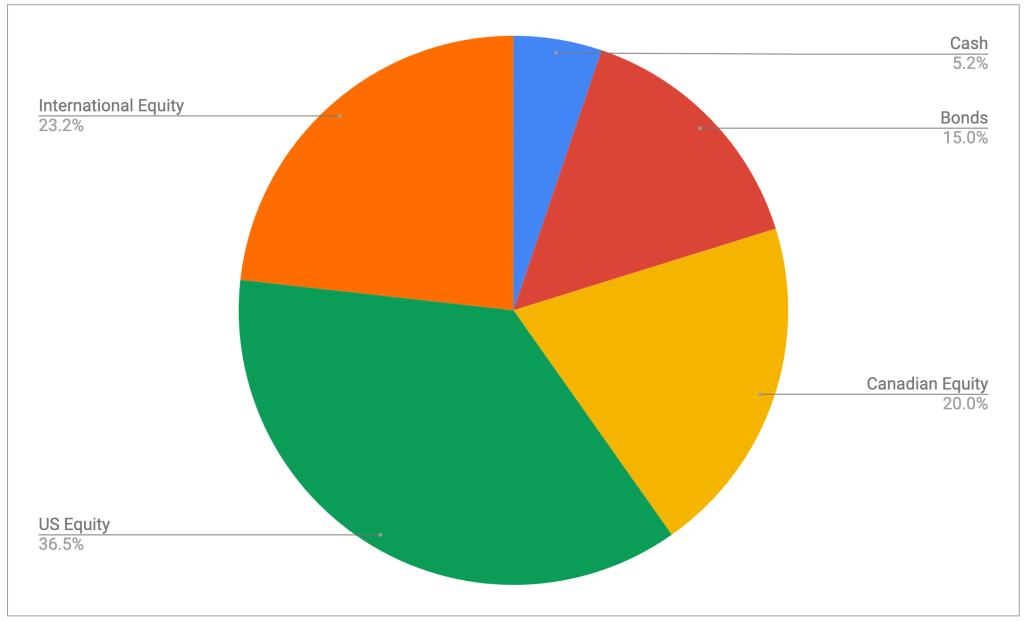
It’s looking pretty close to the targets I have, which are unchanged:

  • 5% cash or cash-like holdings like ICSH and ZMMK
  • 15% bonds (almost all are buried in XGRO and AOA)
  • 20% Canadian equity (mostly based on ETFs that mirror the S&P/TSX 60)
  • 36% US equity (dominated by ETFs that mirror the S&P 500, with a small sprinkling of Russell 2000)
  • 24% International equity (mostly, but not exclusively, developed markets)

All looks to be in order from an asset allocation perspective, no need to do anything here.

Overall

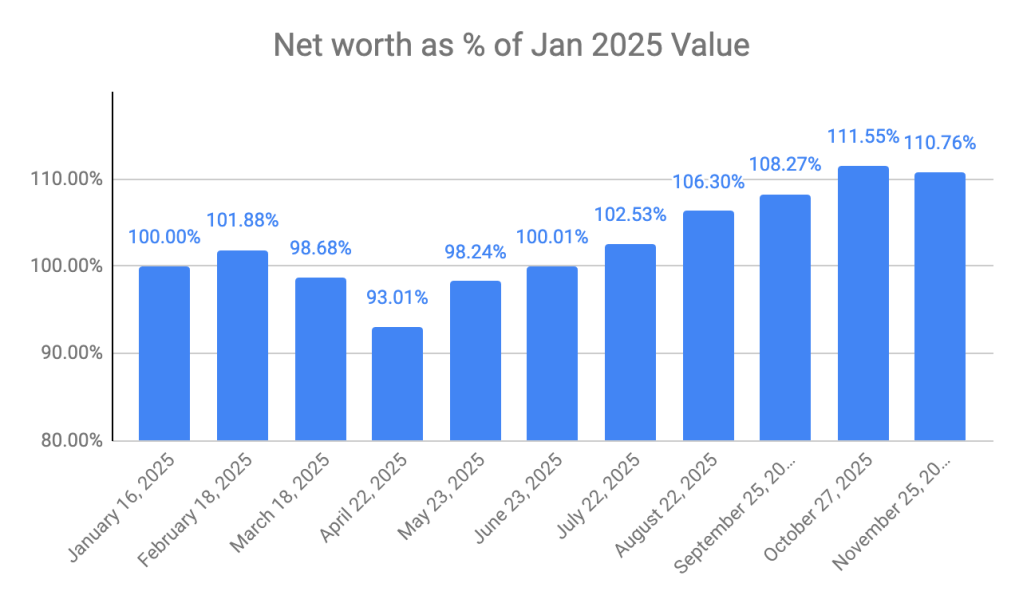
The retirement savings had a great month, again — a 6-month growth streak at this point. Overall, I’m now 11.5% ahead of where I started even though I’ve been drawing a monthly salary since the beginning of the year. I don’t really expect the winning streak to continue, but VPW allows me to take some benefit from the frothy stock markets at moment.

Net Worth as a percentage of starting point

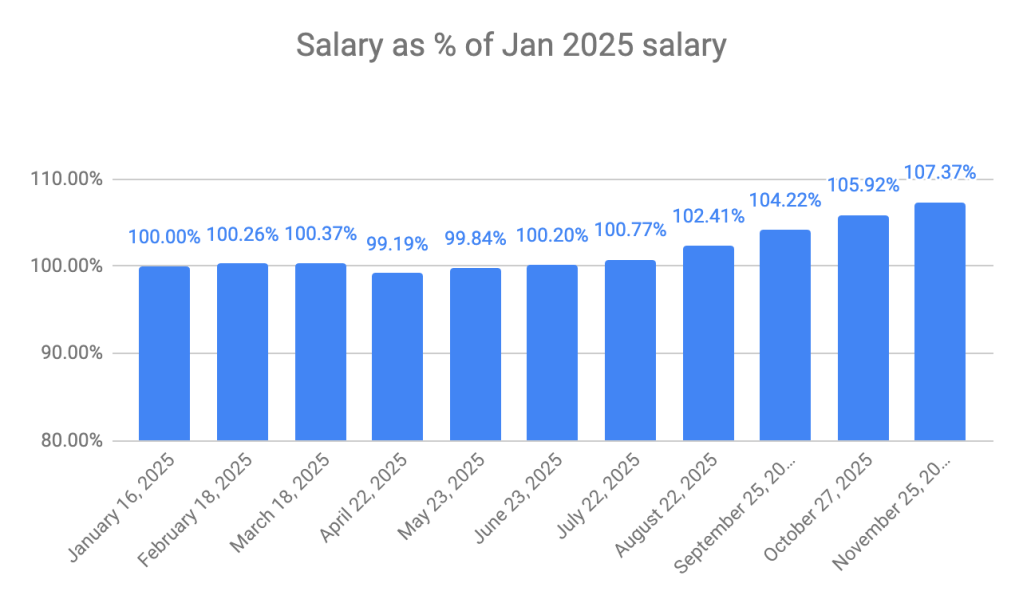
My VPW-calculated salary has hit a new high this year, 5.92% higher than my first draw in January. The monthly salary is also on a 6-month growth streak.

Monthly Salary as a Percentage of Jan 2025 salary

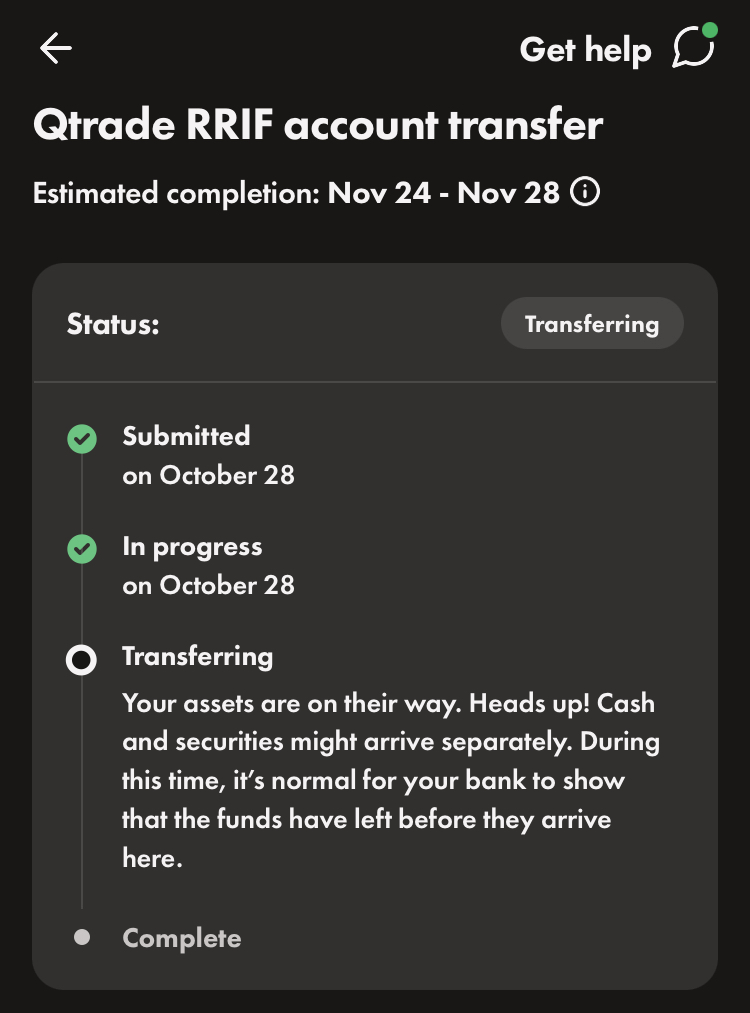
The months ahead will see the final “goodbye” to QTrade1 as the last of my RRIF investments will move to (mostly) Questrade2.

  1. I didn’t have a great deal of issue with QTrade as a provider, but their support (lack thereof) was beginning to become irritating. ↩︎
  2. My own QTrade RRIF will join the RRIF holdings I already have with Wealthsimple. They remain a potential backup provider of my retirement savings. I would have moved more to take advantage of their cashback promotion, but they still, inexplicably, do not support self-directed spousal RRIF accounts. ↩︎

News: Questrade and QTrade changes afoot

I have financial relationships with 4 different brokers, soon to be reducing to 2, if things go according to plan:

  • My long-term relationship with QTrade will come to an end by the end of the year as I move the last of my RRIF accounts out1
  • Questrade holds the vast majority of my retirement savings; they will inherit most of my remaining QTrade holdings this year2
  • Wealthsimple holds a small percentage of my retirement holdings, normally because I’ve been chasing a particularly attractive promotion (free money, or last year, a free MacBook Air)
  • My mother’s estate is held by BMO Investorline and if all goes according to plan (CRA willing), I’ll be done with them early next year as the estate wraps up.

I mention all this because I sometimes get wind of new developments from these providers in near-real-time, if they chose to share those developments with their existing clients. You benefit by hearing about them at the same time I do.

QTrade joins the realm of commission-free brokers

Starting October 28th, QTrade is eliminating trading fees on ALL stocks and ETFs, bringing them in line with Questrade, Wealthsimple, Desjardins, and National Bank. This, combined with their reasonably generous cash back offer3 that runs until the end of the year, makes them a serious contender for your investing dollars. Read more at https://www.qtrade.ca/en/investor/campaign/cashbackoffer.html.

Questrade to ditch Passiv in favour of home-grown tool

One of the things I like about Questrade is their support for Passiv, which I covered here. The main thing I like about Passiv is the integrated dashboard that can span both mine and my spouse’s accounts, especially since Questrade’s native support of Authorized Traders is absolutely abysmal.

This week I received an email from Questrade with subject line “Your Passiv integration will be changing soon”.

Uh-oh.

Anyway, in what I suppose is an effort to make their product “stickier”, Questrade appears to be working on their own Passiv-like “Portfolio Monitoring and Rebalancing Tools”, which are supposed to launch “in 2026”. As a result, the current annual access to Passiv Elite will end at the end of the current renewal date, or on January 30, 2026, whichever is later.

Passiv Elite4 is the tier of Passiv that can do rebalancing trades on your behalf. It’s not a feature I really cared about since Passiv doesn’t model all-in-one ETFs the way I think about them. You might say Passiv is an alternative way of getting the benefits of all-in-one ETFs without actually holding them.

Passiv Elite is $99/year, (which is a bargain compared to the cost of all-in-ones), so I’d expect Questrade’s own tools to be bundled into some tier of their current Questrade Plus offering.

No action required at this juncture, but I’m very curious as to how Questrade’s intended offer will work…and what it will cost.

  1. As mentioned elsewhere, it was mostly because I decided to chase some free money being offered by Questrade at the time. ↩︎
  2. I would have moved everything back in March, but I hit a snag concerning how RRIFs work. In essence, there’s no support offered for changing RRIF providers mid-year. Once the RRIF calculation has been done for the calendar year, your current broker is obligated to pay out the RRIF minimum. If you decide to move RRIF providers mid-year, the current RRIF provider still has to pay you your RRIF minimum for the entire year before allowing the transfer. Read about it here: https://moneyengineer.ca/2025/03/27/cautionary-tale-changing-brokers-when-you-have-a-rrif/ ↩︎
  3. Up to $2000 available for the taking ↩︎
  4. I think this is what I have, currently. I became a Questrade client just before the launch of Questrade Plus and probably got access to the “full” Passiv experience for the current year (March 2026 to be exact) by virtue of the assets Questrade has under their management from me aka “Questrade Elite”. ↩︎

News: The Wealthy Barber Reboots!

Thanks to the Canadian Financial Summit, I learned that David Chilton, aka The Wealthy Barber, has completely revamped his book and it’s scheduled to be released on November 4th, 2025.

David’s original book had a massive influence on me when I read it, um, back in 19891?

A lot has changed since then:

  • The invention of the low-cost ETF structure (I’m a fan)
  • The creation of the TFSA and FHSA
  • Online everything: brokers, banks, and research

The new edition will (per the author) echo the conversational tone of the original, so it’s a great read for new investors, too. Consider buying a copy for yourself or your children2!

  1. Per https://en.wikipedia.org/wiki/The_Wealthy_Barber ↩︎
  2. I pre-ordered already, shhh, don’t tell them. ↩︎