As reported last week, the USA cut their prime rates while Canada did not. The latest rates are now reflected in the HISA and short-term bond table (Canada & US). No changes for at least 6 weeks at this rate. Most cash I hold in my retirement savings is invested in an ultra-short-term bond fund, namely ICSH (one of my ETF all-stars) so I can squeeze out a few more basis points on my cash holdings.
TD Cuts Trading fees on 100 ETFs
TD seems to be upping its game. Not only are they throwing free money around, but an observant reader (thanks, big brother 🙂 ) alerted me to a recent change. You can read all about it here, but the skinny is that they cut trading fees on a list of 100 ETFs. Paying trading fees of any kind seems to be a dying business model, so it’s nice to see TDDI join the free club, at least a little bit. Some of these ETFs are even worth holding; I’ll save you the trouble and show you which ones:
Name
Symbol
What it holds
Vanguard S&P 500 Index
VFV
Largest US Companies
SPDR S&P 500
SPY
Largest US Companies in USD
Vanguard 500 Index
VOO
Same as SPY
iShares Russell 2000
IWM
Small cap US Equity in USD
TD all-in-ones
TEQT, TGRO, TBAL, TCON
100% Equity, 90% Equity, 60% Equity, 30% Equity. Read more here and here.
Newly free-to-trade ETFs at TDDI that are moneyengineer.ca approved
All the above funds would be worthy of consideration since they adhere to my rules about being passively managed, low cost, and aligned with my asset-allocation strategy. The simplest purchases here would be one of the TD or Vanguard all-in-ones (new to all-in-ones? read about them here) best aligned with your risk profile. There’s a bunch of other ones that aren’t of interest to me — bitcoin, leveraged, actively managed, segment-based…nah, I’m good.
The gravy train continues for those willing to put in some effort. TD’s offer is listed here, but I’ll give you the highlights:
TFSA, RRSP, FHSA, LIRA, LRSP accounts: 2% cash back on new transfers for new or existing customers
Non-registered accounts (margin or otherwise) are eligible for 1% cash back
Not eligible: RRIF accounts (boo!)
Register before March 2,2026; complete transfers by March 31, 20261
Keep the money there until March 31, 2027, and get paid by April 30, 2027
$5000 limit on free money provided (meaning $250k in assets transferred).
I myself have no experience with TD’s product, but per their fee schedule, I see they still charge for stock/ETF trades, $9.99 a pop2. It’s zero for mutual funds, if that’s your thing.
Given that Questrade is still giving me free money for another year, and given that RRIF accounts aren’t eligible, I’ll be sitting this one out. But this TD offer looks pretty generous, so of possible interest to others out there.
You might not want to wait until the very last minute to register; the Ts and Cs make it sound like you’ll be out of luck if your transfer in doesn’t land by the 31st. ↩︎
Reduced to $7 a pop if you trade a lot, defined by TD as >150 trades a quarter. ↩︎
Right after the final, final deadline of Wealthsimple’s last free money offer, it appears that Wealthsimple is now offering spousal RRIFs as an account type for the DIY investor (they’ve had them for quite a while in their robo-advisor accounts).
This had always struck me as silly, especially since they have offered spousal RRSPs for a while now.
With this development, Wealthsimple is nearly a viable option to host all of my retirement funds1. My needs are pretty simple:
support for all the account types I need (RRIF/Spousal RRIF, TFSA, joint non-registered, individual non-registered)
zero cost ETF buy/sell
support for Norbert’s Gambit (which implies support for USD accounts, naturally)
Norbert’s Gambit is planned in early 2026 for Wealthsimple, per the very limited info found here.
So, if you’ve been on the fence about Wealthsimple, here’s one more reason to consider them. Once Questrade’s free money gravy train ends for me in March 2027, they become a personal serious contender, especially if they are willing to throw free money my way, which, historically, has certainly been a recurring theme. On that note, if any reader wants to give them a whirl, I have referral codes, just shoot me a note at comments@moneyengineer.ca; if you act quickly2, there might be some free Apple gear in it for you too.
QTrade and Questrade both offer all three. There may be others. ↩︎
The Bank of Canada and the US Federal Reserve both had their last rate setting meeting of 2025 today. These meetings are of interest to the DIY investor because they set the bar for the interest rate paid on short term loans / high interest savings accounts. I track a universe of HISAs and ETFs of interest over at https://moneyengineer.ca/hisa-and-short-term-bond-table-canada-us/.
The Bank of Canada announcement is here, and the US Fed announcement is here. The Bank of Canada kept things the same, with a rate of 2.25% while the US cut their rates by a quarter point, so they’re now sitting in a range of 3.5-3.75%. Anyway, the gap between the US and Canadian rates is narrowing, but the US overnight rates are still 1.5% higher (aka 150 basis points) and so it pays to use USD money market funds and HISAs if you’re able.
The next opportunity for the banks to mess with interest rates is January 28, 2026.
DIY investing also means DIY decumulation. In 2026, I’ll be paying myself from my various RRIFs as well as from non-registered funds. I’ll refer to the letters in the diagram below so you can follow along1:
A: Calculate Net Worth over all retirement accounts
“Retirement accounts” include 3 non registered accounts, 2 TFSAs and 5 RRIF accounts. All of these are at Questrade except for one RRIF account held at Wealthsimple. My net worth calculation ignores my day-to-day spending accounts, and any other assets (my house, for example). In 2026 I could look up this number using Passiv, but I’m not 100% clear on what the fate of my Passiv account will be once Questrade cuts ties with them (March 2026). I still have a spreadsheet with lots of details and pretty graphs based on my multi-asset tracker.
B: Use VPW Methodology to Calculate Monthly “Suggestion”
VPW stands for “Variable Percentage Withdrawal” and it’s the playbook I use to guide my monthly withdrawals from my retirement accounts. I talk a bit about it here. The suggestion is generated by a VPW spreadsheet, but the inputs are pretty simple:
future pension amounts, and age you’ll be when you take them3
asset allocation breakdown (%stocks versus %bonds)
This “suggestion” represents the maximum value of the assets I am advised to sell this month. You could take more or you could take less. It’s merely a suggestion. For me, I take the suggestion at face value and sell the assets needed to meet the value of the “suggestion”.
C: Calculate the Salary
The “Suggestion” in step B is NOT your salary. The VPW methodology enforces one more step to calculate that. The VPW methodology requires the use of a “cash cushion”, which has the effect of making sure you don’t need to make drastic month-to-month changes in your salary, either upward or downward. The cash cushion is roughly 5x the “suggestion”4 and your salary is 1/6th of “suggestion” plus “cash cushion”. The “salary” represents the amount that will eventually turn up in your chequing account.
To make things easier to track, my “cash cushion” is a totally separate non-registered joint account that holds one of four things: Canadian dollars, US dollars, ZMMK or ICSH. I keep a little cash floating around in this account to avoid having to do monthly trades. It just makes tax reporting and ACB tracking a bit simpler, at a small loss of interest income. Also, Questrade doesn’t support fractional shares of either ZMMK or ICSH, and since they routinely trade at roughly $50/share, mathematically, I’ll always have $25 CAD and $25 USD on average 🙂
D/D’: Compare the Suggestion to the Salary and act accordingly
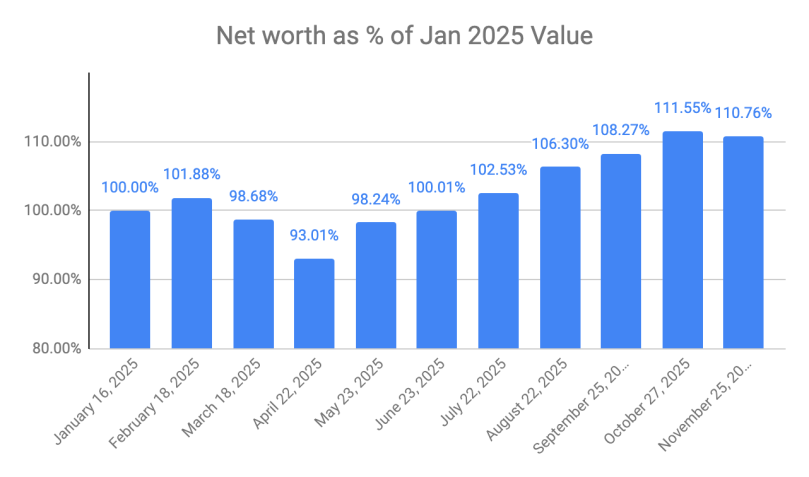
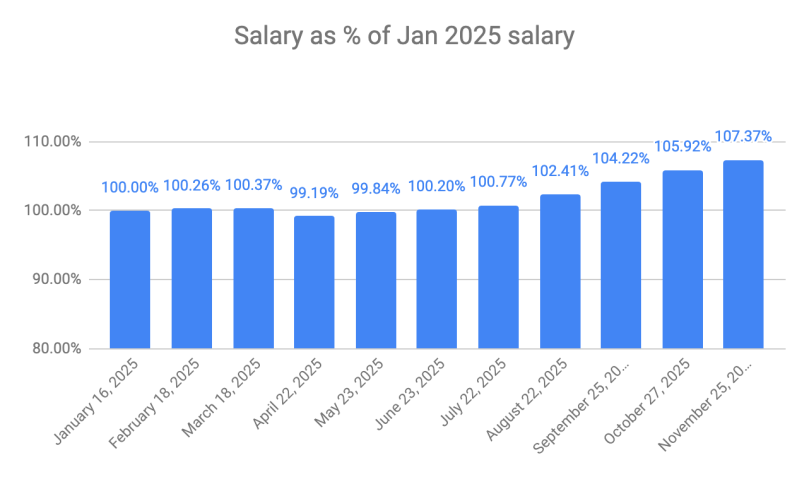
Since the cash cushion is effectively a 5-month moving average Salary, the Suggestion could be more than or less than the Salary. If my net worth is down (or up) month over month, then it follows that the Suggestion will also be down (or up) month over month. My Salary may or may not be down (or up), depending on how long the downturn has lasted. Just to give you a sense of how the cash cushion smooths out the market gyrations, you can see the comparision of net worth versus salary below. (Taken from my most recent monthly “What’s in my Retirement Portfolio” update.) The net worth moves quite a bit month-to-month (generally upward, which is nice), but my salary is much smoother (but also generally upward).
Anyway, what all this means is that I’m either going to move some of the Suggestion money into the cash cushion (because my Salary is less than the Suggestion), or I’m going to pay myself from the cash cushion because my Salary is higher then the Suggestion5. It’s one or the other; as yet, I haven’t had the Salary be equal to the Suggestion, but it is mathematically possible, of course.
E/E’: Make sure the 4 Questrade RRIFs have cash to cover the monthly payment
At the end of 2025, I’m expecting some sort of communication6 from Questrade as to what my minimum monthly7 RRIF withdrawal needs to be for 2026 for each of the four RRIF accounts in my household8. This is a standard “feature” of anyone holding a RRIF — your provider makes a calculation based on the value of your RRIF on the last day of the year and your age (or your spouse’s age) at the end of the year. That’s RRIF minimum — the minimum amount you’re obligated to take. This coming year, I’ll stick with RRIF minimum again to avoid having to deal with spousal attribution rules.
So for 2026, I will know exactly how much cash I will need every month in every Questrade RRIF account. And since I’ve done such a good job in simplifying my RRIFs9 (pats back) I can also calculate exactly how many shares of XGRO need to be sold in each RRIF account every month, in real time10.
So generally, this step involves placing 4 sell orders to put cash in the account.
The E’ step — moving cash from the RRIF to the chequing account — I’m expecting to be automatic, but since I haven’t had to do this with Questrade before, I’m not certain.
F/F’: Generate cash equal to RRIF minimum in the Wealthsimple account and move it to the chequing account
Like with Questrade, I’m expecting Wealthsimple to communicate my RRIF minimum. From what I can see from their website, it appears that they actually make it really obvious.
The same good work I did with my Questrade accounts is even better in my Wealthsimple RRIF account since I hold no USD at Wealthsimple. So here, and thanks to fractional shares, 100% of my RRIF is invested in XGRO, with no additional cash.
Their help article makes it sound like both F and F’ are under my control, which is fine. I’ll just do this step at the same time I do the Questrade step. Maybe I only have to do F’ once and pay out in “Installments”? Not sure.
G/G’: Use the non-registered account(s) to generate cash equal to Suggestion minus all the monthly RRIF payments
I already know my five RRIF minimum payments will fall well short of the VPW “Suggestion”, so every month I have to sell assets from the non-registered accounts to make up the shortfall. This cash will either go 100% to my chequing account or some of it may be diverted to the cash cushion.
Normally this comes from my, not my spouse’s, non-registered account. Since my spouse is still working, I leave hers alone to avoid generating capital gains. Unfortunately, my non-registered accounts are a bit of a dog’s breakfast, and although I’ve made efforts to use spreadsheet formulas to make automated suggestions11, it’s proving a bit more difficult.
In the end, this is again a sale of one or more assets. For step G’, I can then immediately use Questrade’s “Withdraw Money” to move the cash into my chequing account, or “Move Money” to move cash into the Cash Cushion account.
Conclusion
And that, my friends, are the steps I take monthly in retirement. I try to perform these steps in the dying days of every month while allowing enough time for trades to settle to ensure cash is well and truly in hand before I move it to my chequing account.
In my household, a very large portion of this process gets spit out as a step-by-step “do this, do that” set of instructions I’ve built into a macro-enabled spreadsheet. The trades required for Step G are still decided on the fly, manually. Of couse, given that Questrade has APIs, I could conceivably make automatic trades based on the work I’ve done, but I’m not sure I want to take that step. Retirement project?
I don’t really know if any of my readers find this particular articl useful, exasperating or confusing. But for me, it’s useful to write down how it works! ↩︎
For me, CPP, OAS and the OAS supplement. The current plan is to defer CPP/OAS until age 70 to maximize my inflation-indexed income. ↩︎
which, in my case, since I withdraw monthly, is about 5x my salary ↩︎
I’ve run this algorithm ten times so far this year: 3 times I had to pay myself out of the cash cushion and 7 times I added to the cash cushion. That’s the general upward trajectory of this year’s market in action ↩︎
My last provider, I actually called them to check. I had of course calculated it myself (and they were very close) but my numbers don’t matter to the CRA. I’m hoping Questrade makes it a bit more obvious, but I’m pessimistic. ↩︎
I had set it up as monthly. I could’ve chosen quarterly or annually. I like monthly. ↩︎
My RRIF accounts hold one of five assets: Canadian and US dollars (because I can’t buy fractional shares), ICSH, AOA, or XGRO. ICSH is held in RRIFs to keep me at 5% cash in my retirement overall, and I routinely convert (quarterly) AOA into XGRO using Norbert’s Gambit. ↩︎
And yes, I have a macro-based spreadsheet that tells you exactly how many shares to sell at that moment based on share price and current cash in the account. ↩︎
The most appropriate thing to sell in any given month is an asset for which I’ve become overweight per my multi-asset tracker. But when you hold all-in-ones in the portfolio, it’s a bit trickier to work that out. I just need to set aside some time to come up with a spreadsheet-based solution. I would much prefer this decision to be made algorithmically. ↩︎







 The Money Engineer