

The Mechanics of Getting Paid in Retirement

***This is no longer accurate; my new diagram is found at The Mechanics of Getting Paid in Retirement: 2026 Edition ***

DIY investing also means DIY decumulation. I recently completed a change in online broker from QTrade to Questrade and this is how I get paid in retirement; I’ll refer to the letters in the diagram below so you can follow along.
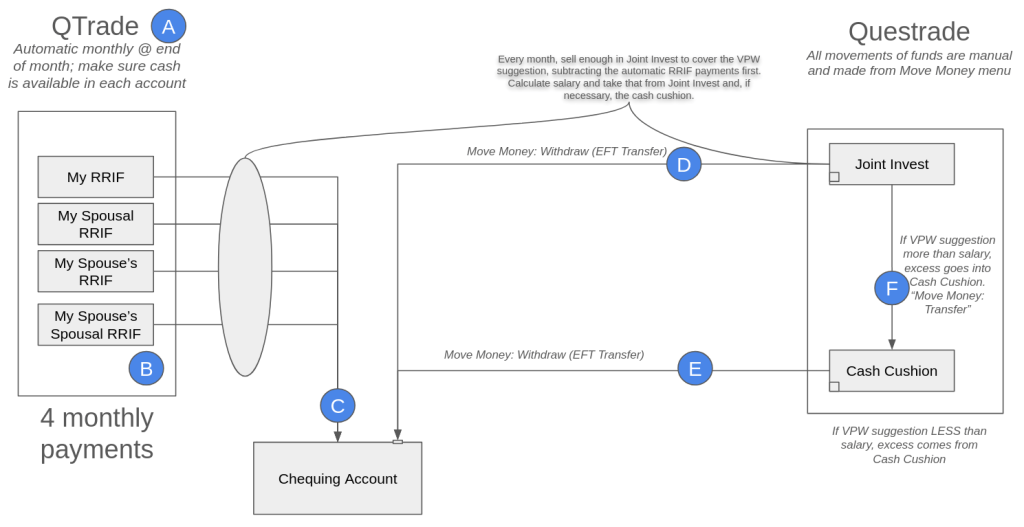
How I get paid, April 2025

A: QTrade? What?

I know I started by saying I completed the transfer from QTrade to Questrade, but due to an unexpected snag, I still have 4 accounts with QTrade which are currently paying a monthly obligatory RRIF-minimum contribution to my salary. I talked about the snag here, but suffice it to say I could have moved these accounts too, but at the expense of foregoing monthly payouts for the remainder of 2025, which I didn’t think was worth it.

Next year, those accounts will disappear and Questrade will handle the RRIF minimum payments.

B: Yes, there are multiple RRIF accounts

When I started the paperwork to open RRIF accounts, I was surprised that the same choices were offered as were offered for RRSPs — individual and spousal. I’m sure that some of the reason is due to the attribution rules for spousal RRIFs, but anyway, there are 4 RRIF accounts generating 4 individual payouts every month. This is automatic, so I have to make sure that there is cash available in the 4 accounts each month, or else my provider will happily charge me an arm and a leg1 to do the necessary asset sale.

The asset sale takes a few seconds; and with T+1 settlement, the cash is available the next day. Right now I try to do all my moves on the 22nd of the month, but admittedly, this is more time than strictly necessary.

C: Opening the RRIF account includes providing your banking information

I don’t know whether there is any provider out there who permits RRIF payments to be paid to a non-registered account, but so far it seems that they all prefer to make EFTs into a bank account. That’s not a problem for me but this may not be what you’re expecting. The money just shows up like a paycheque on or near the last day of the month.

D/E: The sum of all RRIF payments isn’t enough to fund my desired lifestyle

I’m withdrawing RRIF minimum payments and funding the rest of my monthly paycheque by liquidating assets held in my non-registered account. Another approach would be to increase the RRIF payments, but then that attracts withholding tax, which I hate. The monthly liquidation of assets in my non-registered account generates taxable capital gains each time, naturally. The advice I got from my retirement planner suggested I should be able to maintain an overall 15% tax rate by making sure that I have a mix of favorable taxable income (capital gains and dividends) along with the unfavorable2 RRIF income.

I keep an eye on my 2025 tax bill by using the tax calculator I mention on https://moneyengineer.ca/tools-i-use/. I can always choose to switch gears if needed.

In Questrade, movements of cash are done from their aptly-named “Move Money” menu. Setting up your bank account in Questrade was a bit clunky3 and relied on some app like Plaid to get the job done. Moving funds in this way isn’t instant, expect a delay of at least two business days in each case.

Another oddity with Questrade is that any joint non-registered account is set up as a margin account, which means it’s shockingly easy to borrow money you don’t have4.

One unknown with Questrade — I was able to move money instantly after an asset sale. It’s not clear to me whether this uses margin or not5. I’ll know more once I get my April statement, I guess. If I get charged margin interest, I’ll have to hold off moving money until the day after the asset sale.

F: Variable Percentage Withdrawal (VPW) requires the use of a cash cushion

I described the methodology I use to calculate my take-home pay in a previous post, but in essence my salary is related to my real-time net worth, filtered through a 6-month moving average so an anomalous month on the stock market doesn’t impact my take-home pay quite so quickly. VPW makes a “suggestion”, this suggestion is added to the cash cushion, divide by 6, and presto, the “suggestion” is converted to a monthly “salary”.

In any given month, the cash cushion is either being augmented by the sale of some assets in my non-registered account (the suggestion is larger than the salary), or the cash cushion is being depleted to make up the shortfall in my calculated salary (the suggestion is less than the salary). All of those movements are manual. Transferring cash between non-registered accounts is supported by Questrade, but it wasn’t supported by QTrade6.

All in all, this process should take less than 15 minutes a month. The first time included a learning curve and extra setup, but now that pre-work is done. Next step is making sure my spouse knows how to do this, too!

  1. Assuming your arm and leg are worth $40. ↩︎
  2. Unfavorable because it’s treated as straight income, and since RRIF-minimum, no witholding tax. I’m expecting a decent tax bill come April next year. ↩︎
  3. Bank accounts showed up in my mobile app but not on the web portal. To get them to show up there I had to set up my account — again — and successfully transfer a nominal amount. Only then would the web app remember my bank accounts. ↩︎
  4. Which I inadvertently did, paying myself from the wrong non-registered account. Sigh. ↩︎
  5. Since the transfer isn’t instantaneous, and since the cash really is available the day after, one could make the case that this doesn’t require margin. But I really have no idea. ↩︎
  6. For QTrade I had to use my bank account to get around this restriction. ↩︎
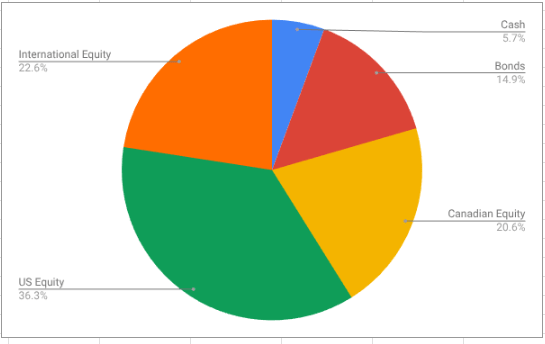
USD Assets in the retirement portfolio. Good idea?

I’m not sure when I first made a purchase of a USD-denominated ETF. Probably over 10 years ago. Clearly, I thought it was a good idea, because as of today I find that 57% of my retirement savings1 are denominated in US Dollars.

And unlike other people I’ve talked to, there’s no underlying rationale for that. I’ve never earned employment income in USD and I don’t own property in the US. So why?

I’m a cheapskate.

I started investing in USD based ETFs simply because they were a much better deal than their Canadian equivalents. This is less true now than it used to be, but it’s still true. Take for example the comparison between comparable USD and CAD ETFs that track the same index:

IndexWhat’s in itUSD ETFMERCAD ETFMER
S&P 500Top 500 US stocksIVV0.03%VFV, XUS0.09%
Russell 20002000 mid-market US StocksVTWO0.07%XSU2, RSSX30.36% for XSU, 0.25% for RSSX
FTSE Developed ex USGlobal stocks outside of the USASCHF0.06%VDU0.22%
USD versus CAD ETFs tracking the same index4

The Canadian market has become more competitive, and MERs have come down, but given the size of the US market, it’s still cheaper to invest there.

I’m not a very savvy cheapskate.

So although the MERs of US ETFs were stunningly attractive, I failed to consider the cost of currency conversion. For this I blame naivete as well as a lack of transparency on the part of my provider. It was not possible for me to easily figure out how much each CAD to USD transaction was costing me. A good estimate is about 1.5% the cost of the transaction, but some providers make this much cheaper5.

I also had USD investments in my TFSAs, which, from a tax perspective, isn’t the best idea.

Over time, I discovered the joys of Norbert’s Gambit to do currency transactions on the cheap and I became more savvy. And I eliminated all US holdings from my TFSA.

Preparing for Retirement

In preparing my portfolio for retirement (steps I took are outlined here), I did seriously consider converting everything to CAD in the interest of keeping things simple. I did not, and here’s why:

  • I figured that having ready access to USD would be rather useful to retired me, since I do vacation there. And I had made other preparations in light of that, setting up a USD credit card and USD savings account for RRIF payments to go to.
  • Although I knew that having USD RRIFs would make getting paid in retirement more complicated, I thought I had worked out a plan with my provider6 that would make extracting USD RRIF payments achievable, with some effort on my part.
  • I sort-of liked having some of my investments in USD since it’s a stable currency. Usually.
  • I also liked the additional boost I got from USD HISAs. (That’s probably an anomaly but one I’m happy to take advantage of)
  • I could change my mind at any time.

Current Reality

This isn’t working like I thought it would.

My provider decided to backtrack on allowing me to extract USD from my USD RRIF;7 we’re still going back and forth on that front, but my friends at QTrade are on my naughty list as a result. I’m not hopeful.

What it means practically is that although the value of my USD RRIF is used to calculate my RRIF minimums, I can only withdraw RRIF payments from the Canadian side. At present, the Canadian side of my RRIF will fund my RRIF minimum payments for a while, but at some point I’ll have to use Norbert’s Gambit to move funds from the USD RRIF to the CAD RRIF.

My Advice

I don’t think that holding USD assets in retirement — especially in a RRIF — is a great idea for the DIYer. Unless platform providers give really clear processes8 for how to extract that money from a USD RRIF, expect trouble.

At some point, I will either switch providers to find one that supports my requirements9, or I will convert everything to CAD. Right now, I have a process that works, but older me I expect will find it too complicated.

  1. Majority of the USD holdings are in my / my spouse’s RRIF; small portion is in my non-registered account. ↩︎
  2. Not an apples to apples comparison, admittedly. This ETF is hedged so it’s less impacted by changes in the CAD/USD exchange rate but this comes at a cost. ↩︎
  3. This is ALMOST the same thing; RSSX uses a capped version of the index ↩︎
  4. And try as I might, I couldn’t find a USD ETF that invested in the TSX/S&P 60. Not really surprising, and my USD retirement holdings have very limited Canadian exposure. AOA has about 2.4% Canadian exposure. ↩︎
  5. Notably, Interactive Brokers and lately, Wealthsimple especially if you hold more than 100k with them. ↩︎
  6. Involving multiple phone conversations and multiple emails ↩︎
  7. You may ask, “what’s the point of having a USD RRIF if you can’t extract USD from it”? I had the same question… ↩︎
  8. RBC says they support it and so does Questrade. ↩︎
  9. I had sorely hoped Wealthsimple could be that provider, but (sigh) they don’t support spousal RRIFs at the moment. ↩︎

Caution! Spousal RRSP/RRIF Attribution Rules

Summary: The spousal RRSP is a great way to reduce current taxes, but if you’re planning on using the money in that spousal RRSP soon, be aware of the rules concerning who declares the income!

Disclaimer: As this article will demonstrate, I’m not a tax expert, lawyer, CPA or anything else. Use with discretion, some assembly required.

I made substantial use of spousal RRSPs during my working life. Spousal RRSPs are a way for the higher earning spouse to take advantage of the lower earning spouse’s unused RRSP contribution room, thus leading to a lower overall tax bill1. All good so far.

Some vocabulary will help with the next bit.

  • The contributor is the person providing the cash for the spousal RRSP and is the one who gets the tax deduction. Usually this is the higher income spouse.
  • The annuitant is the person whose name is on the spousal RRSP statements. This is usually the lower income spouse.

What most primers on spousal RRSPs don’t mention is that there is a restriction when it comes to withdrawing from the RRSP2. Paraphrasing the source material:

If the annuitant withdraws from a spousal RRSP within three years of the last contribution, the income from that withdrawal is considered to belong to the contributor, not the annuitant.

What? Why?

As with all things, there’s no free lunch. CRA doesn’t want to make tax avoidance so easy3, so this little detail will prevent the purely hypothetical scenario of a higher earning spouse making a large spousal RRSP contribution in the last year of their employment, and then getting the lower earning spouse to take out that same money at a much lower tax rate when the calendar moves from December to January.

There is one, small, bone that CRA throws our way in this case. Paraphrasing again:

If the annuitant withdrawal is instead made via a spousal RRIF, and the payment is RRIF minimum, then fine, the annuitant can declare that income.

So, as long as our lower income annuitant spouse opens a spousal RRIF, and as long as for the three years4 following the last spousal contribution, that spousal RRIF only pays out RRIF minimums, then all is well. The annuitant spouse declares the income, as expected.

Now of course, this rule may not matter to you. If you’re newly retired and don’t have much in the way of income, then it may not trouble you that you have to declare the income from your spouse’s spousal RRIF/RRSP. It’s just a bit more paperwork (a T2205, looks like).

In my case, I’m only taking RRIF minimums for the time being. So no extra paperwork for me.

  1. And future income splitting before the age of 65 when the option becomes available to all. ↩︎
  2. I’ve never myself made a withdrawal from an RRSP. That would break my rule of keeping retirement savings firewalled. And it looks to me to be an expensive proposition — your provider will surely charge a deregistration fee, your provider will have to withhold tax, and you have declare the full amount as income in the year you grab it. ↩︎
  3. I have learned to be guided by the humbling tenet of: “If I think I’ve figured out a way to outsmart the taxman, it’s probable that I’m simply demonstrating an incomplete understanding of how it actually works….” ↩︎
  4. To illustrate/clarify: the rule applies in the year the contribution is made, and the previous two years. So the contribution I made in 2024 will be free from all constraints in the 2027 tax year. ↩︎

Getting paid in retirement: a DIY challenge

Summary: The mechanical details of getting paid in retirement require careful review of how your provider allows cash movements between accounts, a handle on how much money is coming in via a RRIF, and, for bonus points, an annual decumulation plan to minimize household taxes.

I covered how I get paid in retirement previously, but this was nothing more than a restatement of how VPW (Variable Percentage Withdrawal) works. My reality is not quite as simple as the Idealized Monthly Routine I laid out in that post.

The actual work required looks more like this:

Actual monthly work needed to get paid in retirement

The first 3 steps are the ones I covered in the last post, and there’s nothing new to talk about there. In brief, you calculate your retirement savings, enter that number into the VPW spreadsheet, and out pops the monthly VPW suggestion (“v”), which is then added to the current value of your cash cushion (“c”) to calculate your salary (“s”).

It’s probably worth noting what specific accounts I hold at my provider to make things a bit clearer1

  • There are 4 total RRIF accounts (two for me, two for my spouse)
  • There are 2 non-registered accounts that hold retirement investments (one for me, one for my spouse)
  • There is 1 non-registered joint account that serves the role of VPW’s cash cushion, which is invested in DYN6004 so I can earn a bit of risk-free interest.

So ideally, my RRIF payments would flow into the cash cushion account, and I would pay myself out of the cash cushion account to my everyday joint chequing account. That is unfortunately NOT how it works.

Let’s pick up the process starting at step 4.

Do the RRIF minimum payments cover the calculated salary?

When I opened my RRIF accounts (and yes, there’s more than one2), one of the questions asked was “what bank account should the payments go to?” Asking for RRIF payments to go to a non-registered account was not presented as an option, and it’s not possible. So already the simple RRIF to cash cushion transaction outlined in the ideal scenario wasn’t possible.

The other questions asked by my provider was: how much do you want to be paid? (RRIF minimum, some percentage/amount higher than that, gross/net?)

(If you’re new to the RRIF world, or if you think that RRIFs are just for 71-year-olds, you may want to check out my previous post on debunking this and other myths.)

The amount each of my RRIFs3 pays me monthly is a well-known fact since I opted to collect RRIF minimum from each RRIF — and RRIF minimum is based on my RRIF value and age as of January 1, 2025. It will stay constant throughout 2025. So while simple, the amounts involved aren’t enough to pay my suggested salary. I’m free to ignore the suggested salary and simply (try to) live off my RRIF minimums, but that would be counter to my “you can’t take it with you” ethos. And so, I have to augment my RRIF minimum salary with money from elsewhere.

If your RRIF minimum payments are higher than the salary, then I suppose it makes sense to re-invest those payments somewhere. Or give the money away. Up to you 🙂

Sell required assets in non-registered account and move $ manually

The title is clear enough — sell something in the non-registered portfolio and use it to make up the salary shortfall. But whose holdings4? Which ones?

To help me decide, at the beginning of the year, I played around with tax scenarios using the calculators referenced in Tools I Use to concoct a high level plan on how to best minimize my household’s collective tax bill. (This was a tip my financial advisor gave me; her advice was to try to pay no more than an average tax rate of 15%5).

I assumed my income sources were

  • My RRIF minimum payments (same for my spouse)
  • My spouse’s salary
  • Minor dividend income6
  • Capital gains caused by the sale of non-registered assets7

Since the first three items above were already known, there was no decision to make; the tax owing on those was already clear8. The capital gains were the only variable — how much should I take versus my spouse? There was a bit of estimation involved in the actual amounts here (the actual gains would depend on the actual sale price), but it gave me a high level plan for 20259. Any additional income needed would be paid by capital gains realized from MY holdings since my income was forecast to be lower than that of my spouse10.

With the pre-work done, it boils down to making the required sell trade, waiting two days for the cash to settle, and then clicking the right buttons to get the cash out of my investment account and into my chequing account. Should be simple, but if you’ve never done it before, you need to make sure it’s all working as you expect.

Sell required assets in RRIF

Yes, you have to make sure that there’s cash available in your RRIF accounts (and remember, I have 4) BEFORE the monthly payment goes out. My provider would only be too happy to do this on my behalf, charging me their “telephone trading rates” for the trade — something like $30 plus $0.06 a share for XGRO. Compared with “free” if I do the work myself, that’s a pretty decent hourly rate…Do not forget that it takes two days for a trade to settle into cash. Since my provider does not pay interest on cash holdings, I’m highly motivated to keep any cash balance to a strict minimum. I hate not earning money on my money.

Adjust cash cushion up or down by comparing VPW suggestion to calculated salary

In my previous post I talked about moving “v” to the cash cushion and then simply taking 1/6th of it as salary. And that is exactly what I do. But practically, it’s impossible to do this maneuver in exactly the way I describe with my current provider (QTrade). Here are the specific reasons I can’t do what VPW asks me to do:

  • QTrade RRIF payments must be made to an external bank account. So right away, part of my salary cannot flow through an intermediary cash cushion account.
  • QTrade does not allow cash transfers between non-registered accounts on their online platform. This means that the asset sales in my non-registered account cannot be moved directly to the cash cushion accounts either11.

I have worked around the limitations imposed by my provider by either

  • moving money from my chequing account to my cash cushion if the VPW suggestion is higher than my salary (market is moving up)
  • moving money from the cash cushion to my chequing account if my salary is higher than the VPW suggestion (market is moving down)

I have set up smart-ish spreadsheets to break down all the various movements of money which I will share at some point once I figure out how to make them a bit more generic. I’ve also documented a step-by-step guide for my spouse which she uses as we sit together walking through the monthly tasks12 so that I have confidence she could execute on them if I became incapacitated. There is no substitute for handing over the controls to see where the gaps in knowledge — and documentation — are.

The future

Having witnessed what happens to savvy adults as they get older, I know deep down that this DIY strategy isn’t sustainable forever. There are too many moving parts, and too many opportunities to make mistakes.

At present, I don’t have a future plan mapped out. I have updated my “death binder“, but beyond this, nothing more. I will dedicate more research (and future posts) on that topic.

  1. For your benefit I have not mentioned the USD variants I have of a few of these. This post is long enough as it is, and I presume that most readers don’t hold assets that are traded on US stock exchanges. ↩︎
  2. My own RRIF and my spousal RRIF account for two, and my spouse has two as well. Total four. They are with the same provider. Spousal RRIFs are generated from spousal RRSPs, in case you were wondering. If you deal with more than one RRIF provider (I would NOT recommend that), you’ll also have to consider that. All this to say that I saw 4 distinct payments made to my joint chequing account on Friday last week, one for each of the 4 RRIFs. ↩︎
  3. I keep saying “my RRIFs” for simplicity, but all 4 RRIFs (2 in my name, 2 in my spouse’s) are treated the same way. All four payments end up in our joint chequing account. ↩︎
  4. Both my spouse and I have non-registered accounts. My spouse’s was funded via a spousal loan I set up years ago to achieve some degree of income splitting. ↩︎
  5. After years of thinking of taxation in terms of what I paid on the LAST dollar I earned, this was admittedly a very different way of considering the problem. ↩︎
  6. Most of my dividend income (via XGRO and AOA) is buried in my RRIF and TFSA to avoid any taxation of it ↩︎
  7. Because I make a lot of use of HXS and HXT in my non-registered portfolio, I earn no dividend income; it’s all capital gains… ↩︎
  8. If you’re not aware, RRIF payments are treated as no-special-treatment taxable income, reported on a T4-RIF form by CRA. ↩︎
  9. Since I get paid monthly, I could always adapt if my assumptions were radically off. ↩︎
  10. I could have also paid the extra from my TFSA holdings, but my advisor suggested that this is the LAST bucket to use in retirement. ↩︎
  11. Unless I like waiting on hold. I do not. ↩︎
  12. Who says romance is dead? ↩︎