
ETFs for parking your money safely

Since my new DIY broker (Questrade) does not support the purchase of high interest savings accounts (HISAs), I need to find a free-to-trade alternative. 5% of my retirement portfolio is invested in what is characterized as “cash”, but I expect that money to earn some sort of return with essentially zero risk. (Another 15% of my portfolio is in the bond market, which, as we all learned in the last few years, has its downsides1.)

Questrade (like Wealthsimple) offers free trades of all ETFs. So it makes sense for me to go looking for ETFs that invest in safe havens. Here’s what I turned up for investments in Canadian dollars, based on some Google searches and some reading of similar questions posted in the public domain. Not all of them are what I would call “equivalent” to a HISA.

Fund SymbolFund CompanyWhat it invests inMERCurrent annual yield2Commentary
CASHGlobal X“high-interest deposit accounts with one or more Canadian chartered banks”0.11%2.68%This invests in the HISAs I currently invest in
CBILGlobal X“short-term Government of Canada T-Bills”0.11%2.88%Not a HISA but a safe investment
HISAEvolve“high-interest deposit accounts”0.15%2.71%Equivalent to CASH but with a higher MER
MCADEvolve“Canadian dollar high-quality short term debt securities (with a term to maturity of 365 days or less)”0.20%3.17%Very short term bond fund. 18% of holdings have due dates of less than 30 days
ZMMKBMO“high-quality money market instruments issued by governments and corporations in Canada, including treasury bills, bankers’ acceptances, and commercial paper. 0.13%3.6%Not a HISA but a very short term bond fund3. 31% of holdings have due dates of less than 30 days.
CAD ETF Candidates for investing Canadian dollars

Based on this quick analysis, ZMMK looks pretty attractive — a lot of very short term (and hence safer) debt as compared to MCAD, excellent returns. It is clearly a riskier investment than something like CASH or HISA. Between CASH and HISA I lean to smaller MERs every time, so CASH wins. CBIL might be a sort of happy middle ground…a T-Bill ought to be as good as a bank. All of these ETFs have a pretty stable NAV, either $50 or $100 per unit, so there should be little to worry about in terms of capital gains.

Since I hold a lot of USD, (not convinced this is a good idea), I need to do the same exercise for USD safe havens.

Fund SymbolFund CompanyWhat it invests inMERCurrent Annual Yield4Commentary
HISUEvolve“primarily in high interest US dollar deposit accounts”0.11%4.05%This invests in the HISAs I currently invest in
HSUVGlobal X“primarily in high interest U.S. dollar deposit accounts with Canadian banks…not currently expected to make any regular distributions”0.2%n/aGlobal X “corporate class” ETFs convert interest payments into capital gains. This sort of ETF makes sense in a non-registered account to minimize taxes.
ICSHBlackRock“broad range of short term U.S. dollar-denominated investment-grade fixed- and floating-rate debt securities and money market instruments”0.08%4.31%Not HISA but 46% is invested in debt with less than 30 days maturity
MUSDEvolve“primarily in U.S. dollar-denominated high-quality short term debt securities (with a term to maturity of 365 days or less).”0.20%3.49%Similar in strategy to ICSH, but only 20% in debt with 30 days maturity and only 40 holdings.
UCSHGlobal X“primarily invests in high-interest U.S. dollar deposit accounts, which provide a higher interest rate than a traditional USD savings account.”0.16%4.08%HISA-like, based on term deposits
USD ETF Candidates for investing US dollars

ICSH is the clear winner in terms of return, but, like ZMMK, a little riskier than a simple bank account. It has a nice broad portfolio (363 individual holdings) which makes it feel safer. HISU looks like the straight-up HISA replacement.

What ETFs do you use to park your cash? Let me know at comments@moneyengineer.ca.

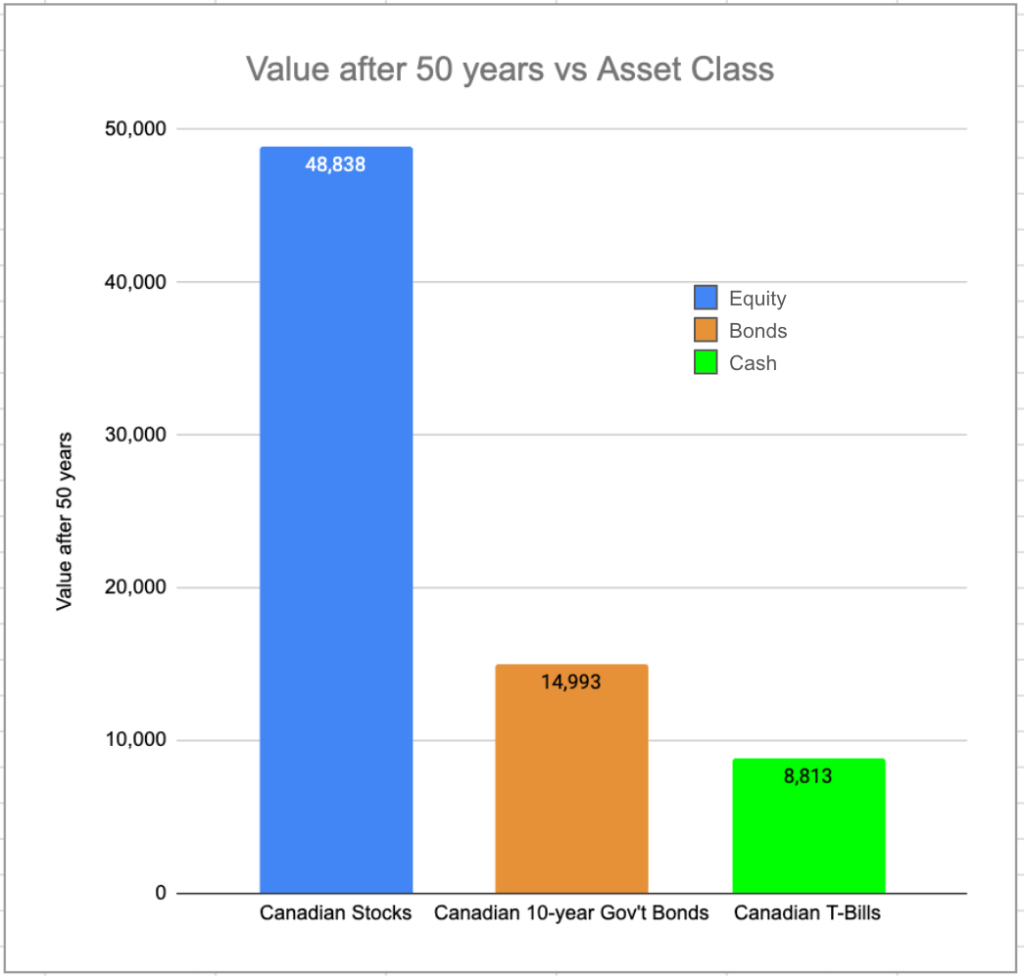
  1. Excellent graphic of historical returns available at https://themeasureofaplan.com/investment-returns-by-asset-class/ ↩︎
  2. Take the latest monthly distribution, divide by the unit price, multiply by 12. If BoC holds their interest rates steady for the year, you could expect to achieve this rate for the next year. As of March 3, 2025. ↩︎
  3. “Commerical paper” refers to very short term debts, 30 days average maturity. Like a credit card debt, maybe. ↩︎
  4. US based funds like this one report a “30 day SEC yield”, it represents “interest earned after deducting the fund’s expenses during the most recent 30-day period by the average investor in the fund”. ↩︎

What’s the deal with AOA?

As mentioned elsewhere, I rely heavily on all-in-one ETFs in my retirement portfolio. New to all-in-ones? Read a bit about them here.

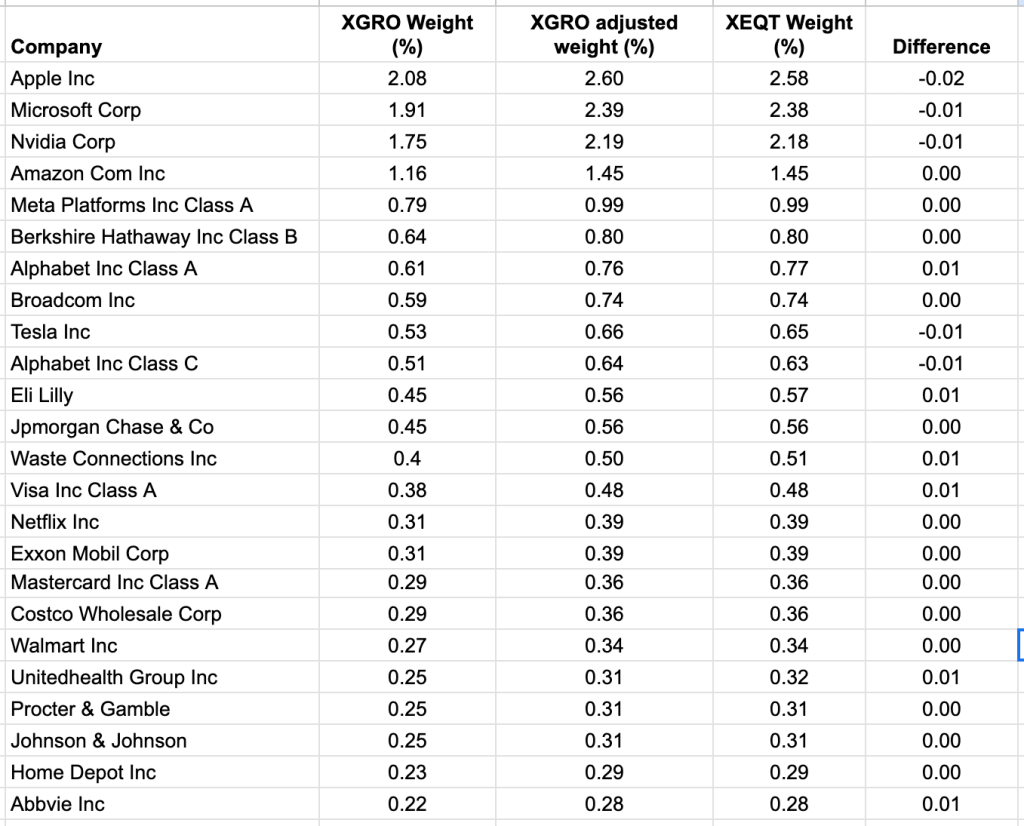
Previously, I covered what’s in XGRO, which is an all-in-one you can purchase on the Canadian market. Because I also happen to have a lot of US dollar-based retirement savings, I have the majority of those funds invested in AOA. AOA is an 80/20 fund 1 offered by BlackRock. It seems that this sort of all-in-one is not as popular in the US as Canada, not sure why2. I see offerings from State Street that sound similar. BlackRock has other members of their asset allocation family with different equity percentages — there’s something for everyone!3

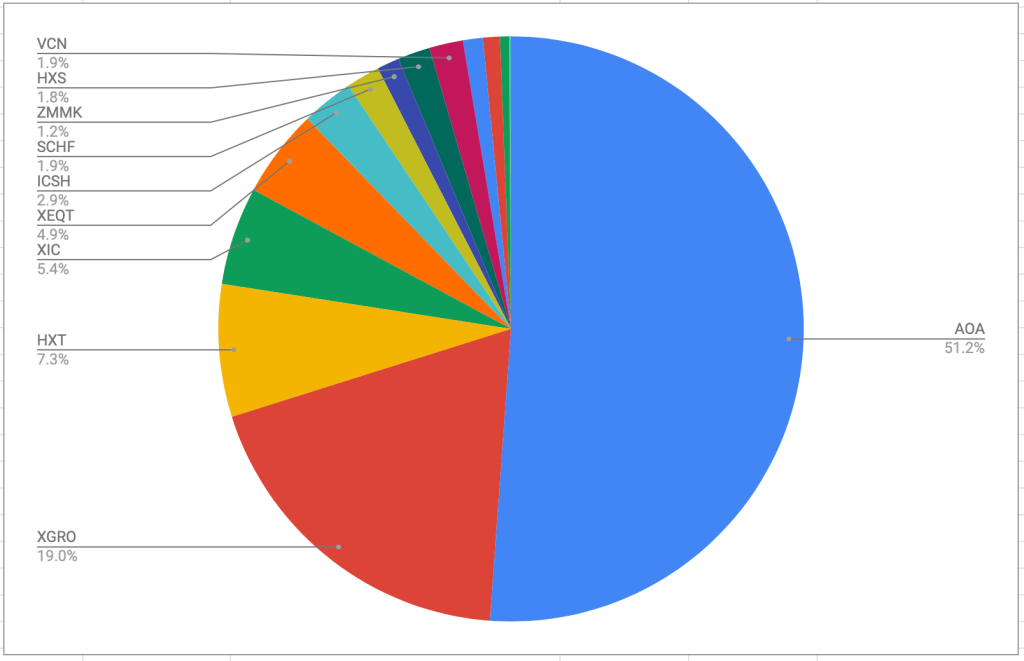
I thought it would be interesting to see what, exactly, is underneath every $100 you invest in AOA. So by reading AOA’s ETF description, following the ETF descriptions of what’s inside AOA, and doing a little math, I came up with the following breakdown4:

FundWhat is it?How much?Colour Commentary
IVV US stock coverage that tracks the S&P 500 Index, 500 of the largest US companies $46.44 of your $100 investment

(of which ~3$ is in each of Apple, Nvidia, and Microsoft, another $2 is in Amazon and Alphabet and $1 in each of Meta and Broadcom)
The Magnificent 7 and 493 other companies
IDEVBroad international (ex-US) developed market stock coverage that tracks the MSCI WORLD ex USA IMI Index, about 2250 companies $21.90 of your $100 investment

(of which SAP gets 29 cents ASML gets 28 cents…)
This also includes a tiny slice of Canada…top holding is RBC at 16 cents of your $100
IUSBBroad US Bond market exposure, about 16,000 bonds from government and corporate entities$16.37 of your $100 investment

(of which $6.29 is in US Treasury, $1.42 is in the Federal National Mortgage Association…)
12 month trailing yield is 4.07%, not too shabby
IEMG3500 or so international companies from emerging markets, following the MSCI Emerging Markets Investable Market Index $8.37 of your $100 investment

(of which 72 cents is in Taiwan Semi, 36 cents is in TenCent..)
27% China, 19% Taiwan, 18% India, 10% South Korea…
IAGGAbout 5800 international bonds tracking the Bloomberg Global Aggregate ex USD 10% Issuer Capped (Hedged) Index5$2.83 of your $100 investment

(of which 5 cents is Chinese T-Bills)
Trailing 12 month yield = 4.27%, even less shbby
IJHUS Midmarket stocks that track the S&P MidCap 400 Index$2.67 of your $100 investment (of which 2 cents is in Williams Sonoma)21% Industrials, 18% Financials…
IJRUS Small Cap stocks that track the S&P SmallCap 600 Index $1.87 of your $100 investment
(largest holding is Hims Hers Health — 2 cents)
IJH+IJR+IVV is sort of similar to ITOT
Main components of AOA as of February 2025

Like XGRO, investing in an all-in-one like AOA provides you with exposure to a bunch of different asset types across many different geographies in one product, including all of the “hot” stocks you read about ad nauseam. Diversification under one banner.

The big difference from XGRO is the very tiny representation of Canada overall. I worked it out to about 2.5% of the overall number, which makes sense given the size of Canada on a global scale.

I came across the “Three Fund Portfolio” popularized by Bogleheads over 15 years ago. AOA and its family members is more or less that concept.

  1. Shorthand for “80% equity, 20% bonds”. There remains a lot of disagreement about the appropriate asset allocation, e.g. https://www.bogleheads.org/forum/viewtopic.php?t=210178 ↩︎
  2. Instead, I see a lot of “target date” retirement ETFs, which are in some ways similar, but lower the equity percentages as you get closer to the target date. ↩︎
  3. There’s also AOR (60% equity), AOM (40% Equity) and AOK (30% Equity) ↩︎
  4. Compare with the XGRO breakdown at https://moneyengineer.ca/2025/01/30/whats-the-deal-with-xgro/ ↩︎
  5. That’s a mouthful. ↩︎

USD Assets in the retirement portfolio. Good idea?

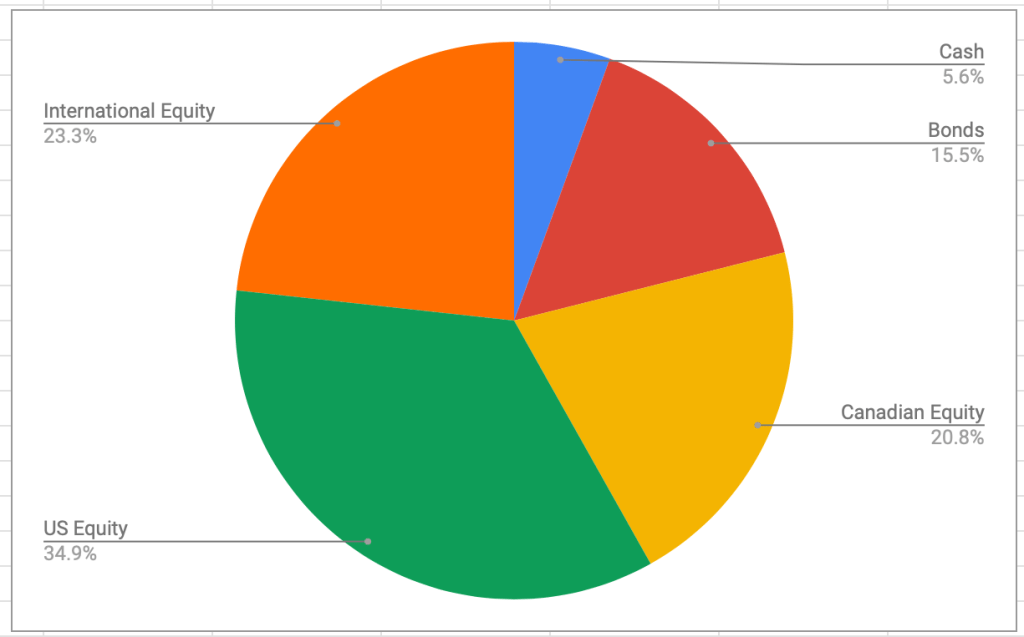
I’m not sure when I first made a purchase of a USD-denominated ETF. Probably over 10 years ago. Clearly, I thought it was a good idea, because as of today I find that 57% of my retirement savings1 are denominated in US Dollars.

And unlike other people I’ve talked to, there’s no underlying rationale for that. I’ve never earned employment income in USD and I don’t own property in the US. So why?

I’m a cheapskate.

I started investing in USD based ETFs simply because they were a much better deal than their Canadian equivalents. This is less true now than it used to be, but it’s still true. Take for example the comparison between comparable USD and CAD ETFs that track the same index:

IndexWhat’s in itUSD ETFMERCAD ETFMER
S&P 500Top 500 US stocksIVV0.03%VFV, XUS0.09%
Russell 20002000 mid-market US StocksVTWO0.07%XSU2, RSSX30.36% for XSU, 0.25% for RSSX
FTSE Developed ex USGlobal stocks outside of the USASCHF0.06%VDU0.22%
USD versus CAD ETFs tracking the same index4

The Canadian market has become more competitive, and MERs have come down, but given the size of the US market, it’s still cheaper to invest there.

I’m not a very savvy cheapskate.

So although the MERs of US ETFs were stunningly attractive, I failed to consider the cost of currency conversion. For this I blame naivete as well as a lack of transparency on the part of my provider. It was not possible for me to easily figure out how much each CAD to USD transaction was costing me. A good estimate is about 1.5% the cost of the transaction, but some providers make this much cheaper5.

I also had USD investments in my TFSAs, which, from a tax perspective, isn’t the best idea.

Over time, I discovered the joys of Norbert’s Gambit to do currency transactions on the cheap and I became more savvy. And I eliminated all US holdings from my TFSA.

Preparing for Retirement

In preparing my portfolio for retirement (steps I took are outlined here), I did seriously consider converting everything to CAD in the interest of keeping things simple. I did not, and here’s why:

  • I figured that having ready access to USD would be rather useful to retired me, since I do vacation there. And I had made other preparations in light of that, setting up a USD credit card and USD savings account for RRIF payments to go to.
  • Although I knew that having USD RRIFs would make getting paid in retirement more complicated, I thought I had worked out a plan with my provider6 that would make extracting USD RRIF payments achievable, with some effort on my part.
  • I sort-of liked having some of my investments in USD since it’s a stable currency. Usually.
  • I also liked the additional boost I got from USD HISAs. (That’s probably an anomaly but one I’m happy to take advantage of)
  • I could change my mind at any time.

Current Reality

This isn’t working like I thought it would.

My provider decided to backtrack on allowing me to extract USD from my USD RRIF;7 we’re still going back and forth on that front, but my friends at QTrade are on my naughty list as a result. I’m not hopeful.

What it means practically is that although the value of my USD RRIF is used to calculate my RRIF minimums, I can only withdraw RRIF payments from the Canadian side. At present, the Canadian side of my RRIF will fund my RRIF minimum payments for a while, but at some point I’ll have to use Norbert’s Gambit to move funds from the USD RRIF to the CAD RRIF.

My Advice

I don’t think that holding USD assets in retirement — especially in a RRIF — is a great idea for the DIYer. Unless platform providers give really clear processes8 for how to extract that money from a USD RRIF, expect trouble.

At some point, I will either switch providers to find one that supports my requirements9, or I will convert everything to CAD. Right now, I have a process that works, but older me I expect will find it too complicated.

  1. Majority of the USD holdings are in my / my spouse’s RRIF; small portion is in my non-registered account. ↩︎
  2. Not an apples to apples comparison, admittedly. This ETF is hedged so it’s less impacted by changes in the CAD/USD exchange rate but this comes at a cost. ↩︎
  3. This is ALMOST the same thing; RSSX uses a capped version of the index ↩︎
  4. And try as I might, I couldn’t find a USD ETF that invested in the TSX/S&P 60. Not really surprising, and my USD retirement holdings have very limited Canadian exposure. AOA has about 2.4% Canadian exposure. ↩︎
  5. Notably, Interactive Brokers and lately, Wealthsimple especially if you hold more than 100k with them. ↩︎
  6. Involving multiple phone conversations and multiple emails ↩︎
  7. You may ask, “what’s the point of having a USD RRIF if you can’t extract USD from it”? I had the same question… ↩︎
  8. RBC says they support it and so does Questrade. ↩︎
  9. I had sorely hoped Wealthsimple could be that provider, but (sigh) they don’t support spousal RRIFs at the moment. ↩︎

How to read an ETF fact sheet: what’s in a name?

Summary: The standard ETF fact sheet is 4 pages of information a Canadian ETF provider is required to provide. Here’s some tips about what to look for in a name.

Google AI, which is never wrong, tells me that there are more than 1500 ETFs available for purchase on the Canadian market. For those new-to-DIY-investing1, that can seem a little overwhelming. Most of my retirement holdings are tied up in just two asset-allocation ETFs, but prior to retirement, I enjoyed juggling a bunch of index ETFs to roll my own custom asset allocation that I rebalanced manually.

A good skill to have is to understand some of the basic language used in these fact sheets so you can decide if a given ETF is right for you and your investment objectives.

What’s the name of the ETF?

So much is captured in the full name of a given ETF. There’s key words I look for, and key words that I avoid.

Words I look for: “Index” or maybe “Idx”

An index is a list of assets that comply to a set of rules laid out by the index manager. You can think of an index as a detailed recipe for building a list of stocks or bonds. What’s important is that the index is not invented by the company selling you the ETF. The index is a third-party invention, and any ETF company can make use of the recipe in offering you, the investor, a product to buy. The index is the recipe, and the ETF company is the chef that prepares the dish that you buy. You could become a chef yourself, and buy the individual components of the index on your own. However, since some of the indices are comprised of hundreds or even thousands of assets, not every index is realistic for the home chef to create.

An ETF that uses the word “index” in its name suggests it’s a passive ETF, meaning there’s a skeleton crew of managers making trades based solely on what’s in the index. I like index funds because they are generally cheap, and over time, they beat the active traders2 again and again.

Like the ETF market itself, there has been an explosion in the number of indices3 out there created by the likes of FTSE Russell or MSCI. Knowing the names of some of the most popular indices can help:

  • S&P/TSX 60: Canadian stock market’s largest 60 companies. Canadian ETFs that track this include XIU and ZIU.
  • S&P 500: US Stock market’s largest 500 companies. Canadian ETFs that track this include VFV, ZSP, and XUS.
  • Russell 2000: US Stock market’s next-largest 2000 companies after first dropping the top 10004. A Canadian ETF that uses this index is XSU.
  • MSCI EAFE: Developed country index, excluding USA and Canada. Canadian ETFs that use this index include ZEA and XEF5
  • FTSE Canada Universe Bond Index: A broad set of Canadian corporate and government bonds. Sold as ZAG by BMO and XBB by BlackRock/iShares.

A quick search reveals all kinds of very specific index funds: sector based (e.g. “AI” or “Healthcare”) and country/region based (e.g. “China”, “BRICSA”). I ignore these kinds of funds because betting a sector or a region feels like market timing to me, and market timing is a proven loser in terms of long-term returns.

Words I avoid: “Hedged”

“Hedged” means that the ETF uses some kind of strategy to smooth out the ups and downs in the Canadian dollar’s exchange rate. And on one level, it makes sense: if you buy the S&P500, you’re owning a bunch of US stocks priced in US dollars. If the Canadian dollar gets stronger, then your US holdings are worth less in CAD. If the Canadian dollar gets weaker, then your US holdings are worth more to you in CAD. So some funds try to make this variance go away.

I avoid hedged funds for a few reasons:

  • It adds cost and complexity to the fund, two things I dislike about where I choose to invest.
  • It’s imperfect; while it makes the bumps in the foreign exchange rate get smaller, it would be overly expensive to make them go away completely
  • If you hold an asset long enough and reinvest your dividends, it will be a wash in the end, and the extra cost just creates a drag on your returns. For example, let’s compare XUS versus XSP, which are identical, save for XSP’s use of hedging:
The long term cost of using hedging: XUS vs XSP (hedged)

Words I avoid: “Leveraged” / “Bull” / “Bear”

“Leveraged” means “we’re buying stocks using borrowed money”. And while buying stocks using borrowed money can significantly enhance your returns in an up market, the opposite is true in a down market. No free lunch.

Any ETF that has Bull or Bear in the name is making a bet based on short term returns. Buying scratch tickets at Christmastime is enough gambling for me, and gambling has no place in my retirement strategy.

Summing up

Looking at the name of an ETF is a good starting filter to decide if it’s for you. It’s just one piece of many included in an ETF’s fact sheet.

  1. Tips on how to execute on that decision were the topic of a previous post ↩︎
  2. For example: https://www.spglobal.com/spdji/en/research-insights/spiva/#canada ↩︎
  3. One tip I can offer: if more than one ETF exists offering the index, it’s probably a decent index to consider. Be a bit suspicious if only one company has an ETF that mirrors said index — I’d consider it a bit of a fringe offering, of no interest to me. ↩︎
  4. This is normally seen as a “mid cap” or “small cap” index, meaning “US stocks that aren’t in the S&P 500”. I looked at https://www.marketbeat.com/types-of-stock/russell-2000-stocks/ and the first company I recognized was Duolingo. ↩︎
  5. As an illustration of the insanity regarding the explosion of indices, XEF tracks not MSCI EAFE but MSCI EAFE IMI, which adds a few more smaller companies into the mix. But if you refer to https://www.msci.com/documents/10199/11a56df6-0f09-4477-a168-cce49e1719cd you will see that the long term performance differs by 0.01%. ↩︎

Earn money with your cash: The HISA table February 2025

Summary: High Interest Savings Accounts (HISAs) are a way for cash to earn half-decent, risk-free interest. These “Series F” HISAs are likely available through your online broker, but you may have to ask how to get at them, exactly.

The high interest savings account (HISA1) is a different animal than the bank accounts offered by the likes of Simplii, Tangerine, EQ, or Wealthsimple2. The bank accounts are more intended for very short term savings for day to day use. They frequently offer attractive promotional rates for new clients. And while these are all good ways to earn a few extra bucks on cash in your account, it’s not the focus here.

The HISAs I’m talking about are usually only offered via a broker, and many of the DIY brokers3 allow you to purchase the so-called “Series F” version of these, which do not have any hidden trailer fees. They are “special” bank accounts insured by CDIC4 that pay rates that are tied to the overnight rates. When those change, expect the HISA rates to follow suit.

There was a mini-explosion in ETFs that invested in HISAs: CASH and HISA are two examples5. I never bothered with these since they weren’t free to trade on QTrade and trading costs would be a significant drag on the ROI.

Part of my investment philosophy is to have 5% of my overall holdings in cash (as for the rest, it’s 15% in bonds, 80% in Equity). And so I’m quite motivated to have some sort of real return6 from my cash position since it is a measurable part of my net worth.

So I do pay attention to the ups and downs of the HISA rates. And I figured I’d share them with you:

Current HISA rates for HISAs available via QTrade

There’s also a Google Sheets version with a bit more detail (source links) if you prefer.

Hopefully most of the fields are self-explanatory. The “fund” column shows the identifier you would need to use to actually trade the HISA on your trading platform. How to access it will vary by provider. QTrade hides their HISAs in the “Mutual Fund” tab which is incorrect; these are not mutual funds, but are often modeled that way in the DIY platforms.

For Canadian Dollar HISAs, Scotiabank7 has been usurped! They have long been the highest-paying provider but the title now falls to B2B bank: https://b2bbank.com/advisor-broker-rates/banking-rates.

For those of you who hold US cash in your brokerage accounts, you can benefit from the much higher US interest rates8, and you have multiple choices since multiple providers are paying the same rate.

Before taking the leap and trading in HISAs, I was surprised by how they were handled on QTrade. There were a few differences possibly specific to QTrade, but pay attention to how your provider handles HISA trades:

  • QTrade considers holdings in HISAs part of your cash position for the purposes of buying stocks and ETFs9. If you successfully complete a trade that exceeds your ACTUAL cash position (i.e. cash NOT in the HISA) you will also have to sell the correct amount of your HISA to get rid of the negative cash balance in your account and avoid interest fees
  • HISA trades are not tracked in the “orders” tab of QTrade10 so be careful that you don’t inadvertently trade the same thing twice
  • QTrade limits all HISA purchases to $1000 minimum; there are no restrictions on sales, and there are no fees for either buying or selling HISAs.

Does your DIY broker give you access to other funds? Let me know about them at comments@moneyengineer.ca!

  1. An aside about the image chosen for this post…I pronounce the acronym HISA….and it’s on a TABLE, get it? ↩︎
  2. Looking at these websites, I may have to consider breaking up with CIBC for my day to day banking… ↩︎
  3. QTrade and iTrade definitely allow you to purchase these. Wealthsimple and BMO Investorline do not. Wealthsimple as a matter of course offers pretty competitive rates for any cash floating around in your account, especially if you have over $500k with them. BMO Investorline has high interest savings too, but you access to their product only (BMT104). ↩︎
  4. My personal bias is that I don’t much pay attention to CDIC-insured or not. I figure if major Canadian banks start failing, I had better make like Survivorman, because no insurance is going to save me. Perhaps that’s naive. ↩︎
  5. Great names for both, by the way ↩︎
  6. That’s return above the current inflation rate. Hiding money under a pillow would typically earn a negative real return, equal in magnitude to the current inflation rate. ↩︎
  7. All my cash holdings are in DYN6004 or DYN6005. ↩︎
  8. US Fed has not been as aggressive in cutting interest rates as compared to Bank of Canada. ↩︎
  9. Since I don’t have a margin account, if I try to buy something I don’t have the money for, I’m normally strongly discouraged from doing so with a clear warning. ↩︎
  10. BMO Investorline is the king of confusing handling of cash positions in your account. ↩︎