Buying US Stocks or ETFs? Save money on US dollar foreign exchange.

I have a lot of US dollar assets in my retirement portfolio. I’m not really convinced it’s a good idea, but it has taught me the ins and outs of USD foreign exchange rates. Here I’m talking about getting access to (or changing from) US funds for the purposes of investing in your brokerage account. Getting access to US funds to buy things is a different1 animal, one that I covered in a previous post.

Here’s a few things I’ve learned.

Google is your friend for real time foreign exchange (FX) rates

“1000 USD in CAD” is a terrific search term to get an instant FX rate. (also: Euro, GBP, THB…). This is as close as you’ll get for the absolute best FX rate and should serve as your target.

For most brokerages, foreign exchange is a profit center

Meaning: They’re making money every time you convert one currency to another, usually on the order of 1.5% a transaction. Some providers seem to go to great lengths to hide what rate they are using on any given transaction. (I’m looking at you, QTrade2).

There are exceptions in the brokerage community, to be sure.

  • Interactive Brokers comes very close to the ideal rate for any sizable transaction3 and is the big winner when it comes to converting currency for investing purposes45
  • Wealthsimple recently introduced a tiered FX rate depending on how much you’re converting6:
    • Under $10k, 1.5%
    • Up to $25k, 1%
    • Up to $100k, 0.5%
    • Over $100k, 0%

The cheapest way to convert at most brokerages is to use Norbert’s Gambit

Norbert’s Gambit, in a nutshell, involves the following steps.

I must say at this point that although the steps are reasonably straightforward, there are usually delays introduced at each step. For example, you probably have to wait a day for the initial trade to settle before making the journaling request. And journaling may not be instantaneous either11.

With no guarantee that any of these are accurate, here are the specific steps to do the Gambit on a number of popular platforms.

  1. For most people. Since I am a CIBC USD savings account client, using Norbert’s Gambit is also a way for me to fund my USD shopping purchases. ↩︎
  2. When attempting to buy a USD ETF from my Canadian account, the only indication I’m about to get fleeced is the warning message “The account funds do not match the market currency. Currency conversion and foreign exchange rates will apply.” No indication of what the exchange rate they are using. ↩︎
  3. Their posted rates are very close to the google ideal, but there is a small (very small) minimum charge of $2 per trade per https://www.interactivebrokers.com/en/pricing/commissions-spot-currencies.php ↩︎
  4. It’s not ideal for getting cash access for shopping since they have very long hold periods where you cannot withdraw your money. See https://www.interactivebrokers.com/campus/glossary-terms/withdrawable-cash-subject-to-origination-restriction/ for the details. ↩︎
  5. But that web interface, wow is it ever complicated ↩︎
  6. See https://www.wealthsimple.com/en-ca/legal/fees/trade for the details. You’ll need a Wealthsimple USD account to pull this off, of course, and the only kind of USD account Wealthsimple offers is non-registered. ↩︎
  7. Did this at BMO Investorline since you cannot buy DLR online. Apparently you can buy it if you call in your order. At BMO using RY, I was able to get USD on the same day. ↩︎
  8. HOW to do this will vary considerably depending on who your broker is. Best to Google for specific instructions involving your broker. ↩︎
  9. Possibly for buying and selling the ETF, possibly a fee imposed for journaling, something Questrade is doing starting April 1, 2025. ↩︎
  10. And minus (or plus) any changes in the price of the thing you bought. Depending on your broker, each step in the process may take a day or two. If you do the Gambit often enough, I figure this sort of thing just averages out. Sometimes you win, sometimes you lose. ↩︎
  11. Per https://www.questrade.com/learning/investment-concepts/dual-listed-securities/journaling-shares it can take five (!) business days. ↩︎


Questrade Bonus Capability: Passiv

**** Update: Per email communication on October 24 2025, as of January 31, 2026, Passiv will not be offered at all by Questrade, as they are planning to launch their own integrated portfolio monitoring and rebalancing tools”.

**** Update: As of June 1, 2025, Passiv Elite is no longer offered for free for Questrade Clients. It’s now part of a subscription service called Questrade Plus***

As you may have heard, I’m in the middle of a transition between online brokers1. And so I’ve been spending some more time getting to know what Questrade offers to the DIY investor besides free buying and selling of stocks and ETFs.

One thing I looked into lately was Passiv, a service that is offered for free for all Questrade clients.

In brief, Passiv is a 3rd party web application2 that allows you to track your investments from a single screen, no matter if they are found in multiple investment vehicles (e.g. TFSA, RRSP, RRIF) or if they are found across multiple providers (full list of supported brokers is here)3.

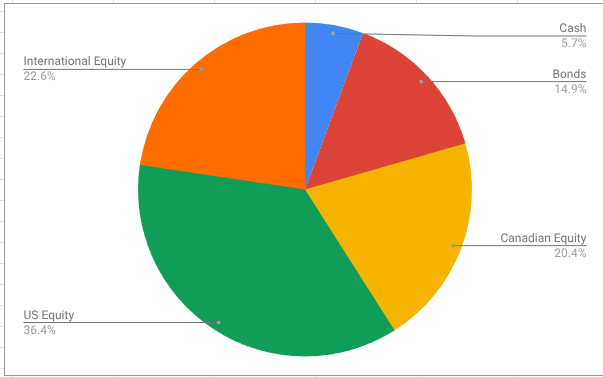
What’s more, it also evaluates your portfolio against a model that you define. For example, if you (like me) have an investment portfolio with a target allocation of 5% cash, 15% bonds, 20% Canadian equity, 36% US equity, and 24% international equity, Passiv can assess your current holdings against these targets, and even do the trades to rebalance the portfolio!

Astute readers will note these are a lot of the same benefits I’m a fan of — and one of the big reasons most of my portfolio is invested in all-in-one asset allocation ETFs. (Are these ETFs unfamiliar? You can read about them here.)

I tried to use Passiv to model my own portfolio, but discovered that all-in-one asset allocation ETFs aren’t really supported by the tool4. Once I thought about it some more, it’s clear why — Passiv really markets itself as an ALTERNATIVE to using all-in-ones. Here’s a clear marketing pitch from Passiv that demonstrates its approach: https://passiv.com/feature-posts/model-portfolios-that-cost-less-than-all-in-one-funds-or-robo-advisors.

So to get the full benefit of Passiv, instead of holding XGRO, you would instead hold the constituent components of XGRO, a fund I’ve broken down previously. This would save you some management fees over time. Passiv helpfully does the math to calculate how much here5.

As a certified cheapskate, I’m always interested in saving a bit of money. But there are some downsides I could see in the Passiv approach:

  • You have to actually DO the rebalancing now and then. Not a big deal, but a fund like XGRO does this as part of their offer6.
  • You have to do the rebalancing no matter what. By this I mean that you have to buy when others are selling, and sell when others are buying. You can’t get overly attached to any one segment of your portfolio, because then you start making bad decisions based on “gut instinct”. Humans are notoriously bad at this7.

On the plus side, you will definitely save on management fees, and you could certainly tweak the contents to avoid products you wouldn’t normally buy (e.g. XGRO has some hedged funds, which I don’t like, typically).

An unknown for me is how foreign exchange is handled. That’s always something I consider since a lot of my retirement savings are in USD. Some experiments required 🙂

Anyway, it’s given me something to think about. I’ll have to see how easy it is to use in practice once all my accounts are back in place. Any Passiv users out there? I’m interested in your take — just drop a line to comments@moneyengineer.ca.

  1. And some (not all) of the funds are now showing up in Questrade, about 3 weeks after starting the process. Switching providers is not for the impatient. ↩︎
  2. WARNING: they don’t have an app. But someone named “Pasiv” does, and it looks very similar. ↩︎
  3. Other benefits include tracking of dividends, performance charts, etc. All stuff Questrade is apparently not very good at. ↩︎
  4. One asset class per stock symbol. My home-grown spreadsheet supports dividing symbols by asset class. ↩︎
  5. The calculation doesn’t include Passiv’s fees for the service, which are waived if you are Questrade client. ↩︎
  6. Per BlackRock “XGRO’s portfolio will be monitored relative to the asset class target weights and will be rebalanced back to asset class target weights from time to time at the discretion of BlackRock Canada and/or BTC. Generally, XGRO’s portfolio is not expected to deviate from the asset class target weights by more than one-tenth of the target weight for a given asset class.” [source] ↩︎
  7. If you’re interested in how behavior shapes investing, https://www.looniedoctor.ca/2024/12/13/etf-investor-behavior/ is a very good introduction to the topic. ↩︎

What’s in my retirement portfolio (March 2025)

This is a (hopefully monthly) look at what’s in my retirement portfolio. The original post is here. Last month’s is here.

Portfolio Construction

The retirement portfolio is spread across a bunch of accounts1:

  • 7 RRIF accounts (3 for me, 3 for my spouse, 1 at an alternative provider as a test)
  • 2 TFSA accounts
  • 5 non-registered accounts, (2 for me 1 for my spouse, 2 joint)

The target for the overall portfolio is unchanged:

  • 80% equity, spread across Canadian, US and global markets for maximum diversification
  • 15% Bond funds, from a variety of Canadian, US and global markets
  • 5% cash, held in savings-like ETFs.

The view as of this morning

As of this morning, this is what the overall portfolio looks like:

Overall retirement portfolio by holding, March 2025

The portfolio, as always, is dominated by AOA and XGRO which are 80/20 asset allocation funds in USD and CAD, respectively. The rest are primarily either cash-like holdings in two ETFs: ZMMK2 in CAD and ICSH3 in USD) or residual ETFs held in non-registered accounts for which I don’t want to create unnecessary capital gains just for the sake of holding AOA or XGRO.

The biggest month over month change is due to switching brokers. My old broker (QTrade) allowed the purchase of HISAs, but my new broker (Questrade) doesn’t seem to offer them4. So I replaced DYN6004 with ZMMK and DYN6005 with ICSH. I made these changes in my QTrade account to avoid any problems with doing an “in-kind” transfer to Questrade.

I’m still in need of USD to pay off some vacation bills, so there is a small hit to SCHF to help out.

Plan for the next month

The asset-class split looks like this

Overall retirement portfolio by market, March 2025

The international equity percentage is below my target of 24%, and so I’ll have to fix that5. VEU looks like it provides exposure to both developed and emerging markets at a rock-bottom price6. XEF would be a perfect fit in the Canadian market, although I should probably also consider XEC to get some emerging markets exposure.The cash position is artificially high because I already did the necessary transactions to get paid out of my RRIF and non-registered accounts (if I did this exercise at the beginning of the month, rather than mid-month, that would disappear). That extra cash will flow to my bank account in the coming days.

A quarterly activity that I’ll be performing this month7 is to shift some of my USD RRIF holdings into my CAD RRIF. I do this to make sure I’m not overexposed to changes in the CAD/USD exchange rate. My current provider reportedly allows me to make RRIF payments natively in USD, so that may be another option to consider. I’ll make an attempt at some point!

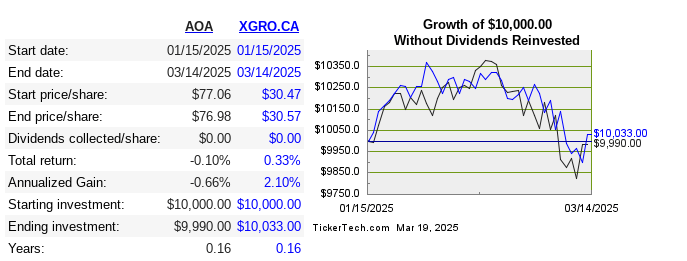
One final note: my retirement savings declined 3%8 over the month due to the wild (mostly downward) swings in the stock market, but this leaves me roughly even since my retirement started at the beginning of the year. Here’s the monthly returns for the 2 ETFs that make up the lion’s share of my portfolio9.

XGRO and AOA monthly returns so far
  1. The list is sort-of accurate. I’m in the middle of changing online brokers and since Questrade combines USD and CAD assets in one account, the number of accounts is diminishing. ↩︎
  2. Current 12-month yield: 3.6% ↩︎
  3. Current 30-day SEC yield: 4.61% ↩︎
  4. This specific topic addressed at https://www.financialwisdomforum.org/forum/viewtopic.php?t=125308. ↩︎
  5. The observant reader will note I also said this LAST month. That was before I decided to switch brokers. Once my holdings settle at Questrade, I’ll revisit. ↩︎
  6. MER = 0.04%. VEU has some Canadian exposure too, which isn’t ideal, but I don’t think there’s a USD ETF that excludes both Canada and the USA. ↩︎
  7. And should have done last month, sorry. ↩︎
  8. It would have been worse, except the USD also went up versus the Canadian dollar in the time period. Diversification works 🙂 ↩︎
  9. “Without dividends reinvested” since these two ETFs only pay out quarterly. There haven’t been any yet — next month! ↩︎

ETFs for parking your money safely

Since my new DIY broker (Questrade) does not support the purchase of high interest savings accounts (HISAs), I need to find a free-to-trade alternative. 5% of my retirement portfolio is invested in what is characterized as “cash”, but I expect that money to earn some sort of return with essentially zero risk. (Another 15% of my portfolio is in the bond market, which, as we all learned in the last few years, has its downsides1.)

Questrade (like Wealthsimple) offers free trades of all ETFs. So it makes sense for me to go looking for ETFs that invest in safe havens. Here’s what I turned up for investments in Canadian dollars, based on some Google searches and some reading of similar questions posted in the public domain. Not all of them are what I would call “equivalent” to a HISA.

Fund SymbolFund CompanyWhat it invests inMERCurrent annual yield2Commentary
CASHGlobal X“high-interest deposit accounts with one or more Canadian chartered banks”0.11%2.68%This invests in the HISAs I currently invest in
CBILGlobal X“short-term Government of Canada T-Bills”0.11%2.88%Not a HISA but a safe investment
HISAEvolve“high-interest deposit accounts”0.15%2.71%Equivalent to CASH but with a higher MER
MCADEvolve“Canadian dollar high-quality short term debt securities (with a term to maturity of 365 days or less)”0.20%3.17%Very short term bond fund. 18% of holdings have due dates of less than 30 days
ZMMKBMO“high-quality money market instruments issued by governments and corporations in Canada, including treasury bills, bankers’ acceptances, and commercial paper. 0.13%3.6%Not a HISA but a very short term bond fund3. 31% of holdings have due dates of less than 30 days.
CAD ETF Candidates for investing Canadian dollars

Based on this quick analysis, ZMMK looks pretty attractive — a lot of very short term (and hence safer) debt as compared to MCAD, excellent returns. It is clearly a riskier investment than something like CASH or HISA. Between CASH and HISA I lean to smaller MERs every time, so CASH wins. CBIL might be a sort of happy middle ground…a T-Bill ought to be as good as a bank. All of these ETFs have a pretty stable NAV, either $50 or $100 per unit, so there should be little to worry about in terms of capital gains.

Since I hold a lot of USD, (not convinced this is a good idea), I need to do the same exercise for USD safe havens.

Fund SymbolFund CompanyWhat it invests inMERCurrent Annual Yield4Commentary
HISUEvolve“primarily in high interest US dollar deposit accounts”0.11%4.05%This invests in the HISAs I currently invest in
HSUVGlobal X“primarily in high interest U.S. dollar deposit accounts with Canadian banks…not currently expected to make any regular distributions”0.2%n/aGlobal X “corporate class” ETFs convert interest payments into capital gains. This sort of ETF makes sense in a non-registered account to minimize taxes.
ICSHBlackRock“broad range of short term U.S. dollar-denominated investment-grade fixed- and floating-rate debt securities and money market instruments”0.08%4.31%Not HISA but 46% is invested in debt with less than 30 days maturity
MUSDEvolve“primarily in U.S. dollar-denominated high-quality short term debt securities (with a term to maturity of 365 days or less).”0.20%3.49%Similar in strategy to ICSH, but only 20% in debt with 30 days maturity and only 40 holdings.
UCSHGlobal X“primarily invests in high-interest U.S. dollar deposit accounts, which provide a higher interest rate than a traditional USD savings account.”0.16%4.08%HISA-like, based on term deposits
USD ETF Candidates for investing US dollars

ICSH is the clear winner in terms of return, but, like ZMMK, a little riskier than a simple bank account. It has a nice broad portfolio (363 individual holdings) which makes it feel safer. HISU looks like the straight-up HISA replacement.

What ETFs do you use to park your cash? Let me know at comments@moneyengineer.ca.

  1. Excellent graphic of historical returns available at https://themeasureofaplan.com/investment-returns-by-asset-class/ ↩︎
  2. Take the latest monthly distribution, divide by the unit price, multiply by 12. If BoC holds their interest rates steady for the year, you could expect to achieve this rate for the next year. As of March 3, 2025. ↩︎
  3. “Commerical paper” refers to very short term debts, 30 days average maturity. Like a credit card debt, maybe. ↩︎
  4. US based funds like this one report a “30 day SEC yield”, it represents “interest earned after deducting the fund’s expenses during the most recent 30-day period by the average investor in the fund”. ↩︎

What’s the deal with AOA?

***Updated numbers February 2026***

As mentioned elsewhere, I rely heavily on all-in-one ETFs in my retirement portfolio. New to all-in-ones? Read a bit about them here.

Previously ,I covered what’s in XGRO, which is an all-in-one you can purchase on the Canadian market. Because I also happen to have a lot of US dollar-based retirement savings, I have the majority of those funds invested in AOA. AOA is an 80/20 fund 1 offered by BlackRock. It seems that this sort of all-in-one is not as popular in the US as Canada, not sure why2. I see offerings from State Street that sound similar. BlackRock has other members of their asset allocation family with different equity percentages — there’s something for everyone!3

I thought it would be interesting to see what, exactly, is underneath every $100 you invest in AOA. So by reading AOA’s ETF description, following the ETF descriptions of what’s inside AOA, and doing a little math, I came up with the following breakdown4:

FundWhat is it?How much?Colour Commentary
IVV US stock coverage that tracks the S&P 500 Index, 500 of the largest US companies $44.53 of your $100 investment

(of which ~3.50$ is in Nvidia, ~$3 in Apple, and ~$2 in Microsoft, with ~$1 in Amazon, Alphabet, Meta, Broadcom and Tesla)
The Magnificent 7 and 493 other companies
IDEVBroad international (ex-US) developed market stock coverage that tracks the MSCI WORLD ex USA IMI Index, about 2250 companies $23.02 of your $100 investment

(of which ASML gets 42 cents, Roche gets 26 cents…)
This also includes a tiny slice of Canada…top holding is RBC at 18 cents of your $100
IUSBBroad US Bond market exposure, about 16,000 bonds from government and corporate entities$16.36 of your $100 investment

(of which $6.45 is in US Treasury, $1.44 is in the Federal National Mortgage Association…)
12 month trailing yield is 4.18%, not too shabby
IEMG3500 or so international companies from emerging markets, following the MSCI Emerging Markets Investable Market Index $9.29 of your $100 investment

(of which $1.06 is in Taiwan Semi, 42 cents is in Samsung..)
23% China, 22% Taiwan, 16% South Korea, 14% India,
IAGGAbout 5800 international bonds tracking the Bloomberg Global Aggregate ex USD 10% Issuer Capped (Hedged) Index5$2.83 of your $100 investment

(of which 30 cents is Japanese T-Bills)
Trailing 12 month yield = 3.27%, has lost a full point in the last year
IJHUS Midmarket stocks that track the S&P MidCap 400 Index$2.59 of your $100 investment (of which 2 cents is in Lumentum, who I’ve never heard of)25% Industrials, 15% Financials…
IJRUS Small Cap stocks that track the S&P SmallCap 600 Index $1.22 of your $100 investment
(largest holding is Solstice Advanced Materials)
IJH+IJR+IVV is sort of similar to ITOT
Main components of AOA as of February 2025

Like XGRO, investing in an all-in-one like AOA provides you with exposure to a bunch of different asset types across many different geographies in one product, including all of the “hot” stocks you read about ad nauseam. Diversification under one banner.

The big difference from XGRO is the very tiny representation of Canada overall. I worked it out to about 2.5% of the overall number, which makes sense given the size of Canada on a global scale.

I came across the “Three Fund Portfolio” popularized by Bogleheads over 15 years ago. AOA and its family members is more or less that concept.

  1. Shorthand for “80% equity, 20% bonds”. There remains a lot of disagreement about the appropriate asset allocation, e.g. https://www.bogleheads.org/forum/viewtopic.php?t=210178 ↩︎
  2. Instead, I see a lot of “target date” retirement ETFs, which are in some ways similar, but lower the equity percentages as you get closer to the target date. ↩︎
  3. There’s also AOR (60% equity), AOM (40% Equity) and AOK (30% Equity) ↩︎
  4. Compare with the XGRO breakdown at https://moneyengineer.ca/2025/01/30/whats-the-deal-with-xgro/ ↩︎
  5. That’s a mouthful. ↩︎