

What’s in my retirement portfolio (Aug 2025)

This is a monthly look at what’s in my retirement portfolio. The original post is here. Last month’s is here.

Portfolio Construction

The retirement portfolio is spread across a bunch of accounts:

  • 7 RRIF accounts (3 for me, 3 for my spouse, 1 at an alternative provider as a test)
  • 2 TFSA accounts
  • 4 non-registered accounts, (1 for me, 1 for my spouse, 2 joint)

The target for the overall portfolio is unchanged:

  • 80% equity, spread across Canadian, US and global markets for maximum diversification
  • 15% Bond funds, from a variety of Canadian, US and global markets
  • 5% cash, held in savings-like ETFs.

You can read about my asset-allocation approach to investing over here.

The view post-payday

I pay myself monthly in retirement, so that’s a good trigger to update this post. At market close, August 22, this is what it looks like:
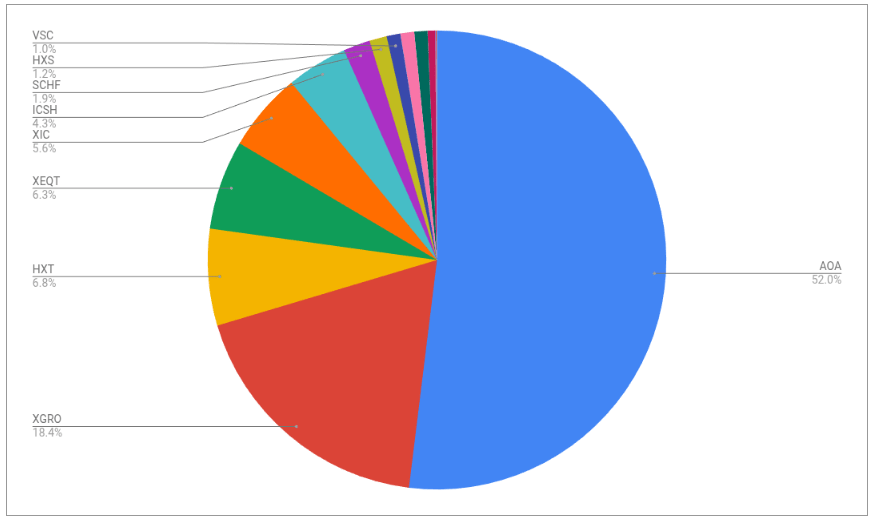
Retirement holdings by ETF, August 2025

The portfolio is dominated by my ETF all-stars; anything not on that page is held in a non-registered account and won’t be fiddled with unless it’s part of my monthly decumulation. Otherwise I’ll rack up capital gains for no real benefit.

The most noticeable change is a growth in the importance of ICSH to my portfolio at the expense of ZMMK. I did the math to justify performing a Norbert’s Gambit of the CAD generated by selling ZMMK and picking up ICSH. The amount of HXS remaining in the portfolio is dwindling, and may be gone altogether by next month. I choose which assets to sell out of my non-registered accounts by simply determining which asset category needs to be trimmed based on my multi-asset spreadsheet.

I also have a new way to track my AOA splits; since it rebalances itself twice annually, it seems to me wiser to fix its bond contribution at 20% in my multi-asset tracker. The equity splits between US, International, and Canadian are still dynamically calculated at least monthly using a properly weighted formula.

Plan for the next month

The asset-class split looks like this
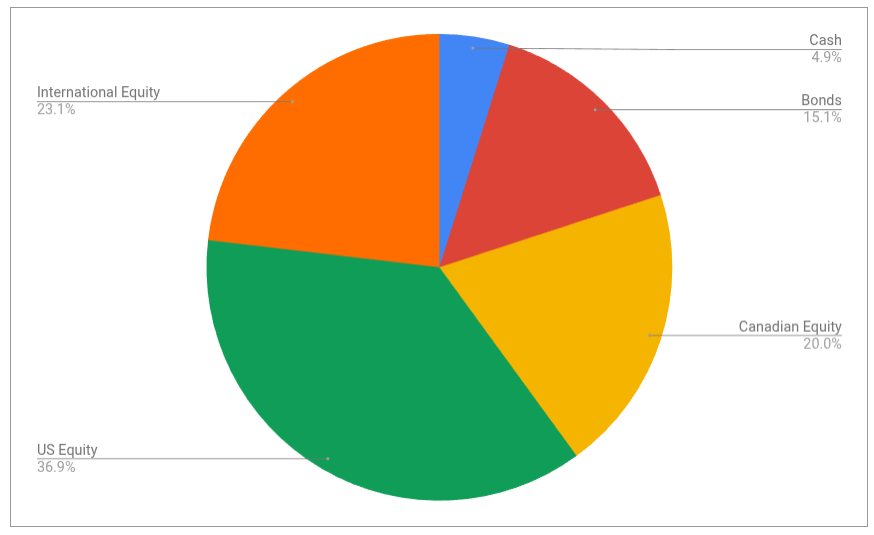
It’s looking pretty close to the targets I have, which are unchanged:

  • 5% cash or cash-like holdings like ICSH and ZMMK
  • 15% bonds (almost all are buried in XGRO and AOA)
  • 20% Canadian equity (mostly based on ETFs that mirror the S&P/TSX 60)
  • 36% US equity (dominated by ETFs that mirror the S&P 500, with a small sprinkling of Russell 2000)
  • 24% International equity (mostly, but not exclusively, developed markets)

I don’t really see a need to make changes based on what I see here. Cash flowing in to the account (bonus payments, regular TFSA contributions) will be re-invested in one of XEQT or XGRO1, typically2.

Overall

The retirement savings had a great month. Overall, I’m ahead of where I started even though I’ve been drawing a monthly salary since the beginning of the year. This is aligned with what my retirement planner told me to expect, but as you can see, the journey has had some interesting ups and downs already.
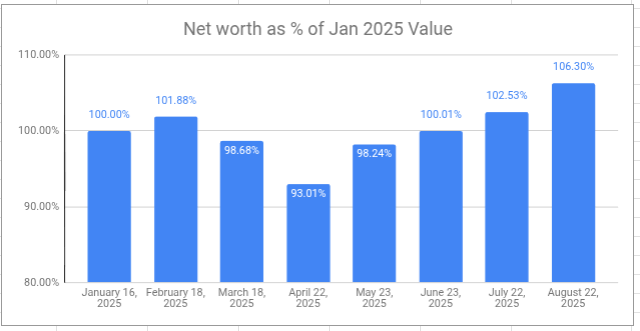
Monthly retirement savings, as percentage of Jan 2025 value

My VPW-calculated salary has hit a new high this year, 2.41% higher than my first draw in January3. This is also expected, since it tracks the value of the retirement portfolio, albeit in a much more controlled way. The VPW “cash cushion” smooths out the ups and downs of the monthly returns. I suppose I really should see an increase in my salary on par with inflation so that I maintain my spending power. I’ll have to think about how to track that4.
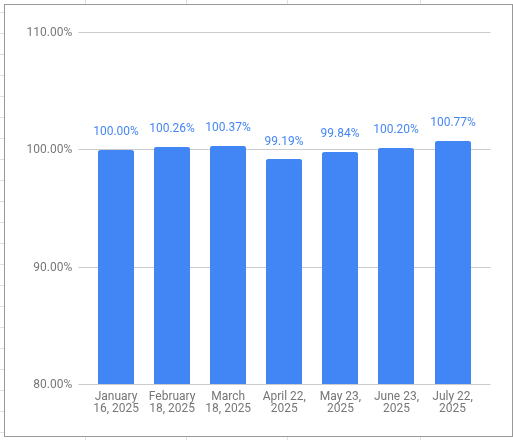
Monthly salary, as percentage of Jan 2025 salary
  1. I have purchased some TEQT lately since it has a lower MER. I covered TD’s family of all-in-ones here. ↩︎
  2. Since my target is 15% bonds, and XGRO is 20% bonds, I have to offset some of the XGRO purchases with 100% equity purchases. ↩︎
  3. Not a bad raise. ↩︎
  4. Looks like https://www.statcan.gc.ca/en/subjects-start/prices_and_price_indexes/consumer_price_indexes is a good place to start. ↩︎

The Cost of Asset Allocation ETFs

Readers will know that I’m a fan of the asset-allocation ETF. In fact, the vast majority of my retirement savings are dedicated to them. (New to the concept of asset allocation ETFs? Here’s an intro.)

Owning asset-allocation ETFs means you can quite literally invest and forget. The target asset allocations are maintained automatically for you, eliminating the all-too-common desire to tinker/experiment/play and mess with your returns in the process.

As with all things investing, there’s no such thing as a free lunch. This automatic asset re-allocation is reflected in the MER1 of the asset-allocation ETFs. So what’s this automatic management actually costing the holder of the all-in-one?

To work out the answer to that question, you have to look at how the asset-allocation ETF in question is built. Some people refer to asset allocation ETFs as “funds of funds” and this is actually quite an apt description, since most asset-allocation ETFs are just constructed by buying up index ETFs issued by the same company.

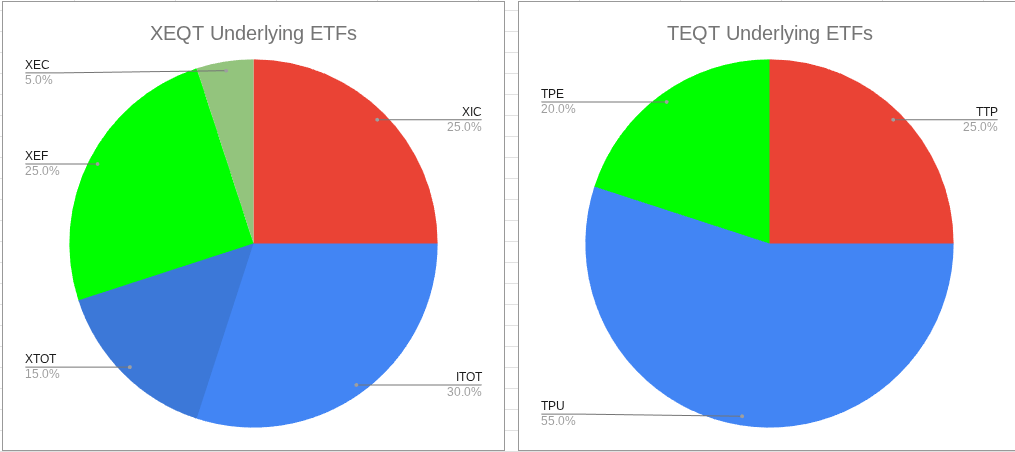
For example, iShares and TD each have an all-equity asset allocation ETF, named XEQT and TEQT2, respectively. Here’s what’s actually under the hood of each of them:

(I tried to keep the colours consistent between the two: red is Canadian equity, blue is US Equity, and other colours are international equity).

The thing about the MER of an all-in-one is that it already includes the MERs of the funds from which it is built. The tip-off is phrases like this one in iShares’ literature:


MER includes all management fees and GST/HST paid by the fund for the period, and includes the fund’s proportionate share of the MER, if any, of any underlying fund in which the fund has invested

https://www.blackrock.com/ca/investors/en/literature/product-brief/core-etf-portfolios-product-brief.pdf3

What this means is you can work out what the MER would be if you decided to simply manage the underlying funds yourself, and in so doing, figure out the premium that the all-in-one is adding to the mix.

I did this exercise, and here’s what I found:

XEQTTEQT
MER of component parts40.103%0.089%
All-in-one MER50.20%0.17%
MER premium for all-in-one60.097%0.081%
Annual premium cost per $1000 invested7$0.97$0.81

I offer a few takeaways from this analysis:

  • The MER costs I’m talking about here are lower than a factor of 10 (at least) that what’s charged by typical investment advisors and bank-backed mutual funds
  • The cost premium of the all-in-one is small, but it’s higher than I expected; even small percentage differences are greatly amplified when you work out (say) the 10 year cost of using these products.

The alternative of managing the constituent parts can be a cheapskate alternative and can save real money over time8, but one must beware of

  • The added complexity inherent in managing a portfolio of multiple ETFs. The XEQT/TEQT example is the simplest one; if you add bonds to the mix (e.g. XBAL/TBAL) you will need to add a few more ETFs to replicate the all-in-one. I used to manage my portfolio without using all-in-ones. I enjoyed it (you may have noticed I have a deep interest in investing). In retirement I have chosen to be practical and have attempted to create an environment that won’t be cognitively overwhelming as I get older.9
  • The greater likelihood of straying from the plan due to inaction or emotion kicking in. I myself didn’t put a lot of credence to this argument, but people smarter than me have pointed out that this is probably the one biggest factor that derails investment plans.
  1. The MER (Management Expense Ratio) is the cost of operating the ETF, expressed as a percentage. You don’t directly pay MER fees, but they reduce the overall returns of your investments. Lower MERs = more money for you. ↩︎
  2. No points for originality here ↩︎
  3. In teeny tiny letters at the bottom of page 1 ↩︎
  4. Weighted MER of each of the component ETFs. ↩︎
  5. You can find these on the ETF pages for XEQT and TEQT ↩︎
  6. Subtract 2 previous rows ↩︎
  7. Just multiply. Watch those decimal points, though. ↩︎
  8. I’m ignoring trading costs which aren’t zero but ought to be very small. Rebalancing assets is necessary of course but is perhaps a monthly, quarterly or annual exercise. ↩︎
  9. And even a portfolio just based on all-in-ones may prove to be too much to handle at some point. I’ve started to pay a bit more attention to the services offered by robo-advisors. ↩︎

Passiv guide to investing

Passiv is a tool I was introduced to via my online broker of choice, Questrade1. As I mentioned elsewhere, Passiv’s main mission is offer an alternative to all-in-one ETF funds by automating trades to make sure your individual holdings support your overall target.

Anyway, Passiv is a nice add-on for me because it’s a way better way for me to see accounts for which my spouse has given me trading authority (it’s a real weakness of the Questrade platform). On one screen, I can see all the accounts in the retirement portfolio.

Anyway, since I use Passiv, I get the occasional email from them. Recently, they posted a blog called The Beginner’s Guide to Passive Investing which I think is a pretty good summary of my own approach to investing; it’s a pretty good article to share with a new investor, too. There’s lots we agree on:

  • Saving is different from investing (my view here)
  • Passive investing is the way to go (I own no individual stocks in my retirement portfolio)
  • You don’t need an advisor. We disagree on why. For me, it’s because there’s all-in-one ETFs. For Passiv, it’s because there’s Passiv 😉
  • Invest consistently, and without thinking. Pay yourself first.

They end the blog with a section called How Do I Start Investing?, which has a lot in common with an article I wrote called Ok, I’m ready to fire my advisor. What do I need to do? Let’s take a look at what I agree with and what I disagree with in that part of the article.

Open a Brokerage Account

Passiv seems to think there’s only two brokers out there, namely Wealthsimple and Questrade2. Given that the Passiv platform supports direct connections to these two brokers, this is somewhat understandable. But make no mistake, there’s plenty of other options out there. And what’s right for your neighbour may not be right for you. What broker to use will depend on a bunch of factors, and I talked about some of them here.

Set up Your Accounts

Yup, that’s something you need to do. I broke it down in some detail over here, since I switched brokers earlier this year. Since the target audience is new investors, non-registered accounts don’t get a mention here, but for many long-term investors, a non-registered account ends up being part of the mix. And RRIFs, of course.

Choose Your Investments

Passiv doesn’t have any use for all-in-ones (aka asset allocation ETFs) since that’s kinda core to what they offer. So while their recommendations are sound if you want to buy into the five funds they recommend3, it’s more complicated than it needs to be. For me, it’s a two-step process

Set up Passiv

It’s of course a bit self-serving, but a tool like Passiv is quite useful to track your allocations if you choose not to use an all-in-one. Or you can use a spreadsheet like I do.

Fund Your Account

If you’re transferring from some other financial services provider expect a lot of form filling. I documented some of the issues with transfers in a general sense here and specific to the RRIF holder here.

Buy Your Investments

No argument here; if you don’t actually invest, your money is just sitting idle. If you buy an all-in-one ETF, that’s one trade per account.

Automate and Chill

Yes, Passiv can in fact do trades on your behalf. (That’s an upcharge, though). A Passiv-run portfolio is possible4. All-in-one ETFs are also automated, since part of what they do is periodically rebalance their holdings automatically. In retirement, automation seems difficult. There’s a lot of steps to get paid.

In conclusion

Passiv’s blog is an excellent primer on how to get started; feel free to share it with your kids, colleagues and relatives. Just be aware that it promotes the Passiv approach which, if followed to its logical conclusion, requires a subscription to Passiv Elite — worth it, if that’s the direction you prefer.

  1. Like most online brokers, Questrade is good at some things, not so good at others. You can read my review here. ↩︎
  2. They are both fine providers; I have accounts at both. And QTrade too, but that should be done by the end of 2025. Anyway, buying and holding ETFs is offered by all Canadian brokers. No need to limit yourself to just these two. ↩︎
  3. Three equity ETFs for the Canadian (VCN), US (VFV), and International markets (VDU) and two bond ETFs covering the Canadian (VAB) and US (AGG) markets. Before I retired, I had a similar approach, but chose different ETFs. In retirement, I chose to simplify. ↩︎
  4. Be mindful that trades executed in non-registered accounts generally have tax implications. ↩︎

HISA Table for August 2025

HISAs, for those in the know, are “High Interest Savings Accounts” and offer a nearly zero risk way to earn some interest on your cash holdings. Read all about them here. “Class F” funds are usually available via your online broker, often bought and sold in the same module as mutual funds, although they are NOT mutual funds.

Both central banks in the Canada and the USA declined to decline their interest rates at their last meetings, so there’s no significant changes to report in the table from last month.

If your broker doesn’t give you access to HISAs (or you have to pay large transaction fees to acquire them1), then there’s also ETFs that fit the bill, and some of them are now in this table, too.

ProviderFundLinkRate SheetRate
RBCRBF2011, RBF2021, RBF2031, RBF2041RBCLink2.55%
ScotiabankDYN6004, DYN5004, DYN3065, DYN3055, DYN3075ScotiabankLink2.70%
Equitable BankEQB1001, ETR1001Equitable Bankn/a2.55%
TDTDB8151, TDB8156, TDB8158, TDB8160TDn/a2.55%
RenaissanceATL5071Renaissancen/a2.55%
Home TrustHOM101,
HOM201
Home TrustLink2.65%
B2BBTB101B2B Bankn/a2.75%
ManulifeMIP610, MIP810Manulifen/a2.40%
National BankNBC200, NBC6200, NBC8200NBI Altamira CashPerformern/a2.55%
Global XCASHCASH Fact Sheetn/a2.55%2
EvolveHISAHISA Fact Sheetn/a2.79%3
BMOZMMKZMMK Fact Sheetn/a2.76%4
Canadian HISA rates, last updated August 5, 2025

Since I hold a substantial amount of USD-denominated ETFs, I also track US interest rates.

ProviderFundLinkRate SheetRate
RBCRBF2015RBCLink4.15%
ScotiabankDYN6005,
DYN5005
ScotiabankLink4.15%
Equitable BankEQB1101,
ETR1101
Equitable Bankn/a3.80%
TDTDB8153TDn/a4.15%
RenaissanceATL5075Renaissancen/a4.15%
ManulifeMIP611Manulifen/a3.30%
National BankNBC201NBI Altamira CashPerformern/a4.15%
Global XUCSHUCSH Fact Sheetn/a4.12%5
EvolveHISUHISU Fact Sheetn/a4.56%6
iSharesICSHICSH Fact Sheetn/a4.87%7
USA HISA rates, last updated August 5, 2025

UCSH and HISU invest in HISAs exclusively; I instead use ICSH which is a rough equivalent of ZMMK in terms of portfolio makeup. Like ZMMK, I enjoy a slight premium in yield as a reward for taking a bit more risk.

  1. I’m looking at you, Questrade. ↩︎
  2. Per July 31, 2025 dividend ↩︎
  3. Per July 29 dividend. Given what HISA holds (mostly National Bank and Bank of Nova Scotia HISAs), it’s puzzling how they managed to increase their per share dividend by 1.5 cents from last month, but that’s where it’s at. I wouldn’t expect that rate to continue. The website shows 2.58% yield (net). ↩︎
  4. I combined the two dividend payouts issued in July to come up with this number. Not sure why there were two; it’s certainly not the norm. ↩︎
  5. Per July 31, 2025 dividend ↩︎
  6. Per July 29 dividend. Same comment as for the Canadian side. This rate doesn’t make sense. Website shows 4.22%. ↩︎
  7. Per August 1, 2025 dividend. 30 day SEC yield shows 4.52% ↩︎

XEQT Shifts again

Stop me if you’ve heard this before, but XEQT, one of my ETF all stars, recently made some changes under the hood1. Specifically, in their words:

XEQT primarily accesses its broad market U.S. equity exposure using …ITOT, a U.S.-domiciled ETF. In certain circumstances, U.S.-domiciled ETFs … are subject to limits on the sale of their shares to non-U.S. domiciled investment funds such as XEQT. Prior to July 2025, iShares Core S&P 500 Index ETF (XUS) had been held as an additional instrument… Effective July 2, 2025, XEQT has replaced XUS with iShares Core S&P Total U.S. Stock Market Index ETF (XTOT). Going forward, XEQT is expected to hold a mix of XTOT and ITOT.

https://www.blackrock.com/ca/investors/en/literature/product-brief/core-etf-portfolios-product-brief.pdf

So, in other words:

  • XEQT isn’t allowed2 to hold “just” ITOT (a broad US market ETF) to cover the US market3
  • XEQT used XUS (the 500 largest US stocks) to get around this restriction until very lately
  • XEQT now uses XTOT which is 99% the same as ITOT to get around this restriction
  • TL/DR: XEQT is now pretty much what it was at the very beginning of 2025

What this means is that lately4, XEQT has reduced its exposure somewhat to the very largest US stocks. I did a little analysis to convince myself, summarized below:

Stock5% delta change XEQT6% delta change ITOT7delta XEQT/ITOT8
Apple-1.7%1.2%-2.9%
Microsoft-2.9%0.2%-3.0%
NVIDIA3.5%6.5%-3.1%
Amazon-1.3%2.3%-3.6%
META-9.2%-6%-3.2%
Berkshire Hathaway-6%-3.4%-2.6%
Alphabet A2.6%6.4%-3.8%
Broadcom-1.0%2.3%-3.3%
Tesla-6%-4%-1.9%
Alphabet C1.6%6.5%-4.9%

The change in the contribution of the largest 10 US stocks has been consistently reduced in XEQT in the past month — that’s what the last column shows. This is what one would expect by removing the “double investing” that was going on previously when XEQT was holding both ITOT and XUS.

To me, that’s all round a good thing, since it provides greater diversification when holding XEQT. I’ve updated the What’s the deal with XEQT? post accordingly!

  1. Thanks to r/JustBuyXEQTfor pointing this out ↩︎
  2. And I don’t know why this is ↩︎
  3. XGRO, my normal go-to in this all-in-family, has not changed at all and continues to hold ITOT and never bothered adding XUS. I guess since the US portion of XGRO is smaller than that of XEQT, it can skirt this restriction. ↩︎
  4. Since July 2 to be precise ↩︎
  5. These are the top 10 US holdings of XEQT, and the top 10 for ITOT. ↩︎
  6. This is % change in the % contribution of each of these stocks between June 30 2025 and July 25, 2025 as reported by the XEQT “underlying aggregate holdings” data on its product sheet. The XEQT change is driven by both the differential in the monthly returns, AND a reduction in the weight of each of the underlying stocks. ↩︎
  7. This is the % change in the % contribution of each of these stocks between June 30 2025 and July 25, 2025 as reported by the ITOT “underlying aggregate holdings” data on its product sheet. The ITOT change is driven purely by differential monthly returns of the stocks. ↩︎
  8. Simply subtract the two previous columns ↩︎