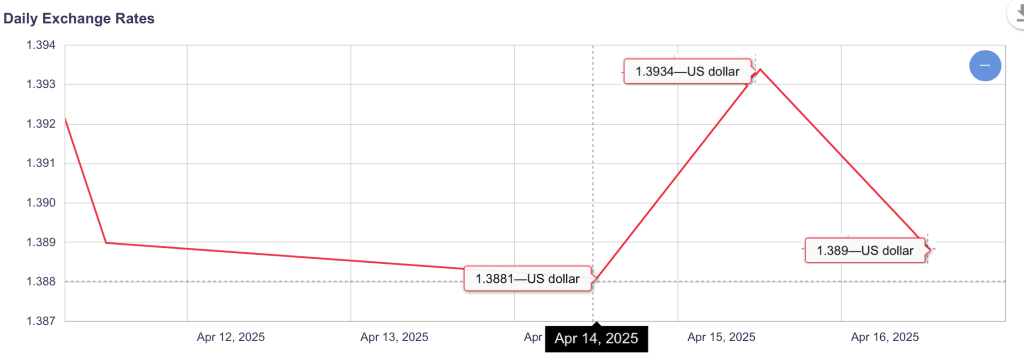
Buying US Stocks or ETFs? Save money on US dollar foreign exchange.

I have a lot of US dollar assets in my retirement portfolio. I’m not really convinced it’s a good idea, but it has taught me the ins and outs of USD foreign exchange rates. Here I’m talking about getting access to (or changing from) US funds for the purposes of investing in your brokerage account. Getting access to US funds to buy things is a different1 animal, one that I covered in a previous post.

Here’s a few things I’ve learned.

Google is your friend for real time foreign exchange (FX) rates

“1000 USD in CAD” is a terrific search term to get an instant FX rate. (also: Euro, GBP, THB…). This is as close as you’ll get for the absolute best FX rate and should serve as your target.

For most brokerages, foreign exchange is a profit center

Meaning: They’re making money every time you convert one currency to another, usually on the order of 1.5% a transaction. Some providers seem to go to great lengths to hide what rate they are using on any given transaction. (I’m looking at you, QTrade2).

There are exceptions in the brokerage community, to be sure.

  • Interactive Brokers comes very close to the ideal rate for any sizable transaction3 and is the big winner when it comes to converting currency for investing purposes45
  • Wealthsimple recently introduced a tiered FX rate depending on how much you’re converting6:
    • Under $10k, 1.5%
    • Up to $25k, 1%
    • Up to $100k, 0.5%
    • Over $100k, 0%

The cheapest way to convert at most brokerages is to use Norbert’s Gambit

Norbert’s Gambit, in a nutshell, involves the following steps.

I must say at this point that although the steps are reasonably straightforward, there are usually delays introduced at each step. For example, you probably have to wait a day for the initial trade to settle before making the journaling request. And journaling may not be instantaneous either11.

With no guarantee that any of these are accurate, here are the specific steps to do the Gambit on a number of popular platforms.

  1. For most people. Since I am a CIBC USD savings account client, using Norbert’s Gambit is also a way for me to fund my USD shopping purchases. ↩︎
  2. When attempting to buy a USD ETF from my Canadian account, the only indication I’m about to get fleeced is the warning message “The account funds do not match the market currency. Currency conversion and foreign exchange rates will apply.” No indication of what the exchange rate they are using. ↩︎
  3. Their posted rates are very close to the google ideal, but there is a small (very small) minimum charge of $2 per trade per https://www.interactivebrokers.com/en/pricing/commissions-spot-currencies.php ↩︎
  4. It’s not ideal for getting cash access for shopping since they have very long hold periods where you cannot withdraw your money. See https://www.interactivebrokers.com/campus/glossary-terms/withdrawable-cash-subject-to-origination-restriction/ for the details. ↩︎
  5. But that web interface, wow is it ever complicated ↩︎
  6. See https://www.wealthsimple.com/en-ca/legal/fees/trade for the details. You’ll need a Wealthsimple USD account to pull this off, of course, and the only kind of USD account Wealthsimple offers is non-registered. ↩︎
  7. Did this at BMO Investorline since you cannot buy DLR online. Apparently you can buy it if you call in your order. At BMO using RY, I was able to get USD on the same day. ↩︎
  8. HOW to do this will vary considerably depending on who your broker is. Best to Google for specific instructions involving your broker. ↩︎
  9. Possibly for buying and selling the ETF, possibly a fee imposed for journaling, something Questrade is doing starting April 1, 2025. ↩︎
  10. And minus (or plus) any changes in the price of the thing you bought. Depending on your broker, each step in the process may take a day or two. If you do the Gambit often enough, I figure this sort of thing just averages out. Sometimes you win, sometimes you lose. ↩︎
  11. Per https://www.questrade.com/learning/investment-concepts/dual-listed-securities/journaling-shares it can take five (!) business days. ↩︎

USD Assets in the retirement portfolio. Good idea?

I’m not sure when I first made a purchase of a USD-denominated ETF. Probably over 10 years ago. Clearly, I thought it was a good idea, because as of today I find that 57% of my retirement savings1 are denominated in US Dollars.

And unlike other people I’ve talked to, there’s no underlying rationale for that. I’ve never earned employment income in USD and I don’t own property in the US. So why?

I’m a cheapskate.

I started investing in USD based ETFs simply because they were a much better deal than their Canadian equivalents. This is less true now than it used to be, but it’s still true. Take for example the comparison between comparable USD and CAD ETFs that track the same index:

IndexWhat’s in itUSD ETFMERCAD ETFMER
S&P 500Top 500 US stocksIVV0.03%VFV, XUS0.09%
Russell 20002000 mid-market US StocksVTWO0.07%XSU2, RSSX30.36% for XSU, 0.25% for RSSX
FTSE Developed ex USGlobal stocks outside of the USASCHF0.06%VDU0.22%
USD versus CAD ETFs tracking the same index4

The Canadian market has become more competitive, and MERs have come down, but given the size of the US market, it’s still cheaper to invest there.

I’m not a very savvy cheapskate.

So although the MERs of US ETFs were stunningly attractive, I failed to consider the cost of currency conversion. For this I blame naivete as well as a lack of transparency on the part of my provider. It was not possible for me to easily figure out how much each CAD to USD transaction was costing me. A good estimate is about 1.5% the cost of the transaction, but some providers make this much cheaper5.

I also had USD investments in my TFSAs, which, from a tax perspective, isn’t the best idea.

Over time, I discovered the joys of Norbert’s Gambit to do currency transactions on the cheap and I became more savvy. And I eliminated all US holdings from my TFSA.

Preparing for Retirement

In preparing my portfolio for retirement (steps I took are outlined here), I did seriously consider converting everything to CAD in the interest of keeping things simple. I did not, and here’s why:

  • I figured that having ready access to USD would be rather useful to retired me, since I do vacation there. And I had made other preparations in light of that, setting up a USD credit card and USD savings account for RRIF payments to go to.
  • Although I knew that having USD RRIFs would make getting paid in retirement more complicated, I thought I had worked out a plan with my provider6 that would make extracting USD RRIF payments achievable, with some effort on my part.
  • I sort-of liked having some of my investments in USD since it’s a stable currency. Usually.
  • I also liked the additional boost I got from USD HISAs. (That’s probably an anomaly but one I’m happy to take advantage of)
  • I could change my mind at any time.

Current Reality

This isn’t working like I thought it would.

My provider decided to backtrack on allowing me to extract USD from my USD RRIF;7 we’re still going back and forth on that front, but my friends at QTrade are on my naughty list as a result. I’m not hopeful.

What it means practically is that although the value of my USD RRIF is used to calculate my RRIF minimums, I can only withdraw RRIF payments from the Canadian side. At present, the Canadian side of my RRIF will fund my RRIF minimum payments for a while, but at some point I’ll have to use Norbert’s Gambit to move funds from the USD RRIF to the CAD RRIF.

My Advice

I don’t think that holding USD assets in retirement — especially in a RRIF — is a great idea for the DIYer. Unless platform providers give really clear processes8 for how to extract that money from a USD RRIF, expect trouble.

At some point, I will either switch providers to find one that supports my requirements9, or I will convert everything to CAD. Right now, I have a process that works, but older me I expect will find it too complicated.

  1. Majority of the USD holdings are in my / my spouse’s RRIF; small portion is in my non-registered account. ↩︎
  2. Not an apples to apples comparison, admittedly. This ETF is hedged so it’s less impacted by changes in the CAD/USD exchange rate but this comes at a cost. ↩︎
  3. This is ALMOST the same thing; RSSX uses a capped version of the index ↩︎
  4. And try as I might, I couldn’t find a USD ETF that invested in the TSX/S&P 60. Not really surprising, and my USD retirement holdings have very limited Canadian exposure. AOA has about 2.4% Canadian exposure. ↩︎
  5. Notably, Interactive Brokers and lately, Wealthsimple especially if you hold more than 100k with them. ↩︎
  6. Involving multiple phone conversations and multiple emails ↩︎
  7. You may ask, “what’s the point of having a USD RRIF if you can’t extract USD from it”? I had the same question… ↩︎
  8. RBC says they support it and so does Questrade. ↩︎
  9. I had sorely hoped Wealthsimple could be that provider, but (sigh) they don’t support spousal RRIFs at the moment. ↩︎

News: Bank of Canada Lowers Rate

As widely expected, the Bank of Canada lowered its overnight rate to 3% from 3.25%: https://www.bankofcanada.ca/2025/01/fad-press-release-2025-01-29/.

For the DIY investor, no action needed. Expect cash/HISA interest rates to follow suit shortly.

For all the woes having holdings in US dollars causes me, I can take some solace in the fact that the equivalent US rate is almost a full percentage point higher. Don’t believe me? Compare the interest rates given by Scotia’s HISAs (DYN6004 in CAD, DYN6005 in USD) over here: https://ads.scotiabank.com/Investment-savings-account.

I was working on comparing a bunch of HISA interest rates (spoiler alert, as of yesterday the winner for highest rate paid on Canadian holdings went to B2B Bank), but given this announcement, the data I collected will all be null and void shortly. I guess I’ll revisit next week.

Reduce Travel Costs by Paying Attention to Foreign Exchange

Travel is something I like doing. Spending money on seeing new places, trying new things, all good from my perspective. But spending unnecessary money to line the pockets of a bank? I’m not so good with that.

For many years, I’ve used my credit card everywhere, in every country. Very convenient. I recall my first big trip abroad (circa 1992) where my main source of money was Travelers Cheques, if you can believe it. (Looks like they aren’t even available in Canada anymore).

But I never realized how much this habit was costing me. From https://www.cibc.com/en/personal-banking/credit-cards/articles/foreign-currency-credit-card.html:

It’s common for a credit card company to charge a foreign currency conversion fee between 1% and 3% of the transaction amount.

What’s especially sneaky, and the reason I never gave it much thought, is that the fee is buried in the exchange rate that is posted as part of the transaction. As a result, it’s easy to miss how much you’re giving to the bank.

Now, 1% to 3% extra for a cup of coffee or a taxi ride isn’t going to break the bank, but for a multi-night stay in a hotel? Show tickets? Car rentals? It can start to add up.

Here are two products that I use to help get rid of those fees. There are others out there, but these I have used myself and can recommend them.

Wealthsimple’s Cash Card

I’ve been rather curious about Wealthsimple for a while now. I started with using their “pay what you want” tax service and saw it got a mention from the Globe and Mail’s Rob Carrick (an excellent resource, by the way) which led me to investigate further. This is NOT their “beta” Wealthsimple Infinite Visa credit card that is coming out in 2025.

From https://www.wealthsimple.com/en-ca/spend:

Now you can feel like a local while shopping abroad. With no additional foreign transaction or ATM fees from Wealthsimple, your Cash card is a must-have travel companion.

The Cash Card, as far as a vendor is concerned, looks like a MasterCard. But to you, the card holder, the Cash Card looks like a debit card. Any transaction charged to the Cash Card is instantly debited, so you have to have the money available in your Weathsimple account before you go on a shopping spree.

Signing up for the Cash Card was done online, in minutes. Putting money on your Cash Card can be done using Interac e-transfer from your “usual” bank account, and is available pretty much instantly as well. Cash Card supports Apple Pay and as a nice bonus, also provides you with a “virtual card” accessible from the Wealthsimple app so you can enter credit card details for online purchases. You can also order up a physical card, but I’m still waiting for mine….The Canada Post strike apparently is still being used as an excuse in that regard. (Not a big deal, I rarely use a physical card anymore).

I’ve now successfully used the Cash Card for US dollar and British pound purchases, and the rate I got was exactly the same as the rate I saw in real time from Google (cries quietly at the current exchange rate):

  • Pro: Very easy to set up, does what it says — no extra foreign exchange fees
  • Pro: Supports multiple foreign currencies, with only a few exceptions.
  • Pro: It’s free, and the money in your Cash account actually earns a bit of interest.
  • Con: You have to have the money available up front, it’s not a credit card that you can pay later.

CIBC’s US Dollar Aventura Gold Visa Card + CIBC US Dollar Savings Account

If instead you’re looking for a REAL credit card and you’re only interested in US dollar transactions, then CIBC’s US Dollar Aventura Gold Visa might be a choice. I signed up for this card because a lot of my retirement funds are in US Dollars, I travel and shop in US Dollars pretty regularly, and I happen to bank with CIBC which also makes things easier.

However, unless you already have a US Dollar bank account that can pay off your US Dollar credit card, you’ll need to set that up at the same time. So for that I used the CIBC US Dollar Savings account. This should not be confused with CIBC’s US checking account which isn’t required (I have this account too, but have very limited use for it).

So, applying for these products is the typical Canadian bank experience. Multiple days, multiple forms, mildly unpleasant, but as a self-directed investor, not unusual, either.

The Visa card has an annual fee ($35, which includes up to 3 additional cards) and allows you to collect a small amount of Aventura points which can be redeemed for cash or gift cards. The card supports Apple Pay and generally works like any other card you may have used. Just make sure you don’t accidentally use it for a Canadian dollar transaction or else you’ll get charged that extra conversion fee that you were trying to avoid in the first place.

The savings account pays a paltry amount of interest (0.05% for balances under $10,000 USD) and charges $0.75 USD for every transaction. So, nothing to write home about there. But it is in essence a Canadian bank account in every way; this means (for example) it can be set up as a legitimate bank account with your online broker.

  • Pro: if you’re already banking with CIBC, both the credit card and the savings account are linked to your existing CIBC bank card, so you can see everything from one login.
  • Pro: Related to the above, you can set up auto payment of your USD credit card from your USD savings account
  • Pro: Related to the above, you can easily move money from your Canadian accounts to your US accounts. Of course, with this convenience comes the added foreign exchange fee that you were hoping to avoid, but if you’re short US Dollars, then it’s an option. (In another post, I’ll talk about how I convert US dollars cheaply).
  • Pro: It’s a real credit card, meaning you can defer payment.
  • Con: Compared with Wealthsimple, it’s somewhat painful to set up
  • Con: it’s only useful for US dollar transactions

For most people, the Wealthsimple Cash Card is the easy way to save money on foreign transactions, and the downside is small. If you have access to US dollars (maybe you’re paid in USD, or like me, have investments in USD), then perhaps the CIBC Aventura card might make sense, too.