
Tracking Norbert’s Gambit Costs with Questrade

Since I hold a fair amount of USD in my retirement portfolio and most of my expenses are in CAD, I do have to convert between the two worlds from time to time. Most of the time I’m converting USD to CAD, but because of higher US interest rates, I’ve recently converted some CAD into USD to take advantage of that fact and earn a little more money on my cash positions1. My normal way of dealing with this conversion is using Norbert’s Gambit, which I’ve talked about here and here.

Anyway, I’ve decided to keep track on what these movements are costing me using my current broker of choice, Questrade. The answer is not quite as straightforward as you might think.

Fixed Cost

With Questrade, a journaling2 fee is charged every time you do the Gambit. This costs $9.95 plus HST for a total of $11.24, always charged in Canadian dollars. If you choose to subscribe to Questrade Plus, then your monthly fee covers these costs. I’ve done the Gambit twice this year, with one more planned in the 4th quarter. So for me, the cost of journaling is a pay-as-you-go cost. This cost is the same whether you are journaling one share or 10,000 shares, so larger transactions are better here.

Variable Cost: Changes in USD/CAD rate

Performing the Gambit using Questrade takes several business days. The foreign exchange rate moves all the time, so by the time you complete the conversion, the rate has almost certainly changed from when you started the process. Sometimes this works in your favour, sometimes not. Most of the reading I’ve done suggests you ignore this variability, since over time it should even out. For kicks, I’m tracking it.

Variable Cost: Buying and Selling DLR/DLR.u

Any trade you do has an inherent cost, even if you pay $0 commissions3, as I do. That cost is buried in the bid/ask spread. You may have noticed this at work immediately after completing a trade — it almost always seems that the market value of what you just bought is a little lower than what you just paid4. This variable cost is buried, but can be estimated by looking at the average bid/ask spread of DLR, which is featured on its fact sheet. It’s currently stated to be 0.07% when buying/selling DLR and 0.1% when buying/selling DLR.U5 . So, on average, you will sustain a total 0.17% cost when doing the Gambit. But I must reiterate — this cost is buried in the actual price per share you get when buying/selling DLR. Now, I actually paid very close attention to the bid/ask pricing last time I did the Gambit and I paid about half that rate but that’s all down to things like the volume of trading on the day, how many shares you’re moving and a whole bunch of other things that I don’t fully comprehend.

Anyway, here’s my tracking table that I’ll update as I do more of these trades:

Some definitions are in order:

  • DLR Buy: date upon which DLR (or DLR.u) was purchased.
  • DLR Sell: date upon which DLR (or DLR.u) was sold. There’s a lag because that’s how long Questrade takes to complete the journaling request. Seems like it’s 3 business days.
  • USD: The USD value of DLR bought or sold as reported by the trade confirmation6
  • CAD: The CAD value of DLR bought or sold as reported by the trade confirmation7
  • Effective rate: divide the previous two columns to come up with a USD in CAD rate8
  • Spot Rate on BUY/SELL date: daily average exchange rate9 as reported by the Bank of Canada
  • Target currency: what we end up with, USD or CAD. It’s the opposite of what we start with
  • Ideal in target currency: This is a calculation that takes the starting currency and applies the spot Rate on the DLR buy day to come up with the target amount. The ideal would be what you would have gotten if you had access to a no-cost conversion on the day you decided you wanted it.
  • Net Cost subtracts either the USD or CAD column from the ideal amount. If it’s negative, it means the foreign exchange rate moved in our favour between the buy and sell dates. Net Cost is given in the target currency.
  • Journal fee is charged by Questrade
  • Total cost adds the journal fee and the net Cost and converts everything to CAD using the spot Rate on the buy day. If it’s negative, we actually made money doing the conversion.
  • % cost takes total cost and divides by the CAD column

If you want a comparative cost, a typical broker charges 1.5% of the amount changing hands. Looks like I’m doing far better than that so far!

  1. And by “cash” I mean either ICSH or ZMMK, which are ultra-short-term bond funds denominated in USD and CAD, respectively. They are both featured as ETF All-Stars. ā†©ļøŽ
  2. “Journaling” is the technical term for moving an interlisted stock/ETF from the CAD side to the USD side of your account or vice versa. ā†©ļøŽ
  3. An attractive feature of Questrade, among others ā†©ļøŽ
  4. This effect is often masked by the volatility in the asset you’re buying, but when you buy very stable priced assets like ZMMK or ICSH or CASH it becomes quite noticeable. ā†©ļøŽ
  5. And 0.07% happens to be one cent divided by the current DLR Canadian price of $14.12. And 0.1% happens to be one cent divided by the current DLR.u price of $10.24 USD. ā†©ļøŽ
  6. And thus includes the bid/ask spread ā†©ļøŽ
  7. And thus includes the bid/ask spread ā†©ļøŽ
  8. And 1/effective rate gives you CAD in USD ā†©ļøŽ
  9. And this is an approximation since the rate changes throughout the day ā†©ļøŽ

Cautionary Tale: Staying safe as a DIY Investor

A recent Globe and Mail article featuring a Questrade client who lost $70k from their investment account due to unauthorised access caught my eye. The article is behind a paywall, but I’m a subscriber and can gift you a link if you’re curious1.

This didn’t seem like a garden-variety incident; the victim seemed reasonably well-educated concerning cyber-security best practices, and the hack may have involved a compromised device. But there are steps we should all take to make it harder to fall victim to an attack.

Use Strong, Unique Passwords2

Don’t reuse them. Don’t think that by adding a random character to an existing password buys you safety. The best way to avoid reusing passwords is to not know any of them. You do this by using some sort of password manager3 that can generate long and complex passwords. Even a notebook in a locked cabinet is better than using “password”4.

Use Two Factor Authentication (2FA)

Most online brokers have some sort of two factor authentication you can enable, but it may not be mandatory. Turn it on. This is a second step added after you enter your password to make sure it’s you, since it’s based on something you have. Most brokers I’ve dealt with use SMS as a 2nd factor, but both Questrade and Wealthsimple offer the use of a separate authenticator app like Google Authenticator, Microsoft Authenticator, or Apple’s Passwords app. I prefer authenticator apps because they work with or without cell phone coverage. And the experts don’t much like SMS as an authentication method because it’s not that difficult to hack for the determined criminal.

Don’t “trust” devices

While it will considerably speed up the login process to your online broker if you “trust” a given device, I never do this. Trusting a device typically does things like render 2FA unnecessary, which becomes very dangerous indeed if the device itself has somehow become compromised.

Know how to contact your provider over the phone

Store their contact number so you can call them directly if you are at all suspicious of anything. This is far safer than absent-mindedly clicking a link received in an email or text message. And if you do get a call/voicemail from your provider, follow up quickly.

Add a Trusted Contact Person (TCP) to your account

The TCP is someone your provider is authorised to call if they have concerns about your account. I don’t know under what circumstances “concerns” are raised, but having one seems to me a better idea than not having one. A quick primer on TCP here. Your broker will have a process by which they can add a TCP, take advantage of it.

Got other tips for staying safe while investing? Drop me a line!

  1. Just drop a line to comments@moneyengineer.ca. ā†©ļøŽ
  2. Or, if supported, use passkeys instead; I don’t know of any Canadian broker using them. ā†©ļøŽ
  3. I use Apple’s native Password app but in my working life used Bitwarden. ā†©ļøŽ
  4. The 4th most common password used, findable by brute force methods in less than a second, per https://nordpass.com/most-common-passwords-list/ ā†©ļøŽ

Spousal Loans: A good way to split income

Disclaimer: I am neither a tax lawyer nor a tax accountant. Engage the services of a professional if you have doubts.

For most of my working career, I earned more than my spouse did and as a result, paid more income tax, too. Spousal RRSPs are a very easy way to split income down the road1, but what about the here and now? Is there a way to shift income from one spouse to another without a whole lot of complexity2 for THIS year’s tax return?

One thing I set up a few years ago was a spousal loan. The concept is pretty simple:

  • You loan your spouse funds3
  • These funds are used by your spouse for investment in a non-registered account
  • You charge your spouse interest on that loan, which you must declare as income (and your spouse can deduct as an investment expense)
  • Your spouse gets to keep capital gains, dividends and interest payments in their name and file them on their return, and thus pay less tax than you would on those gains.

Now, of course, there is the small matter of “what interest rate do you charge”? Since the name of the game is income-splitting it’s advantageous to charge as little as possible. But before you run to the exit and give an interest-free loan, there are prescribed rates set by the CRA, found here. The rate to use is called the “The interest rate used to calculate taxable benefits for employees and shareholders from interest free andĀ low-interestĀ loans” and it currently4 sits at 3%56.

The nice thing about setting up such a loan is that the interest rate is fixed at the time you set it up. I feel pretty smart knowing that my spouse is paying a rock-bottom 1% annual rate and has done so since the 4th quarter of 2020.

So how to go about it? Like all things involving the CRA, it’s good to have records, so

  • I set up a formal loan agreement dated, signed and archived. It spells out the date the loan was made, the amount, the payment schedule and so on. There’s lots of templates out there.
  • I transferred the funds to my spouse using a cheque to create a paper trail.
  • My spouse pays the interest due annually via eTransfer so there’s an email record
  • I declare the interest as income on my tax return
  • My spouse declares the interest expense on her tax return

One thing I haven’t figured out yet is when to dissolve this loan. In retirement, I’m not making more than my spouse, so perhaps it’s time to wrap up this arrangement7.

  1. And if you’re careful, you can arrange to have you and your spouse have the SAME amounts in your respective RRSPs when it’s time to convert to a RRIF. ā†©ļøŽ
  2. I suppose there’s probably some way involving setting up a corporation and paying your spouse a salary, but that concept doesn’t work for everybody ā†©ļøŽ
  3. Left unsaid, is that you have to have spare cash available to actually loan this money and your spouse needs a way to invest it ā†©ļøŽ
  4. Q3 2025 ā†©ļøŽ
  5. According to multiple sources this is the interest rate of the 3-month treasury bill sold at auction. Who knew? ā†©ļøŽ
  6. If I were a betting man, I’d say this rate is likely to go lower before the end of the year. Returns need to exceed the interest rate charged for this to make sense but 3% is a pretty low bar. ā†©ļøŽ
  7. Or perhaps I’ll just wait until my bonus payouts from Questrade are done. Decreasing my spouse’s holdings will have an adverse effect on the bonus being paid. ā†©ļøŽ

The Cost of Asset Allocation ETFs

Readers will know that I’m a fan of the asset-allocation ETF. In fact, the vast majority of my retirement savings are dedicated to them. (New to the concept of asset allocation ETFs? Here’s an intro.)

Owning asset-allocation ETFs means you can quite literally invest and forget. The target asset allocations are maintained automatically for you, eliminating the all-too-common desire to tinker/experiment/play and mess with your returns in the process.

As with all things investing, there’s no such thing as a free lunch. This automatic asset re-allocation is reflected in the MER1 of the asset-allocation ETFs. So what’s this automatic management actually costing the holder of the all-in-one?

To work out the answer to that question, you have to look at how the asset-allocation ETF in question is built. Some people refer to asset allocation ETFs as “funds of funds” and this is actually quite an apt description, since most asset-allocation ETFs are just constructed by buying up index ETFs issued by the same company.

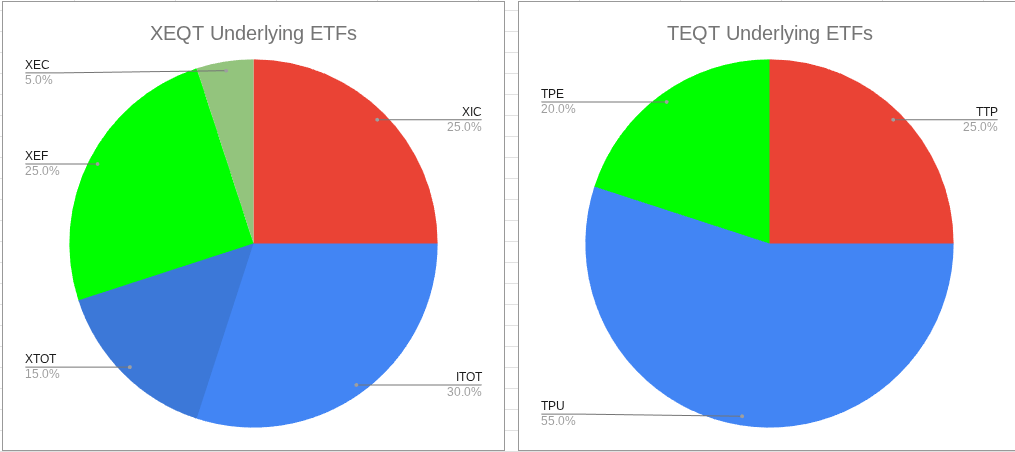
For example, iShares and TD each have an all-equity asset allocation ETF, named XEQT and TEQT2, respectively. Here’s what’s actually under the hood of each of them:

(I tried to keep the colours consistent between the two: red is Canadian equity, blue is US Equity, and other colours are international equity).

The thing about the MER of an all-in-one is that it already includes the MERs of the funds from which it is built. The tip-off is phrases like this one in iShares’ literature:


MER includes all management fees and GST/HST paid by the fund for the period, and includes the fund’s proportionate share of the MER, if any, of any underlying fund in which the fund has invested

https://www.blackrock.com/ca/investors/en/literature/product-brief/core-etf-portfolios-product-brief.pdf3

What this means is you can work out what the MER would be if you decided to simply manage the underlying funds yourself, and in so doing, figure out the premium that the all-in-one is adding to the mix.

I did this exercise, and here’s what I found:

XEQTTEQT
MER of component parts40.103%0.089%
All-in-one MER50.20%0.17%
MER premium for all-in-one60.097%0.081%
Annual premium cost per $1000 invested7$0.97$0.81

I offer a few takeaways from this analysis:

  • The MER costs I’m talking about here are lower than a factor of 10 (at least) that what’s charged by typical investment advisors and bank-backed mutual funds
  • The cost premium of the all-in-one is small, but it’s higher than I expected; even small percentage differences are greatly amplified when you work out (say) the 10 year cost of using these products.

The alternative of managing the constituent parts can be a cheapskate alternative and can save real money over time8, but one must beware of

  • The added complexity inherent in managing a portfolio of multiple ETFs. The XEQT/TEQT example is the simplest one; if you add bonds to the mix (e.g. XBAL/TBAL) you will need to add a few more ETFs to replicate the all-in-one. I used to manage my portfolio without using all-in-ones. I enjoyed it (you may have noticed I have a deep interest in investing). In retirement I have chosen to be practical and have attempted to create an environment that won’t be cognitively overwhelming as I get older.9
  • The greater likelihood of straying from the plan due to inaction or emotion kicking in. I myself didn’t put a lot of credence to this argument, but people smarter than me have pointed out that this is probably the one biggest factor that derails investment plans.
  1. The MER (Management Expense Ratio) is the cost of operating the ETF, expressed as a percentage. You don’t directly pay MER fees, but they reduce the overall returns of your investments. Lower MERs = more money for you. ā†©ļøŽ
  2. No points for originality here ā†©ļøŽ
  3. In teeny tiny letters at the bottom of page 1 ā†©ļøŽ
  4. Weighted MER of each of the component ETFs. ā†©ļøŽ
  5. You can find these on the ETF pages for XEQT and TEQT ā†©ļøŽ
  6. Subtract 2 previous rows ā†©ļøŽ
  7. Just multiply. Watch those decimal points, though. ā†©ļøŽ
  8. I’m ignoring trading costs which aren’t zero but ought to be very small. Rebalancing assets is necessary of course but is perhaps a monthly, quarterly or annual exercise. ā†©ļøŽ
  9. And even a portfolio just based on all-in-ones may prove to be too much to handle at some point. I’ve started to pay a bit more attention to the services offered by robo-advisors. ā†©ļøŽ

Passiv guide to investing

Passiv is a tool I was introduced to via my online broker of choice, Questrade1. As I mentioned elsewhere, Passiv’s main mission is offer an alternative to all-in-one ETF funds by automating trades to make sure your individual holdings support your overall target.

Anyway, Passiv is a nice add-on for me because it’s a way better way for me to see accounts for which my spouse has given me trading authority (it’s a real weakness of the Questrade platform). On one screen, I can see all the accounts in the retirement portfolio.

Anyway, since I use Passiv, I get the occasional email from them. Recently, they posted a blog called The Beginner’s Guide to Passive Investing which I think is a pretty good summary of my own approach to investing; it’s a pretty good article to share with a new investor, too. There’s lots we agree on:

  • Saving is different from investing (my view here)
  • Passive investing is the way to go (I own no individual stocks in my retirement portfolio)
  • You don’t need an advisor. We disagree on why. For me, it’s because there’s all-in-one ETFs. For Passiv, it’s because there’s Passiv šŸ˜‰
  • Invest consistently, and without thinking. Pay yourself first.

They end the blog with a section called How Do I Start Investing?, which has a lot in common with an article I wrote called Ok, I’m ready to fire my advisor. What do I need to do? Let’s take a look at what I agree with and what I disagree with in that part of the article.

Open a Brokerage Account

Passiv seems to think there’s only two brokers out there, namely Wealthsimple and Questrade2. Given that the Passiv platform supports direct connections to these two brokers, this is somewhat understandable. But make no mistake, there’s plenty of other options out there. And what’s right for your neighbour may not be right for you. What broker to use will depend on a bunch of factors, and I talked about some of them here.

Set up Your Accounts

Yup, that’s something you need to do. I broke it down in some detail over here, since I switched brokers earlier this year. Since the target audience is new investors, non-registered accounts don’t get a mention here, but for many long-term investors, a non-registered account ends up being part of the mix. And RRIFs, of course.

Choose Your Investments

Passiv doesn’t have any use for all-in-ones (aka asset allocation ETFs) since that’s kinda core to what they offer. So while their recommendations are sound if you want to buy into the five funds they recommend3, it’s more complicated than it needs to be. For me, it’s a two-step process

Set up Passiv

It’s of course a bit self-serving, but a tool like Passiv is quite useful to track your allocations if you choose not to use an all-in-one. Or you can use a spreadsheet like I do.

Fund Your Account

If you’re transferring from some other financial services provider expect a lot of form filling. I documented some of the issues with transfers in a general sense here and specific to the RRIF holder here.

Buy Your Investments

No argument here; if you don’t actually invest, your money is just sitting idle. If you buy an all-in-one ETF, that’s one trade per account.

Automate and Chill

Yes, Passiv can in fact do trades on your behalf. (That’s an upcharge, though). A Passiv-run portfolio is possible4. All-in-one ETFs are also automated, since part of what they do is periodically rebalance their holdings automatically. In retirement, automation seems difficult. There’s a lot of steps to get paid.

In conclusion

Passiv’s blog is an excellent primer on how to get started; feel free to share it with your kids, colleagues and relatives. Just be aware that it promotes the Passiv approach which, if followed to its logical conclusion, requires a subscription to Passiv Elite — worth it, if that’s the direction you prefer.

  1. Like most online brokers, Questrade is good at some things, not so good at others. You can read my review here. ā†©ļøŽ
  2. They are both fine providers; I have accounts at both. And QTrade too, but that should be done by the end of 2025. Anyway, buying and holding ETFs is offered by all Canadian brokers. No need to limit yourself to just these two. ā†©ļøŽ
  3. Three equity ETFs for the Canadian (VCN), US (VFV), and International markets (VDU) and two bond ETFs covering the Canadian (VAB) and US (AGG) markets. Before I retired, I had a similar approach, but chose different ETFs. In retirement, I chose to simplify. ā†©ļøŽ
  4. Be mindful that trades executed in non-registered accounts generally have tax implications. ā†©ļøŽ