Investment basics: Asset Allocation

We’ve talked about asset allocation / asset classes before in this space, most recently here. But while watching a recent post1 from one of my favourite experts, The Loonie Doctor2, it occurred to me that it might be helpful to start right from the beginning.

And to me, that beginning is understanding WHAT to invest in. Broadly speaking, you can choose between three categories: “Equity”, “Bonds” and “Cash”.

“Equity” refers to stocks of publicly traded3 companies. Owning stock means you own a piece of the company you invest in. This allows you to collect dividends if and when the company pays them out. If the company fails/goes bankrupt, the stock becomes worthless.

“Bonds” are essentially loans to companies or governments4. When you buy a bond, you’re buying into a stream of interest payments that stop when the bond is paid off. If a company who issued the bond fails/goes bankrupt, bond holders legally get first dibs on whatever assets remain in an effort to get their money back, but it’s possible that there isn’t anything left to fight over. Bonds can be fully paid off in various timeframes, from very short (30 days) to very long (20 years).

Cash” is the money that’s left. Cash can be invested in things like high interest savings accounts, GICs/Term Deposits, Treasury bills (aka T-Bills), or stuffed under a mattress5. There is definitely a grey area between “Cash” and “Bonds” since both involve lending money to an entity. Shorter duration loans are more cash like. Lending to governments and large corporate entities (like banks, which is what you’re doing when you buy a GIC) is more cash-like. Money under a mattress is absolutely cash, albeit not really an investment at that point.

Using the data tabulated here, you can build a chart like the one below to see how much the $1000 investment you made in each of these categories would be worth 50 years later6.

The chart shows that Equities outperform Bonds and Cash by a wide margin when looking at an investment time period of 50 years. Bonds also outperform Cash substantially.
Historical returns for Canadian equities, bonds, and cash (as of December 2024)

Looking at this chart, it should be reasonably obvious that equities, represented here by Canadian Stocks, over time, generate the best bang for your invested buck. The “over time” phrase is very important, because otherwise, one could rightly ask, “why would anyone ever invest in anything other than stocks?”. The reason is volatility — in any given short time period, your returns could look very, very bad indeed. Just one example (of many) — the TSX has LOST money in 3 of the last 10 calendar years per https://en.wikipedia.org/wiki/S%26P/TSX_Composite_Index.

Bonds, generally speaking7, have a much steadier and predictable return, often uncorrelated with stocks. When stocks go up, bonds often move in the opposite direction. And cash, well, its benchmark is the inflation rate. If cash is returning the inflation rate8, then at least you’re standing still.

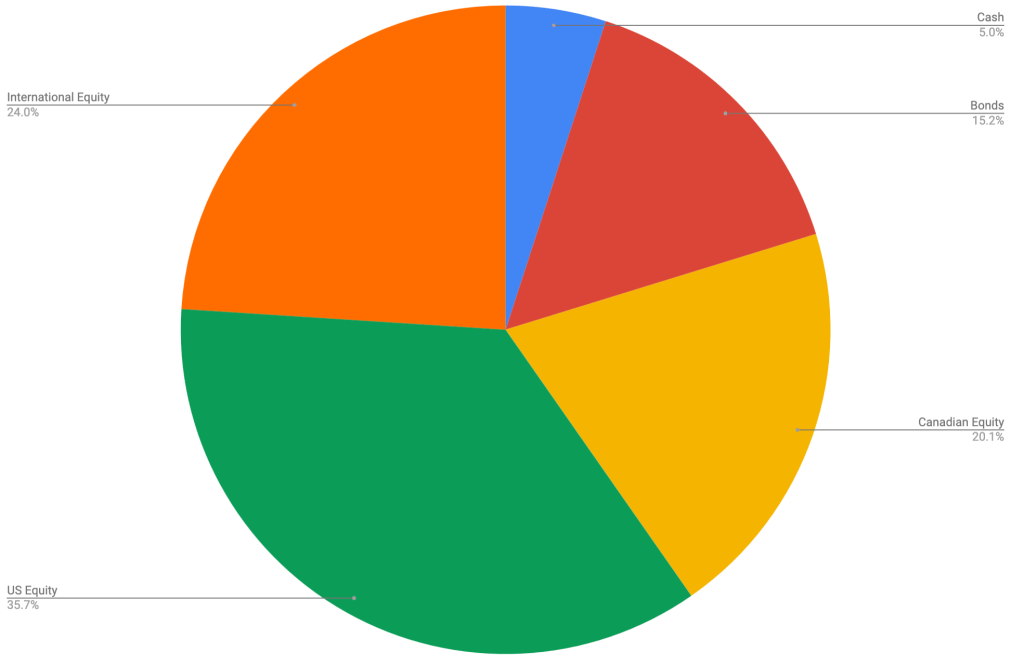
In my investment portfolio, my target allocations are 80% Equity, 15% Bonds, 5% Cash. Using products like all-in-one ETFs and my handy-dandy multi-asset tracker spreadsheet make this relatively easy to track. In my next post, I’ll show how to identify ETFs in each of the categories.

  1. Which provides further justification that using all-in-one ETFs is really the best approach. ↩︎
  2. Which, while positioning itself as being for doctors, has a ton of useful information for those of us who are not physicians as well. ↩︎
  3. And of course it is possible to buy stock in private companies (so-called private equity) but since I don’t know very much about that world, I figured I’d keep it simple and just talk about things that are available to the general public. ↩︎
  4. And the financial stability of those companies and governments can vary a lot. That’s where bond rating services can point you to higher quality entities (with a low risk of not paying) or lower quality entities (with a higher risk of not paying, but a better interest rate — the bottom of the barrel here are called “junk bonds”). ↩︎
  5. AKA “the chequing account of most major banks”, which don’t pay any interest ↩︎
  6. For “Canadian Stocks” this is the TSX Composite index (former name: TSE 300). “Canadian Bonds” is 10 year Government Bonds. ↩︎
  7. Let’s forget 2021-2 ever happened to the bond market. ↩︎
  8. And it doesn’t always do so! ↩︎

News: HISA Table for May, Questrade Plus, WealthSimple Self-Directed RESPs

Happy May to all, here’s some news from the world of Canadian DIY investing.

HISA rates are stable

HISAs, for those in the know, are “High Interest Savings Accounts” and offer a nearly zero risk1 way to earn some interest on your cash holdings. Read all about them here. “Class F” funds are usually available via your online broker, often bought and sold in the same module as mutual funds, although they are NOT mutual funds.

The periodically updated HISA table I maintain has been updated for May. No changes seen from last month, which is unsurprising, given both Canada and the USA have held interest rates steady over the past month. Here it is:

ProviderFundLinkRate SheetRate
RBCRBF2011, RBF2021, RBF2031, RBF2041RBCLink2.55%
ScotiabankDYN6004, DYN5004, DYN3065, DYN3055, DYN3075ScotiabankLink2.70%
Equitable BankEQB1001, ETR1001Equitable Bankn/a2.55%
TDTDB8151, TDB8156, TDB8158, TDB8160TDn/a2.55%
RenaissanceATL5071Renaissancen/a2.55%
Home TrustHOM101,
HOM201
Home TrustLink2.65%
B2BBTB101B2B Bankn/a2.75%
ManulifeMIP610, MIP810Manulifen/a2.40%
National BankNBC200, NBC6200, NBC8200NBI Altamira CashPerformern/a2.55%
Canadian HISA rates, last updated June 9, 2025

Here are the USD rates offered:

ProviderFundLinkRate SheetRate
RBCRBF2015RBCLink4.15%
ScotiabankDYN6005,
DYN5005
ScotiabankLink4.15%
Equitable BankEQB1101,
ETR1101
Equitable Bankn/a3.80%
TDTDB8153TDn/a4.15%
RenaissanceATL5075Renaissancen/a4.15%
ManulifeMIP611Manulifen/a3.30%
National BankNBC201NBI Altamira CashPerformern/a4.15%
USA HISA rates, last updated June 9, 2025

Questrade Plus Launches: Meh

In other news, Questrade launched a new subscription service2. Dubbed “Questrade Plus”, $11.95/month gets you free journaling, better quote data, and a subscription to Passiv Elite.

As a newly-minted Questrade user (got my first bonus payment yesterday, yay!) I see this as a net negative. Let’s look at why.

Passiv Elite is no Longer Free

One nifty (and unexpected) bonus I discovered being a Questrade client was getting access to Passiv’s advanced features. Questrade Plus means that particular freebie is coming to an end. Passiv’s “community” (i.e. free) service is still somewhat useful, but if you want automated rebalancing, you’re going to have either pay Questrade (and subscribe to Questrade Plus) or Passiv (currently $99/year) for that privilege in the near future.

Unlimited Journaling of Limited Use

The unlimited journaling feature of Questrade Plus targets people like me who do Norbert’s Gambit to convert USD to CAD on the cheap, but since I don’t do this sort of thing super-frequently (maybe 5-6 times a year at most), I’d rather pay-as-I-go (currently priced at $9.95 per request).

Real Time Data Streaming of No Interest

The “real time data streaming” feature targets the day trader. Other providers include this sort of thing for free (QTrade, Interactive Brokers). That’s not my thing. It does make me wonder who Questrade sees as their ideal client. Are they trying to be Wealthsimple? Or are they trying to be Interactive Brokers?

Wealthsimple Self-Directed RESPs, coming soon

Wealthsimple continues to chip away at the gaps in their self-directed portfolio offerings. RESPs were one of those gaps, but now it’s been filled, and the main website has been updated to reflect this. I can confirm that I have been offered a spot on the beta launch, so its release to the general public is imminent. Wealthsimple has offered robo-advisor RESPs for a while, but the DIY investor has been forced — until now — to look elsewhere for this.

  1. Unless banks fail. We are all in a lot more trouble if that happens. ↩︎
  2. Because, we all know, you can never have enough subscriptions, right? ↩︎

Is XEQT shift a reason to be concerned?

Quite a lot of my portfolio is tied up in all-in-ones. My Canadian holdings are dominated by XGRO. (If you’re new to the concept of all-in-ones, you may want to give this a read.) I noted with interest a post this week about how XEQT was shifting investments from ITOT to XUS. In plain English, the post was concerned about XEQT’s US holdings moving from the “total” US stock market (ITOT is a mix of small, medium and large companies) versus the S&P 500 (XUS holds the largest 500 companies in the US.)

Now, I don’t hold a ton of XEQT1 (which is 100% stocks); instead, I prefer to hold XGRO, which up until now, I figured was (in my simple way of thinking about such things) “XEQT, except with 20% in bonds”.

The post made me look to see if the report was accurate2. Sure enough, referring to the “Holdings” section of both ETFs, you can see the difference easily.

TickerNameXEQT WeightXGRO weightXGRO Adjusted Weight
ITOTIShares Core S&P Total US Stock34.35%35.16%43.73%
XEFIShares MSCI EAFE IMI26.33%20.76%25.82%
XICIShares S&P/TSX Capped Composite25.88%20.55%25.56%
XECIShares MSCI Emerging4.97%3.93%4.89%
XUSIShares S&P 5008.28%0%0%

“XGRO adjusted weight” takes into consideration that you can’t just compare the weight of a given equity component since XGRO is roughly 20% bonds. “XGRO Adjusted weight” can be read as “the % contribution of this stock to the equity portion of XGRO”. This allows an apples to apples comparison between XEQT and XGRO.

Clearly, there’s 8.28% that XEQT is investing in the S&P that isn’t in the XGRO portion. So this means that XEQT has a slight bias towards the larger portion of the US stock market over XGRO. I like diversification, so I was mildly concerned that perhaps this wasn’t a good idea. So I did some number crunching by downloading the detailed assets from both of these ETFs.

And this is what I found

Comparing % contribution of the largest US holdings of XGRO and XEQT, April 2025

So while there are some differences in the largest stocks I looked at, there wasn’t a consistent bias towards the large stocks. In fact, the sum of the “difference” column shown here is precisely zero.

But why? Shouldn’t XEQT’s double purchasing of large US stocks (via both ITOT and XUS) result in a bias towards the large US stocks at the expense of smaller US stocks? It should, but right now, at the moment, it doesn’t.

This is because XGRO, at the moment, actually has a slightly larger US bias than XEQT, and both of them are actually below target (as per their reference guide):

Current XEQT US equity weightTarget XEQT US Equity WeightCurrent Adjusted XGRO US equity weightTarget Adjusted XGRO US Equity Weight
42.63%45%43.73%45%

This, I suppose, will wash out in the coming weeks/months as both XGRO and XEQT buy up more US stocks to get closer to their targets. In short, there isn’t anything to worry about in the near term; in the longer term, owning XEQT will probably tilt the US equity bias a bit towards larger stocks, which I’m not too fussed about.

  1. I do have a growing amount here because otherwise I’d have a hard time keeping my bond allocation to the desired 15% of my portfolio. ↩︎
  2. I believe this is called “doing the research”. ↩︎

The Mechanics of Getting Paid in Retirement

***This is no longer accurate; my new diagram is found at The Mechanics of Getting Paid in Retirement: 2026 Edition ***

DIY investing also means DIY decumulation. I recently completed a change in online broker from QTrade to Questrade and this is how I get paid in retirement; I’ll refer to the letters in the diagram below so you can follow along.

How I get paid, April 2025

A: QTrade? What?

I know I started by saying I completed the transfer from QTrade to Questrade, but due to an unexpected snag, I still have 4 accounts with QTrade which are currently paying a monthly obligatory RRIF-minimum contribution to my salary. I talked about the snag here, but suffice it to say I could have moved these accounts too, but at the expense of foregoing monthly payouts for the remainder of 2025, which I didn’t think was worth it.

Next year, those accounts will disappear and Questrade will handle the RRIF minimum payments.

B: Yes, there are multiple RRIF accounts

When I started the paperwork to open RRIF accounts, I was surprised that the same choices were offered as were offered for RRSPs — individual and spousal. I’m sure that some of the reason is due to the attribution rules for spousal RRIFs, but anyway, there are 4 RRIF accounts generating 4 individual payouts every month. This is automatic, so I have to make sure that there is cash available in the 4 accounts each month, or else my provider will happily charge me an arm and a leg1 to do the necessary asset sale.

The asset sale takes a few seconds; and with T+1 settlement, the cash is available the next day. Right now I try to do all my moves on the 22nd of the month, but admittedly, this is more time than strictly necessary.

C: Opening the RRIF account includes providing your banking information

I don’t know whether there is any provider out there who permits RRIF payments to be paid to a non-registered account, but so far it seems that they all prefer to make EFTs into a bank account. That’s not a problem for me but this may not be what you’re expecting. The money just shows up like a paycheque on or near the last day of the month.

D/E: The sum of all RRIF payments isn’t enough to fund my desired lifestyle

I’m withdrawing RRIF minimum payments and funding the rest of my monthly paycheque by liquidating assets held in my non-registered account. Another approach would be to increase the RRIF payments, but then that attracts withholding tax, which I hate. The monthly liquidation of assets in my non-registered account generates taxable capital gains each time, naturally. The advice I got from my retirement planner suggested I should be able to maintain an overall 15% tax rate by making sure that I have a mix of favorable taxable income (capital gains and dividends) along with the unfavorable2 RRIF income.

I keep an eye on my 2025 tax bill by using the tax calculator I mention on https://moneyengineer.ca/tools-i-use/. I can always choose to switch gears if needed.

In Questrade, movements of cash are done from their aptly-named “Move Money” menu. Setting up your bank account in Questrade was a bit clunky3 and relied on some app like Plaid to get the job done. Moving funds in this way isn’t instant, expect a delay of at least two business days in each case.

Another oddity with Questrade is that any joint non-registered account is set up as a margin account, which means it’s shockingly easy to borrow money you don’t have4.

One unknown with Questrade — I was able to move money instantly after an asset sale. It’s not clear to me whether this uses margin or not5. I’ll know more once I get my April statement, I guess. If I get charged margin interest, I’ll have to hold off moving money until the day after the asset sale.

F: Variable Percentage Withdrawal (VPW) requires the use of a cash cushion

I described the methodology I use to calculate my take-home pay in a previous post, but in essence my salary is related to my real-time net worth, filtered through a 6-month moving average so an anomalous month on the stock market doesn’t impact my take-home pay quite so quickly. VPW makes a “suggestion”, this suggestion is added to the cash cushion, divide by 6, and presto, the “suggestion” is converted to a monthly “salary”.

In any given month, the cash cushion is either being augmented by the sale of some assets in my non-registered account (the suggestion is larger than the salary), or the cash cushion is being depleted to make up the shortfall in my calculated salary (the suggestion is less than the salary). All of those movements are manual. Transferring cash between non-registered accounts is supported by Questrade, but it wasn’t supported by QTrade6.

All in all, this process should take less than 15 minutes a month. The first time included a learning curve and extra setup, but now that pre-work is done. Next step is making sure my spouse knows how to do this, too!

  1. Assuming your arm and leg are worth $40. ↩︎
  2. Unfavorable because it’s treated as straight income, and since RRIF-minimum, no witholding tax. I’m expecting a decent tax bill come April next year. ↩︎
  3. Bank accounts showed up in my mobile app but not on the web portal. To get them to show up there I had to set up my account — again — and successfully transfer a nominal amount. Only then would the web app remember my bank accounts. ↩︎
  4. Which I inadvertently did, paying myself from the wrong non-registered account. Sigh. ↩︎
  5. Since the transfer isn’t instantaneous, and since the cash really is available the day after, one could make the case that this doesn’t require margin. But I really have no idea. ↩︎
  6. For QTrade I had to use my bank account to get around this restriction. ↩︎