
Mini-Review: Optiml.ca

My fellow DIYing neighbour gave me a heads-up about this made-in-Canada retirement app and so I set up an account an gave it a whirl.

Optiml.ca helps you to “build and customize your financial strategy, stress-test different ‘What-if’ scenarios, or simply confirm you’re on the right track.”

Setting up an account was very easy since it supports integration with Google credentials. And they offer a fully-enabled trial for 14 days without requiring a credit card, which makes things even easier. I chose their most popular plan, the Pro Plan, which is $199 a year1.

The interface is clean and easy to navigate. I was able to get started right away without bothering with the offered tutorials.

I chose to set up the parameters of my current retirement savings manually, but it wasn’t difficult. You could instead choose to link with Wealthica and populate this sort of information automatically. I don’t use Wealthica myself, but perhaps I’ll give that a look in a future post.

Once your data is entered, you can run a “standard” scenario which is what a retirement planner would generate. This is table stakes for any tool, including some of the ones I mention in Tools I Use.

But it looks like Optiml goes much, much further in its analysis. You can ask it to auto-generate scenarios based on historical returns and different inflation rates to see how likely your plan would succeed, and you can choose other objectives, like maximizing spend or maximizing your estate value. You can also ask it to model the three phases of retirement where spending varies as you get older (aka go-go, slow-go, no-go23). You can ask it to play with CPP/OAS start dates, and so on. It seems quite comprehensive and well thought out. And what I really like about it is that it has pre-canned scenarios so you don’t have to think about (and overthink about) each and every input into the model.

And you can save your analysis on the tool itself, which is handy for comparing outcomes and trying different “what if” scenarios.

I encountered what I thought were some bugs in the system, but online support quickly set me straight with prompt, detailed, specific and accurate answers, which is highly unusual in the Canadian financial services space 😉

All this to say, I’m pretty impressed with what I see here. At this point in my retirement, I don’t see the need for it myself4, but for others who are still looking for a tool to help guide retirement spending, this looks like a winner.

  1. Given what this tool can do, this seems a more-than-fair price to me; the cost of a fee-based advisor (who is likely using a similar tool to generate the output) is a lot more than that. ↩︎
  2. This model, according to Google, is attributed to Michael Stein, author of “The Prosperous Retirement↩︎
  3. …and while intuitively this is something that makes a lot of sense, it’s the first time I’ve seen it called out so explicitly ↩︎
  4. In other words, I’ve passed the analysis phase and am just trying to enjoy retirement 🙂 ↩︎

Happy Retirement, Mr. Carrick

Someone to whom I am greatly indebted is Rob Carrick, a personal finance columnist for the Globe and Mail. His insightful columns helped guide me over the course of many years as a DIY investor.

He recently announced his retirement, and I wanted to take this space to wish him well, and to thank him for his help over the course of his career. You made a difference, sir!

Things he has helped me with, just off the top of my head1:

In the course of writing this article, I stumbled across Rob’s guide to ETFs, a new-to-me resource which looks pretty awesome. And even better, it’s not paywalled: https://www.theglobeandmail.com/files/editorial/ebooks/Guide_to_ETFs_-_The_Globe.pdf

Once again, thanks so much Mr. Carrick, and I wish you a long, healthy and income-stable retirement!

  1. All of these are paywalled articles; you can probably get them online through your local library (the OPL link is here). As a subscriber, I have a few free articles I can share monthly, hit me up if interested. ↩︎

What’s in my retirement portfolio (June 2025)

This is a (hopefully1 monthly) look at what’s in my retirement portfolio. The original post is here. Last month’s is here.

Portfolio Construction

The retirement portfolio is spread across a bunch of accounts2:

  • 7 RRIF accounts (3 for me, 3 for my spouse, 1 at an alternative provider as a test)
  • 2 TFSA accounts
  • 4 non-registered accounts, (1 for me, 1 for my spouse, 2 joint)

The target for the overall portfolio is unchanged:

  • 80% equity, spread across Canadian, US and global markets for maximum diversification
  • 15% Bond funds, from a variety of Canadian, US and global markets
  • 5% cash, held in savings-like ETFs.

You can read about my asset-allocation approach to investing over here.

The view as of this morning

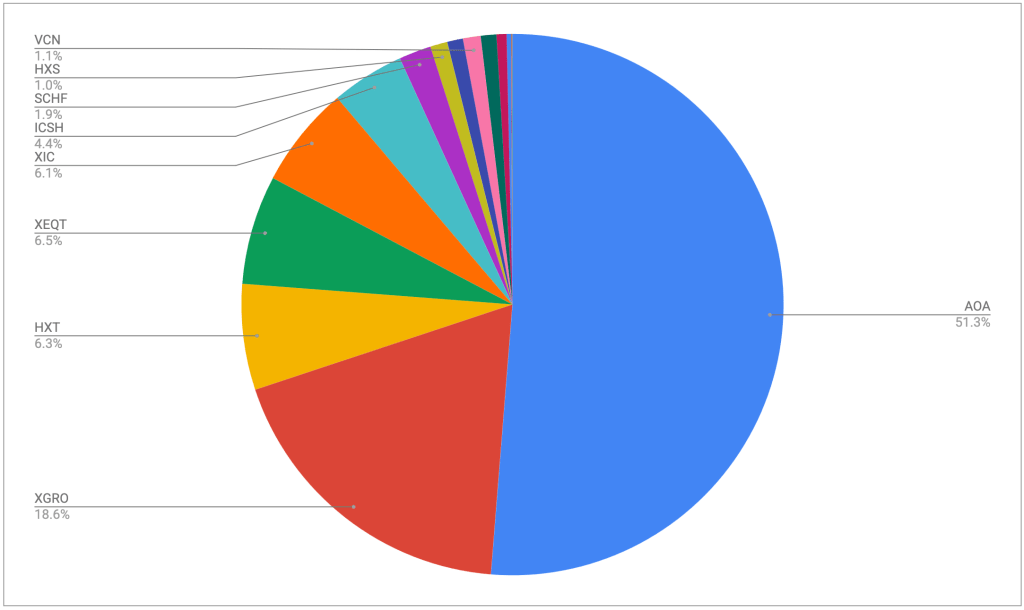
As of this morning, this is what the overall portfolio looks like:

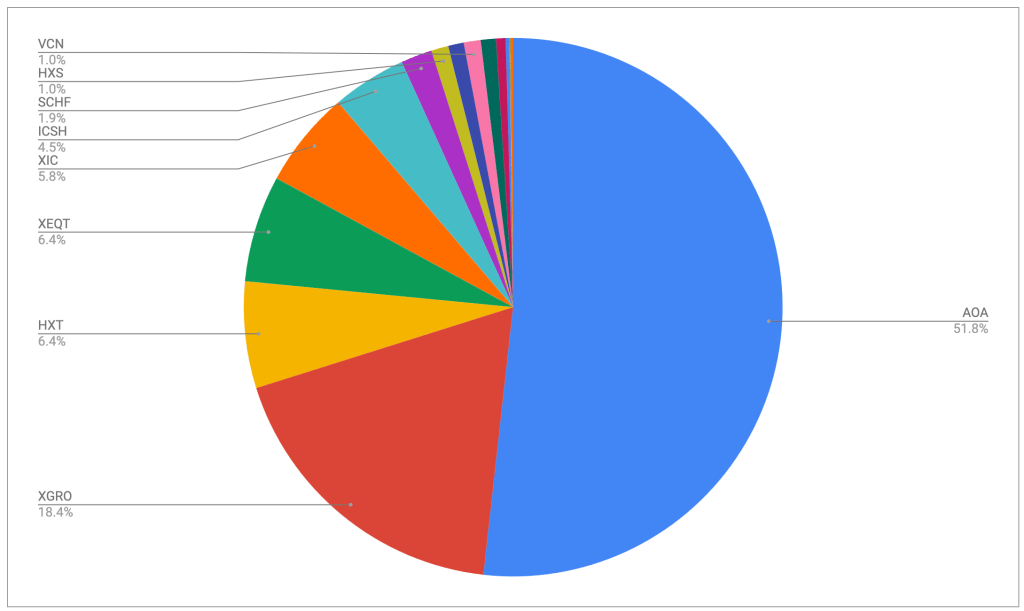
Retirement holdings by ETF, June 2025

The portfolio is dominated by my ETF all-stars; anything not on that page is held in a non-registered account and won’t be fiddled with unless it’s part of my monthly decumulation. Otherwise I’ll rack up capital gains for no real benefit.

The biggest changes over the last 30 days was due to a small rebalancing exercise I executed. I sold off some AOA in order to pick up more ICSH. The stock market has been roaring lately, and it caused my target allocations to become a bit cash-poor; ICSH is not, strictly speaking, “cash”, but for my purposes, it’s close enough. (You can read about my cash thoughts here). I could have instead sold XGRO to pick up more ZMMK, but US interest rates are a lot better than Canadian ones at the moment, so I figured I’d enjoy the extra few percentage points of return on my cash holdings.

Plan for the next month

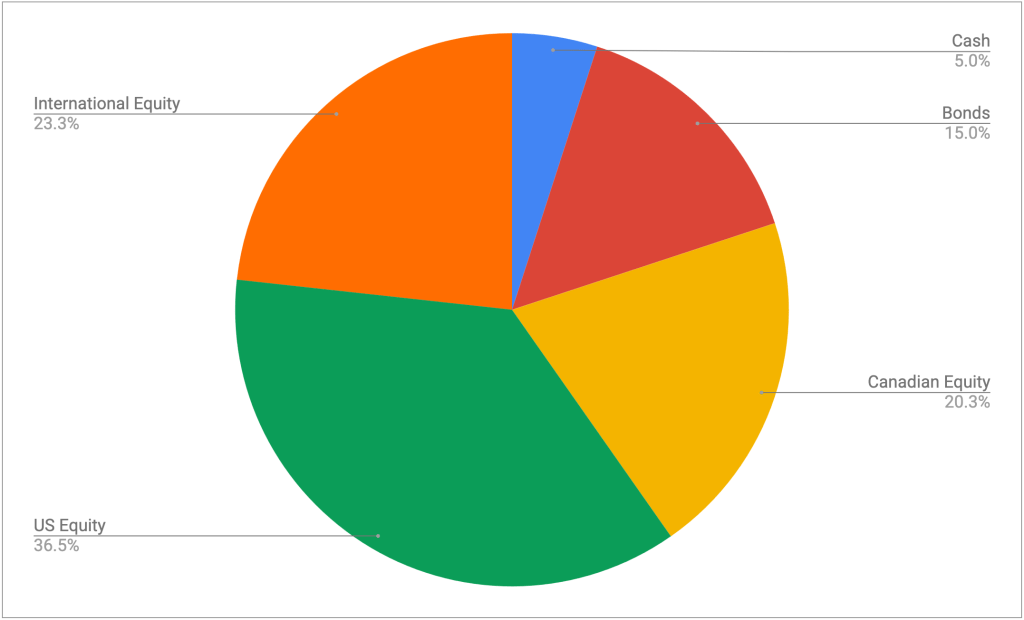
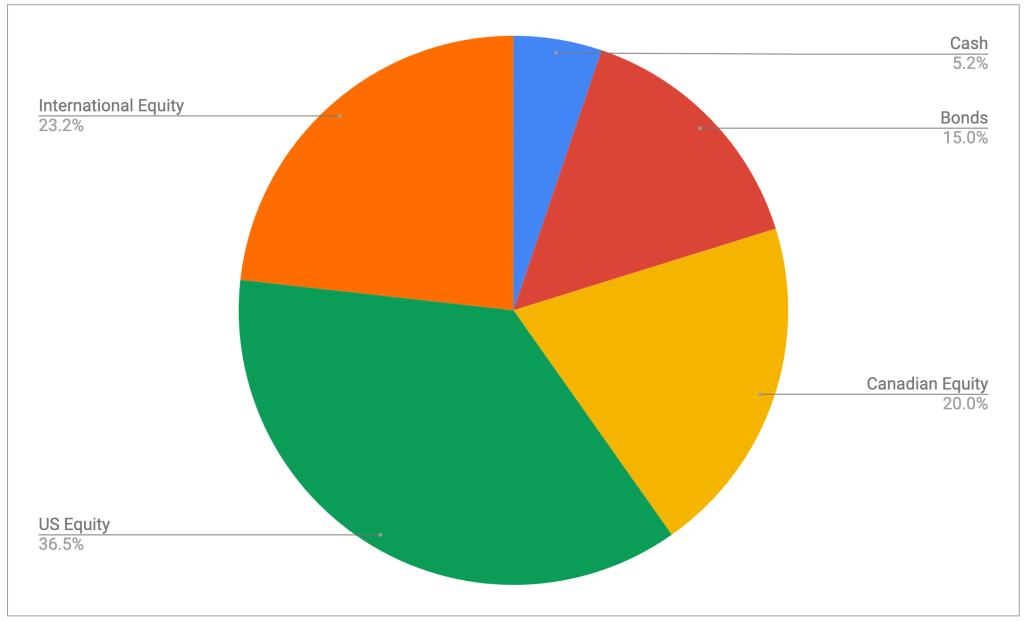
The asset-class split looks like this

This looks to be pretty close to my target percentages which haven’t changed:

  • 5% cash or cash-like holdings like ICSH and ZMMK
  • 15% bonds (almost all are buried in XGRO and AOA)
  • 20% Canadian equity (mostly based on ETFs that mirror the S&P/TSX 60)
  • 36% US equity (dominated by ETFs that mirror the S&P 500, with a small sprinkling of Russell 2000)
  • 24% International equity (mostly, but not exclusively, developed markets)

The pie is looking almost perfect at the moment. I don’t see any near-term need for fiddling with what’s there.

Overall

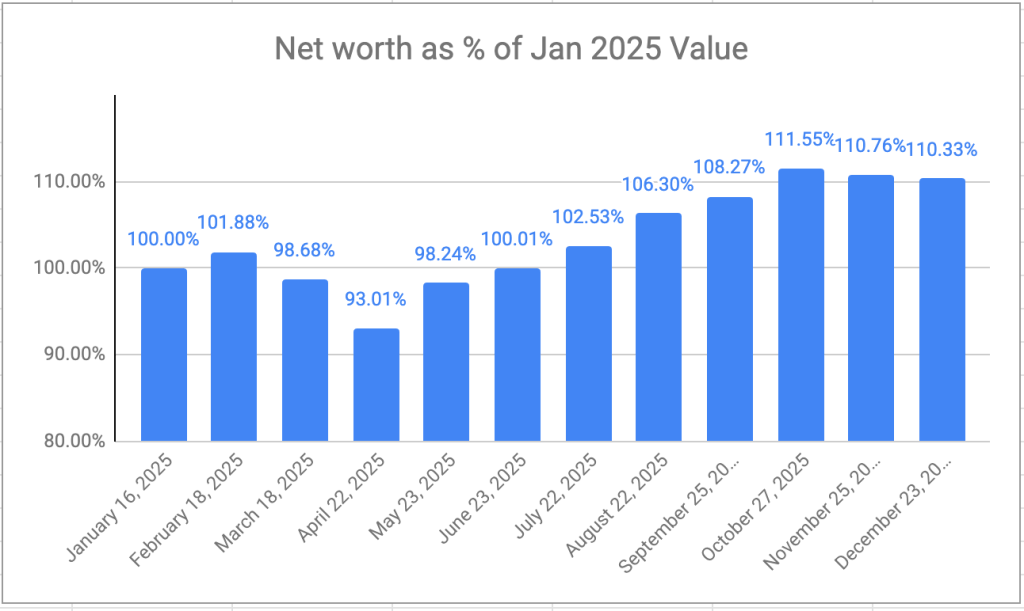
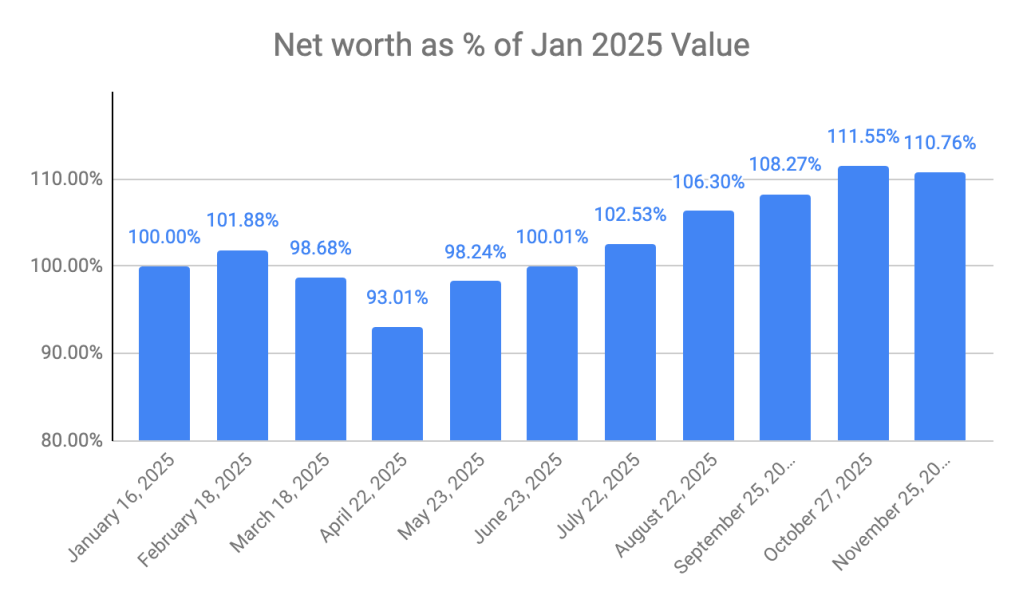
The retirement savings look quite healthy; even though I’ve been drawing a monthly salary for 6 months, I’m now ahead of where I was3 when I started my retirement journey. This is aligned with what my retirement planner told me to expect, but as you can see, the journey has had some interesting ups and downs aready.

Monthly retirement savings, as percentage of Jan 2025 value

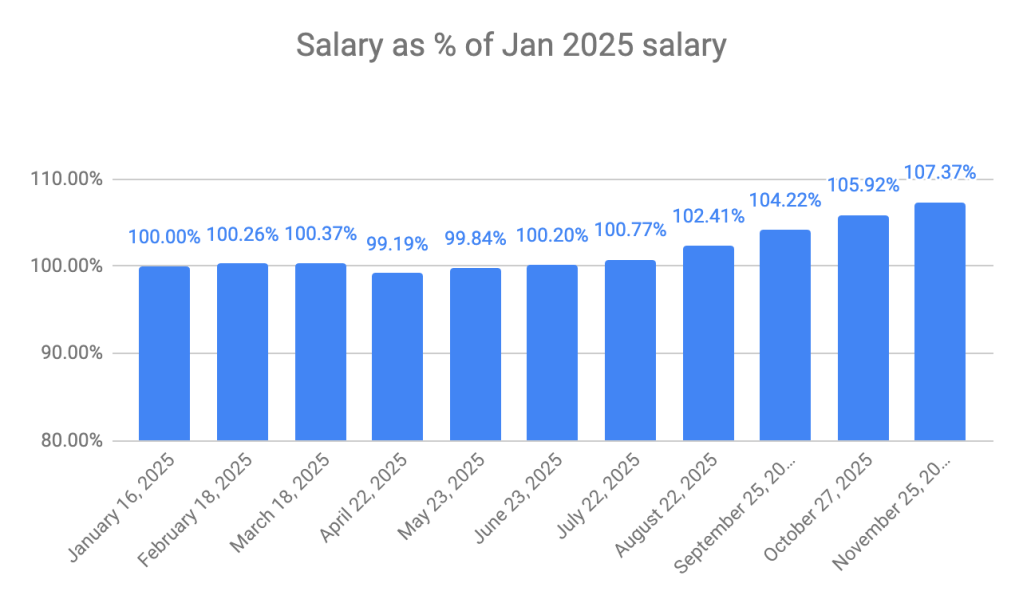
My VPW-calculated salary has gone back to more or less where I started at the beginning of the year. And even with the crazy market swings we’ve seen, it’s stayed remarkably stable4. That’s thanks to the built-in shock-absorber of the VPW model (a 6-month cash cushion which smooths out the market gyrations considerably). I also think it’s an endorsement of my choice to take retirement payments monthly; my exposure to short-term market hiccups is greatly reduced since I’m not making big sales of ETFs to fund a year of spending all at once.

Monthly salary, as percentage of Jan 2025 salary

  1. I know it’s July 7, but the numbers are accurate for June, more or less. ↩︎
  2. I treat retirement savings as firewalled from my day to day chequing account. ↩︎
  3. Just barely, but I’ll take it ↩︎
  4. I changed the vertical axis of this chart to align with the other chart; it makes its stability much clearer. ↩︎

A “two-fund” method for retirement investing

I read a lot of different financial blogs from a bunch of different sources. Last week, this article from “boomer&echo” caught my eye.

In it, they propose a “two fund” solution for how to invest in retirement:

They suggest funding your day to day spending needs from the HISA ETFs. Replenishing the HISA ETF comes courtesy dividends from the all-in-one equity ETF, and selling units “during up markets…or on a regular annual schedule”.

There are some things to like about this method, and some things not to like. I’ll break them down for you.

Like: It’s really simple

Two funds, and two percentages to remember. That’s simplicity. In a perfect world, my holdings would look similar, but would instead look something like

  • 75% in XGRO (an 80/20 ETF)
  • 20% in XEQT
  • 5% in ZMMK

This breakdown would give me the 80% equity, 15% bonds, 5% cash that I strive for in my asset allocation targets.

Like: It’s broadly diversified (mostly)

Holding an all-in-one equity fund seems like you’re putting all your eggs in one basket, but as I discussed over here concerning XEQT, it’s actually a great way to make sure you have your investment spread out across many companies in many geographies. My one mild objection to this approach is that there are no bonds5 in the boomer&echo portfolio, but it’s a minor point.

Like: It recommends keeping cash in the retirement holdings

Having cash on hand is a good way to smooth out the gyrations of the market. It’s a fundamental part of my own withdrawal strategy.

Dislike: The approach is likely to get emotional

The approach to refilling the cash portion of the boomer&echo portfolio is left a bit vague in the linked article. “During up markets” is almost guaranteed to encourage daily agonizing over whether it’s really the “right” time to sell. “On a regular annual schedule” is better advice, but that’s a big trade to execute on a single day, and the temptation to delay this trade would be rather large, I expect.

Dislike: It may not be practical

In theory, it’s really nice to have a super-simple portfolio. In practice, it’s much harder to pull off when you have substantial non-registered investments. Making trades in your non-registered accounts to simplify your holdings may attract unwanted capital gains, which of course may attract unwanted taxes. Add to this my dubious practice of holding substantial USD assets, and you quickly go from an ideal to what a real retiree’s portfolio actually looks like. In any case, it’s always good to try to simplify wherever you can, like I did.

My approach: similar, but different

My approach to portfolio maintenance in retirement is similar to the boomer&echo approach, with a few key differences:

  • Withdrawals are done monthly, without fail, and selling parts of my equity portfolio happen every month. No emotion, and I sell in up or down markets, on the same day every month.
  • The 80/15/5 mix between equity, bonds, and cash is maintained at all times, plus or minus a percentage point. My multi-asset tracker spreadsheet helps with that. Extra trades might be needed in a given month to keep the mix correct.
  • The cash portion of my portfolio is divided between a 6 month non-registered cash cushion that is part of the VPW methodology, and everything else. “Everything else” is largely in registered accounts so as to not generate unnecessary (and taxable) interest income.

What do you think about the boomer&echo two-fund approach? Anyone out there using it? Let me know at comments@moneyengineer.ca.

  1. The article in question mentions VEQT, but its MER is 0.24%, and the others are 0.20% or less. I hold XEQT myself. ↩︎
  2. Elsewhere in the article they characterize the HISA bucket as “12 months of withdrawals”, which is not at all the same as “10%”. ↩︎
  3. These kinds of ETFs invest in a variety of HISAs, like the ones I talk about here. ↩︎
  4. I use ZMMK in this role which is a bit riskier but with a bit higher return. Writing this article makes me wonder if I should head back to HISA ETFs instead. ↩︎
  5. Some research indicates that holding no bonds is in fact the best strategy. ↩︎

What’s in my retirement portfolio (May 2025)

This is a (hopefully monthly) look at what’s in my retirement portfolio. The original post is here. Last month’s is here.

Portfolio Construction

The retirement portfolio is spread across a bunch of accounts:

  • 7 RRIF accounts (3 for me, 3 for my spouse, 1 at an alternative provider as a test)
  • 2 TFSA accounts
  • 4 non-registered accounts1, (1 for me, 1 for my spouse, 2 joint)

The target for the overall portfolio is unchanged:

  • 80% equity, spread across Canadian, US and global markets for maximum diversification
  • 15% Bond funds, from a variety of Canadian, US and global markets
  • 5% cash, held in savings-like ETFs.

The view as of this morning

As of this morning, this is what the overall portfolio looks like:

Retirement holdings by ETF, May 2025

The portfolio is dominated by my ETF all-stars; anything not on that page is held in a non-registered account and won’t be fiddled with unless it’s part of my monthly decumulation. Otherwise I’ll rack up capital gains for no real benefit.

The biggest changes were caused by two events that happened over the past 30 days:

  • I did a small rebalancing exercise to reduce my exposure to the Canadian equity market, selling VCN in favor of XEQT. (XEQT is only 23% Canadian equity per dollar invested; VCN was 100%). This sort of rebalancing happens whenever I drift more than 1% off of my target allocations.
  • I took some cash from a HISA and invested it in ZMMK; for reasons too boring to report here, that money was effectively not being tracked in these pages until this month — that anomaly won’t be repeated in subsequent months since ZMMK and ICSH are where I park the “cash” position of my portfolio.

Plan for the next month

The asset-class split looks like this

This looks to be pretty close to my target percentages which haven’t changed:

  • 5% cash or cash-like holdings like ICSH and ZMMK
  • 15% bonds (almost all are buried in XGRO and AOA)
  • 20% Canadian equity (mostly based on ETFs that mirror the S&P/TSX 60)
  • 36% US equity (dominated by ETFs that mirror the S&P 500, with a small sprinkling of Russell 2000)
  • 24% International equity (mostly, but not exclusively, developed markets)

So, the plan for next month is, do nothing out of the ordinary. Reinvest cash (dividends, TFSA contributions) in one of AOA, XEQT/XGRO, ICSH or ZMMK depending on the asset category most in need on the day of the reinvestment. All these ETFs are covered on my ETF All-Stars page.

One thing I may do is to try to make shifts2 to get a little more return out of my cash position. US interest rates are quite a bit higher than Canadian rates, and so if my cash position is held in USD, I stand to eke a few more points of return there. TBD.

Overall

My retirement savings had a nice bounce-back this month, looks like I can cancel the mega-pack of pot noodles I had on order.

Monthly retirement savings, as percentage of Jan 2025 value

The salary I collect month to month recovered a bit, too, although not as quickly. That’s the magic of using VPW’s cash cushion — neither boom nor bust months translate into large changes in the take-home pay.

Monthly salary, as percentage of Jan 2025 salary

  1. That’s up one from the previous month. In order to collect on Questrade’s transfer bonus, (which they have yet to pay me, they are apparently in a world of hurt on the IT front) you have to have a non-registered account to get paid into. The other 3 are “normal” — one non-registered account for me, one for my spouse, and jointly held one that serves as a cash cushion to smooth out month to month variations in my retirement salary. Read more about that over at https://moneyengineer.ca/2025/01/31/im-retired-now-how-do-i-get-paid/ ↩︎
  2. With Questrade, all ETF trades are free to make, so I don’t have any real reason not to make such changes. ↩︎