
I’m retired. Now how do I get paid?

Summary: In a previous post, I talked about preparing your portfolio for retirement. But now that the paycheques have stopped, how do I get paid from my DIY portfolio?

I got (retirement) paid for the first time today! This is indeed a cause for celebration, at least personally. As a DIYer who is self-funding retirement1, it’s not exactly sitting back and waiting for the cheque to arrive2. There’s a fair bit of work that has to be done if you want, as I do, a monthly salary.

As mentioned elsewhere, I’ve adopted the brilliant strategy of VPW (Variable Percentage Withdrawal) to calculate how much I can get paid every month.

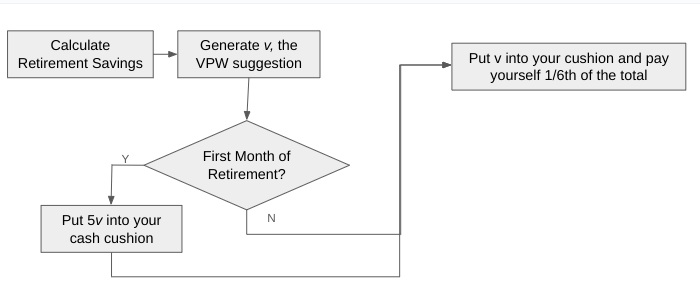
Here’s the high-level flowchart of how VPW works:

Idealized Monthly Routine to get paid using VPW

Let’s go through step by step.

Calculate Retirement Savings

If you’ve simplified your retirement portfolio, this is probably as simple as logging in to your online broker’s portal and looking at what you’re worth today. For more complex scenarios (like mine, because I am test driving a new provider) you’ll need some sort of spreadsheet. Mine is based on this template. I don’t include day to day chequing accounts or anything like that. My retirement portfolio remains firewalled from all the daily puts and takes.

Generate v, the VPW Suggestion

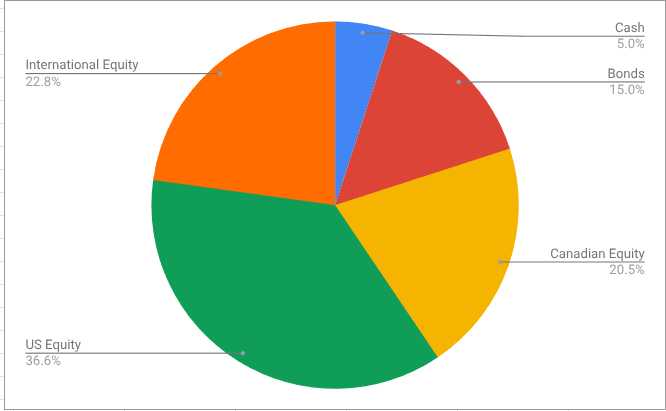
This uses the VPW worksheet available over here. Basically, you enter a few parameters (how old you are, what your asset mix3 is, what your retirement savings are and what pensions (CPP, OAS or employer) you may have now or in the future. Predicting future CPP was made easier for me by using CPP Calculator. The first time you fill in the worksheet, it’s a bit more effort, but most of it (aside from retirement savings) doesn’t change much (if at all) month to month. Enter all the parameters, and out comes v, the monthly VPW4 “suggestion”.

Now, if this is the very first time you’re running through this, meaning that it’s your first month of retirement, there’s one additional step, and that is creating what the VPW folks refer to as a “cash cushion”. I think of it as a shock absorber myself, and my DIY enthusiast neighbour5? He thinks of it as the source of a cash waterfall you drink from monthly.

Whatever you choose to call it, the cash cushion, as the name implies, sits between the VPW suggestion and your retirement salary, dampening possible month to month swings caused by swings in your net worth. A sudden drop in the stock market won’t translate immediately to a sudden drop in your salary, and by the same token, a sudden rise in the stock market won’t translate immediately to a sudden rise in your monthly salary.

Creating the cushion the first time is easy. Just take 5 times what VPW suggests and put that in your cushion. That ought to be a firewalled account that pays decent interest.

Put v in your cushion and pay yourself 1/6th of the total

In the very first month, the astute reader will note that my salary is v, the VPW suggestion. As time goes on, the salary will vary with my retirement savings, and the cushion acts like a moving 6 month average function.

That, in essence, is what the monthly routine looks like.

The reality behind the scenes takes quite a bit more steps due to factors like

  • How many RRIFs you have (personally, I have two…or maybe three6)
  • Whether or not your scheduled RRIF payments cover your VPW-generated salary (mine do not and probably will not ever do so)
  • The time lag between asset (stock/ETF) sale and cash availability7
  • The ability (or not) to easily move money around between accounts8

I will show you the actual work behind the scenes in a future post, but be aware and take the time to work through the details before you pull the plug for real.

  1. I’m delaying CPP and OAS until much later to get more monthly money of inflation-indexed protection. ↩︎
  2. Or an envelope of cash, apparently. The things you get when you type “paycheque” in the search engine… ↩︎
  3. All VPW cares about is how much of your savings are in stocks AKA equity. More stocks = higher returns = more risk. ↩︎
  4. VPW also supports quarterly or annual calculations. I’m sticking with monthly since it’s much closer to what is typical cash flow management for my household. ↩︎
  5. And volunteer copy-editor, thanks Steve 🙂 ↩︎
  6. One spousal RRIF based on the spousal RRSP my spouse contributed to, one personal RRIF based on my personal RRSP. I also have a USD personal RRIF but my provider treats it as part of my personal CAD RRIF. My portal shows three accounts, but I only get two payments. ↩︎
  7. Typically, two days ↩︎
  8. I learned, sadly, that my current provider offers no way to move money between non-registered accounts without resorting to a phone call. As I have already reached my hold music limit for 2025, there’s no way I’m going to put up with that. And so the chequing account comes into play as a way to move money around at the cost of delay. Dear QTrade, please fix this. ↩︎

Preparing your portfolio for retirement

It’s all well and good to leave the working world, but unless you have a way to start tapping into your retirement savings, it’s going to be tough sledding. Here is what I did to prepare.

Preparation step 1: Try to keep your RRSP aligned with your spouse’s RRSP

By “aligned” I mean “try to keep your retirement income equal to your spouse’s retirement income”. This only matters if you’re planning on retiring before the age of 65; those who are 65+ can achieve similar results via pension splitting. For me, this is rather easy to work out since I’m the same age as my spouse and we don’t have workplace pensions. So for me, that meant keeping the value of my RRSP close to my spouse’s RRSP.

This step isn’t so easy to do if you’re in the last stages before retirement, admittedly, since the only way to “fix” the numbers is by contributing to a spousal RRSP. But I figured I’d mention it anyway as it can reduce your household income tax bill once you are retired.

Preparation step 2: Simplify the portfolio

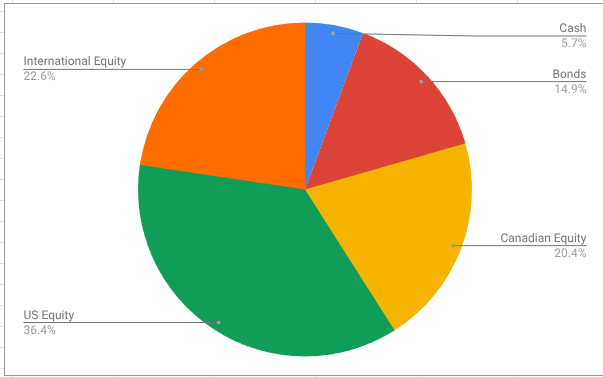
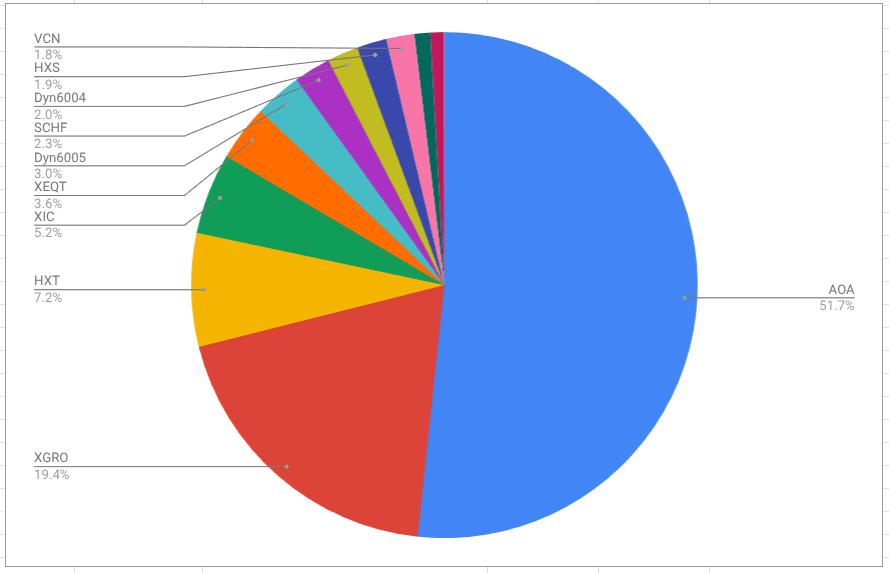
As shown over here, the vast majority (about 80%) of my holdings are in four investments: two asset-allocation ETFs (one in CAD, one is USD) and two high interest savings accounts (one CAD, one USD).

It didn’t always look like that. Prior to moving to XGRO and AOA, I had holdings that attempted to mirror (more or less) what these all-in-ones actually invest in under the hood — US Equity funds, Canadian Equity funds, International Equity funds, short-, mid- and long term bond funds….The list was pretty long. This for me caused three problems:

  • Trying to keep the holdings at the ratios I wanted while actively selling the assets seemed like too much effort, too much trading, and too many opportunities for emotion1 to get in the way.
  • The folks behind VPW (my chosen method of budgeting in retirement) recommended using an all-in-one which is based on “no market timing, no concentration into any asset, no investment into alternative assets, no factor investing, and no modulation of asset allocation or withdrawals based on guru prognostications or metrics2
  • The random bus principle3 meant I had to make things easier for my spouse and/or my heirs

And so, with a bit of trepidation, I started the work, one account at a time — bearing in mind that between RRSPs, TFSAs, and non-registered accounts, many of which had USD and CAD variants, there were around a dozen accounts to take the simplification knife to.

These were big trades! To mitigate market volatility somewhat (I didn’t want to get caught on an overly good or overly bad market day), I made progress account by account and after about a month, my portfolio was more or less what it is today.

Preparation Step 3: Open and fund RRIFs

If you’re new to RRIFs, you may want to take a detour to Demystifying RRIFs. I’ll wait here.

Part of the retirement plan I paid for recommended that I fund the early part of my retirement with a combination of RRSP money and non-registered money. My plan didn’t say anything about when to convert to a RRIF, and I figured that a RRIF was something for much older me to worry about.

As I started to investigate the mechanics of taking money directly out of an RRSP, I discovered two things:

  • My provider, and I suppose most providers, charge a fee for making this sort of “exceptional” request, known as a “deregistration fee“. I hate fees.
  • RRSP withdrawals attract withholding tax. I hate loaning the government money interest-free.

And so, I set out to open RRIFs. (Don’t forget to designate a beneficiary or successor annuitant!) This was a bit more involved than I imagined, and due to a number of snags unique to my provider4, it took about 4 weeks from beginning to end. I already had set up EFT connections5 between my provider and my bank, so that wasn’t something I had to do as well.

At the time of opening the RRIF, I also had to designate the frequency of payment. I presume (you tell me) that most providers offer the same options of annually, quarterly or monthly. I chose monthly, which makes cash flow a bit easier to manage, it does create extra work to make sure funds are in place every month.

Preparation Step 4: Move employer based holdings to your control

My private-sector employer offered no pension plan. They did offer an RRSP matching program with associated DPSP at a provider dictated by them. Anyway, the instant I could break off that association (my last day of work) I did, and planned to move the money to my usual provider. Unfortunately, I got caught in a situation I describe in my cautionary tale, and this money will not be part of my RRIF holdings in 2025. A minor hiccup, but if you’re counting on having access to this money shortly after pulling the plug, be very careful!

Preparation Step 5: Have potential capital gains insight into your non-registered accounts

Capital gains are only a concern in non-registered accounts. If you don’t have any, ignore this step.

Part of my retirement funding in the early days will come from non-registered accounts. Any time you sell a stock/ETF in a non-registered account, it generates capital gains (or capital losses) which are reported on your tax return. Knowing up front what the potential capital gains are for each ETF/stock you hold will help you optimize your taxes. You can only know that if you know the Adjusted Cost Base (ACB) of your holdings and the current price. Your provider probably shows a “gain” number, but it’s not always accurate. Best to track it yourself using a tool like https://www.adjustedcostbase.ca/.

This I think captures the main steps I went through to get “retirement ready”. My first RRIF payment is due January 31, 2025 — I’ll believe it’s “done” when I see the entry in my chequing account!

  1. “I’m sure if I wait a week, this ETF will go lower/higher” is a good sign you’re using emotion rather than cold, hard, numbers to make your investment decisions. ↩︎
  2. As stated at Re: A Simple Retirement Using Variable Percentage Withdrawals (VPW Forward Test) ↩︎
  3. A lifetime guiding principle of mine: “what would happen if I got hit by a random bus today”? Thankfully, it hasn’t happened yet. ↩︎
  4. Dear QTrade, please fix your RRIF application forms so you can properly fund both CAD and USD accounts. And make sure you can designate a successor annuitant correctly when filling out the application. ↩︎
  5. EFT = “Electronic Funds Transfer”. It’s a connection that allows the RRIF payment to land directly in your usual bank account where it can do useful things, like, you know, pay bills. If your RRIF provider is also a bank, you probably (?) needn’t worry about this. ↩︎

How much can I afford to spend in retirement?

Summary: Variable Percentage Withdrawal (VPW) is a safe way to draw down your retirement investments, and feels a lot more reasonable than relying on a fixed budget.

When I finally decided to pull the plug on the “working to earn a living” world, (and you can read about how I came to that decision here) I was still left with lingering doubts over my retirement spending plans.

Of course, I had prepared a retirement budget as part of the exercise.

Of course, I had hired an advisor to take a look at the numbers.

And as a result, of course, I had a tidy year by year breakdown of my inflation-adjusted budget and net worth. The charts always look something like the one on PERCs home page.

But my own experience made me really uneasy about this approach — in 2023 that forecast showed I couldn’t retire until 2027, but then back-to-back stock market silliness (in a good way) allowed my 80/20 investment portfolio blow through “the number” two years early!

So, on the one hand, hooray for me, but on the other hand, the story could have happened in precisely the opposite way with a (temporary, they are always temporary) market meltdown, and the moneyengineer.ca domain would have been snapped up by the Canadian Mint, and I’d still be working for a living. The variability of year to year returns isn’t a big deal over a long period of time, but it makes a huge difference in the immediate future1, and by “immediate” I mean, “how much will I take out of my retirement portfolio this month?”

And then I stumbled upon Variable Percentage Withdrawal (VPW).

In plain language,

VPW offers you a sustainable salary in retirement; if the market is doing well, you can afford to spend more, but if the market is doing less well, tighten the belt.

VPW uses your net worth, your age, your portfolio and any current or future pensions to dynamically calculate what you can afford to spend in a given month, quarter or year.

The key is “dynamically”. Every month, quarter or year, you calculate your net worth, and the VPW Accumulation and Retirement worksheet generates two numbers: what you can afford to spend, and what that number would look like in the event of a market meltdown.

And all of a sudden, my unease evaporated. This was just like REAL (pre-retirement) LIFE! I’ve never had a “constant” budget, I’ve never had a “constant” salary, and I’ve never been able to predict what either would look like 6 months from now, let alone 15 years from now. So why pretend I had all the answers in retirement? VPW gives a boring, emotion free algorithm2 for doing the work, and is perfectly aligned with my boring, emotion-free algorithm for investing.

You can watch a simulated VPW-based retirement, in real time over at https://www.financialwisdomforum.org/forum/viewtopic.php?p=638130#p638130. It’s been running since July 2019. An outstanding effort!

In future posts, I’ll talk a bit about how the mechanics of VPW work in practice with my own situation. NB: my first VPW-calculated retirement payment will be in January, 2025!

  1. Interested readers should take a look at the many writings out there on “sequence of returns” risk. Basically, it’s the risk that the retiree gets really unlucky and suffers a big stock market meltdown at the very start of retirement, the worst possible time. ↩︎
  2. AND spreadsheets 🙂 ↩︎

How did you know you had enough to retire?

As a recent and relatively young retiree, I get this question a lot. I’ll try to break down the significant steps in the journey….

It started with knowing how much I actually had saved and tracking it

When you have multiple accounts across multiple providers, this can be more difficult than it should be. The full list circa 5 years ago looked something like this:

  • Joint investment account in Canadian Dollars
  • Joint investment account in US Dollars1
  • My spouse’s investment account2
  • My TFSA account
  • My spouse’s TFSA account
  • My RRSP in Canadian dollars
  • My RRSP in US dollars
  • My wife’s Spousal RRSP in Canadian dollars
  • My wife’s Spousal RRSP in US dollars
  • My spousal RRSP
  • My RRSP at my employer-mandated provider3
  • My DPSP4 at my employer-mandated provider

So yeah, a lot of accounts to keep track of. Not to mention that the RRSPs and TFSAs still had active monthly contributions, so aside from stock market changes, the actual amount being invested kept changing, too.

I built a partly-automated Google Sheets spreadsheet to keep track of everything. The template I used is over here if you’re interested.

Knowing how much I had saved for my retirement allowed me to start charting progress, and even allowed me to build models with calendar predictions for hitting milestones.

Then, I started researching how others figured this out

A book that made a lot of sense to me at the time was Fred Vettese’s great book, “Retirement Income for Life“. This started me down the rabbit hole of the many, many forecasting tools out there. A small sample included:

These tools provided me with three very important pieces of information.

First, it forced me to think about what retirement might look like from a budget perspective. What will I spend per month/per year in retirement on housing, utilities, transportation, entertainment, medical expenses, charitable giving, clothes, subscriptions….the list can be very long.

Second, it also forced me to think about how income would work in retirement. Would I radically change what I was investing in? Would I still earn money part-time? How much would that bring in? For how long?

Third, every simulation I ran showed me that I was quite close to retiring. But honestly, the amount of effort I put into running the numbers through these free tools was not very high. So I was still not feeling very sure I really had a handle on things.

I paid for a professional assessment

One habit of mine is that unless I have money invested in something, I’m unlikely to follow through. I want to learn piano, so prepaying for a year of lessons provides me with the incentive to put in time at the keyboard every day without fail. The same held true for making a retirement plan. Until and unless I put some money against it, I was likely to keep putting off making a decision. So I started searching for an independent financial planner who specialized in retirement. Someone local to me was Retirement in View5 and with appointment booked and payment sent, I was on my way to have a pro look at what I had concocted. How did I pick this provider? I had a short list of must-haves:

  • They didn’t sell products, only services. Providers who sell products (e.g. mutual funds, ongoing subscriptions) are always going to have some degree of a conflict of interest. I wanted to pay for advice, not stuff I didn’t need.
  • They had professional designations (CFP is the usual one)
  • They seemed to have a clue about retirement

The process of producing a detailed plan forces you to put a stake in the ground with respect to the questions I raised in the previous section: what’s your net worth, what’s it invested in, what’s your budget, what’s your work plan and so on.

The net result of the assessment from two years ago was that I was in good shape to retire two years from now, in 2027. It also provided me with the specific, per account totals I should have in place in my retirement savings. Those totals became my obsession, since they represented “the number” I needed to retire. The assessment also gave me a realization that the mechanics of withdrawing from your holdings isn’t trivial if you’re also trying to reduce taxes (and who isn’t, right?). The big things I learned from my encounter were:

  • I had become accustomed to thinking of taxes in terms of marginal rates, i.e. the rate of tax you are paying for the last dollar you earn. For retirement, it makes a lot more sense to think of overall tax rates, meaning the average rate of tax you’re paying. And since RRIF/RRSP income is treated differently from capital gains income which is treated differently from dividend income, you can play with sequencing to have some control over your annual tax bill.
  • Start with drawing down your RRSP6 holdings. Otherwise, by the time you start collecting CPP and OAS, you’re going to be paying a lot of tax, and maybe foregoing the income-tested OAS.
  • Delay CPP and OAS as long as possible, since this income may be the only income you have that is inflation-adjusted. (ok, this wasn’t really new, just about every pundit out there recommends you do this)

Some Lingering Doubts, But Onward!

And so, in 2023, I resigned myself to retiring sometime in 2027 and continued doing what I was doing, namely tracking my retirement savings and contributing to TFSA and RRSP. I even built a little “number tracker” to show how close I was to the targets I had for retirement.

And then, in 2023 and 2024, the stock market had back-to-back banner years, and early in 2024, barring a total disaster, it was looking quite promising that I would hit “the number” in the next 6 months. What? The assessment I paid for showed quite clearly that I shouldn’t have hit that number until 2027!

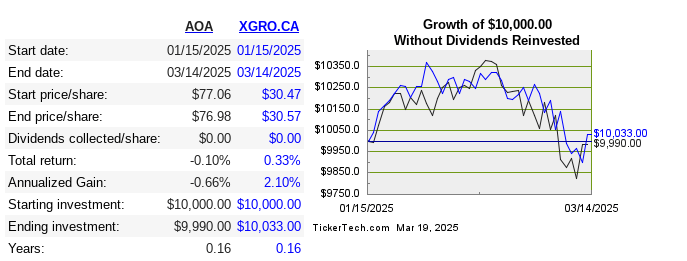
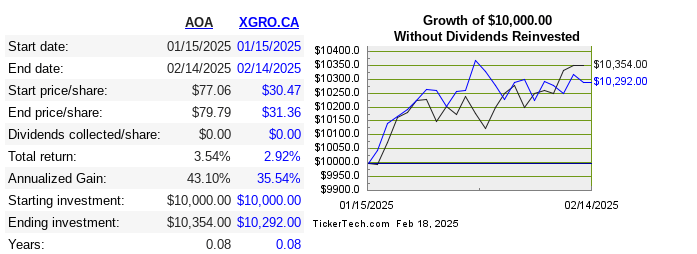
Total return of AOA and XGRO, Jan 1 2023 to Jan 1 2025, all dividends reinvested, courtesy https://dqydj.com/etf-return-calculator/ and https://www.canadastockchannel.com/compound-returns-calculator/

I realized that ALL the modeling, ALL the assessments, ALL the forecasts are based on static assumptions. Static inflation. Static growth from your portfolio. Static spending budgets, adjusted for inflation. And while static assumptions certainly make modeling easier, real life does not work that way, proven, in my mind, by the fact that my portfolio was a full 2 years ahead where it was predicted to be 2 years prior. And sure, you could build models that account for all kinds of changes, but you’re at that point building guesses on guesses. It all left me feeling rather unsatisfied.

Regardless, at that point, I made the decision that I would “officially” retire at the end of 2024 as long as the numbers held up midway through 2024. And they did. And I did.

But there was still the nagging problem I felt. 2023 and 2024, were certainly to my advantage, but what about the next two years? And the ten years after that? What happens if the stock market were to take a large beating the week after I stopped collecting a paycheque? Would I have to stock up on cheap ramen as a fallback?

It was in the last 12 months or so I discovered the concept of VPW — variable percentage withdrawal. A concept that much better models the real world. More on that next time.

  1. My provider (QTrade) treats US dollar and Canadian dollar accounts completely separately. Other providers blend them into one account. There are pluses and minuses for each. ↩︎
  2. Totally funded by a fully documented and interest-paying spousal loan. A topic for another blog post, but it’s a way to split income with a spouse. ↩︎
  3. In order to get automatic per paycheque contributions and automated matches, I had to use Manulife, a fate I would not wish upon my worst enemy. ↩︎
  4. “Deferred Profit Sharing Plan”. Not sure how common this vehicle is anymore, but my employer included it as part of my total compensation. Their modest RRSP matching contributions had to go into this separate account which is for all intents and purposes an RRSP account, except for the fact that you cannot touch the funds until your employment is terminated. I’m 22 days into my retirement, and still waiting for my funds to arrive… ↩︎
  5. Give Ayana my best regards! ↩︎
  6. Or RRIF ↩︎

Thanks, Wealthy Barber

My investment journey started a long time ago, when I somehow got myself a copy of The Wealthy Barber. I can no longer recall the specific lessons I picked up from that bestseller, save one:

“Pay Yourself First”.

It’s a really simple tenet that reminds me that the only person funding my retirement is me. If you fail to pay yourself first, “future you” will pay the price. It doesn’t have to be a lot, but it does have to be a regular and prioritized occurrence.

One way to prioritize saving is to make it automatic. Every paycheque, carve off a fixed amount to redirect to your firewalled retirement account. At the beginning, maybe that’s just a savings account, but it could just as well be an online broker, as long as that broker is helping you by paying you interest on the money you’ve saved.

As time went on, I came to realize that paying myself first also meant NOT paying advisor fees for my managed retirement portfolio and instead investing that money in future me. It was, at the time, a bit of a scary decision, but one that I do not regret at all.

I was reminded of this very influential book because I discovered you can download the updated version, “The Wealthy Barber Returns” for free from RBC Direct Investing. Do check it out! https://www.rbcdirectinvesting.com/_assets-custom/includes/wealthy_barber.pdf