
I’m retired. Now how do I get paid?

Summary: In a previous post, I talked about preparing your portfolio for retirement. But now that the paycheques have stopped, how do I get paid from my DIY portfolio?

I got (retirement) paid for the first time today! This is indeed a cause for celebration, at least personally. As a DIYer who is self-funding retirement1, it’s not exactly sitting back and waiting for the cheque to arrive2. There’s a fair bit of work that has to be done if you want, as I do, a monthly salary.

As mentioned elsewhere, I’ve adopted the brilliant strategy of VPW (Variable Percentage Withdrawal) to calculate how much I can get paid every month.

Here’s the high-level flowchart of how VPW works:

Idealized Monthly Routine to get paid using VPW

Let’s go through step by step.

Calculate Retirement Savings

If you’ve simplified your retirement portfolio, this is probably as simple as logging in to your online broker’s portal and looking at what you’re worth today. For more complex scenarios (like mine, because I am test driving a new provider) you’ll need some sort of spreadsheet. Mine is based on this template. I don’t include day to day chequing accounts or anything like that. My retirement portfolio remains firewalled from all the daily puts and takes.

Generate v, the VPW Suggestion

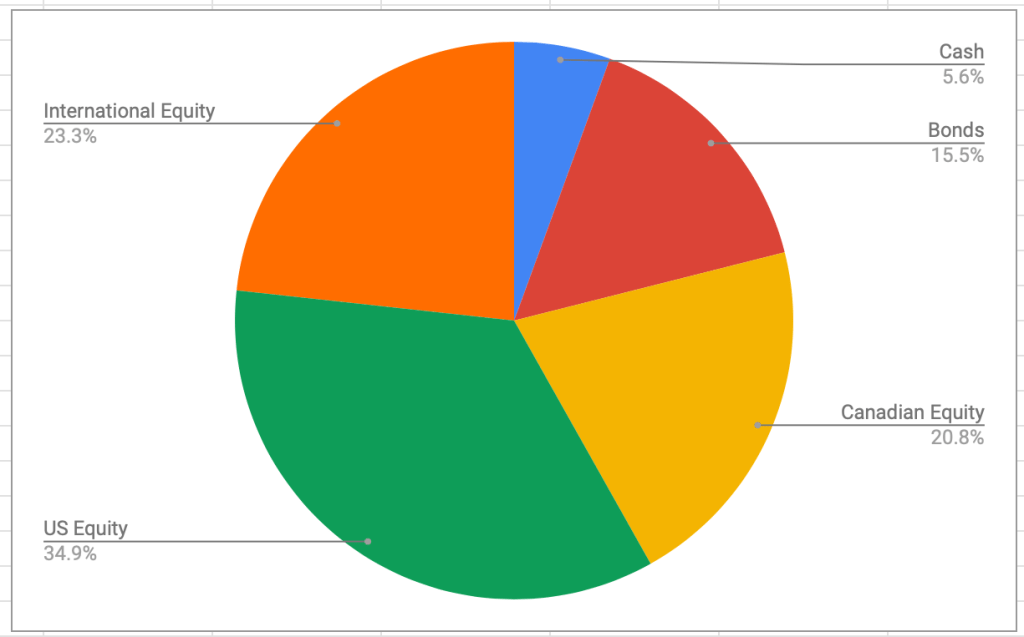
This uses the VPW worksheet available over here. Basically, you enter a few parameters (how old you are, what your asset mix3 is, what your retirement savings are and what pensions (CPP, OAS or employer) you may have now or in the future. Predicting future CPP was made easier for me by using CPP Calculator. The first time you fill in the worksheet, it’s a bit more effort, but most of it (aside from retirement savings) doesn’t change much (if at all) month to month. Enter all the parameters, and out comes v, the monthly VPW4 “suggestion”.

Now, if this is the very first time you’re running through this, meaning that it’s your first month of retirement, there’s one additional step, and that is creating what the VPW folks refer to as a “cash cushion”. I think of it as a shock absorber myself, and my DIY enthusiast neighbour5? He thinks of it as the source of a cash waterfall you drink from monthly.

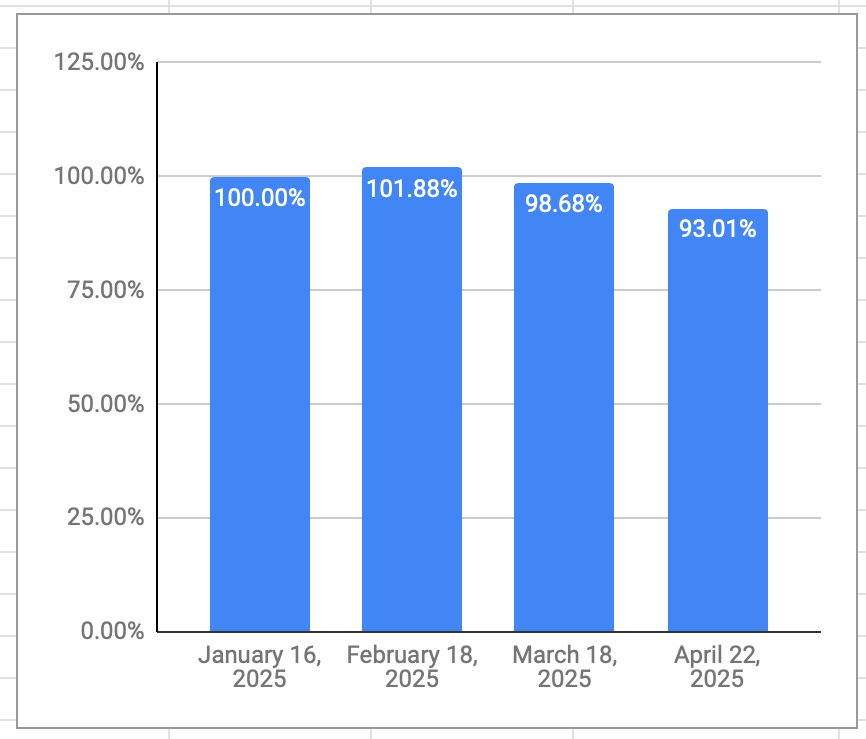
Whatever you choose to call it, the cash cushion, as the name implies, sits between the VPW suggestion and your retirement salary, dampening possible month to month swings caused by swings in your net worth. A sudden drop in the stock market won’t translate immediately to a sudden drop in your salary, and by the same token, a sudden rise in the stock market won’t translate immediately to a sudden rise in your monthly salary.

Creating the cushion the first time is easy. Just take 5 times what VPW suggests and put that in your cushion. That ought to be a firewalled account that pays decent interest.

Put v in your cushion and pay yourself 1/6th of the total

In the very first month, the astute reader will note that my salary is v, the VPW suggestion. As time goes on, the salary will vary with my retirement savings, and the cushion acts like a moving 6 month average function.

That, in essence, is what the monthly routine looks like.

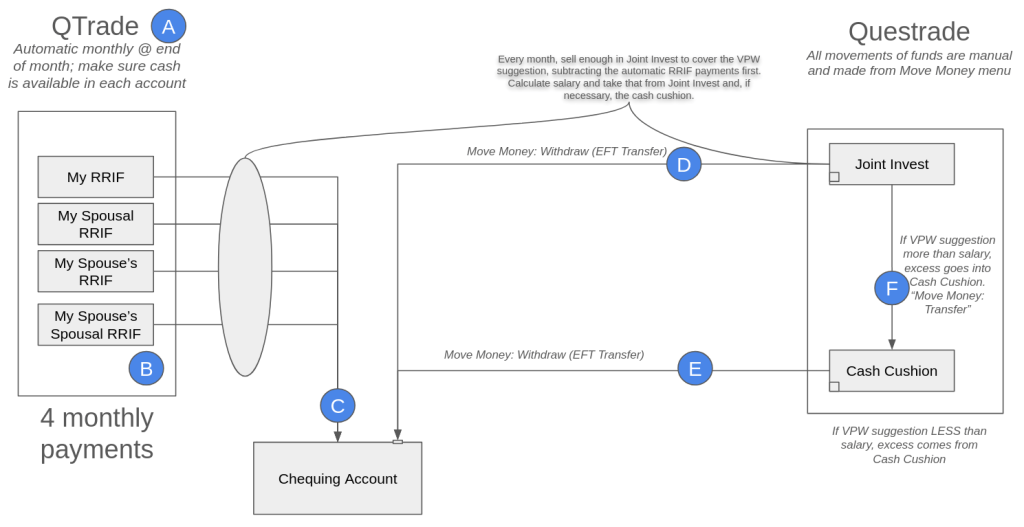
The reality behind the scenes takes quite a bit more steps due to factors like

  • How many RRIFs you have (personally, I have two…or maybe three6)
  • Whether or not your scheduled RRIF payments cover your VPW-generated salary (mine do not and probably will not ever do so)
  • The time lag between asset (stock/ETF) sale and cash availability7
  • The ability (or not) to easily move money around between accounts8

I will show you the actual work behind the scenes in a future post, but be aware and take the time to work through the details before you pull the plug for real.

  1. I’m delaying CPP and OAS until much later to get more monthly money of inflation-indexed protection. ↩︎
  2. Or an envelope of cash, apparently. The things you get when you type “paycheque” in the search engine… ↩︎
  3. All VPW cares about is how much of your savings are in stocks AKA equity. More stocks = higher returns = more risk. ↩︎
  4. VPW also supports quarterly or annual calculations. I’m sticking with monthly since it’s much closer to what is typical cash flow management for my household. ↩︎
  5. And volunteer copy-editor, thanks Steve 🙂 ↩︎
  6. One spousal RRIF based on the spousal RRSP my spouse contributed to, one personal RRIF based on my personal RRSP. I also have a USD personal RRIF but my provider treats it as part of my personal CAD RRIF. My portal shows three accounts, but I only get two payments. ↩︎
  7. Typically, two days ↩︎
  8. I learned, sadly, that my current provider offers no way to move money between non-registered accounts without resorting to a phone call. As I have already reached my hold music limit for 2025, there’s no way I’m going to put up with that. And so the chequing account comes into play as a way to move money around at the cost of delay. Dear QTrade, please fix this. ↩︎

Preparing your portfolio for retirement

It’s all well and good to leave the working world, but unless you have a way to start tapping into your retirement savings, it’s going to be tough sledding. Here is what I did to prepare.

Preparation step 1: Try to keep your RRSP aligned with your spouse’s RRSP

By “aligned” I mean “try to keep your retirement income equal to your spouse’s retirement income”. This only matters if you’re planning on retiring before the age of 65; those who are 65+ can achieve similar results via pension splitting. For me, this is rather easy to work out since I’m the same age as my spouse and we don’t have workplace pensions. So for me, that meant keeping the value of my RRSP close to my spouse’s RRSP.

This step isn’t so easy to do if you’re in the last stages before retirement, admittedly, since the only way to “fix” the numbers is by contributing to a spousal RRSP. But I figured I’d mention it anyway as it can reduce your household income tax bill once you are retired.

Preparation step 2: Simplify the portfolio

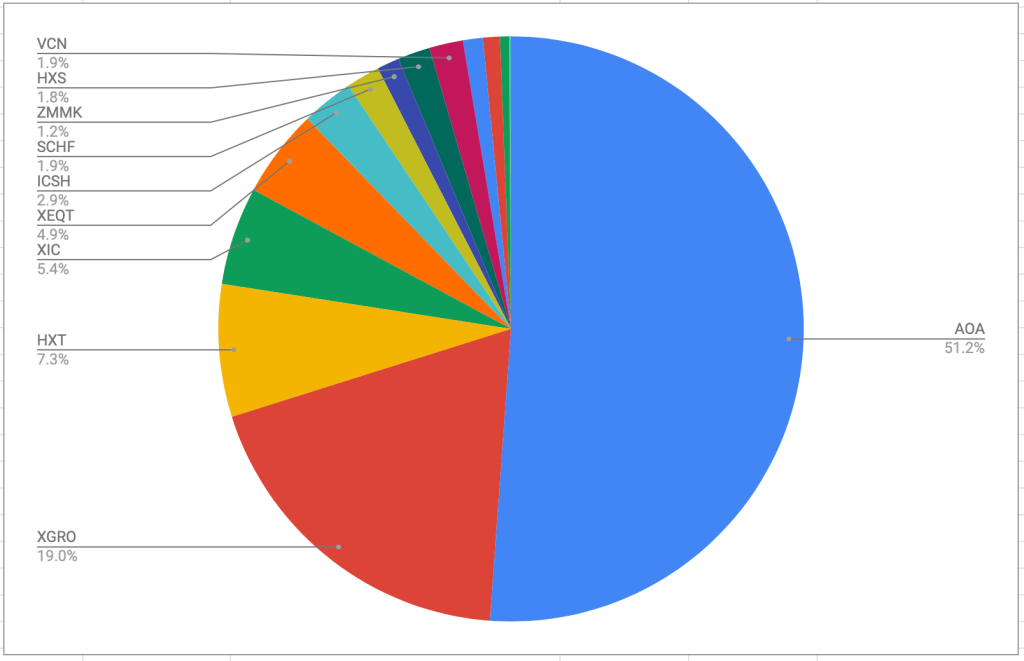
As shown over here, the vast majority (about 80%) of my holdings are in four investments: two asset-allocation ETFs (one in CAD, one is USD) and two high interest savings accounts (one CAD, one USD).

It didn’t always look like that. Prior to moving to XGRO and AOA, I had holdings that attempted to mirror (more or less) what these all-in-ones actually invest in under the hood — US Equity funds, Canadian Equity funds, International Equity funds, short-, mid- and long term bond funds….The list was pretty long. This for me caused three problems:

  • Trying to keep the holdings at the ratios I wanted while actively selling the assets seemed like too much effort, too much trading, and too many opportunities for emotion1 to get in the way.
  • The folks behind VPW (my chosen method of budgeting in retirement) recommended using an all-in-one which is based on “no market timing, no concentration into any asset, no investment into alternative assets, no factor investing, and no modulation of asset allocation or withdrawals based on guru prognostications or metrics2
  • The random bus principle3 meant I had to make things easier for my spouse and/or my heirs

And so, with a bit of trepidation, I started the work, one account at a time — bearing in mind that between RRSPs, TFSAs, and non-registered accounts, many of which had USD and CAD variants, there were around a dozen accounts to take the simplification knife to.

These were big trades! To mitigate market volatility somewhat (I didn’t want to get caught on an overly good or overly bad market day), I made progress account by account and after about a month, my portfolio was more or less what it is today.

Preparation Step 3: Open and fund RRIFs

If you’re new to RRIFs, you may want to take a detour to Demystifying RRIFs. I’ll wait here.

Part of the retirement plan I paid for recommended that I fund the early part of my retirement with a combination of RRSP money and non-registered money. My plan didn’t say anything about when to convert to a RRIF, and I figured that a RRIF was something for much older me to worry about.

As I started to investigate the mechanics of taking money directly out of an RRSP, I discovered two things:

  • My provider, and I suppose most providers, charge a fee for making this sort of “exceptional” request, known as a “deregistration fee“. I hate fees.
  • RRSP withdrawals attract withholding tax. I hate loaning the government money interest-free.

And so, I set out to open RRIFs. (Don’t forget to designate a beneficiary or successor annuitant!) This was a bit more involved than I imagined, and due to a number of snags unique to my provider4, it took about 4 weeks from beginning to end. I already had set up EFT connections5 between my provider and my bank, so that wasn’t something I had to do as well.

At the time of opening the RRIF, I also had to designate the frequency of payment. I presume (you tell me) that most providers offer the same options of annually, quarterly or monthly. I chose monthly, which makes cash flow a bit easier to manage, it does create extra work to make sure funds are in place every month.

Preparation Step 4: Move employer based holdings to your control

My private-sector employer offered no pension plan. They did offer an RRSP matching program with associated DPSP at a provider dictated by them. Anyway, the instant I could break off that association (my last day of work) I did, and planned to move the money to my usual provider. Unfortunately, I got caught in a situation I describe in my cautionary tale, and this money will not be part of my RRIF holdings in 2025. A minor hiccup, but if you’re counting on having access to this money shortly after pulling the plug, be very careful!

Preparation Step 5: Have potential capital gains insight into your non-registered accounts

Capital gains are only a concern in non-registered accounts. If you don’t have any, ignore this step.

Part of my retirement funding in the early days will come from non-registered accounts. Any time you sell a stock/ETF in a non-registered account, it generates capital gains (or capital losses) which are reported on your tax return. Knowing up front what the potential capital gains are for each ETF/stock you hold will help you optimize your taxes. You can only know that if you know the Adjusted Cost Base (ACB) of your holdings and the current price. Your provider probably shows a “gain” number, but it’s not always accurate. Best to track it yourself using a tool like https://www.adjustedcostbase.ca/.

This I think captures the main steps I went through to get “retirement ready”. My first RRIF payment is due January 31, 2025 — I’ll believe it’s “done” when I see the entry in my chequing account!

  1. “I’m sure if I wait a week, this ETF will go lower/higher” is a good sign you’re using emotion rather than cold, hard, numbers to make your investment decisions. ↩︎
  2. As stated at Re: A Simple Retirement Using Variable Percentage Withdrawals (VPW Forward Test) ↩︎
  3. A lifetime guiding principle of mine: “what would happen if I got hit by a random bus today”? Thankfully, it hasn’t happened yet. ↩︎
  4. Dear QTrade, please fix your RRIF application forms so you can properly fund both CAD and USD accounts. And make sure you can designate a successor annuitant correctly when filling out the application. ↩︎
  5. EFT = “Electronic Funds Transfer”. It’s a connection that allows the RRIF payment to land directly in your usual bank account where it can do useful things, like, you know, pay bills. If your RRIF provider is also a bank, you probably (?) needn’t worry about this. ↩︎

Demystifying RRIFs

RRIF stands for “Registered Retirement Income Fund” and can be thought of as your own self-funded pension plan. The RRSP is where you built up that pension plan, and the RRIF is where you get to take a salary from it.

I opened a RRIF last year as part of my retirement preparations (more on that in a future post) and came into this process with a whole lot of preconceived notions about how this would work and what the final result would look like. Turns out I had a lot of incorrect beliefs that I’ll break down for you:

RRIF Myth #1: You can only do this when you turn 711

A lot of what you read about RRIFs may make you believe that they’re only available as an option once you turn 71. Nope. That’s the absolute LAST opportunity to convert your RRSP into a RRIF. Anyone can open a RRIF, and in the year after opening it must start getting (at least) RRIF minimum payments.

RRIF Myth #2: You can only withdraw so much money a year from a RRIF

Nope — you can take as much from your RRIF as you want in a given year. However, the rules state you MUST take a MINIMUM amount from your RRIF every year (an amount I’ll refer to as “RRIF Minimum”) starting the year after you open it. RRIF Minimum for a given year is based on your (or if you prefer) your spouse’s age and the value of your RRIF on January 1.

The formula for calculating the minimum amount you can withdraw from a RRIF for a given year prior to age 71 is (1/(90-age))*(RRIF value on Jan 1).

https://www.taxtips.ca/rrsp/rrif-minimum-withdrawal-factors.htm

You can take more at any time, but then two things are likely to happen:

  • You won’t get all the money you asked for because your provider is obliged to withhold tax once you exceed RRIF minimum
  • You may get hit with an additional fee from your provider (e.g. QTrade charges $50 for every “additional” payment per https://www.qtrade.ca/en/investor/pricing/fees.html)

RRIF Myth #3: You ‘convert’ your RRSP to a RRIF

“Convert” is a completely inaccurate way to describe the mechanics of opening a RRIF. It’s more like “open a new account and move your RRSP assets into it”. And what’s more, each kind of RRSP you have gets its own RRIF. In my case:

  • My personal CAD RRSP has a personal RRIF
  • My personal USD RRSP has a personal USD RRIF
  • My Spousal RRSP (the one in my name but has my spouse as a contributor) has a Spousal RRIF

You may think (as I did) that the opening of a RRIF collapses all this nonsense into one tidy account. Not so. For every RRSP you have, you can expect a corresponding RRIF. And, each of them will have RRIF minimum amounts calculated at the beginning of the year.

The other unexpected side effect is that even after opening RRIF accounts, I still have all the RRSP accounts2. Yes, it’s possible to have a RRIF and an RRSP3 at the same time.

Anyway, once the work was complete, all the assets I was used to seeing in my RRSP were now showing up in my shiny new RRIF account (new number, new entry on the monthly statements…sigh) and all my RRSP accounts showed zero assets4.

RRIF Myth #4: You can only withdraw RRIF minimum payments once a year

This is one I learned from my parents, who dutifully withdrew their RRIF minimum payments as late in the calendar year as possible to max out every last bit of tax-free growth. As it turns out, my provider (and I presume all providers) allow monthly, quarterly or annual RRIF payments. There is no change to HOW the payment is calculated regardless of how you choose to get paid. The total amount is still only calculated once, at the beginning of the year. For example, if in a given year your RRIF minimum payment works out to $1200, then you can choose to get paid $1200 once, $300 a quarter, or $100 a month.

I’ve set up my RRIF payments such that I’m getting them monthly. Why?

  • All my expenses tend to show up on a monthly basis, and that’s how I’ve always been paid. Monthly payments make cash flow less of a concern.
  • Having a big lump sum of cash would require me to DO something useful with it, like earning interest until I needed it. Given my day-to-day bank account does not pay any interest, it would require extra effort to figure that out.
  • A single payment implies a single relatively large stock transaction, and then you may have a timing issue if you happen to pick a bad day to sell. I’ve always invested on a monthly basis, it just feels “right” to de-invest on a monthly basis too.

  1. Why did I convert to a RRIF? Firstly, it’s what my advisor recommended in order to reduce my taxable income later in life, when I start collecting CPP and OAS. Secondly, the alternative, withdrawing from my RRSP directly didn’t look so great once you started to factor in withholding tax and likely deregistration fees imposed by your provider. ↩︎
  2. All with no assets, of course. However, it SHOULD be possible to convert only part of your RRSP to a RRIF according to https://www.taxtips.ca/rrsp/converting-your-rrsp-to-a-rrif.htm. I’ve not tried this, YMMV. ↩︎
  3. Of course, for the RRSP to be useful you have to actually earn employment income ↩︎
  4. Do keep an eye on that — as a result of a dividend payment during the transition of assets, I ended up with some cash in my RRSP after all other assets had moved to the RRIF. ↩︎

Do this TODAY with your RRIF, RRSP or TFSA

Disclaimer: I’m not an accountant and I’m not a lawyer. Consult a professional if desired.

Summary: Make sure your RRSPs, RRIFs and TFSAs have named SUCCESSORS or BENEFICIARIES to save those who survive you time, effort and money.

The CRA lets RRSPs, RRIFs and TFSAs of a dead person pass to other people without tax penalties. But the account(s) have to be properly set up. Make sure they are! It only takes a moment.

The CRA does like us to pay taxes. But they are not completely heartless. They’ve set up the concepts of successor annuitant (for RRIFs), successor holder (for TFSAs) and “Beneficiary” (for RRIFs, TFSAs and RRSPs) to help lower the tax burden of someone who has died.

A “Successor Annuitant” for a RRIF basically takes over the account of the dead person. This can only be a spouse. This is similar conceptually to the named successor holder of a TFSA. The benefits?

  • There’s no sale of the assets of the RRIF/TFSA unless desired; everything can pass “in kind” to the successor
  • The successor does not take a tax hit1 (although the dead person does in the case of a RRIF/RRSP2)
  • The funds are not considered part of the estate, which means these funds will avoid probate. That’s good because you won’t have to pay the estate administration tax (aka probate fees) and access to the funds is MUCH quicker since you don’t have to wait for probate to be granted (a months long process, typically)

A “Beneficiary” is someone who gets the money in the accounts. This can be anyone. Or even more than one (e.g. the children of the TFSA holder or children of the RRIF holder). The same benefits apply

  • The named beneficiary or beneficiaries don’t take a tax hit
  • The funds in the TFSA/RRSP/RRIF are not part of the estate

Both the “successor Annuitant” and the “Beneficiary” are set up at the account level by your financial service provider (e.g. your bank, your broker) usually set up at the time the account was created. (Remember those long forms you had to fill out when you first opened a TFSA, RRSP or RRIF? It was on the application form). These can of course be changed at any time. One common situation where a change is warranted is after the death of one spouse — this would be a good time for the surviving spouse to name their children as beneficiaries of their RRSP/RRIF/TFSA.

The actions you should take? Call up the people who manage your RRIF/RRSP/TFSA and make sure that:

  • If you’re the holder of a RRIF/TFSA, are married, and intend to give everything you own to your spouse, make sure you name your spouse as the SUCCESSOR
  • If you’re the holder of an RRSP, are married, and intend to give everything you own to your spouse, make sure you name your spouse as the BENEFICIARY
  • If you’re the holder of a RRIF/TFSA/RRSP and don’t have a spouse, or want to name someone other than your spouse for the funds, then make sure they are named as a BENEFICIARY

This only takes minutes, and can save those who remain after you’re gone time, effort, and money!

  1. Not 100% true. The recipients have to pay tax on the gains made by the holdings between day of death and the day of liquidation. ↩︎
  2. For RRIFs, this is true. Put simply, under tax rules, the dead person is considered to have sold the entire RRIF on the day they died and must declare it all as income. ↩︎

Moving from DPSP to RRIF: Cautionary Tale