Norbert’s Gambit is a way to save money on USD/CAD conversions. (Want to learn more? I’ve written about it here). Most brokers take extra margin points on these conversions, hidden in the relatively crappy exchange rate you actually get. Since a lot of my retirement holdings are in USD, and since I am a cheapskate, I’ve used Norbert’s Gambit at three different brokerages (BMO Investorline, QTrade and Questrade1) over the years.
And now, Wealthsimple has joined the fray. It’s not open to the general public quite yet, but I did get a notification that I can now perform the Gambit on this platform. This brings Wealthsimple agonizingly close to being a contender for my retirement savings business. They only lack (puzzlingly) USD support in RRIF accounts. Otherwise, they check the other boxes in my “need to have” list for any broker:
$0 trading commissions
Support for USD accounts in non-registered, RRIF, and spousal RRIF2
Wealthsimple’s implementation of the Gambit seems to mirror that of Questrade insofar as they charge a $9.95 plus tax fee for journaling shares, a necessary step of performing the Gambit. There are a few oddball wrinkles documented on their website, none of them show-stoppers in my view:
Not available on the Wealthsimple app
You can only journal DLR/DLR.U. Other cross-listed shares aren’t supported4.
The journaling fee is always charged in Canadian dollars, and by the language used on the website, it sounds like you are blocked from doing the journaling unless you have the cash in your account at the time of the request5
Normally I’d give the feature a whirl to see if it’s comparable to the Questrade/QTrade experience, but I only hold CAD assets at Wealthsimple at the moment. It’s not really a complicated thing to do, the only way Wealthsimple could make the experience better is to do the journaling faster. I’ve documented the timelines involved with doing the Gambit at Questrade here.
Other brokers also support it, but I just have no personal experience with it. ↩︎
People (especially on Reddit) frequently cite Interactive Brokers as the best game in town to do currency conversions. I did at one time have an IB account, and I can confirm that their currency conversion rates across the board are a pittance, and in most cases will be cheaper (and faster) than even Norbert’s Gambit. HOWEVER, if you want to actually get hold of the cash you’re converting, then you can expect VERY long delays before you are allowed to withdraw the funds. ↩︎
Most people use DLR/DLR.U to do the Gambit but it isn’t obligatory. At BMO Investorline, if you didn’t want to place a phone call, you had to use some other share combination (I usually chose a Canadian bank stock like RY). Not sure this is still true. ↩︎
Questrade lets you carry a negative balance, but of course they will charge interest on that. ↩︎
4 non-registered accounts, (1 for me, 1 for my spouse, 2 joint, all at Questrade)
You will notice that QTrade is no longer in the mix. I successfully moved the last RRIF accounts during the month; I learned a lot in the process. QTrade was the victim in the chase for free money offered by Questrade last year; based on current offerings, I’d say that QTrade still has an edge in terms of user experience over Questrade. I’ll go into more detail in a future post.
The view post-payday
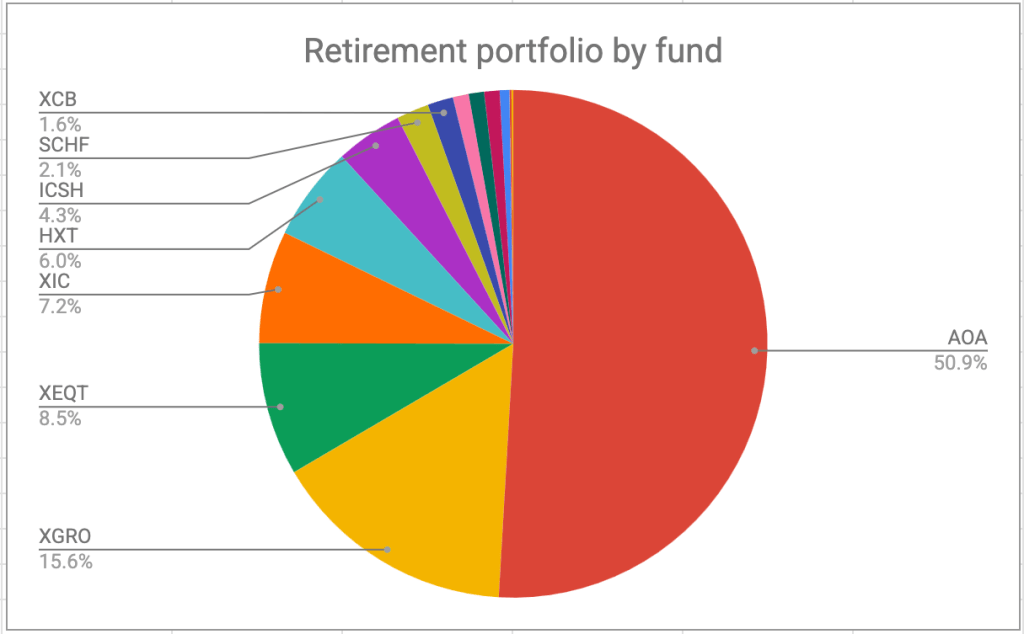
I pay myself monthly in retirement, so that’s a good trigger to update this post. On February 28, this is what it looks like:
The portfolio is dominated by my ETF all-stars, (and if not an all-star, they are probably on the Magnificent Seven ETFs list) but if you’ve been following along, you’ll see a few changes.
I dropped XAW since I realized I didn’t need it if I was smarter the ratios of holdings I already owned (XEQT/XIC/XCB). Less is more.
I sold XIC instead of HXT in my non-registered account this month to help pay the bills because I reasoned that eliminating its dividend payouts would be better from a tax perspective2.
Plan for the next month
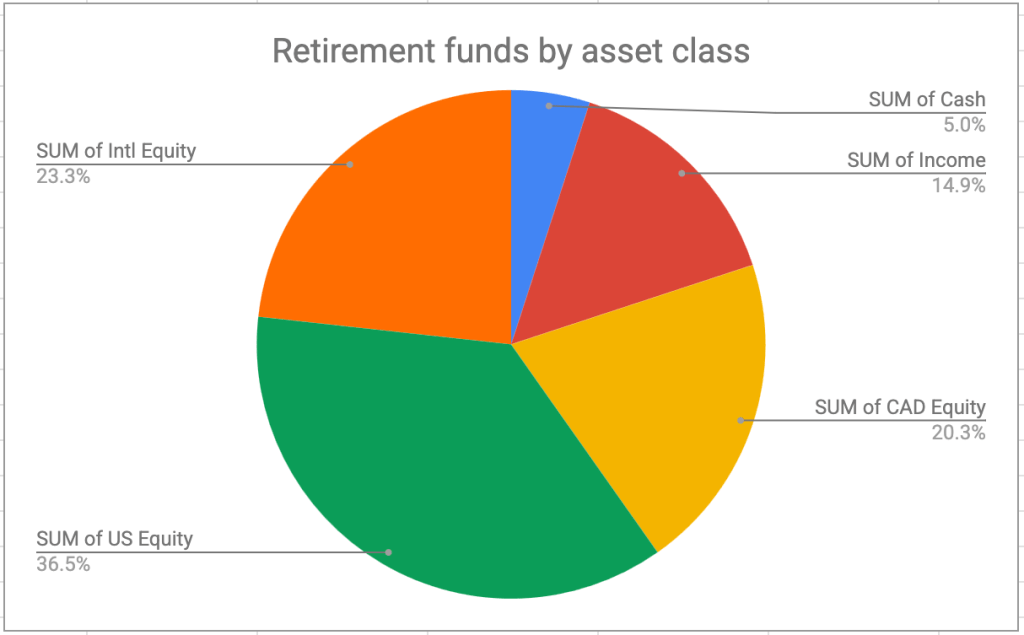
The asset-class split looks like this; you can read about my asset-allocation approach to investing over here.
It’s looking pretty close to the targets I have, which are unchanged:
5% cash or cash-like holdings like ICSH and ZMMK
15% bonds3 (most are buried in XGRO and AOA, rest are in XCB)
20% Canadian equity (mostly based on ETFs that mirror the S&P/TSX — HXT and XIC)
36% US equity (dominated by ETFs that mirror the S&P 500)
24% International equity (mostly, but not exclusively, developed markets)
I am mulling over making a small tweak to these percentages, increasing US equity exposure at the expense of International equity based on some calculations I’ve done4 but this is neither urgent nor will it be massively impactful to the overall picture.
Overall
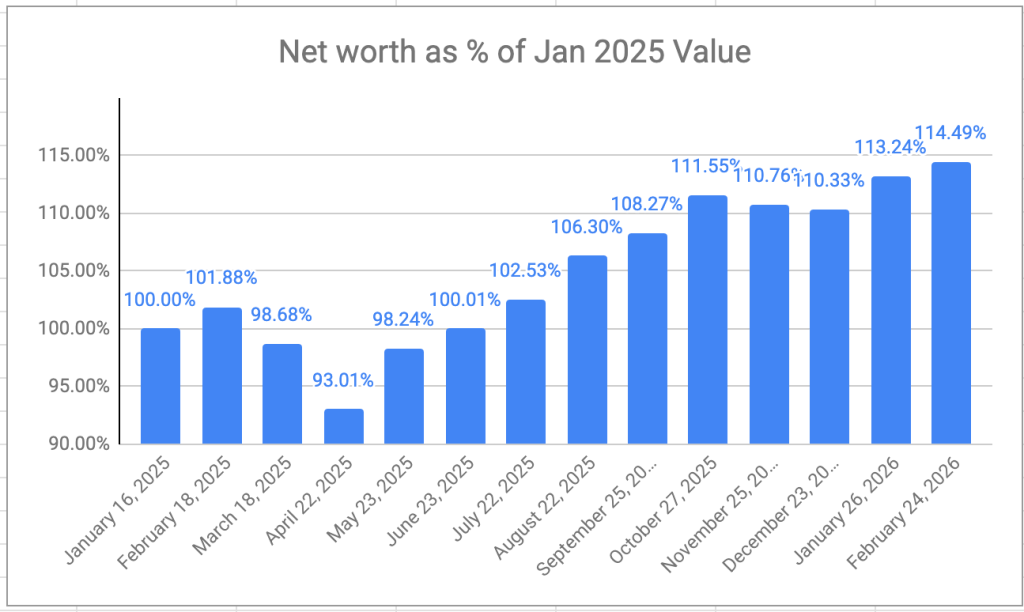
There is a bit of an anomaly this month that I should mention. A number of readers have questioned my wisdom of contributing monthly to a TFSA in retirement. From a tax-free growth perspective, it would be far better to make the contribution at the beginning of the year. And many studies have shown that lump sum investing provides better returns than spacing them out. And so, I have taken their advice5 and made all my TFSA contributions for the year this month. And since my TFSA is part of my net worth, there’s a bump being caused by that contribution.
And so, net worth overall is up month over month, a two month winning streak.
One spousal, one individual. One at Wealthsimple because (a) I like their user experience and may consider them as my primary broker in the future and (b) they offered me free money and a laptop to move some fees their way. I can be bought. ↩︎
HXT does not pay dividends and instead uses swap contracts to convert them into capital gains, which receive better tax treatment for me ↩︎
DIY investors include a growing number of RRIF holders (like me). If you want a primer on RRIFs, you can read that here. There are some strange nuances involved with moving RRIFs between brokers which may not be obvious and are not documented anywhere — or if they are, I have yet to find where.
I’ve covered parts of this topic before, (here and here) but this post attempts to summarize the weirdness so you don’t get caught unaware. It is my belief that the cautions outlined below are applicable to ALL brokers, but happy to learn otherwise, just drop me a line at comments@moneyengineer.ca, I read all my mail.
For simplicity, I’m going to refer to the “sending” broker (the broker that currently manages the RRIF) and the “receiving” broker (the broker to whom you’re transferring those same assets).
Caution 1: A sending broker cannot transfer a RRIF unless it has fully paid out RRIF minimum for that year.
As RRIF aficionados will know, at the end of the calendar year, a new “RRIF minimum” amount is calculated by the broker based on the market value of the RRIF at that time and the age of either the RRIF owner or the spouse of the RRIF owner. This is a well-known fact. What is perhaps not so well known is that the broker who holds the RRIF at the start of the year is obligated to pay out the full amount of the RRIF minimum, even if that RRIF is transferred in the course of the year1.
This has implications, especially if you attempt the transfer early in a calendar year:
You are going to end up with “extra” cash that you weren’t expecting. You’ll have to be prepared to do something with that money, but what? Leave it as cash? Invest it in a HISA? Invest it in an all-in-one?
This early windfall also means that your potential tax-free growth2 is lost.
Caution 2: Waiting past end of November to initiate a RRIF transfer runs the risk of tying up your RRIF funds for multiple months
“Fine”, you think, “if I wait until late in the year to transfer my RRIF, I can avoid the problems inherent in Caution 1”. This is what I thought, too. I was, again, wrong.
There seems to be an industry-wide pause on RRIF transfers that starts in late November and lasts until January of the following year. I’ve seen more than one mention of it. Questrade’s message when I attempted to transfer-in my RRIF to them was
“Please be advised that RRIF/LIF account transfers are subject to the industry-wide cut-off date, November 28, 2025. This cut-off date is not specific to Questrade, but is arranged and agreed upon by all Canadian financial institutions to ensure yearly payments are made in an orderly and timely manner to all account holders.”
It appears I got extremely unlucky: the transfer STARTED before November 28th, but failed to fully complete before the deadline. Performing a transfer is a multi-step process using a service called “ATON”34. You can read all about how ATON works over here.
In my case, it took until mid-February for the transfer to complete. During that time, the account was in limbo, and no payments could be made. For someone who expects to be paid monthly from a RRIF, this was a bit of a problem.
Advice: Initiate RRIF transfers before November 1.
This ought to give enough time for the transfer to complete before the cut-off date. And minimizes the amount and time you have “extra” money floating around. You can help make sure your transfer goes as expected:
Make sure the assets you hold are supported at both institutions. GICs are a frequent problem. So are bank-backed HISAs. If you hold assets like that, do yourself a favour and sell them before you initiate the transfer so that they are just cash.
If you hold fractional shares in your account5, get rid of them by selling off the fractions or buy more so that you have whole shares. From what I’ve read, fractional shares are a construct that is broker-specific and will cause issues when you attempt to transfer them.
Make sure you have enough cash in your RRIF so that the sending broker can pay out your RRIF minimum before the transfer begins.
Happy investing. If a transfer really goes astray, it looks like OBSI can help.
Since the average gains of the market are positive, I’m always going to make the assumption that it’s better to be invested than not. You could of course get lucky and avoid a big market downturn because your RRIF cashed early, but that’s not how I think about investing. Time in the market is always better than timing the market, per Ken Fisher↩︎
I’ve had the dubious privilege of serving as the executor of the estate of my late mother, who was predeceased by my father. I’ve been documenting my journey along the way (previous instalment here).
This instalment is subtitled “Endgame” because late last week I received a Clearance Certificate from CRA. The Clearance Certificate allows me as the executor to distribute the funds in the estate to the beneficiaries without worrying that the CRA will come knocking on my door at some future date looking for taxes1.
So now it is time to move money around from estate to beneficiaries, close accounts and shred the piles of paper in the filing cabinet. Money exists in three places: a CIBC bank account (not an estate account), a CIBC estate account, and in a BMO Investorline estate account.
CIBC Bank Account
Thanks to the advice of a friend who went through this before me, I had a joint chequing account with my mother. It was her account, and I never touched it, but when she died, the account became mine completely, no different than the other chequing account I hold at CIBC. This arrangement proved very handy in the early days of the estate, as I was able to pay funeral expenses out of this account without being out of pocket myself. The balance was low here, and a few e-Transfers to the beneficiaries later, the funds were cleared. A call to CIBC telephone banking (a surprisingly painless experience), and this account was closed from the comfort of my couch.
BMO Investorline
The vast majority of the estate funds are held at BMO Investorline, since I was acting as my parents’ DIY advisor for about 10 years. When my mother died, her RRIF and TFSA passed to her beneficiaries outside of the probate process (you’ve done this, right? Read more here). Her non-registered funds were converted into a brand new estate account and all the assets were transferred in kind. I could not access this account until I had a probated will. With full access, I eventually converted all the holdings into non-interest bearing cash; all that happened over a year ago (December 2024, to be exact). The account has been largely dormant since then, although I did pay the whopping tax bill for my mother’s Final Return2 from it.
Moving the funds out of BMO Investorline couldn’t be easier; thanks to their AccountLink service, you can write cheques against the cash balance held in your non-registered Investorline account. They do charge $1 for each transaction after the first 2 in any calendar month, so I have to make sure I leave enough cash behind to deal with that3.
CIBC Estate Account
Estate accounts are required to deposit cheques made out to the estate. One possible source of such a payment is CRA4, the other is death benefits from CPP/QPP and/or life insurance policies. My experience with the creation and management of a CIBC estate account was a total disaster. Something that should be relatively straightforward is inexplicably very labour intensive. The reasons are probably only knowable to CIBC, but I’ll give my perspective here:
The workflow has not been updated in decades. Opening an estate account required me to make an appointment at the bank. At this appointment, I sat in a chair in an office while I watched the bank employee type my information into some sort of online form. My involvement at this meeting was limited to producing a death certificate and repeating answers to questions that the bank already had in their systems (my name/address etc etc).
The branch employees do not understand how estate accounts work and they rely on a centrally located help desk to guide them through the process. I know this because the branch employee inadvertently gave me the number to this help desk and the very helpful employee I spoke to there was confused that a customer rather than a branch was calling.
There are no electronic records, no electronic access to estate accounts. Deposit a cheque? Visit the bank. Want the balance? Visit the bank. It’s all very circa 1970.
And, lastly, for all this, they have the gall to charge a $5 monthly service fee for “record keeping”.
Anyway, I am guessing that all the major banks are terrible with estates, but it’s hard to imagine a worse experience than with CIBC.
So, to close this account, I need an appointment (of course). The soonest one I could get at my local branch was a week away. I’ve compiled all the materials needed to unlock the funds (probated will, death certificate, blood sample) so I’m hoping this is a “one and done” kind of visit, but I’m not holding my breath on that one.
What’s especially annoying about the estate account is that it has a relatively small amount of money in it, growing smaller monthly thanks to the monthly service fee.
But this chapter is nearly over. Make no mistake, serving as an executor is a lot of work and requires a lot of patience.
RRIFs and non-registered accounts generate a lot of tax since they are assumed to be sold and converted to income in the hands of the account holder on the day of death. It’s nearly unavoidable, but I wrote a bit about reducing that tax bomb here. ↩︎
I can only imagine how much work it would be should I end up needing to clear a negative balance in a BMO Investorline Estate account. I wouldn’t know where to begin, ↩︎
In my case, the estate tax return had a refund. Not really sure why, one would have presumed that paying thousands of dollars to an accountant would result in a penny-perfect return, but you’d evidently be wrong about that. ↩︎
This was the title of a recent webinar I attended via PWL. You can watch it yourself over here: https://www.youtube.com/watch?v=pQl6n4zepys. I don’t think I learned a ton from it — the short answer? “It depends”. “On what?”, you may ask. Here’s some things that influence the answer to the question:
It depends on HOW you live.
Put another way, “what’s your budget in retirement1“? This is a question that many people don’t have an answer to. There’s a few buckets to think about, it’s not intended to be exhaustive:
Medical expenses (drugs, dentists, optometrists, physiotherapy)
Entertainment (eating out, shows, memberships/user fees)
Travel (transport, housing, activities)
Charities
One thing you don’t have to worry about is setting aside money for an RRSP, since once you’re retired, that’s no longer a thing. But don’t neglect the need for a savings fund for unexpected larger expenses. We always keep a “house fund” that gets a monthly payment that we don’t touch for anything other than home renovations or repairs.
Your bank/credit card4 statements5 might be a good place to see what your typical spending looks like.
It depends on where you live
Live in Toronto? Vancouver? Yeah, that’s not cheap. But if you were willing to move to, say, Thailand or a low cost Canadian city, you might be able to spend a lot less on housing. But since most people aren’t willing to uproot, these costs are known, or can at least be reasonably estimated. And if you’re staying put, then will you downsize? When?
It depends on whether you have a pension outside of CPP/OAS
And I’d add, “and it depends if that pension is indexed to inflation”. (The CPP and OAS are, which is why they are great).
It depends on how long you’re going to live
Not predictable, obviously. The oft-cited “4% rule” of retirement assumes a 30 year retirement. That’s living until age 95 if you retire at the “usual” age of 65. When I engaged a financial advisor in the lead-up to retirement, the charts stopped at age 95 as well.
It depends on whether you want to leave an estate to your beneficiaries
Want to die with nothing6? Then you need less money than if you want to leave assets behind. It’s a pretty fundamental question. And if you want to leave assets behind, then how much? And to who? (You do have an up to date will, right?)
It depends on what your CPP and OAS payments are likely to look like
CPP is dependent on how long you’ve been contributing to the plan, up to a maximum that is published annually7. You can take CPP as early as age 60, and as late as age 70, with penalities/bonuses accumulating every month. CPP needs to be applied for before the cheques start rolling in.
OAS is dependent on how long you’ve lived in the country. If you’ve lived here for 40 years or more, then you qualify for the maximum payment of $742.31 at age 65 and automatically starts at age 658 (for most people) unless you specifically ask for it to be deferred.
It depends on how much income you’re intending to make in retirement
The CPP isn’t designed to pay a living wage9. For this reason, many people “ease” into retirement by working part-time or on short-term contracts. This income impacts the answer to the original question — obviously, if you are earning money, then the retirement nest egg can be smaller.
It depends on what your retirement assets are invested in
This, in my view, is frequently overlooked. The fact is that retirement can be quite long, and assets invested in a retirement portfolio still have growth potential. My retirement assets are 80% equities, 15% bonds, 5% cash. This provides me with more growth potential at the risk of having to weather periods of market volatility. I’m comfortable with that degree of risk, but others may not be. Having a lower exposure to equities means your nest egg needs to be bigger.
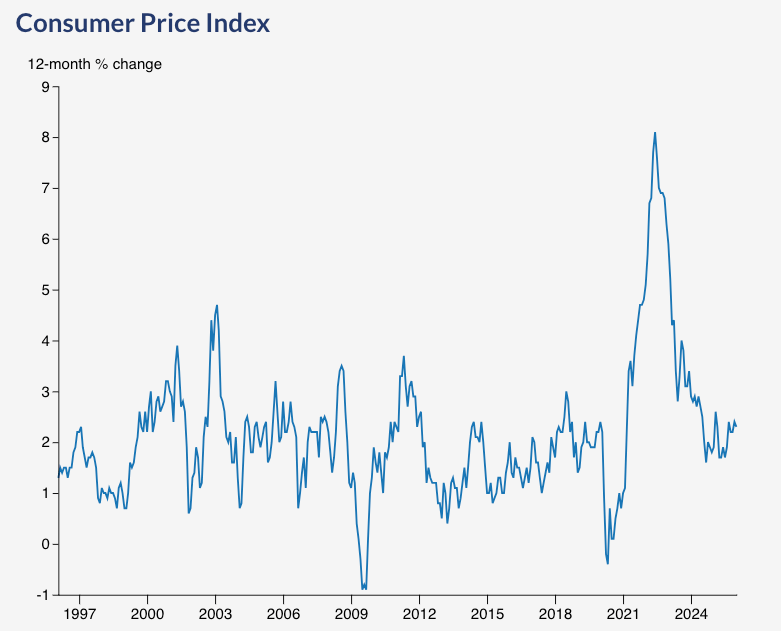
It depends on future inflation
Inflation can fluctuate a lot over the course of retirement. Take the last 30 years as an example:
Inflation is really the biggest concern in my retirement since most of my current income is not inflation-protected10.
My approach? Knowledge and a willingness to be flexible
What kind of knowledge?
I had a sense of what my budget desires were
I knew my retirement portfolio was going to stay 80% equities
I knew I had no pensions outside of CPP/OAS. With advice from my advisor, this lead to the current plan to defer these pensions to age 70 so I can maximize my inflation-protected income.
My advisor advised me that I had enough saved up that I could retire
But I gained additional, non-data-driven knowledge:
that market returns are highly variable12, that inflation is highly variable, that my personal spending budget is highly variable
that I have always, always, always, adapted to life changes (income, expenses) by either being looser or tighter with money.
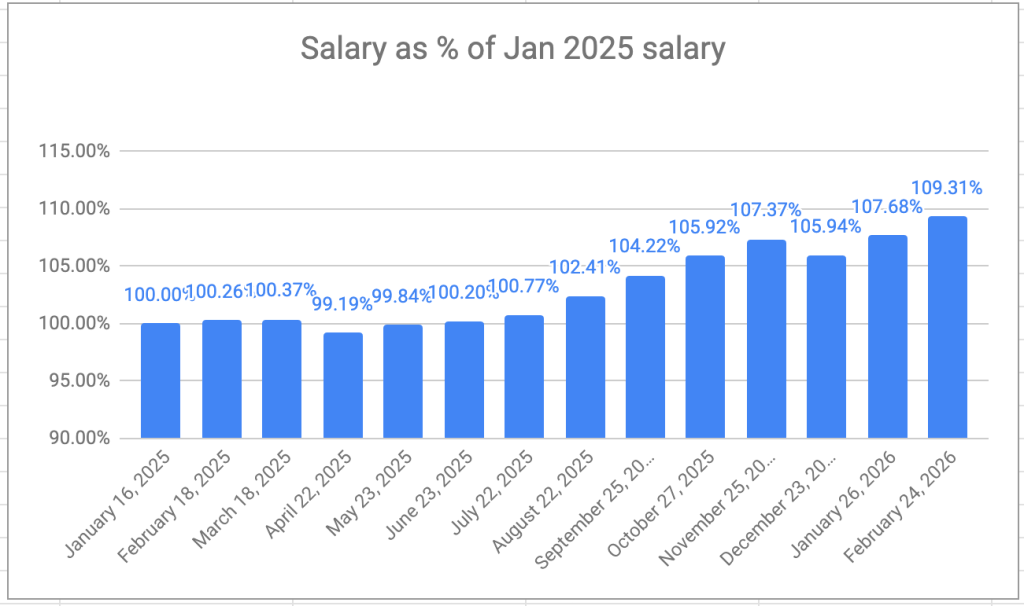
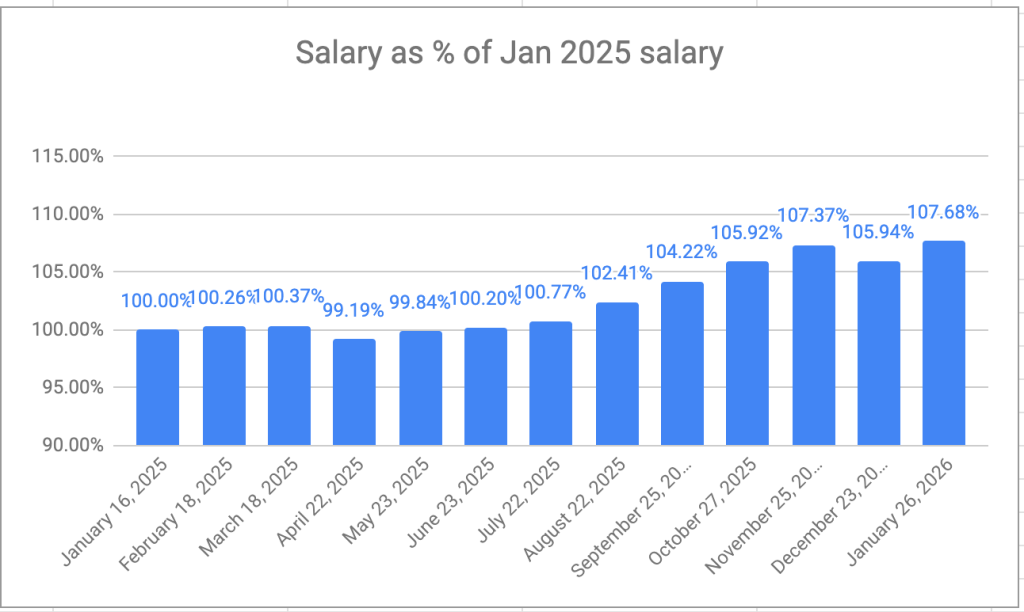
The decumulation strategy I use (VPW, Variable Percentage Withdrawal, talked about here) is deceptively simple, but requires you to be flexible, as your monthly calculated salary is based on your net worth. My salary has generally ticked upwards in the past 12 months, but it could just as easily turn in the other direction in the event of a sustained market downturn. I’ve decided I can live with that. And if you want to see a much longer test in action, check out longinvest’s VPW forward test at https://tinyurl.com/vpwForwardTest.
My final thoughts: be suspicious of a specific answer to “how much do you need to retire”? It depends on so many factors, including your own propensity to adapt to changing conditions, that a simple answer doesn’t seem possible — or reasonable.
And does it change over time? I expect my budget needs are higher now than they will be in the future, when presumably I’m less able/willing to travel. ↩︎
Doing this with 100% accuracy would imply you know the date of your own demise, so probably not a realistic objective ↩︎
And is currently $1507.65/month if you’re 65 this year. ↩︎
This one thing I did learn from the PWL webinar: that for most of us, unless you take action, the OAS will start when you turn 65. ↩︎
Per the CPP website (emphasis mine): “The Canada Pension Plan (CPP) retirement pension is a monthly, taxable benefit that replaces part of your income when you retire” ↩︎
Owning equities is a sort of imperfect inflation hedge since equity prices, like all prices, are influenced by it. ↩︎
I’m reminded of the famous quote by Mike Tyson: “Everyone has a plan until they get punched in the mouth” ↩︎
One year after paying for my retirement plan that informed me I was still three years from retirement, I retired. Why? My retirement savings had blown past “the number” I was advised to hit. And, after a year of retirement, my net worth is 10% higher than when I started retirement. The market sometimes works in your favour. ↩︎






 The Money Engineer