Reduce Travel Costs by Paying Attention to Foreign Exchange

Travel is something I like doing. Spending money on seeing new places, trying new things, all good from my perspective. But spending unnecessary money to line the pockets of a bank? I’m not so good with that.

For many years, I’ve used my credit card everywhere, in every country. Very convenient. I recall my first big trip abroad (circa 1992) where my main source of money was Travelers Cheques, if you can believe it. (Looks like they aren’t even available in Canada anymore).

But I never realized how much this habit was costing me. From https://www.cibc.com/en/personal-banking/credit-cards/articles/foreign-currency-credit-card.html:

It’s common for a credit card company to charge a foreign currency conversion fee between 1% and 3% of the transaction amount.

What’s especially sneaky, and the reason I never gave it much thought, is that the fee is buried in the exchange rate that is posted as part of the transaction. As a result, it’s easy to miss how much you’re giving to the bank.

Now, 1% to 3% extra for a cup of coffee or a taxi ride isn’t going to break the bank, but for a multi-night stay in a hotel? Show tickets? Car rentals? It can start to add up.

Here are two products that I use to help get rid of those fees. There are others out there, but these I have used myself and can recommend them.

Wealthsimple’s Cash Card

I’ve been rather curious about Wealthsimple for a while now. I started with using their “pay what you want” tax service and saw it got a mention from the Globe and Mail’s Rob Carrick (an excellent resource, by the way) which led me to investigate further. This is NOT their “beta” Wealthsimple Infinite Visa credit card that is coming out in 2025.

From https://www.wealthsimple.com/en-ca/spend:

Now you can feel like a local while shopping abroad. With no additional foreign transaction or ATM fees from Wealthsimple, your Cash card is a must-have travel companion.

The Cash Card, as far as a vendor is concerned, looks like a MasterCard. But to you, the card holder, the Cash Card looks like a debit card. Any transaction charged to the Cash Card is instantly debited, so you have to have the money available in your Weathsimple account before you go on a shopping spree.

Signing up for the Cash Card was done online, in minutes. Putting money on your Cash Card can be done using Interac e-transfer from your “usual” bank account, and is available pretty much instantly as well. Cash Card supports Apple Pay and as a nice bonus, also provides you with a “virtual card” accessible from the Wealthsimple app so you can enter credit card details for online purchases. You can also order up a physical card, but I’m still waiting for mine….The Canada Post strike apparently is still being used as an excuse in that regard. (Not a big deal, I rarely use a physical card anymore).

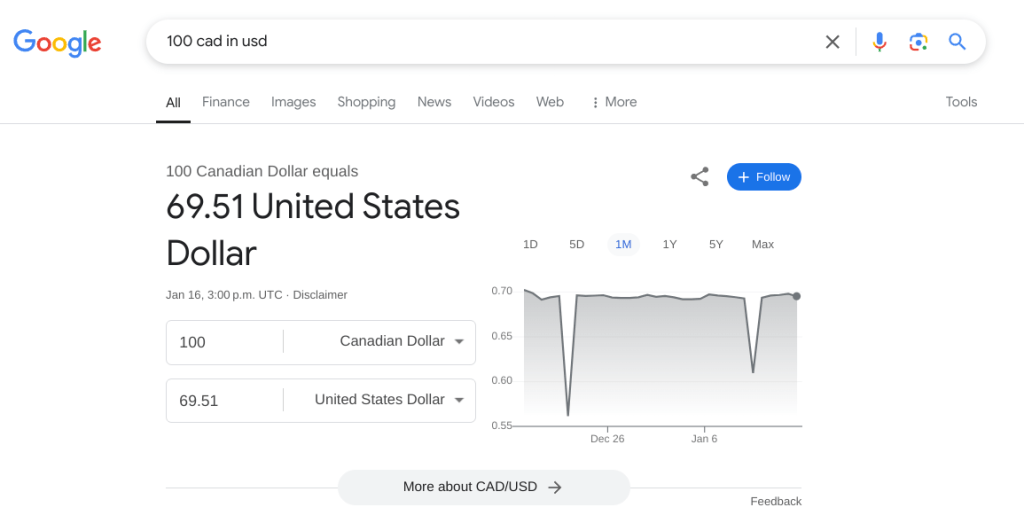
I’ve now successfully used the Cash Card for US dollar and British pound purchases, and the rate I got was exactly the same as the rate I saw in real time from Google (cries quietly at the current exchange rate):
  • Pro: Very easy to set up, does what it says — no extra foreign exchange fees
  • Pro: Supports multiple foreign currencies, with only a few exceptions.
  • Pro: It’s free, and the money in your Cash account actually earns a bit of interest.
  • Con: You have to have the money available up front, it’s not a credit card that you can pay later.

CIBC’s US Dollar Aventura Gold Visa Card + CIBC US Dollar Savings Account

If instead you’re looking for a REAL credit card and you’re only interested in US dollar transactions, then CIBC’s US Dollar Aventura Gold Visa might be a choice. I signed up for this card because a lot of my retirement funds are in US Dollars, I travel and shop in US Dollars pretty regularly, and I happen to bank with CIBC which also makes things easier.

However, unless you already have a US Dollar bank account that can pay off your US Dollar credit card, you’ll need to set that up at the same time. So for that I used the CIBC US Dollar Savings account. This should not be confused with CIBC’s US checking account which isn’t required (I have this account too, but have very limited use for it).

So, applying for these products is the typical Canadian bank experience. Multiple days, multiple forms, mildly unpleasant, but as a self-directed investor, not unusual, either.

The Visa card has an annual fee ($35, which includes up to 3 additional cards) and allows you to collect a small amount of Aventura points which can be redeemed for cash or gift cards. The card supports Apple Pay and generally works like any other card you may have used. Just make sure you don’t accidentally use it for a Canadian dollar transaction or else you’ll get charged that extra conversion fee that you were trying to avoid in the first place.

The savings account pays a paltry amount of interest (0.05% for balances under $10,000 USD) and charges $0.75 USD for every transaction. So, nothing to write home about there. But it is in essence a Canadian bank account in every way; this means (for example) it can be set up as a legitimate bank account with your online broker.

  • Pro: if you’re already banking with CIBC, both the credit card and the savings account are linked to your existing CIBC bank card, so you can see everything from one login.
  • Pro: Related to the above, you can set up auto payment of your USD credit card from your USD savings account
  • Pro: Related to the above, you can easily move money from your Canadian accounts to your US accounts. Of course, with this convenience comes the added foreign exchange fee that you were hoping to avoid, but if you’re short US Dollars, then it’s an option. (In another post, I’ll talk about how I convert US dollars cheaply).
  • Pro: It’s a real credit card, meaning you can defer payment.
  • Con: Compared with Wealthsimple, it’s somewhat painful to set up
  • Con: it’s only useful for US dollar transactions

For most people, the Wealthsimple Cash Card is the easy way to save money on foreign transactions, and the downside is small. If you have access to US dollars (maybe you’re paid in USD, or like me, have investments in USD), then perhaps the CIBC Aventura card might make sense, too.

Thanks, Wealthy Barber

My investment journey started a long time ago, when I somehow got myself a copy of The Wealthy Barber. I can no longer recall the specific lessons I picked up from that bestseller, save one:

“Pay Yourself First”.

It’s a really simple tenet that reminds me that the only person funding my retirement is me. If you fail to pay yourself first, “future you” will pay the price. It doesn’t have to be a lot, but it does have to be a regular and prioritized occurrence.

One way to prioritize saving is to make it automatic. Every paycheque, carve off a fixed amount to redirect to your firewalled retirement account. At the beginning, maybe that’s just a savings account, but it could just as well be an online broker, as long as that broker is helping you by paying you interest on the money you’ve saved.

As time went on, I came to realize that paying myself first also meant NOT paying advisor fees for my managed retirement portfolio and instead investing that money in future me. It was, at the time, a bit of a scary decision, but one that I do not regret at all.

I was reminded of this very influential book because I discovered you can download the updated version, “The Wealthy Barber Returns” for free from RBC Direct Investing. Do check it out! https://www.rbcdirectinvesting.com/_assets-custom/includes/wealthy_barber.pdf

What’s in my retirement portfolio?

So what’s in my retirement portfolio these days? A fair question. My portfolio is 100% in ETFs excepting the cash position. For historical reasons, a lot of my retirement savings are in US dollars. As as result, you’ll see ETFs listed here that trade on the US stock exchange, in US dollars. It’s not an approach I’d recommend for most people as it adds a lot of complexity to the mechanics of moving money around, which is really what decumulation boils down to!

The pie

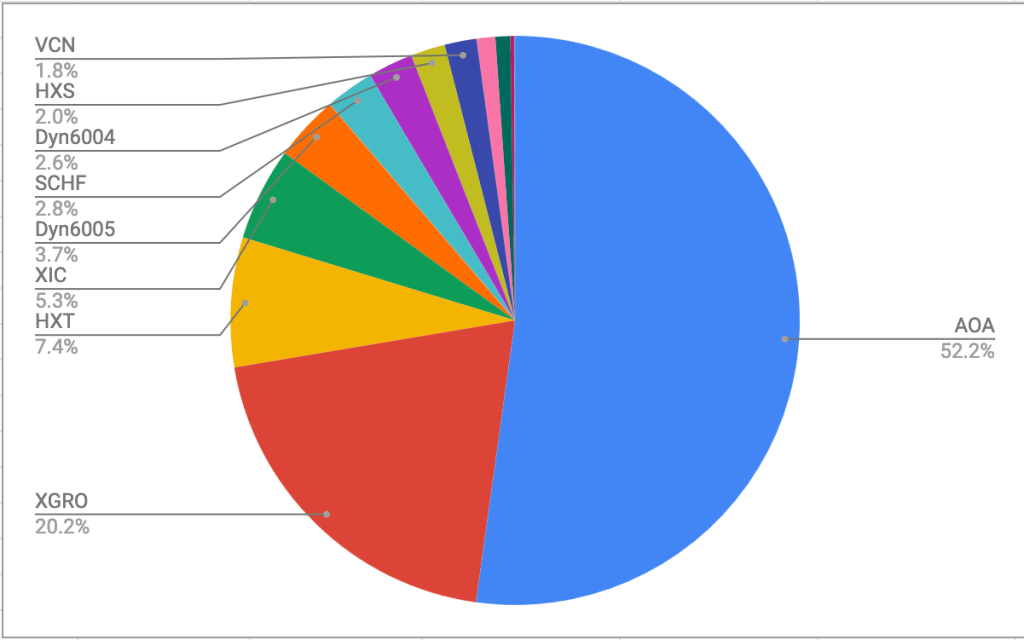
The chart shown below is the summary of all my accounts: personal and spousal RRIFs in CAD and USD, TFSAs for me and my spouse, and non-registered accounts in USD and CAD. It comes pretty close to my target of 80/15/5: 80% equity, 15% bonds, 5% cash. Let’s visit how that comes about.

Summary of funds held in my retirement portfolio

What’s in the pie?

AOA: This is what I call an “All-in-one” ETF that trades on the US stock exchange. It’s an 80/20 fund, 80% equity, 20% bonds. Its US weighting is pretty high, its Canadian weighting is pretty small (about 2.4% by my calculation).

XGRO: This is the Canadian sibling of AOA. An “all-in-one” ETF that trades on the Canadian stock exchange. It’s also an 80/20 fund, with a much stronger tilt to the Canadian equity market.

HXT: Is a fund that I only hold in my non-registered account. Through behind-the-scenes accounting and swap contracts, it provides no-dividend access to the S&P/TSX 60. This is useful from a tax perspective if you’re still earning a salary since it effectively defers any tax impact until you sell shares.

XIC: A variant of the S&P/TSX 60 that caps the contribution of any one company to prevent the “Nortel effect” seen in the late 1990s. I’ve been too lazy to clean this out of the account.

DYN6004/DYN6005: Are Scotiabank HISAs in Canadian and US funds (High Interest Savings Accounts). On my provider’s trading platform, they look like mutual funds, but are just savings accounts that pay a decent interest rate, monthly. They have consistently provided the best rates of all the HISAs available on my provider’s platform.

SCHF: A very low cost equity fund that trades in USD. It provides exposure to international developed markets except the USA. It has about 8.5% weighting for the Canadian equity market. I used to have this in my registered accounts, but dropped it in favor of AOA. It’s still in my non-registered accounts so I don’t have to take an unnecessary capital gain.

HXS: The sibling of HXT, but it covers US markets. Only held in non-registered accounts.

VCN: Provides broad exposure to the Canadian market including smaller companies.

In an ideal world, my portfolio would just hold AOA/DYN6005 for US funds and XGRO/DYN6004 in Canadian funds. Eventually, as I decumulate my holdings, that’s what it will look like. Simple is best.

So why is my portfolio not aligned with my ideal model? Three main reasons:

  • Some of the “extraneous” holdings are in my non-registered accounts and I don’t want to incur a capital gain just to make the portfolio simpler.
  • I want a little bit more Canadian market exposure since I do live and spend money here.
  • No pressing need to. The splits between Canada/US/International equities are fine where they are. I try to trade only when necessary.

I’ll revisit this post from time to time as I go through decumulation to see how it evolves. Prior to hitting the button on retirement, I had a lot more ETFs in the list, basically attempting to build the equivalent of XGRO and AOA through other ETFs. For a small cost, (roughly 0.15%) AOA and XGRO rebalance their holdings quarterly so I can just let them run on autopilot, confident that they will always be close to my desired 80/20 splits. That’s why these two ETFs make up the lion’s share of my retirement portfolio.

My rules for retirement investing

I provide some rules here to help you understand some of my own biases. They may not align with yours. But at least you know where I’m coming from.

Retirement investments are distinct from savings and day-to-day expenses

I have always maintained a firewall between investments and all other money. “Investments” for me always meant “money to be accessed only in retirement”. Whether that money was in an RRSP, TFSA or non-registered account made little difference. I never mixed the two. My rationale was that by keeping things separate, I made it much more difficult to “borrow” from retirement to fund today’s expenses. And it allowed me to take on the appropriate level of risk in my long-term investments, which helped boost my returns in the long run. I had another rainy-day cache of money to deal with unexpected expenses, and this money had to be absolutely liquid (no GICs, for example). My long term investments were always in place for “future me”.

More return requires more risk which requires holding more of your investments in stocks (aka “equities”)

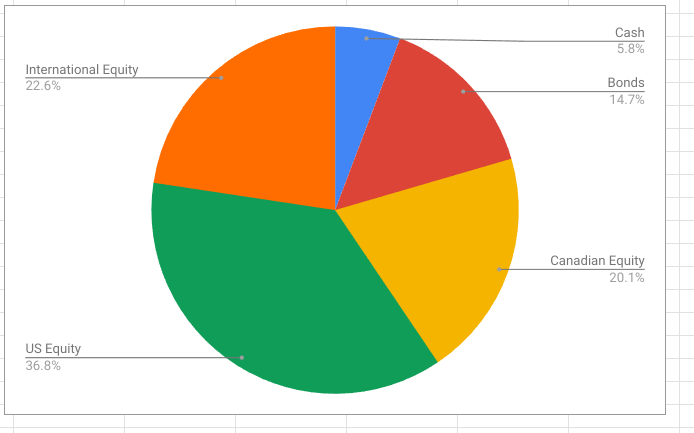
If you want more return on your investments, you have to take on more risk. “Risk” doesn’t (or shouldn’t) mean “my money may go to zero” (that’s called “gambling”), but it does mean that in a given short-term period (one quarter, one year, three years) your money may not grow or even shrink. I have always maintained an 80/20 portfolio — 80% equity, 20% bonds. As I neared retirement, I moved to 80% equity, 15% bonds, 5% cash. Here’s my portfolio in real time (love Google Sheets for this).

Portfolio breakdown
The 80/15/5 portfolio, with breakdowns of Canadian, US, and International Equity Shown

Diversification helps mitigate risk

I don’t pick stocks. I only buy indices. You can certainly build a great portfolio at rock-bottom prices by buying individual stocks but I’m too lazy to do the necessary research. I’ve always spread my investment equity in different markets: Canada, USA, International. You can do this all through ETFs purchased on the Canadian stock market. Did I say “ETFs”? You can actually buy the 80/20 (or 60/40…or 40/60) portfolio in exactly ONE (1) ETF. More on that in a future post.

Dividends are nice, but total return is what really matters

I think a lot of the literature out there focuses on dividend stocks because they generate income. I think this is seen as attractive because many people can’t bear the thought of selling their holdings to pay the hydro bill. (“I want to just live off my dividends”). And while you can certainly be successful by buying into dividend stocks exclusively, I think you can miss out on maximizing the total return of your portfolio this way. And you may end up with a larger-than-intended estate when you die. The overall yield of my portfolio is somewhere around 2.5%, which is pretty paltry, but the total return is much higher.

Demystifying ETFs

I’ve built my investments using Exchange Traded Funds (ETFs). In years before ETFs were commonplace, I invested in mutual funds instead. But why have I used ETFs?

Attribute 1: They are easy to buy and sell.

They list on the stock markets, meaning that buying and selling (should be) easy and cheap.

Attribute 2: They are portable.

Because they list on stock markets, you can buy them using any self-directed investment platform. Whether it’s one of the bank’s platforms (e.g. CIBC’s Investor’s Edge, BMO’s Investorline) or one of the independents (e.g. Questrade, QTrade, Wealthsimple), it shouldn’t matter who you do business with.

Attribute 3: ETFs offer a passive, inexpensive way to invest in an index.

As stated elsewhere, I am not a stock-picker, and I don’t worry about sector analysis. I buy, and I hold. A “passive” ETF is one that simply follows the makeup of a given stock index. Some of the more common indicies you’ll come across are the TSX 60 (for Canadian stocks), the S&P 500 (for US stocks) and MSCI EAFE (for everywhere else). The easiest way to judge the priciness of a given ETF is to look for the MER, which is the “Management Expense Ratio”. Canadian passive index ETFs should be at or below 0.20% MER, meaning that they should cost you less than 2 dollars for every thousand dollars you have invested, per year.

But not all ETFs are created equal.

As the ETF market has exploded, companies have launched all manner of kooky ETF products that adhere to attributes 1 and 2, but break attribute 3. They are typically not passive (and have highly paid money managers pulling levers behind the scenes), not cheap (because of the money managers, pay attention to the MERs). So the blanket statement “ETFs good, mutual funds bad” is not universally true.

Many ETFs copy each other.

A quick google search for “TSX 60 ETF” reveals a bunch of ETFs, that, on the face of it, all look to track the S&P/TSX60 index.

  • Blackrock’s iShares XIU
  • BMO’s ZIU
  • GlobalX HXT (this one is quite different1 from the other two from a tax perspective, but otherwise, it mirrors the makeup of the other two).

Picking one ETF over the other may be a matter of seeing if your provider treats them differently. For instance, my provider (QTrade) allows HXT to be bought and sold at no fee. Not so for XIU/ZIU. On the other hand, BMO Investorline clients can buy/sell ZIU at no charge. Avoiding unnecessary fees, no matter how small, is an ongoing hobby.

ETFs: The simple, portable, inexpensive way to build a diversified portfolio at a risk level that’s appropriate to you

ETFs are what I have used to build my retirement portfolio at an average cost of around 0.2% of the overall value. A typical financial advisor will charge 5 to 10 times as much. For me, that math doesn’t work.

  1. This is a gross simplification, to be sure. I’ve used HXT in my non-registered accounts because of its unique tax treatment, but don’t use it elsewhere. ↩︎