
Comparing asset-allocation ETFs: what’s the right allocation?

I’ve talked about my approach to investing before, which is slavishly devoted to maintaining a constant asset allocation across all my accounts. And as I’ve mentioned, my current targets are:

  • 20% is Canadian Equity, 36% is US Equity, and 24% is International Equity, for a total of 80% equity overall
  • 15% bonds
  • 5% cash

My allocation targets were picked to align with XGRO1, which, over time, will make up more and more of my retirement portfolio2.

As I’ve written elsewhere, these are pretty broad categories and could be sub-divided further. I’ve not bothered with this myself, but I thought it would be an interesting exercise to survey what the major all-equity and high-growth funds have under the hood. And so, I present this comparison:
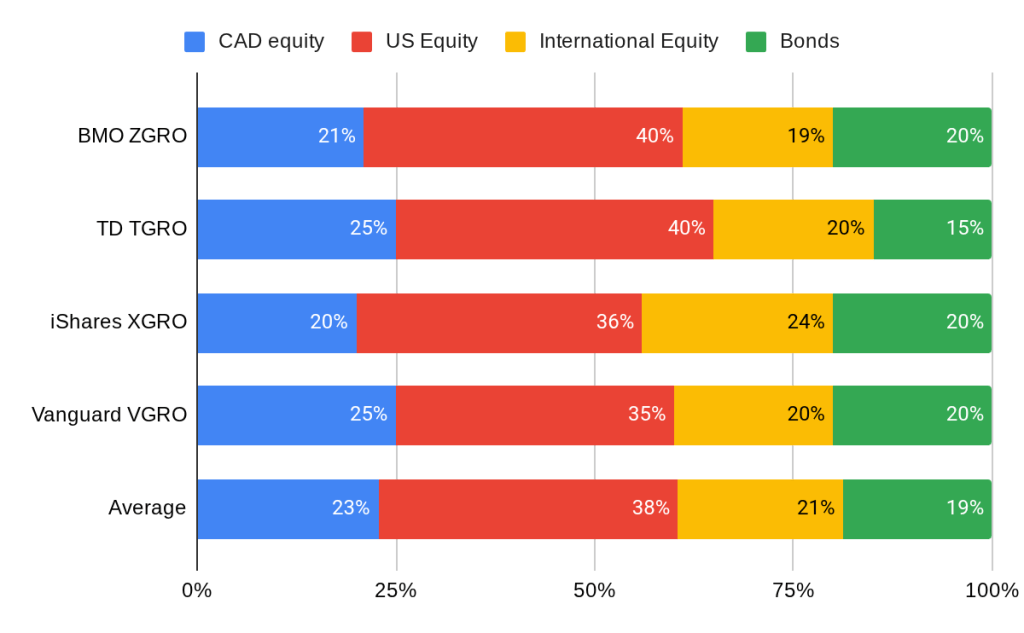
A few notes on the above:

  • Canadian Equity: Some use an all-cap index (TGRO, VGRO) while some use a capped composite index (ZGRO, XGRO).
  • US Equity: VGRO and XGRO use an all-cap index, TGRO sticks to large cap, and ZGRO holds large, mid and small cap indices. TGRO is a bit of an outlier because it doesn’t hold small cap..
  • International Equity: TGRO takes an all countries approach, whereas the other three split between developed and emerging markets. Net effect is pretty much the same thing.
  • Bonds: Here you find the greatest variation; VGRO is the only ETF to hold bonds outside of North America whereas TGRO holds only Canadian bonds. XGRO and ZGRO are pretty similar, with XGRO having a bit more Canadian bond exposure over ZGRO.

The most notable difference between my allocations and the average allocation of the big 4 funds is that I have more international exposure than other funds, and that’s because I’ve chosen to hitch my wagon to the iShares/XGRO family.

The reason? I started investing in the iShares family some time ago because it was the family that my old provider (QTrade) allowed me to trade without fees. With my current provider (Questrade), all of the families are free to trade, and hence my continued devotion to iShares/XGRO no longer holds that attraction — I could buy any of the all-in-ones. (Indeed, I’ve actually been adding some TD all-in-ones because their management fees are a bit lower).

But this exercise has given me food for thought; perhaps I have a bit too much bias to the international equity portion of the portfolio. But honestly, I can’t believe it makes that much of a difference, and churning my portfolio simply to reduce my international exposure a point or two seems unnecessary3.

  1. Why XGRO and not an all-in-one from another company? Read on. ↩︎
  2. I’m slowly converting my main holding (AOA, which trades in USD) to XGRO on a quarterly basis so that I’m never over exposed to foreign exchange variations. I convert a percentage of these holdings annually, corresponding to the percentage at which I’m draining my RRIF. ↩︎
  3. Running some numbers through https://www.dividendchannel.com/drip-returns-calculator/ demonstrates that XGRO is the bottom of the performance pile over the past 5 years or so as compared to TGRO, ZGRO and VGRO. The difference isn’t massive, and the window is short because these funds haven’t been around all that long, but it’s another data point to consider…p.s. the tool above doesn’t (yet?) understand the 3 for 1 reverse split ZGRO undertook in August, so best to end any simulation involving the BMO funds at August 1,2025. ↩︎

Dealing with Drift in Asset Allocation ETFs

I rely a lot on asset-allocation ETFs in my retirement portfolio, mostly XGRO in the CAD side of the portfolio and AOA on the USD side1. These ETFs (about 70% of my overall retirement portfolio, as you can see here), like all asset-allocation ETFs, rebalance their holdings periodically in order to stick to their asset allocation targets. This aligns perfectly with my way of investing; I’ve always tried to stick to my asset allocation targets portfolio-wide, assisted by tools like my multi-asset tracker spreadsheet. (If you aren’t familiar with asset-allocation as an investment strategy, you could give this article a read.)

XGRO’s asset allocation targets are written right in the prospectus2:

  • 80% Equity, with 36% US equity, 20% Canadian Equity, 20% International Developed Market Equity, 4% Emerging Market Equity.
  • 20% Bonds, 16% being held in Canadian bonds. The other 4% are designated “non-Canadian” but seems like it’s always US bonds.

Anyway, XGRO’s approach to making changes to the portfolio in order to maintain this target percentage is written in the prospectus too:

XGRO’s portfolio will be monitored relative to the asset class target weights and will be rebalanced back to asset class target weights from time to time …XGRO’s portfolio is not expected to deviate from the asset class target weights by more than one-tenth of the target weight for a given asset class

Page 419 of the iShares Prospectus (June 2025)

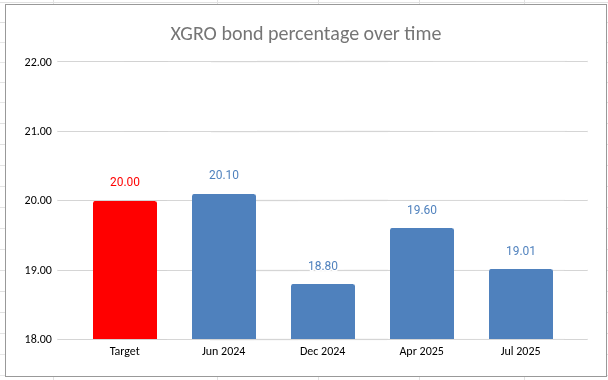
Now “from time to time” isn’t terribly precise. I thought I’d take a closer look at the history of XGRO’s asset allocations. So I dug through annual and semi-annual reports as well as the website. I focused on the Fixed Income (aka Bond) proportion of XGRO over time because that’s the asset class that’s most likely to drift lower3…equities typically outperform fixed income historically. So this is what I found:

So there is a bit of drift in the fixed income portion of XGRO, but in the past year I haven’t seen it off by more than 1.2%, meaning that the promise made in XGRO’s prospectus is being adhered to.4

Turning now to AOA, the fixed income proportion is clearly stated to be 20%, and rebalancing is stated to happen twice annually, in April and October. After that, things become a bit harder to work out56. The various equity contributions are determined by the target index, namely the S&P Target Risk Aggressive Index, which are constructed by using market capitalization of the various indices used7.

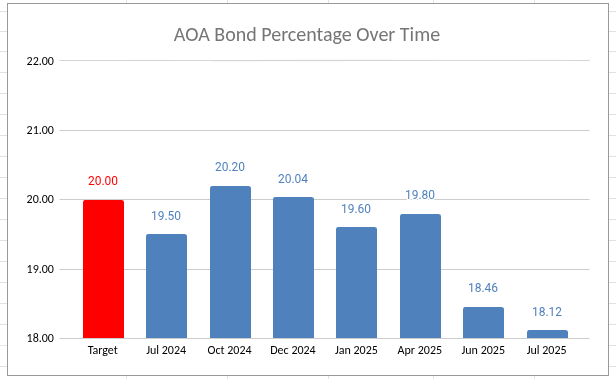
Anyway, like XGRO, what I’m most concerned about is the fixed income portion of AOA, and digging through the various reports, I came up with this:

Of late, the fixed income portion AOA has become small, almost 2% lower than it should be. And given that AOA is about 50% of my holdings, it means that my equity exposure is quite a bit higher than I would let it drift myself.

I suppose the next rebalancing in October 2025 will correct this, but I admit it makes me a little uneasy to see that sort of volatility in the asset allocation8. I could of course just sell some AOA and reinvest it in some bond fund (AOA uses IUSB and IAGG, which seem like fine choices) but then I’m just working around the asset allocation strategy I’m paying for in AOA’s management fees, which seems dumb. Not to mention that anything I do now will almost certainly have to be undone come October.

So I guess this all means I should just let sleeping dogs lie. I have minor bits of money to reinvest every month (I still contribute to my TFSAs) so using those funds to buy bonds are probably what I’ll do. It’s a tiny pre-correction that should be addressed come October…or by the next equity meltdown.

  1. And both are on my “ETF all-stars” page ↩︎
  2. And since detailed targets are clearly stated, these are the percentages I assume for XGRO in my multi-asset tracker spreadsheet. I could continually update the percentages since they calculated daily on XGRO’s page, but it seems like busywork. ↩︎
  3. My retirement decumulation strategy (VPW) relies on knowing what my asset allocation is, too ↩︎
  4. It does mean, however, that my equity exposure Is higher than I thought. ↩︎
  5. Well, or maybe I’m just not that smart — I’m not really sure if one can calculate the market caps needed to work out the allocations. ↩︎
  6. And unlike XGRO, I actually do track (from time to time) the underlying allocations of AOA so that my multi-asset tracker reflects reality. It was through my most recent update that I discovered that the bond portion of AOA was a lot lower than it had been. ↩︎
  7. Namely the S&P500, the S&P MidCap 400, the S&P SmallCap 600, the S&P Developed Ex-U.S. BMI, and the S&P Emerging BMI ↩︎
  8. It’s still within the stated drift that XGRO tolerates, however. So maybe I’m overthinking this. ↩︎

My rules for retirement investing

I provide some rules here to help you understand some of my own biases. They may not align with yours. But at least you know where I’m coming from.

Retirement investments are distinct from savings and day-to-day expenses

I have always maintained a firewall between investments and all other money. “Investments” for me always meant “money to be accessed only in retirement”. Whether that money was in an RRSP, TFSA or non-registered account made little difference. I never mixed the two. My rationale was that by keeping things separate, I made it much more difficult to “borrow” from retirement to fund today’s expenses. And it allowed me to take on the appropriate level of risk in my long-term investments, which helped boost my returns in the long run. I had another rainy-day cache of money to deal with unexpected expenses, and this money had to be absolutely liquid (no GICs, for example). My long term investments were always in place for “future me”.

More return requires more risk which requires holding more of your investments in stocks (aka “equities”)

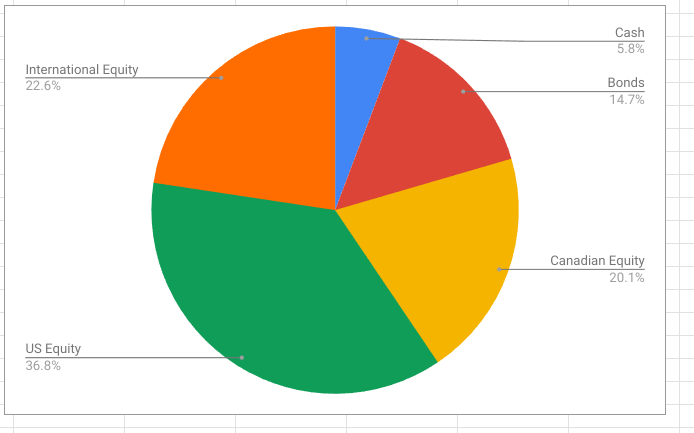
If you want more return on your investments, you have to take on more risk. “Risk” doesn’t (or shouldn’t) mean “my money may go to zero” (that’s called “gambling”), but it does mean that in a given short-term period (one quarter, one year, three years) your money may not grow or even shrink. I have always maintained an 80/20 portfolio — 80% equity, 20% bonds. As I neared retirement, I moved to 80% equity, 15% bonds, 5% cash. Here’s my portfolio in real time (love Google Sheets for this).

Portfolio breakdown
The 80/15/5 portfolio, with breakdowns of Canadian, US, and International Equity Shown

Diversification helps mitigate risk

I don’t pick stocks. I only buy indices. You can certainly build a great portfolio at rock-bottom prices by buying individual stocks but I’m too lazy to do the necessary research. I’ve always spread my investment equity in different markets: Canada, USA, International. You can do this all through ETFs purchased on the Canadian stock market. Did I say “ETFs”? You can actually buy the 80/20 (or 60/40…or 40/60) portfolio in exactly ONE (1) ETF. More on that in a future post.

Dividends are nice, but total return is what really matters

I think a lot of the literature out there focuses on dividend stocks because they generate income. I think this is seen as attractive because many people can’t bear the thought of selling their holdings to pay the hydro bill. (“I want to just live off my dividends”). And while you can certainly be successful by buying into dividend stocks exclusively, I think you can miss out on maximizing the total return of your portfolio this way. And you may end up with a larger-than-intended estate when you die. The overall yield of my portfolio is somewhere around 2.5%, which is pretty paltry, but the total return is much higher.