
News: BMO reduces fees on all-in-one ETFs

Summary: BMO has reduced fees on its family of asset-allocation ETFs (ZCON, ZBAL, ZGRO, ZEQT) to put its Management Expense Ratio (MER) in the same realm as competing families from GlobalX, iShares and TD.

If you’re a fan of all-in-one ETFs (as I am)1, then there is a new low-cost competitor2 to consider in BMO. BMO announced a reduction in their fees last week, and per Rob Carrick, it’s a win for everyone concerned. If you’re new to the idea of all-in-one ETFs (aka asset allocation ETFs), here’s a good place to start: https://moneyengineer.ca/2025/01/21/why-you-can-fire-your-advisor-asset-allocation-etfs/.

It’s probably worth taking a quick scan of the four lowest-cost families out there. Here’s the overview.

ProviderFund Symbols
TD3TEQT, TGRO,TBAL,TCON
BMO4ZEQT, ZGRO, ZBAL, ZCON
GlobalX5HEQT, HGRW, HBAL, HCON
iShares6XEQT, XGRO, XBAL, XCNS, XINC
Low-cost all-in-one ETF providers, and the symbols you can use to buy them

In my view, any of these families are worthy of your investment dollars. Which particular fund you pick within a family depends on your tolerance for volatility and/or your timeline for needing the money you’re investing. Each list of fund symbols in the table above is listed in order of amount of equity — so for TD, you can see that TEQT has the most equity (100%) whereas TCON has the least (40%). You might want to give https://moneyengineer.ca/2025/05/06/investment-basics-asset-allocation/ a read to get more familiar with the concepts.

  1. XGRO and XEQT are both members of the coveted “ETF All Stars” slot. ↩︎
  2. There are other all-in-one families (Vanguard, Fidelity, Mackenzie), the ones shown here are the least expensive of the lot at 0.20% MER or less. TD is the current winner of the lot with a rock-bottom 0.17% MER. ↩︎
  3. TEQT launched in April 2025. ↩︎
  4. There’s also an ESG asset allocation fund, ZESG. ↩︎
  5. There’s also a bunch of covered call variations that are of no interest to me. ↩︎
  6. iShares is the family I work within. I started with them over the others because they could be traded for free on my former provider (QTrade). My current provider (Questrade) allows free trading for any ETF. ↩︎

Investment basics: Asset Allocation

We’ve talked about asset allocation / asset classes before in this space, most recently here. But while watching a recent post1 from one of my favourite experts, The Loonie Doctor2, it occurred to me that it might be helpful to start right from the beginning.

And to me, that beginning is understanding WHAT to invest in. Broadly speaking, you can choose between three categories: “Equity”, “Bonds” and “Cash”.

“Equity” refers to stocks of publicly traded3 companies. Owning stock means you own a piece of the company you invest in. This allows you to collect dividends if and when the company pays them out. If the company fails/goes bankrupt, the stock becomes worthless.

“Bonds” are essentially loans to companies or governments4. When you buy a bond, you’re buying into a stream of interest payments that stop when the bond is paid off. If a company who issued the bond fails/goes bankrupt, bond holders legally get first dibs on whatever assets remain in an effort to get their money back, but it’s possible that there isn’t anything left to fight over. Bonds can be fully paid off in various timeframes, from very short (30 days) to very long (20 years).

Cash” is the money that’s left. Cash can be invested in things like high interest savings accounts, GICs/Term Deposits, Treasury bills (aka T-Bills), or stuffed under a mattress5. There is definitely a grey area between “Cash” and “Bonds” since both involve lending money to an entity. Shorter duration loans are more cash like. Lending to governments and large corporate entities (like banks, which is what you’re doing when you buy a GIC) is more cash-like. Money under a mattress is absolutely cash, albeit not really an investment at that point.

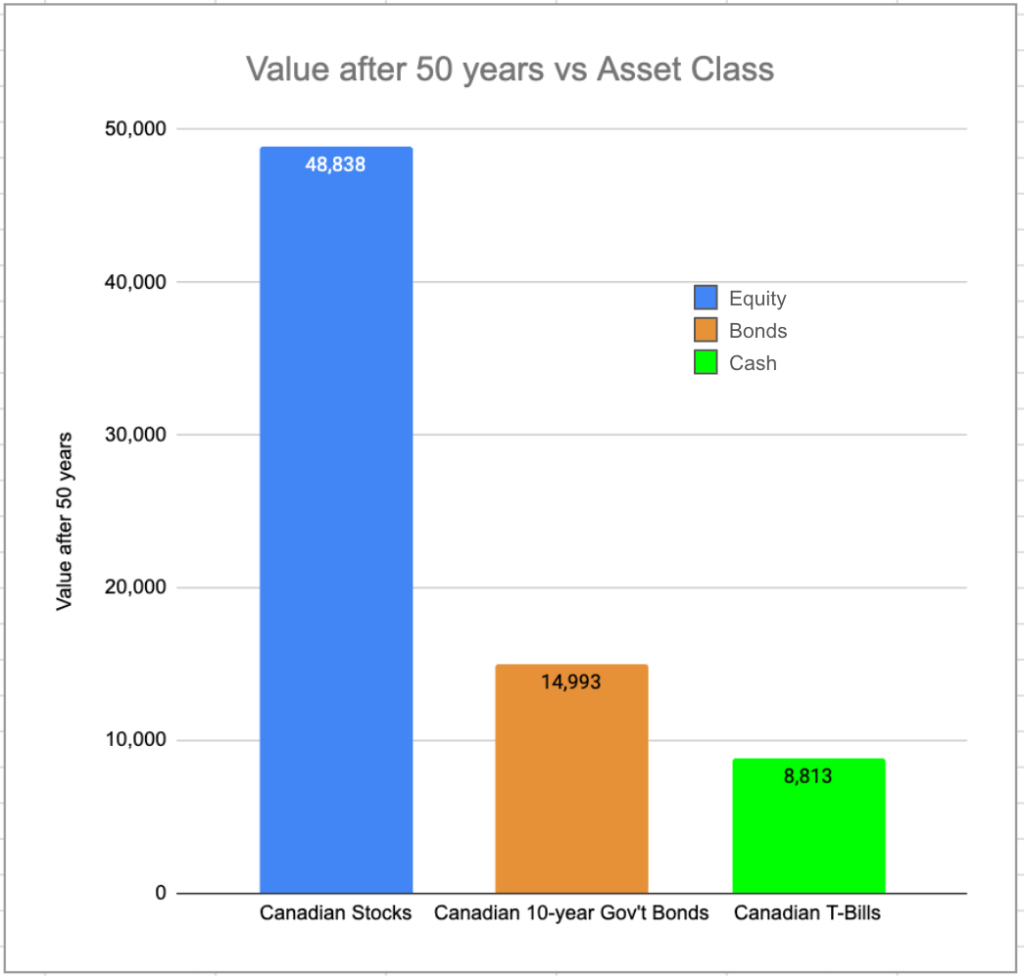
Using the data tabulated here, you can build a chart like the one below to see how much the $1000 investment you made in each of these categories would be worth 50 years later6.

The chart shows that Equities outperform Bonds and Cash by a wide margin when looking at an investment time period of 50 years. Bonds also outperform Cash substantially.
Historical returns for Canadian equities, bonds, and cash (as of December 2024)

Looking at this chart, it should be reasonably obvious that equities, represented here by Canadian Stocks, over time, generate the best bang for your invested buck. The “over time” phrase is very important, because otherwise, one could rightly ask, “why would anyone ever invest in anything other than stocks?”. The reason is volatility — in any given short time period, your returns could look very, very bad indeed. Just one example (of many) — the TSX has LOST money in 3 of the last 10 calendar years per https://en.wikipedia.org/wiki/S%26P/TSX_Composite_Index.

Bonds, generally speaking7, have a much steadier and predictable return, often uncorrelated with stocks. When stocks go up, bonds often move in the opposite direction. And cash, well, its benchmark is the inflation rate. If cash is returning the inflation rate8, then at least you’re standing still.

In my investment portfolio, my target allocations are 80% Equity, 15% Bonds, 5% Cash. Using products like all-in-one ETFs and my handy-dandy multi-asset tracker spreadsheet make this relatively easy to track. In my next post, I’ll show how to identify ETFs in each of the categories.

  1. Which provides further justification that using all-in-one ETFs is really the best approach. ↩︎
  2. Which, while positioning itself as being for doctors, has a ton of useful information for those of us who are not physicians as well. ↩︎
  3. And of course it is possible to buy stock in private companies (so-called private equity) but since I don’t know very much about that world, I figured I’d keep it simple and just talk about things that are available to the general public. ↩︎
  4. And the financial stability of those companies and governments can vary a lot. That’s where bond rating services can point you to higher quality entities (with a low risk of not paying) or lower quality entities (with a higher risk of not paying, but a better interest rate — the bottom of the barrel here are called “junk bonds”). ↩︎
  5. AKA “the chequing account of most major banks”, which don’t pay any interest ↩︎
  6. For “Canadian Stocks” this is the TSX Composite index (former name: TSE 300). “Canadian Bonds” is 10 year Government Bonds. ↩︎
  7. Let’s forget 2021-2 ever happened to the bond market. ↩︎
  8. And it doesn’t always do so! ↩︎

The Money Engineer now on YouTube

Early on when I first launched this blog, one of my friends suggested that video content would be ideal for the topics I wanted to cover. “I’m a visual learner” was her pitch1. I did hesitate because I wasn’t sure what I would post there.

But the hesitation is over, and I’ve launched a YouTube channel which you can find in the top menu (“Videos”) or you can go to it directly: https://www.youtube.com/@MoneyEngineerCA.

The first video2 is a quick intro to the Multi-Asset Tracker, a Google Sheets template that’s based on my personal spreadsheet that I’ve developed over the years.

Today’s video is a quick look at BlackRock’s family of asset-allocation ETFs (XEQT, XGRO, XBAL, XCNS and XINC) and what makes the members of the family different.

My philosophy is to keep the videos short with no window dressing. There’s no big intro, no sponsor plugs3, no big plea to “Like and Subscribe”, and no theme music. We get going right from the opening frame. I reserve the right to jazz things up later, but with 2 views thus far I’m not too worried about going viral anytime soon.

If you have thoughts/comments/ideas about the videos, feel free to drop me a line at comments@moneyengineer.ca.

  1. Although I do love an elegant diagram or chart, as my kids will tell you, I have very little patience for a 3 minute YouTube video telling me how to change a setting on my iPhone. ↩︎
  2. Recorded on April 1st, but it’s no joke ↩︎
  3. At least, none coming from me — YouTube ad insertion is not something I can control, at least as far as I can figure out. ↩︎