Summary: High Interest Savings Accounts (HISAs) are a way for cash to earn half-decent, risk-free interest. These “Series F” HISAs are likely available through your online broker, but you may have to ask how to get at them, exactly.
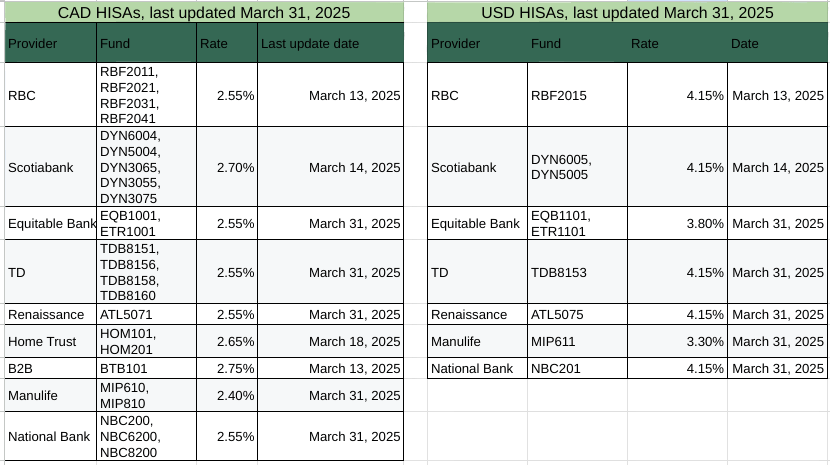
On March 12, the Bank of Canada reduced their overnight rates by another 0.25%.1 Unsurprisingly, this had a knock-on effect to the interest rates provided by the series F HISAs I track.
Equally unsurprisingly is that the US Federal Reserve didn’t touch their rates, and as a result, there were no changes in the HISA rates paid out for USD accounts. Here’s the full breakdown:
Current HISA rates for HISAs available via QTrade
There’s also a Google Sheets version with a bit more detail (source links) if you prefer.
For those of you who hold US cash in your brokerage accounts, you can benefit from the much higher US interest rates, and you have multiple choices since multiple providers are paying the same rate.
You can also say “25 basis points” if you want to impress your friends ↩︎
Since my new DIY broker (Questrade) does not support the purchase of high interest savings accounts (HISAs), I need to find a free-to-trade alternative. 5% of my retirement portfolio is invested in what is characterized as “cash”, but I expect that money to earn some sort of return with essentially zero risk. (Another 15% of my portfolio is in the bond market, which, as we all learned in the last few years, has its downsides1.)
Questrade (like Wealthsimple) offers free trades of all ETFs. So it makes sense for me to go looking for ETFs that invest in safe havens. Here’s what I turned up for investments in Canadian dollars, based on some Google searches and some reading of similar questions posted in the public domain. Not all of them are what I would call “equivalent” to a HISA.
“high-quality money market instruments issued by governments and corporations in Canada, including treasury bills, bankers’ acceptances, and commercial paper.
0.13%
3.6%
Not a HISA but a very short term bond fund3. 31% of holdings have due dates of less than 30 days.
CAD ETF Candidates for investing Canadian dollars
Based on this quick analysis, ZMMK looks pretty attractive — a lot of very short term (and hence safer) debt as compared to MCAD, excellent returns. It is clearly a riskier investment than something like CASH or HISA. Between CASH and HISA I lean to smaller MERs every time, so CASH wins. CBIL might be a sort of happy middle ground…a T-Bill ought to be as good as a bank. All of these ETFs have a pretty stable NAV, either $50 or $100 per unit, so there should be little to worry about in terms of capital gains.
“primarily in high interest U.S. dollar deposit accounts with Canadian banks…not currently expected to make any regular distributions”
0.2%
n/a
Global X “corporate class” ETFs convert interest payments into capital gains. This sort of ETF makes sense in a non-registered account to minimize taxes.
“primarily invests in high-interest U.S. dollar deposit accounts, which provide a higher interest rate than a traditional USD savings account.”
0.16%
4.08%
HISA-like, based on term deposits
USD ETF Candidates for investing USdollars
ICSH is the clear winner in terms of return, but, like ZMMK, a little riskier than a simple bank account. It has a nice broad portfolio (363 individual holdings) which makes it feel safer. HISU looks like the straight-up HISA replacement.
Take the latest monthly distribution, divide by the unit price, multiply by 12. If BoC holds their interest rates steady for the year, you could expect to achieve this rate for the next year. As of March 3, 2025. ↩︎
“Commerical paper” refers to very short term debts, 30 days average maturity. Like a credit card debt, maybe. ↩︎
US based funds like this one report a “30 day SEC yield”, it represents “interest earned after deducting the fund’s expenses during the most recent 30-day period by the average investor in the fund”. ↩︎
Summary: High Interest Savings Accounts (HISAs) are a way for cash to earn half-decent, risk-free interest. These “Series F” HISAs are likely available through your online broker, but you may have to ask how to get at them, exactly.
The high interest savings account (HISA1) is a different animal than the bank accounts offered by the likes of Simplii, Tangerine, EQ, or Wealthsimple2. The bank accounts are more intended for very short term savings for day to day use. They frequently offer attractive promotional rates for new clients. And while these are all good ways to earn a few extra bucks on cash in your account, it’s not the focus here.
The HISAs I’m talking about are usually only offered via a broker, and many of the DIY brokers3 allow you to purchase the so-called “Series F” version of these, which do not have any hidden trailer fees. They are “special” bank accounts insured by CDIC4 that pay rates that are tied to the overnight rates. When those change, expect the HISA rates to follow suit.
There was a mini-explosion in ETFs that invested in HISAs: CASH and HISA are two examples5. I never bothered with these since they weren’t free to trade on QTrade and trading costs would be a significant drag on the ROI.
Part of my investment philosophy is to have 5% of my overall holdings in cash (as for the rest, it’s 15% in bonds, 80% in Equity). And so I’m quite motivated to have some sort of real return6 from my cash position since it is a measurable part of my net worth.
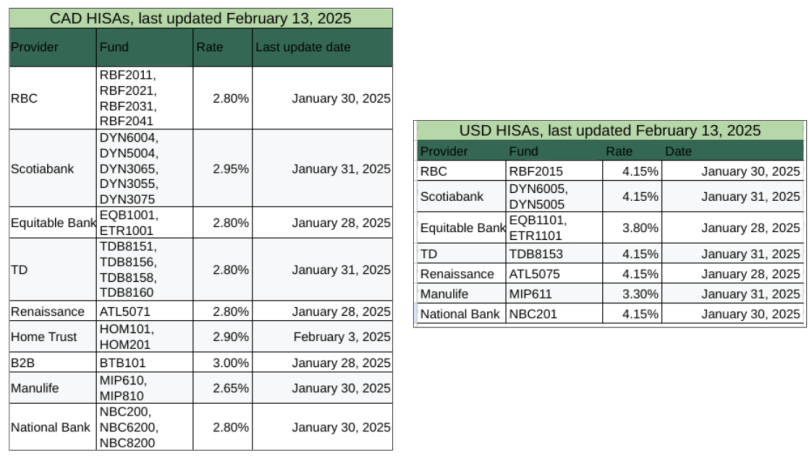
So I do pay attention to the ups and downs of the HISA rates. And I figured I’d share them with you:
Current HISA rates for HISAs available via QTrade
There’s also a Google Sheets version with a bit more detail (source links) if you prefer.
Hopefully most of the fields are self-explanatory. The “fund” column shows the identifier you would need to use to actually trade the HISA on your trading platform. How to access it will vary by provider. QTrade hides their HISAs in the “Mutual Fund” tab which is incorrect; these are not mutual funds, but are often modeled that way in the DIY platforms.
For those of you who hold US cash in your brokerage accounts, you can benefit from the much higher US interest rates8, and you have multiple choices since multiple providers are paying the same rate.
Before taking the leap and trading in HISAs, I was surprised by how they were handled on QTrade. There were a few differences possibly specific to QTrade, but pay attention to how your provider handles HISA trades:
QTrade considers holdings in HISAs part of your cash position for the purposes of buying stocks and ETFs9. If you successfully complete a trade that exceeds your ACTUAL cash position (i.e. cash NOT in the HISA) you will also have to sell the correct amount of your HISA to get rid of the negative cash balance in your account and avoid interest fees
HISA trades are not tracked in the “orders” tab of QTrade10 so be careful that you don’t inadvertently trade the same thing twice
QTrade limits all HISA purchases to $1000 minimum; there are no restrictions on sales, and there are no fees for either buying or selling HISAs.
Does your DIY broker give you access to other funds? Let me know about them at comments@moneyengineer.ca!
An aside about the image chosen for this post…I pronounce the acronym HISA….and it’s on a TABLE, get it? ↩︎
Looking at these websites, I may have to consider breaking up with CIBC for my day to day banking… ↩︎
QTrade and iTrade definitely allow you to purchase these. Wealthsimple and BMO Investorline do not. Wealthsimple as a matter of course offers pretty competitive rates for any cash floating around in your account, especially if you have over $500k with them. BMO Investorline has high interest savings too, but you access to their product only (BMT104). ↩︎
My personal bias is that I don’t much pay attention to CDIC-insured or not. I figure if major Canadian banks start failing, I had better make like Survivorman, because no insurance is going to save me. Perhaps that’s naive. ↩︎
That’s return above the current inflation rate. Hiding money under a pillow would typically earn a negative real return, equal in magnitude to the current inflation rate. ↩︎
All my cash holdings are in DYN6004 or DYN6005. ↩︎
US Fed has not been as aggressive in cutting interest rates as compared to Bank of Canada. ↩︎
Since I don’t have a margin account, if I try to buy something I don’t have the money for, I’m normally strongly discouraged from doing so with a clear warning. ↩︎
BMO Investorline is the king of confusing handling of cash positions in your account. ↩︎




 The Money Engineer