What’s the deal with XEQT?

***updated this post to reflect the fact that XEQT has dropped XUS from its portfolio as of July 2, 2025***

This post is inspired by my original on the topic, “What’s the deal with XGRO“? XGRO is great, but since my target asset allocation is only 15% bonds, and XGRO’s bond target is 20%, there’s some tweaking I have to do in order to reduce the bond exposure. That tweak is increasingly being provided by XEQT, part of the same iShares family that produced XGRO.

(As mentioned elsewhere, I rely heavily on all-in-one ETFs in my retirement portolio. New to all-in-ones? Read a bit about them here.)

XEQT, like XGRO, is actually investing in thousands1 of different stocks. Unlike XGRO, it does not hold any bonds at all. I thought it would be interesting to see what, exactly, is underneath every $100 you invest in XEQT. See the results below:

FundWhat is it?How much?Compare with XGRO23
ITOT/ XTOT4Broad US stock coverage that tracks the S&P Total Market Index, about 2529 companies (top holdings: Apple, Nvidia, Microsoft, Amazon, Meta)$43.62 of your $100 investment$36.32 of your $100 investment
XEFBroad international (Europe, Asia, Australia) stock coverage that tracks the MSCI EAFE Investable Market Index, about 2500 holdings$25.25 of your $100 investment
$19.76 of your $100 investment
XICBroad Canadian stock coverage that tracks the S&P/TSX Capped Composite Index, about 223 companies (top holdings: RBC, Shopify, TD, Enbridge, Brookfield)$25.71 of your $100 investment
$20.09 of your $100 investment
XEC3000+ emerging market stocks that track the MSCI Emerging Markets Investable Market Index$5.04 of your $100 investment$4.07 of your $100 investment

The top 10 stocks of XEQT as of today looks like this:

TickerCompanyInvestment for every $100
NVDANvidia$2.99
MSFTMicrosoft$2.70
AAPLApple$2.26
RYRoyal Bank$1.67
AMZNAmazon$1.54
SHOPShopify$1.35
TDTD Bank$1.15
METAMeta$1.09
AVGOBroadcom$0.96
ENBEnbridge$0.88
Total$16.59
Top 10 holdings of XEQT as of July 25, 20255

The top stock holding outside North America belongs to Taiwan Semiconductor, at 46 cents for every $100 invested. Additionally, the geographic exposure looks like this:

Geographic exposure of XEQT as of July 25, 2025

One other little tidbit that might be interesting: the distribution yield of XEQT is 2.94% compared with 2.91% for XGRO. This I find a bit surprising, since I would have expected XGRO’s yield to be quite a bit better.

  1. 8,550 to be precise, as of today ↩︎
  2. As of today, might be different from when I wrote https://moneyengineer.ca/2025/01/30/whats-the-deal-with-xgro/ ↩︎
  3. And, if you’re really paying attention, you’ll see that the dollar amounts of this column add up to roughly $80, in keeping with the 80/20 philosophy of XGRO. ↩︎
  4. i lump these together because they hold exactly the same thing. Some loophole that iShares needs to exploit, I gather. ↩︎
  5. On the date I pulled these numbers, cash cracked the top 10 for a holding of $1.34, which is not usual, so I just dropped it. Not sure why that is…perhaps by the end of the month it will resolve itself. ↩︎

What’s in my retirement portfolio (April 2025)

This is a (hopefully monthly) look at what’s in my retirement portfolio. The original post is here. Last month’s is here.

Portfolio Construction

The retirement portfolio is spread across a bunch of accounts:

  • 7 RRIF accounts (3 for me, 3 for my spouse, 1 at an alternative provider as a test)
  • 2 TFSA accounts
  • 3 non-registered accounts1, (1 for my spouse, 2 joint)

The target for the overall portfolio is unchanged:

  • 80% equity, spread across Canadian, US and global markets for maximum diversification
  • 15% Bond funds, from a variety of Canadian, US and global markets
  • 5% cash, held in savings-like ETFs.

The view as of this morning

As of this morning, this is what the overall portfolio looks like:
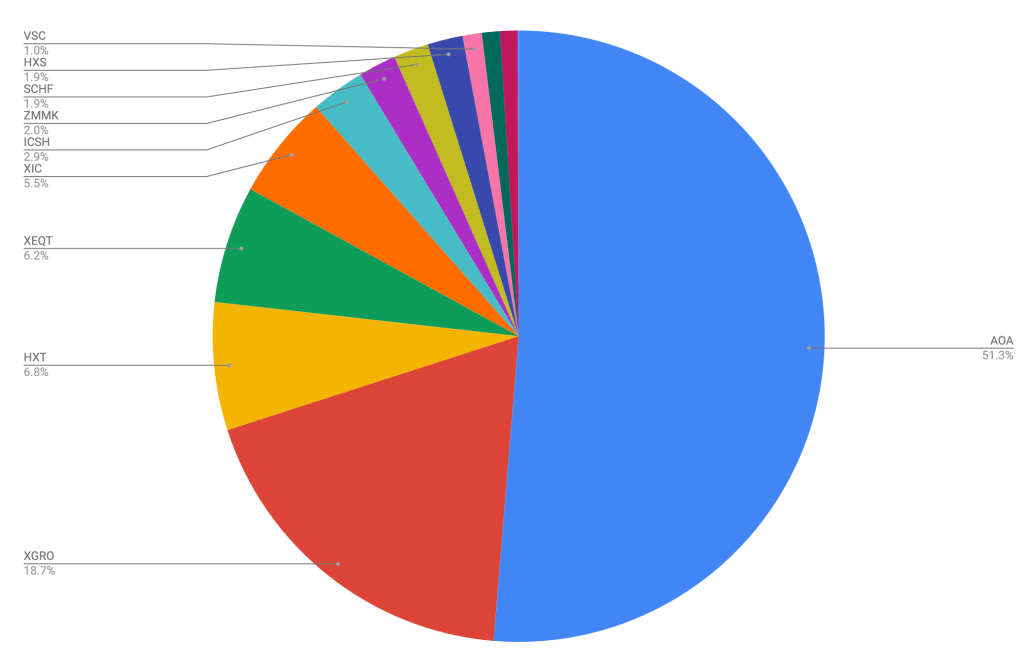
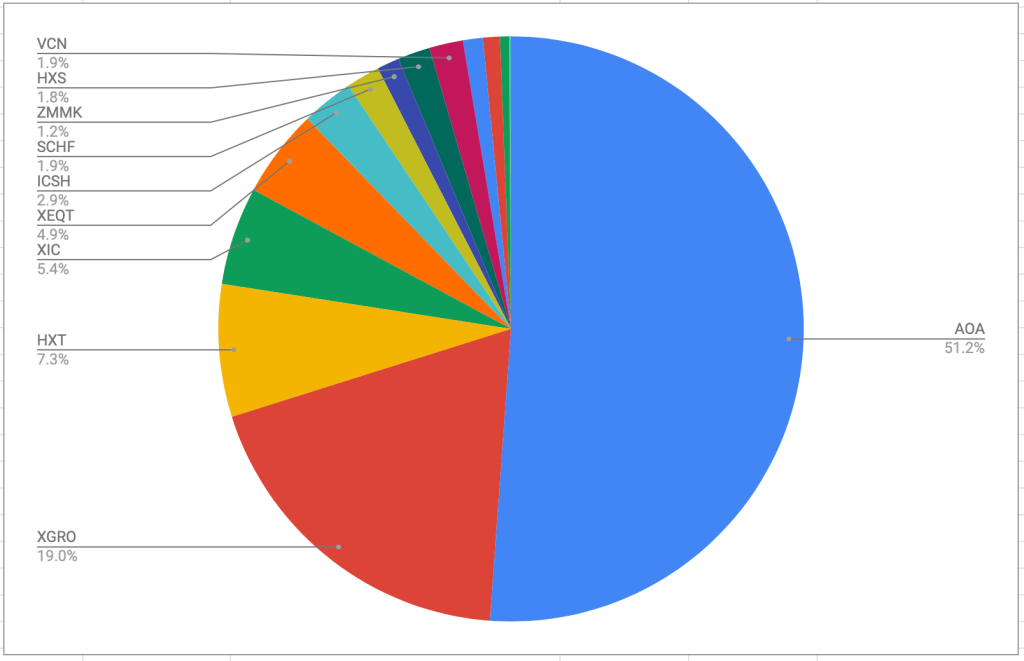
Overall retirement portfolio by holding, April 2025

The portfolio, as always, is dominated by AOA and XGRO which are 80/20 asset allocation funds in USD and CAD, respectively. The rest are primarily either cash-like holdings in two ETFs: ZMMK in CAD and ICSH in USD) or residual ETFs held in non-registered accounts for which I don’t want to create unnecessary capital gains just for the sake of holding AOA or XGRO.

The biggest month over month change was a small decline in AOA and a small uptick in XEQT, about a 1% shift overall. This was because I shifted some of my USD assets to CAD assets in the RRIF using Norbert’s Gambit2. I chose XEQT over XGRO because the contribution of bonds in the portfolio was slightly over my asset allocation target3. XEQT is essentially XGRO, minus the bond holdings (it’s a 100% equity fund).

There was also a noticeable reduction in the contribution of ICSH to the portfolio; this was largely due to the unfavourable change in the USD/CAD exchange rate over the course of the month, and not due to any change in the holdings there.

Plan for the next month

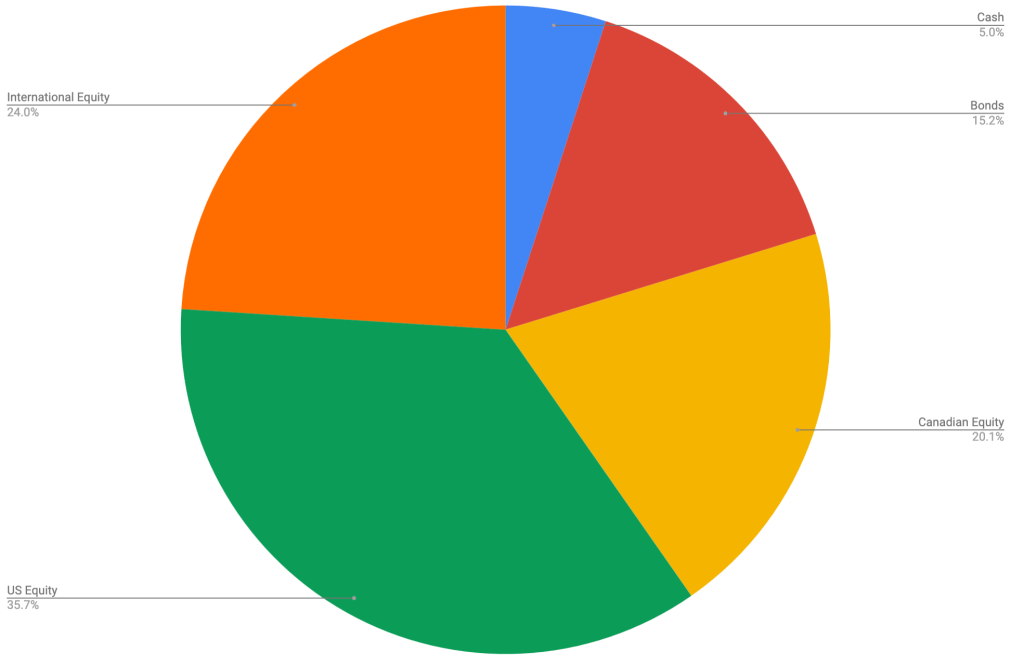
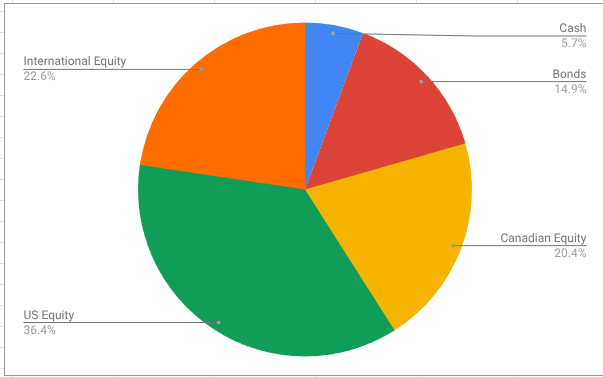
The asset-class split looks like this
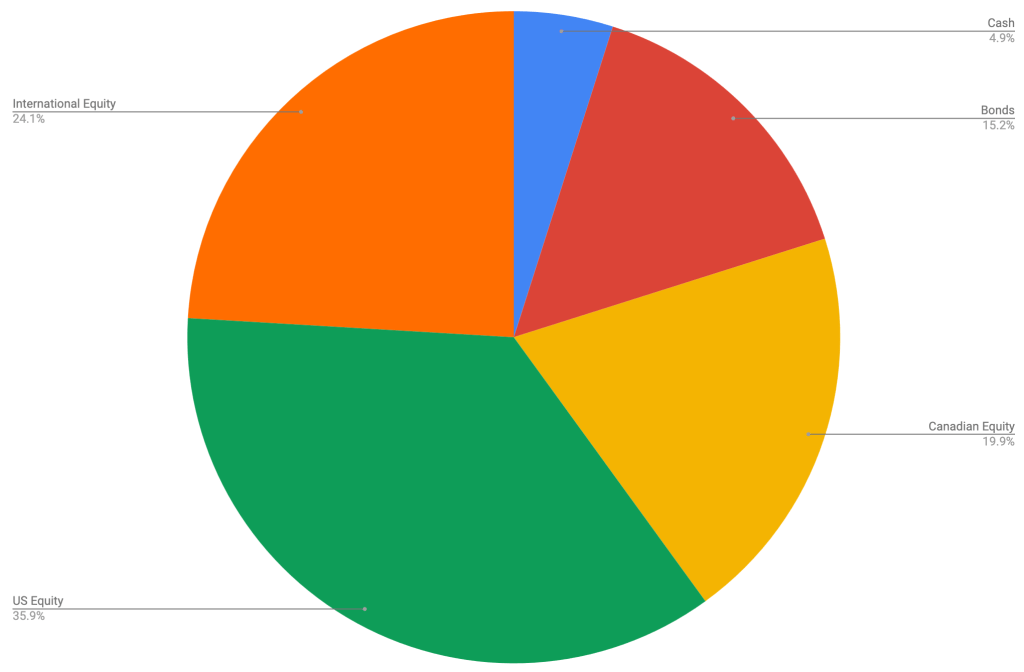
Overall retirement portfolio by market, April 2025

This looks to be pretty close to my target percentages which haven’t changed:

  • 5% cash or cash-like holdings like ICSH and ZMMK
  • 15% bonds (almost all are buried in XGRO and AOA)
  • 20% Canadian equity (mostly based on ETFs that mirror the S&P/TSX 60)
  • 36% US equity (dominated by ETFs that mirror the S&P 500, with a small sprinkling of Russell 2000)
  • 24% International equity (mostly, but not exclusively, developed markets)

So, the plan for next month is, do nothing out of the ordinary. Reinvest cash (dividends, TFSA contributions) in one of AOA, XEQT/XGRO, ICSH or ZMMK depending on the asset category most in need on the day of the reinvestment. All these ETFs are covered on my ETF All-Stars page.

Overall

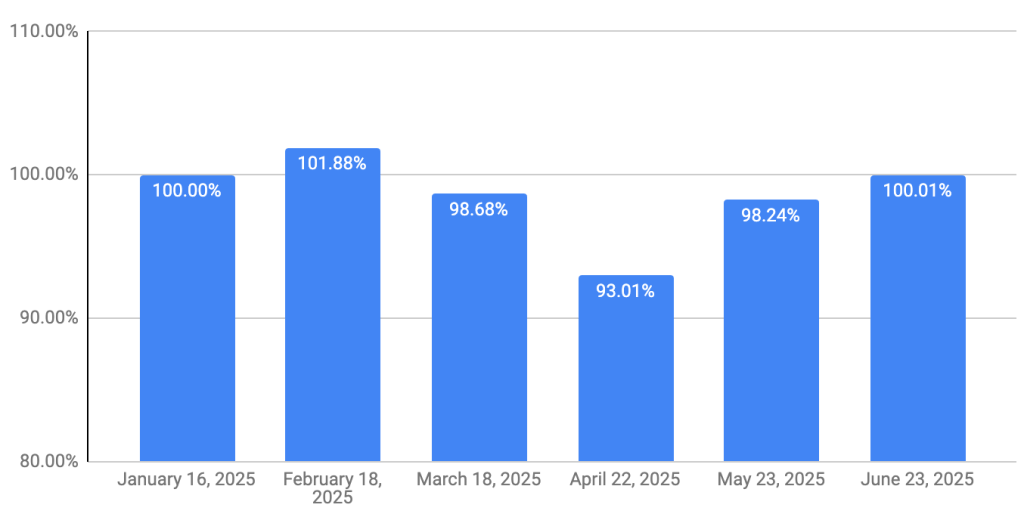
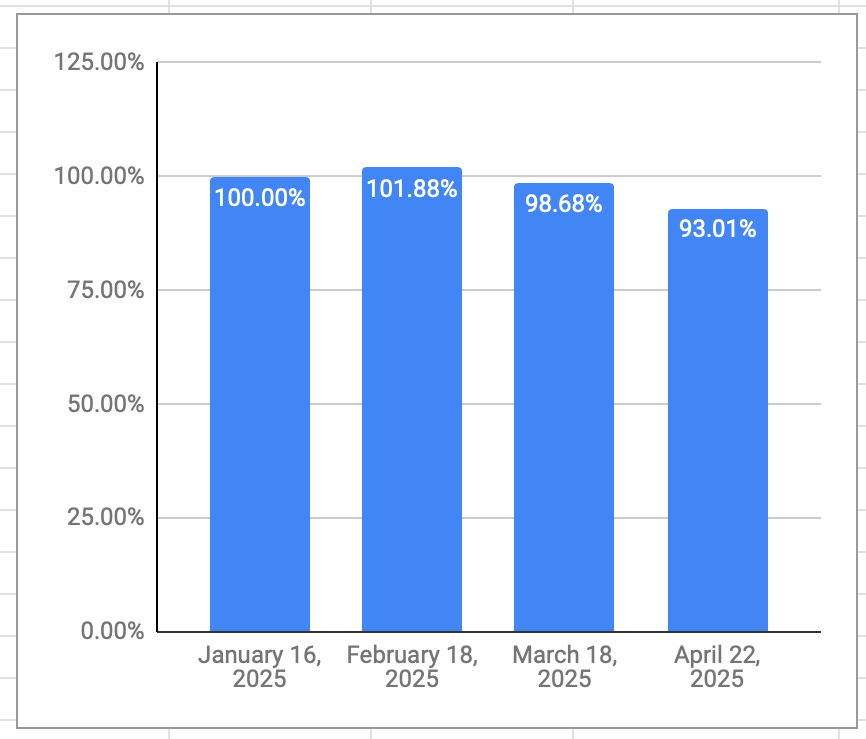
My retirement savings declined 5.75% over the month (down 7% since January) due to the continuing meltdown in the equity markets. It’s not a pretty picture!

Net worth of retirement savings compared to start of retirement

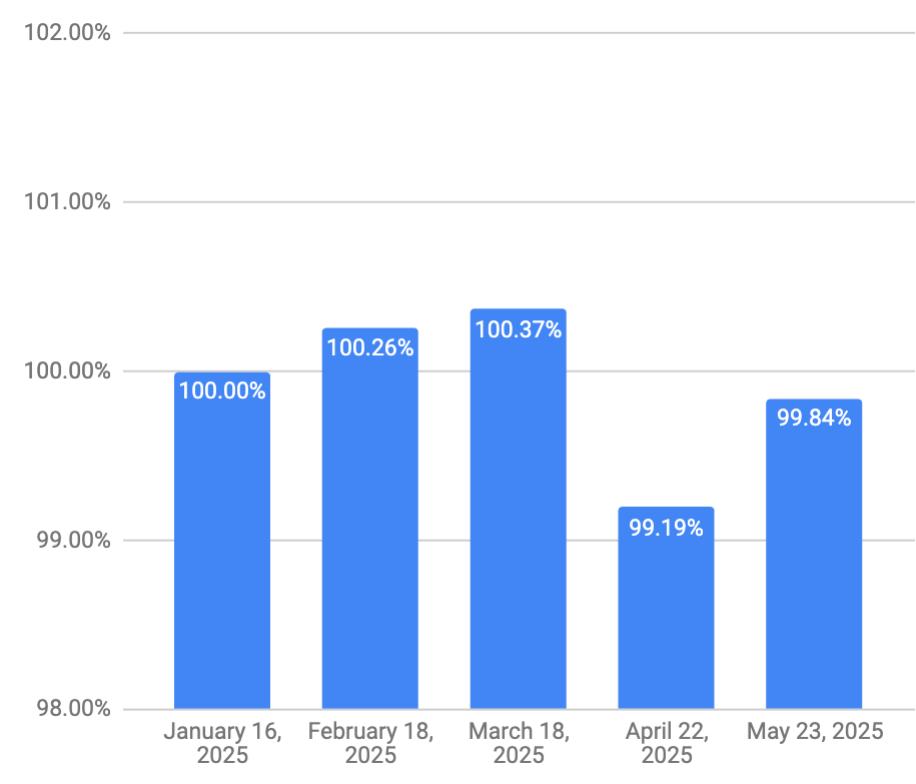
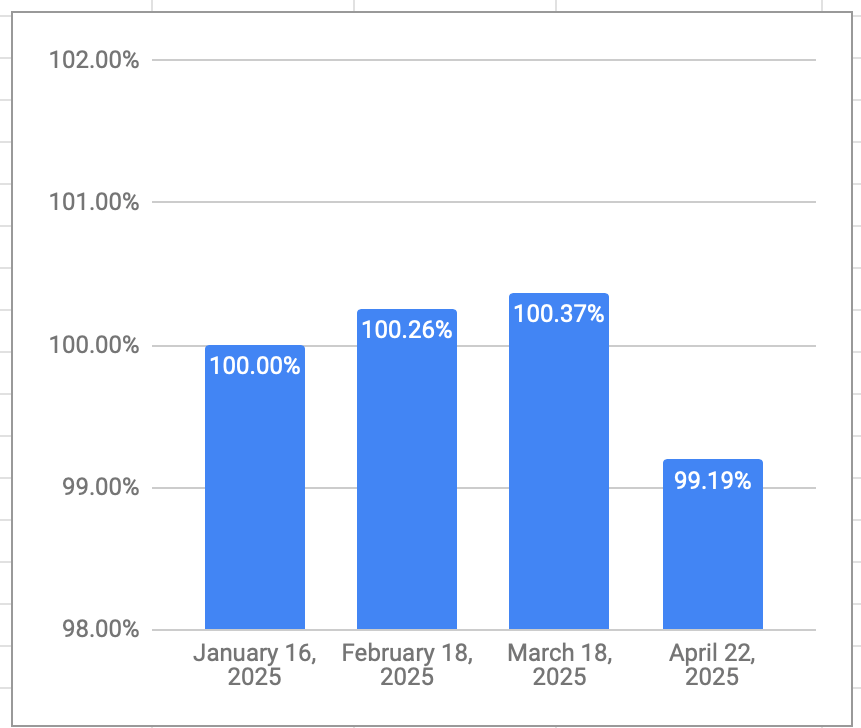
This has not translated to a the same degree of change in my monthly salary. Why? My retirement payouts are calculated by Variable Percentage Withdrawal (VPW), which I cover here. VPW has a built-in cash cushion, which serves to dampen month to month swings in my net worth, either up or down. As you can see in the chart below, my monthly salary has stayed within a 1% band of the first salary I drew in January.

Month over month salary, as compared to start of retirement

  1. Since Questrade combines USD and CAD assets under the same account umbrella, I was able to reduce the number here. ↩︎
  2. I shift funds from the USD to the CAD side of the RRIF more or less quarterly since all RRIF payments are currently coming out of the CAD side of the portfolio. ↩︎
  3. That’s the optimistic point of view; it’s perhaps more accurately stated as “bonds haven’t melted down quite as much as the equity portion of my portfolio”. ↩︎

What’s in my retirement portfolio (March 2025)

This is a (hopefully monthly) look at what’s in my retirement portfolio. The original post is here. Last month’s is here.

Portfolio Construction

The retirement portfolio is spread across a bunch of accounts1:

  • 7 RRIF accounts (3 for me, 3 for my spouse, 1 at an alternative provider as a test)
  • 2 TFSA accounts
  • 5 non-registered accounts, (2 for me 1 for my spouse, 2 joint)

The target for the overall portfolio is unchanged:

  • 80% equity, spread across Canadian, US and global markets for maximum diversification
  • 15% Bond funds, from a variety of Canadian, US and global markets
  • 5% cash, held in savings-like ETFs.

The view as of this morning

As of this morning, this is what the overall portfolio looks like:

Overall retirement portfolio by holding, March 2025

The portfolio, as always, is dominated by AOA and XGRO which are 80/20 asset allocation funds in USD and CAD, respectively. The rest are primarily either cash-like holdings in two ETFs: ZMMK2 in CAD and ICSH3 in USD) or residual ETFs held in non-registered accounts for which I don’t want to create unnecessary capital gains just for the sake of holding AOA or XGRO.

The biggest month over month change is due to switching brokers. My old broker (QTrade) allowed the purchase of HISAs, but my new broker (Questrade) doesn’t seem to offer them4. So I replaced DYN6004 with ZMMK and DYN6005 with ICSH. I made these changes in my QTrade account to avoid any problems with doing an “in-kind” transfer to Questrade.

I’m still in need of USD to pay off some vacation bills, so there is a small hit to SCHF to help out.

Plan for the next month

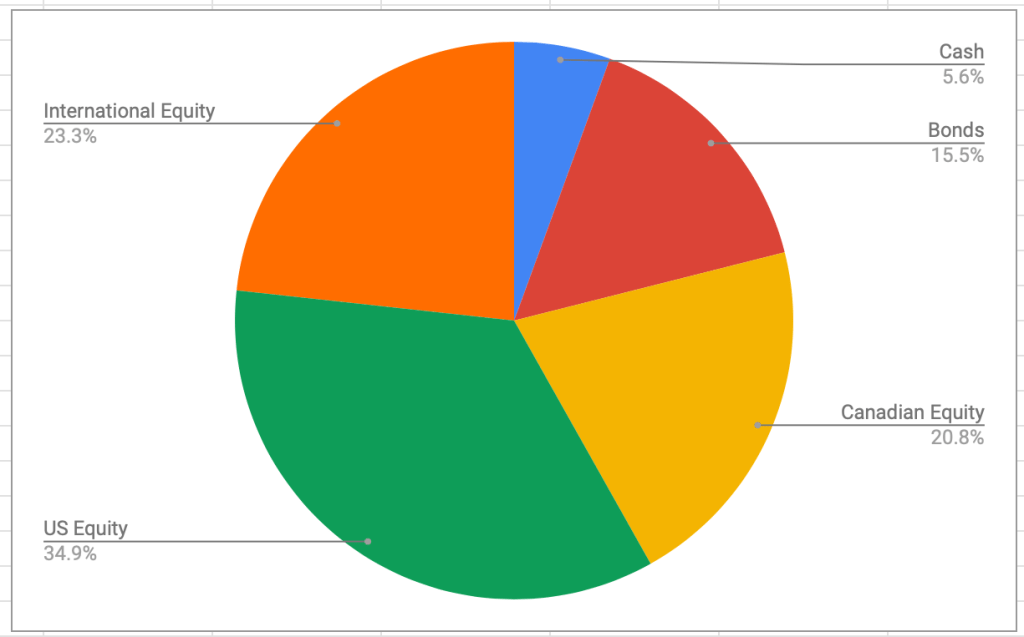
The asset-class split looks like this

Overall retirement portfolio by market, March 2025

The international equity percentage is below my target of 24%, and so I’ll have to fix that5. VEU looks like it provides exposure to both developed and emerging markets at a rock-bottom price6. XEF would be a perfect fit in the Canadian market, although I should probably also consider XEC to get some emerging markets exposure.The cash position is artificially high because I already did the necessary transactions to get paid out of my RRIF and non-registered accounts (if I did this exercise at the beginning of the month, rather than mid-month, that would disappear). That extra cash will flow to my bank account in the coming days.

A quarterly activity that I’ll be performing this month7 is to shift some of my USD RRIF holdings into my CAD RRIF. I do this to make sure I’m not overexposed to changes in the CAD/USD exchange rate. My current provider reportedly allows me to make RRIF payments natively in USD, so that may be another option to consider. I’ll make an attempt at some point!

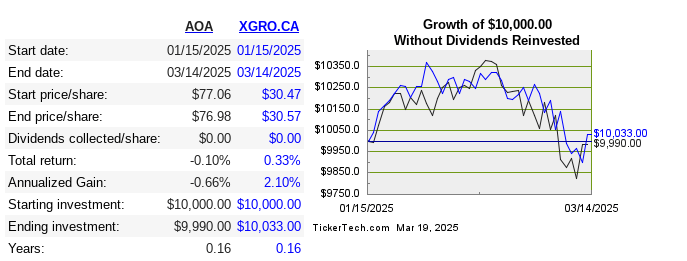
One final note: my retirement savings declined 3%8 over the month due to the wild (mostly downward) swings in the stock market, but this leaves me roughly even since my retirement started at the beginning of the year. Here’s the monthly returns for the 2 ETFs that make up the lion’s share of my portfolio9.

XGRO and AOA monthly returns so far
  1. The list is sort-of accurate. I’m in the middle of changing online brokers and since Questrade combines USD and CAD assets in one account, the number of accounts is diminishing. ↩︎
  2. Current 12-month yield: 3.6% ↩︎
  3. Current 30-day SEC yield: 4.61% ↩︎
  4. This specific topic addressed at https://www.financialwisdomforum.org/forum/viewtopic.php?t=125308. ↩︎
  5. The observant reader will note I also said this LAST month. That was before I decided to switch brokers. Once my holdings settle at Questrade, I’ll revisit. ↩︎
  6. MER = 0.04%. VEU has some Canadian exposure too, which isn’t ideal, but I don’t think there’s a USD ETF that excludes both Canada and the USA. ↩︎
  7. And should have done last month, sorry. ↩︎
  8. It would have been worse, except the USD also went up versus the Canadian dollar in the time period. Diversification works 🙂 ↩︎
  9. “Without dividends reinvested” since these two ETFs only pay out quarterly. There haven’t been any yet — next month! ↩︎

QTrade versus Questrade unboxing

I’m in the middle of my transition from QTrade to Questrade. With 11 different accounts to migrate, most of my time has been spent with their new account setup screens, but I have already taken note of a few differences that I’ve noticed between the two in my first week of using Questrade.

Trading fees on stocks and ETFs

Questrade recently announced that they were eliminating commissions on the buying and selling of all stocks and ETFs. QTrade has a decent list of free to trade ETFs, but obviously Questrade is the winner here.

Personally, I don’t think this will make a huge difference for me since my retirement portfolio is mostly based on QTrade’s “free” list (most notably XGRO and AOA), but it’s not fully in that camp. I’ll save a few bucks over the course of the year thanks to this.

Support

Those of you who read my mini-review of QTrade will know that I don’t consider their support a strong suit1.

I encountered quite a few snags2 along the way with Questrade’s account opening process, and as a result I have spent some time dealing with their support team.

One big difference you see right away is that they seem to rely exclusively on chat, with very clear (if sometimes disheartening3) queue position metrics. I myself am a fan of chat, especially one that makes it very clear where you are in the queue. Compared with QTrade, no contest — I’ll take keeping a window open on a computer I’m using over having to listen to highly compressed and repetitive hold music any day of the week!

A technical quibble I have with Questrade’s chat is that it is inconsistently persistent as you navigate the Questrade screens4. On more than one occasion I had my chat closed accidentally because I navigated to the “wrong” screen. Compared to other support chat platforms I’ve used (Rogers, for one), it’s decidedly feature-light.

The support I eventually got was uneven. I suppose last week may not have been the best week to attempt calling Questrade5, but all the same, sometimes the answers I got made no sense or were just flat out wrong.

US Dollar Account Support

Both companies are strong in this regard, allowing USD holdings in various accounts. Personally, I hold USD-denominated assets in my RRIF and my non-registered accounts. (I also used to hold USD assets in my TFSA, but because of the non-preferred tax treatment of dividends held in TFSAs, I got rid of those a few years ago).

The big difference that’s obvious immediately is while QTrade keeps the USD and CAD accounts separate — different account numbers, different screens to navigate — Questrade combines CAD and USD assets in one account. This has the pleasant side-effect of reducing the total number of accounts I have.

I haven’t investigated (yet) how values of accounts and portfolios are reported in Questrade6. I’m expecting that they will allow you to see your account and portfolio values in either USD or CAD7.

One of the irritants I had with QTrade is that they never, ever showed the USD/CAD exchange rate they were using to display the overall CAD value of the portfolio. It appeared they were using a rate that was consistently 1.5% below the spot rate.

And another irritant I had with QTrade is that I could not get RRIF payments natively in USD, something I was told was possible before I opened the RRIF in the first place8. Questrade claims they allow this on their public website, so I’m hopeful. More to come at the end of this month, hopefully.

HISA support

High Interest Savings accounts are an important part of my portfolio holdings since my decumulation strategy depends on them. QTrade has an extensive list of free to trade HISAs (I covered them here) but Questrade doesn’t provide access to this class of product. Instead I have to use ETFs. But since all ETFs are free to trade on Questrade, this shouldn’t really make a big deal of difference. In some ways, it’s better because QTrade restricted HISA purchases to a minimum of $1000, whereas most of the cash-oriented ETFs have an entry price of either $50 or $100 per unit.

I find it difficult to get answers to super-specific questions about various platforms, so if you have questions about any of the platforms I use/ have used (namely, BMO Investorline, Interactive Brokers, Wealthsimple, QTrade and Questrade), then feel free to ask away at comments@moneyengineer.ca.

  1. For an example of coherent and attentive customer support, you’d have to look at Wealthsimple ↩︎
  2. Their website appeared to be getting crushed at times…weird sporadic and non-repeatable error messages ↩︎
  3. Last week on one of my calls, I started at position 370 or so. That was a 90 minute wait. But at least I could write blogs while I waited, something that is really irritating to do when you have to listen to hold music. ↩︎
  4. Possibly browser-related, but c’mon, it’s 2025 and I was using OSX Safari! ↩︎
  5. RRSP season, and their generous promo ending… ↩︎
  6. I have accounts, but until the in-kind asset transfer completes, I have no assets. ↩︎
  7. Taking a peek at the mobile app while I write this, I see options for account balances to be reported as “Combined in CAD”, “Combined in USD”, “CAD” and “USD” so it appears my expectations will be met. ↩︎
  8. After two months (!) of back and forth with QTrade, I was told — last week — that this is possible using the exact same method I unsuccessfully attempted in January. ↩︎

ETFs for parking your money safely

Since my new DIY broker (Questrade) does not support the purchase of high interest savings accounts (HISAs), I need to find a free-to-trade alternative. 5% of my retirement portfolio is invested in what is characterized as “cash”, but I expect that money to earn some sort of return with essentially zero risk. (Another 15% of my portfolio is in the bond market, which, as we all learned in the last few years, has its downsides1.)

Questrade (like Wealthsimple) offers free trades of all ETFs. So it makes sense for me to go looking for ETFs that invest in safe havens. Here’s what I turned up for investments in Canadian dollars, based on some Google searches and some reading of similar questions posted in the public domain. Not all of them are what I would call “equivalent” to a HISA.

Fund SymbolFund CompanyWhat it invests inMERCurrent annual yield2Commentary
CASHGlobal X“high-interest deposit accounts with one or more Canadian chartered banks”0.11%2.68%This invests in the HISAs I currently invest in
CBILGlobal X“short-term Government of Canada T-Bills”0.11%2.88%Not a HISA but a safe investment
HISAEvolve“high-interest deposit accounts”0.15%2.71%Equivalent to CASH but with a higher MER
MCADEvolve“Canadian dollar high-quality short term debt securities (with a term to maturity of 365 days or less)”0.20%3.17%Very short term bond fund. 18% of holdings have due dates of less than 30 days
ZMMKBMO“high-quality money market instruments issued by governments and corporations in Canada, including treasury bills, bankers’ acceptances, and commercial paper. 0.13%3.6%Not a HISA but a very short term bond fund3. 31% of holdings have due dates of less than 30 days.
CAD ETF Candidates for investing Canadian dollars

Based on this quick analysis, ZMMK looks pretty attractive — a lot of very short term (and hence safer) debt as compared to MCAD, excellent returns. It is clearly a riskier investment than something like CASH or HISA. Between CASH and HISA I lean to smaller MERs every time, so CASH wins. CBIL might be a sort of happy middle ground…a T-Bill ought to be as good as a bank. All of these ETFs have a pretty stable NAV, either $50 or $100 per unit, so there should be little to worry about in terms of capital gains.

Since I hold a lot of USD, (not convinced this is a good idea), I need to do the same exercise for USD safe havens.

Fund SymbolFund CompanyWhat it invests inMERCurrent Annual Yield4Commentary
HISUEvolve“primarily in high interest US dollar deposit accounts”0.11%4.05%This invests in the HISAs I currently invest in
HSUVGlobal X“primarily in high interest U.S. dollar deposit accounts with Canadian banks…not currently expected to make any regular distributions”0.2%n/aGlobal X “corporate class” ETFs convert interest payments into capital gains. This sort of ETF makes sense in a non-registered account to minimize taxes.
ICSHBlackRock“broad range of short term U.S. dollar-denominated investment-grade fixed- and floating-rate debt securities and money market instruments”0.08%4.31%Not HISA but 46% is invested in debt with less than 30 days maturity
MUSDEvolve“primarily in U.S. dollar-denominated high-quality short term debt securities (with a term to maturity of 365 days or less).”0.20%3.49%Similar in strategy to ICSH, but only 20% in debt with 30 days maturity and only 40 holdings.
UCSHGlobal X“primarily invests in high-interest U.S. dollar deposit accounts, which provide a higher interest rate than a traditional USD savings account.”0.16%4.08%HISA-like, based on term deposits
USD ETF Candidates for investing US dollars

ICSH is the clear winner in terms of return, but, like ZMMK, a little riskier than a simple bank account. It has a nice broad portfolio (363 individual holdings) which makes it feel safer. HISU looks like the straight-up HISA replacement.

What ETFs do you use to park your cash? Let me know at comments@moneyengineer.ca.

  1. Excellent graphic of historical returns available at https://themeasureofaplan.com/investment-returns-by-asset-class/ ↩︎
  2. Take the latest monthly distribution, divide by the unit price, multiply by 12. If BoC holds their interest rates steady for the year, you could expect to achieve this rate for the next year. As of March 3, 2025. ↩︎
  3. “Commerical paper” refers to very short term debts, 30 days average maturity. Like a credit card debt, maybe. ↩︎
  4. US based funds like this one report a “30 day SEC yield”, it represents “interest earned after deducting the fund’s expenses during the most recent 30-day period by the average investor in the fund”. ↩︎