

What’s in my retirement portfolio (Feb 2025)

This is a (hopefully monthly) look at what’s in my retirement portfolio. The original post is here.

Portfolio Construction

The retirement portfolio is spread across a bunch of accounts:

  • 7 RRIF accounts (3 for me1, 3 for my spouse, 1 at an alternative provider as a test)
  • 2 TFSA accounts
  • 5 non-registered accounts2, (2 for me 1 for my spouse, 2 joint)

The target for the overall portfolio is unchanged:

  • 80% equity, spread across Canadian, US and global markets for maximum diversification
  • 15% Bond funds, from a variety of Canadian, US and global markets
  • 5% cash, held in high interest savings accounts (list available to me shown here)

The view as of this morning

As of this morning, this is what the overall portfolio looks like:
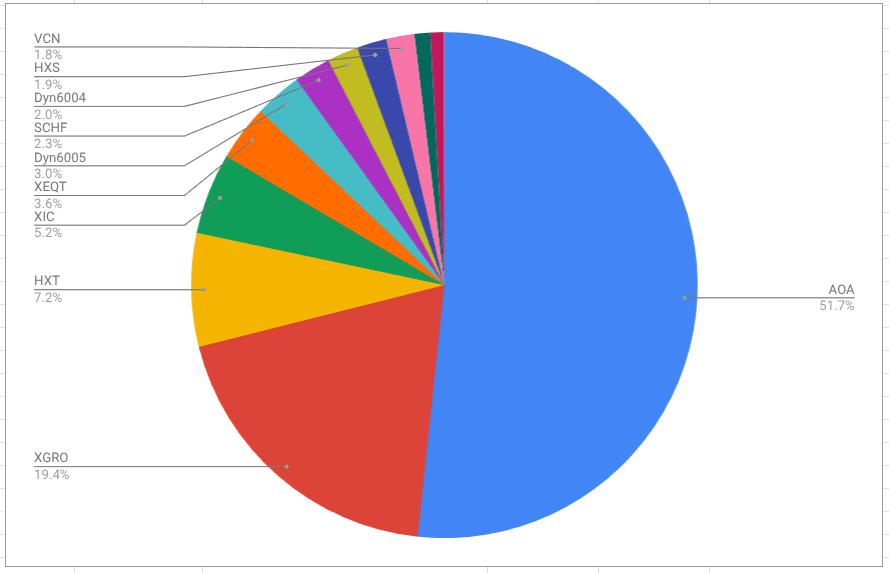
Overall retirement portfolio by holding, February 2025

The portfolio, as always, is dominated by AOA and XGRO which are 80/20 asset allocation funds in USD and CAD, respectively. The rest are primarily either cash holdings in HISAs (DYN6004/5 in CAD and USD) or residual ETFs held in non-registered accounts for which I don’t want to create unnecessary capital gains just for the sake of holding AOA or XGRO.

The biggest month over month change is due to a small re-balancing exercise. I replaced some of my XGRO (which is an 80/20 equity/Bond asset allocation fund) with XEQT (a 100% equity asset allocation fund). I do re-balancing any time my asset allocation drifts more than 1% off my target allocations3. The trigger for me was an overweighting in bonds, which had drifted to represent 16% of my portfolio instead of the desired 15%. Upon reflection, the reason was obvious: both AOA and XGRO are 20% bonds, and if I want only 15% bonds, I will periodically need to fund an all-equity alternative. The net effect will be that you will see more XEQT show up in the portfolio over time.

The observant reader will also notice a bit of a shift between DYN6004 and DYN6005. The reason? I raided some USD from DYN6005 to pay my US credit card bill and replaced it with CAD in DYN6004 using the spot FX rate at the time. Seemed the easiest way to get some USD4 without having to resort to my friends at Knightsbridge.

SCHF percentages drifted down a bit since that’s the ETF I’m selling in my non-registered portfolio to augment my monthly RRIF payments. That will continue for the next few months at least since the USD payouts are needed to fund a few holidays5 I’m taking that are billed in USD.

Otherwise, nothing interesting to see in the month to month changes.

Plan for the next month

The geographic split looks like this
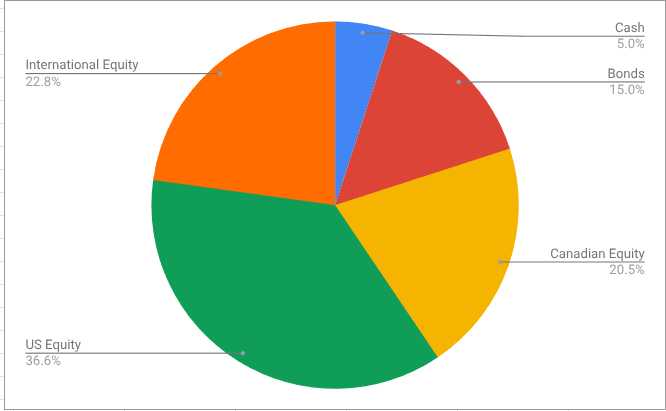
Overall retirement portfolio by market, February 2025

The international equity percentage is below my target of 24%, and so I’ll have to fix that. SCHF seems a good choice in USD6 since it’s free to trade with QTrade. XEF would be a perfect fit in the Canadian market.

A quarterly activity that I’ll be performing this month is to shift some of my USD RRIF holdings into my CAD RRIF. This wasn’t something I had planned to do but since my provider has backtracked on allowing me to get paid out of my USD RRIF in USD, I needed a way to keep the USD exposure at a constant-ish level in the overall portfolio. I’ll talk about the USD in my portfolio in a future dedicated post.

One final note: my retirement savings continue to grow even though I’m now actively removing assets out of it. On paper, this makes perfect sense since an 80/15/5 portfolio ought to grow at a rate greater than my rate of removal. In practice, of course, it’s rather stock market dependent. Here’s the monthly returns for the 2 ETFs that make up the lion’s share of my portfolio7.
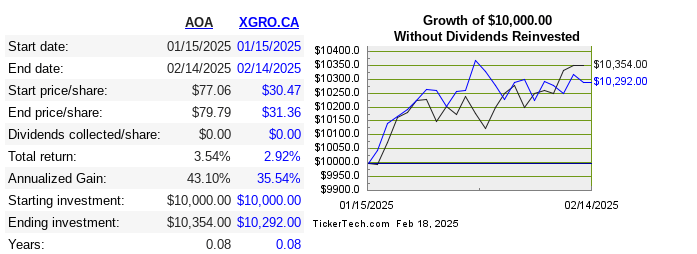
XGRO and AOA monthly returns so far8
  1. For me, that’s one personal RRIF that has 2 accounts, one for CAD, one for USD, and one spousal RRIF. My spouse has one spousal RRIF in two currencies, and a personal RRIF. The alternative provider RRIF exists because I wanted to give Wealthsimple a try. ↩︎
  2. For me, two because one each for CAD and USD. The 2 joint accounts are my cash cushion accounts for the VPW methodology outlined here and here. ↩︎
  3. Completely spreadsheet-driven. I don’t trade on news, analyses, gut feelings, hot tips, or guesses. ↩︎
  4. I did hesitate a bit because the interest rate on DYN6005 is over 1% higher, but given the amounts involved, I’m clearly overthinking things. ↩︎
  5. All booked before this current tariff nonsense. Sorry. ↩︎
  6. Although it does have a 9% exposure to the Canadian market so not 100% “international”. Hard to beat the MER of this, though. ↩︎
  7. I don’t think this tool accounts for FX so it’s probably not totally accurate. Check out https://moneyengineer.ca/tools-i-use/ for other useful tools. Canadian dollar gained 1.4% against the USD in the past 30 days, per https://www.bankofcanada.ca/rates/exchange/daily-exchange-rates/ so that will reduce the effective return of AOA by the same amount. ↩︎
  8. “Without dividends reinvested” since these two ETFs only pay out quarterly. There haven’t been any yet. ↩︎

Ok, I’m ready to fire my advisor. What do I need to do?

So you’ve decided to make the leap and keep more of your own money. Congratulations! Here’s a list of things you need to do to put that plan into action.

Disclaimer: I treat my retirement assets separately from any other assets (rainy day funds, day-to-day expenses). If you blend these sort of things together, it may change things like step 1.

1. Determine your desired asset mix

“Asset mix” is just another way of describing your risk profile, or in really plain English, what percentage of your portfolio is going to be invested in equity. There’s a quick questionnaire over here that will put you in one of 5 buckets:

  • Very Conservative: This means 20% Equity.
  • Conservative: This means 40% Equity.
  • Balanced: This means 60% Equity.
  • Growth: This means 80% Equity.
  • Aggressive Growth: This means 100% Equity.

If you’re happy with the way your existing portfolio is performing, then you can instead calculate the percentage of equity in it and use that as your asset mix. For simplicity, I would consider any stock as “equity” and any cash, HISA, Bond fund or GIC as “not equity”. If your portfolio holds ETFs, then you need to see what’s inside them. You can typically read that on the “fund facts” page. They are usually one or the other, unless you already hold funds like XGRO.

2. Choose your platform and create login(s) for it

But which one? I talk about some of the things to consider over here, or you can investigate a trustworthy source like the Globe and Mail’s annual rankings. Some providers (e.g. QTrade, Questrade) allow you to make trial accounts to test drive them. I myself use QTrade for my investments. Like all providers, it does some things really well, and others, not so much. I have either personal experience or friends using (in alphabetical order) BMO Investorline, Interactive Brokers, iTRADE, QTrade, Questrade and Wealthsimple. Any of them will do. Many of them run promotions1 trying to entice you to switch. Might as well take advantage of that if it makes sense23. Also consider if they will reimburse you the transfer fees imposed by your soon-to-be-ex provider of choice4.

The heading of this section says “login(s)” because if you’re part of a spousal team, you should really do this as a team.

This step also usually entails form-filling and proof of life uploads/emails/faxes5 (photo ID, banking info….). Put on your favourite tunes and the time will be filled with pleasant sounds.

3. Figure out how to move money to and from your new platform

If you’re still contributing to your TFSA/RRSP/RESP, or if you have non-registered accounts, or are close to retirement and about to set up a RRIF, then it’s pretty important to know how money will move in/out of these accounts. Typical things you’ll have to do are

  • set up your new account(s) as “Bill Payees” online banking6
  • set up EFTs7 between your bank account and new platform
  • set up new Interac eTransfers8
  • Get cheques/bank card for your non-registered account, if applicable9

4. Collect all your existing account information

To successfully complete the transfer, you are going to need to know the details of all your existing accounts. The usual information requested is found on your monthly/annual statements. Client number, account number, rough value of what’s in each.

If applicable, you’ll also want to have a very good handle on exactly how much you’ve contributed to capped government savings vehicles (e.g. RRSP, TFSA) so you don’t inadvertently over contribute in the year you make the shift10.

There may be a snag at this step. You may hold assets at your old provider that are not supported at your new provider. This may or may not be a big deal. Typical issues are caused by

  • GICs11. The reason you get good interest rates from them is because the money is locked away. You may or may not be able to move them without incurring penalties. You’ll have to ask your new provider what they are willing to do. In most cases, the answer will be “sorry, can’t help you, if you want to move them, you’ll have to sell them first”12.
  • Mutual Funds. Many of these are private to that provider,13 and constitute, in their estimation, considerable value add. For these, you are almost certainly going to have to say goodbye (and good riddance) .

For GICs, you can choose not to move those assets, wait until they mature, or eat the cost of cashing them in early.

For Mutual Funds, selling them usually isn’t a concern, unless you hold them in a non-registered account, in which case there may be undesirable capital gains that will cause a tax hit.

For most people, the costs involved in moving assets are small compared to the money you’ll ultimately save by firing your advisor. But don’t say I didn’t warn you.

5. Initiate account transfers from your newly selected platform

This is the first step where things get real.

Different providers will do this somewhat differently, but it’s usually called something like “Transfer Account”. In my experience, providers are highly motivated to be highly helpful at this stage ;-).

But in essence, initiating an account transfer will involve two things:

  • The creation of the kind of account you’re moving (e.g. TFSA, RRSP, Spousal RRSP, RRIF14) AND
  • The details of that account (client number, account number….all collected in the previous step)

It’s also possible you have to create the account (TFSA, RRSP….) on your new platform FIRST, and once it’s created THEN you can initiate a transfer.

You will have to answer a question of moving the existing assets “in kind” or “as cash”. If you hold portable assets at your old provider (e.g. cash, stocks, ETF), “in kind” is fine. If you don’t (e.g. GICs, mutual funds) then “as cash” will allow your new provider to trigger a sale of those assets.

You will have to do this for EVERY account you’re moving. Were I to switch, I’d have to move

  • 4 RRIF accounts (2 each for me and my spouse; one in CAD, one in USD)
  • 2 spousal RRIF accounts (1 for each spouse)
  • 2 TFSA accounts (1 for each spouse)
  • 5 investment accounts (2 for me, 1 for my spouse, and 2 joint15)
  • 1 RESP account

6. Wait for the funds to arrive

This always seems to take forever. Expect a delay of 5-10 business days at this point. Expect a panicky call from your soon-to-be-ex advisor. Take the time to set up Trading Authority (TA) for your personal accounts (spouse, adult child, other relative) so they can make trades on your behalf. There’s a form for that. Having TA for my spouse’s accounts means I can see our ENTIRE retirement portfolio from my login which is Highly Desireable.

7. Buy the correct ETF in line with step 1.

As as example, if you were to use the Blackrock family of asset allocation funds:

  • Very Conservative: This means 20% Equity. This means XINC.
  • Conservative: This means 40% Equity. This means XCNS.
  • Balanced: This means 60% Equity. This means XBAL.
  • Growth: This means 80% Equity. This means XGRO.
  • Aggressive Growth: This means 100% Equity. This means XEQT.

The reason for choosing an asset allocation fund is for automatic re-balancing. You pay about 0.15% for that service, which is baked into the price of the fund. It’s more or less what your advisor should do for you today.

8. Pay as much or as little attention as you like

As you invest new funds (e.g. for TFSA/RRSP), buy more units. You might also consider setting up a DRIP at this stage so as dividends roll in (typically, monthly or quarterly), you automatically purchase more of the same. Autopilot.

If you want a second set of eyes to assess your holdings, then dropping some cash on a fee-for-service advisor from time to time may make sense.

Eight steps to save potentially thousands of dollars. You’re worth it!

  1. Googling (for example) “Wealthsimple promotion” would be one way to find the current one. ↩︎
  2. Read the fine print, there are almost always caps on rewards, as well as obligations to stick with the provider for a period of time. ↩︎
  3. Here is one rare case where there may indeed be something pretty close to a free lunch. ↩︎
  4. Almost all providers do this; there is almost always some sort of lower limit…$15k is pretty typical. ↩︎
  5. Any provider wanting faxes should disqualify them as a provider, just sayin’. ↩︎
  6. This is how QTrade does it. ↩︎
  7. Electronic fund transfers. You provide institution/transit/bank account number using a blank cheque. That’s how QTrade knows where to put my RRIF payments. Another form to fill. ↩︎
  8. Only Wealthsimple seems to allow this. It’s fast, but has upper daily/weekly/monthly limits that may make it impractical. ↩︎
  9. Both BMO Investorline and Wealthsimple allow this. I’m guessing that it’s a common feature for providers that also operate bank services (e.g. CIBC, TD, National Bank, Scotiabank). My provider (QTrade) does not. ↩︎
  10. Your new provider will have no idea what your TFSA limits are; only CRA knows that. Most providers will track what you contribute IN THEIR ACCOUNT in a given year, so that’s somewhat helpful. ↩︎
  11. The lack of liquidity of GICs is the main reason I don’t use them. ↩︎
  12. The one exception I’ve encountered thus far is that BMO Investorline was willing to accept the GICs purchased via BMO Advisor Services. There may be others. ↩︎
  13. Manulife and Sunlife, much loved by employers for DPSPs, are notorious for their 1.5% MER index funds. ↩︎
  14. Don’t forget to properly designate beneficiaries or survivor annuitants. ↩︎
  15. These are CAD and USD versions of the cash cushion required by the system I use to pay myself in retirement. ↩︎

What’s the deal with XGRO?

***Numbers updated November 30, 2025****

As mentioned elsewhere, I rely heavily on all-in-one ETFs in my retirement portolio. New to all-in-ones? Read a bit about them here. While it may seem unwise to have (seemingly) so little diversification, when you buy an all-in-one like XGRO, you are actually getting a piece of THOUSANDS of different assets.

The main all-in-one Canadian ETF that I hold is an 80/20 fund1 called XGRO. There’s nothing special about XGRO other than it being free to trade on the platform I use — there are other 80/20 funds out there (e.g. ZGRO, HGRW). There’s also other all-in-ones with different equity percentages; there’s something for everyone!2

I thought it would be interesting to see what, exactly, is underneath every $100 you invest in XGRO. So by reading XGRO’s ETF description, following the ETF descriptions of what’s inside XGRO, and doing a little math, I came up with the following breakdown:

FundWhat is it?How much?Colour Commentary
ITOTBroad US stock coverage that tracks the S&P Total Market Index, about 2508 companies (top holdings: Alphabet, Apple, Nvidia, Microsoft, Amazon, Broadcom)$36.42 of your $100 investment

(of which ~2$ is in each of Alphabet, Apple, Nvidia, and Microsoft, and another $1 is in each of Amazon and Broadcom)
The Magnificent 7 and 2501 other companies
XICBroad Canadian stock coverage that tracks the S&P/TSX Capped Composite Index, about 223 companies (top holdings: RBC, Shopify, TD, Enbridge, Brookfield)$20.68 of your $100 investment

(of which RBC gets $1.40, Shopify gets $1.26, TD gets 93 cents)
You want banks? We got banks!
XEFBroad international (Europe, Asia, Australia) stock coverage that tracks the MSCI EAFE Investable Market Index, about 2500 holdings$19.49 of your $100 investment
(of which 24 cents goes to AstraZeneca, 34 cents goes to ASML…)
One of these years, MSCI EAFE is going to have another year like 2017…
XBB1400 or so investment-grade Canadian bonds that comprise the FTSE Canada Universe Bond Index$12.26 of your $100 investment (of which $3.89 is in federal bonds, $1.50 is in Ontario bonds, 91 cents is in Canada Housing Trust #, 85 cents is in Quebec bondsBonds got a lot of hate in 2023/4, but staying the course has been nice of late
XEC3000+ emerging market stocks that track the MSCI Emerging Markets Investable Market Index$4.18 of your $100 investment (of which 41 cents is in Taiwan Semi, 18 cents is in Tencent3…)“But honey, buying a case of power banks from Alibaba is helping our retirement portfolio”
XSHAbout 540 short term Canadian Corporate Bonds that track the FTSE Canada Universe + Maple Short Term Corporate Bond Index$2.96 of your $100 investment (of which 24 cents is in Royal Bank debt, 23 cents is in TD debt, 18 cents is in BMO debt)You want bank debt? We got bank debt!
USIGOver 10000 (!) US corporate bonds$1.95 of your $100 investment (of which 4 cents is JP Morgan debt, 3 cents is BoA debt)No idea how they track 10,000 bonds, but look at the yield4!
GOVTExposure to 191 US T-Bills$1.94 of your $100 investmentThey say “No pain, no gain”. I guess there’s only minuscule pain in T-Bills5.

If you were so inclined to run the numbers yourself, I’m pretty sure you’d get something similar to my numbers. It does change daily, mind you. And the percentages are routinely rebalanced, of course.

The big takeaway is that investing in an all-in-one like XGRO provides you with exposure to a bunch of different asset types across many different geographies in one product, including all of the “hot” stocks you read about ad nauseam. No FOMO here!

  1. A spirited discussion on the wisdom of 80/20 over here: https://www.bogleheads.org/forum/viewtopic.php?t=210178 ↩︎
  2. More equity=more risk=higher returns. No free lunch. ↩︎
  3. I desperately wanted the math to work out to “10 cents in Tencent”, but alas ↩︎
  4. https://stockanalysis.com/etf/usig/dividend/ ↩︎
  5. No gain. I feel much pain: https://www.google.com/finance/quote/GOVT:BATS?sa=X&window=MAX ↩︎

Why you can fire your advisor: Asset allocation ETFs

Summary: Asset allocation ETFs1 let you buy exactly ONE fund to meet your investing needs. Buy ONE fund, and forget about it. Really? Really.

In the run-up to getting ready for retirement, I greatly simplified my portfolio. On the Canadian dollar side, it’s almost all invested in two places: XGRO and DYN6004 (a Canadian high-interest savings account). On the US dollar side, it’s almost all invested in two equivalent places: AOA and DYN6005 (a US high-interest savings account). XGRO is an example of an Asset Allocation ETF that trades in Canadian dollars, whereas AOA is an example of an Asset Allocation ETF that trades in US dollars. The overarching objective of my retirement portfolio is to keep allocations at 5% Cash and the rest in XGRO or AOA. Effectively, this puts me at about 80% stocks.

What’s an Asset Allocation ETF?

Very simply, they are a kind of ETF that allow you to make one investment decision based on your desired risk profile. Risk is a personal decision, based on factors like timeline before needing the money, how much you agonize over stock market fluctuations and so forth.

More risk means better long-term growth prospects means more stocks.

Looking for higher long term growth? Choose an asset-allocation ETF that has a higher percentage of stocks. Looking for lower long term growth with less volatility? Choose an asset-allocation ETF that has a lower percentage of stocks.

There are many Canadian providers out there who provide their own families of asset allocation ETFs.

Which provider you choose may boil down to which is the most convenient / least expensive to buy and sell. For example, BMO Investorline clients can buy and sell the BMO family with no charges, while QTrade clients can trade the iShares family with no charges.

I personally don’t think that there is much to differentiate each of the families. Each provider is just trying to capture your business. So whether you buy ZEQT or XEQT or HEQT or VEQT 2 probably doesn’t matter very much in the big picture.

I summarized them below:

ProviderETF SymbolsRead more
BMO100% Stocks: ZEQT
80% Stocks: ZGRO
60% Stocks: ZBAL
40% Stocks: ZCON
https://bmogam.com/ca-en/products/exchange-traded-funds/asset-allocation-etfs/
iShares100 % Stocks: XEQT
80% Stocks: XGRO
60% Stocks: XBAL
40% Stocks: XCNS
20% Stocks: XIC
https://www.blackrock.com/ca/investors/en/learning-centre/etf-education/asset-allocation-etfs
Global X3100% Stocks: HEQT
80% Stocks: HGRW
60% Stocks: HBAL
40% Stocks: HCON
https://www.globalx.ca/asset-allocation-etfs
TD90% Stocks: TGRO
60% Stocks: TBAL
30% Stocks: TCON
https://www.td.com/ca/en/asset-management/insights/summary/all-in-one-td-etf-portfolio-solutions
Vanguard100% Stocks: VEQT
80% Stocks: VGRO
60% Stocks: VBAL
40% Stocks: VCNS
20% Stocks: VCIP
https://www.vanguard.ca/en/product/investment-capabilities/asset-allocation-etfs

The magic? Reallocation.

The real magic of asset allocation ETFs is that they do the work of reallocation for you. This is subtle, but crucial. Automatic reallocation takes the emotion out of investing, and means you’re buying low/selling high, every quarter. What?

Take for example XGRO. Per the product brief you can see that its target composition is

  • 20% XIC (the TSX 60)
  • 36% ITOT (the S&P total US stock market, about 2000 companies)
  • 20% XEF (international developed stock market)
  • 4% XEC (international emerging stock market)
  • 16% Canadian bonds (XBB and XSH)
  • 4% Non-Canadian bonds (GOVT and USIG)

The observant reader will note that 80% of this list is made of stocks, divided up over multiple geographies. Anyway, the “target composition” is key here. What this means is that every quarter stocks get bought and sold to re-establish the targets. If the US stock market goes on a tear while the Canadian stock market is tanking, the US gains will be locked in and the Canadian market will get picked up at a discount. It’s a perfect system. No emotion. Just ratios. No work on your part.

What’s the catch?

There is a small cost associated with owning an asset-allocation ETF. Most charge you about 0.20% every year. If you instead decided to own the underlying assets you could probably save on the order of 0.10%. (This is, more or less, what I had in place before I started simplifying my portfolio). But that assumes that you do the rebalancing yourself in a timely way, and the trading fees are negligible.

Wrap up

Asset Allocation ETFs are a great way to get a diversified, risk-appropriate, emotion-free, inexpensive investment portfolio. They are the ultimate tool in the DIY investor’s toolkit.

  1. Also known as “all in one” ETFs. Also known as “funds of funds”. They all mean the same thing. ↩︎
  2. Geez, no points for originality on the ETF names… ↩︎
  3. Global X has additional ETFs on the same page that add leverage to amplify returns. I don’t use them, since the amplification works both ways — in good AND bad markets. ↩︎