
What’s the deal with XEQT?

***updated this post to reflect the fact that XEQT has dropped XUS from its portfolio as of July 2, 2025***

This post is inspired by my original on the topic, “What’s the deal with XGRO“? XGRO is great, but since my target asset allocation is only 15% bonds, and XGRO’s bond target is 20%, there’s some tweaking I have to do in order to reduce the bond exposure. That tweak is increasingly being provided by XEQT, part of the same iShares family that produced XGRO.

(As mentioned elsewhere, I rely heavily on all-in-one ETFs in my retirement portolio. New to all-in-ones? Read a bit about them here.)

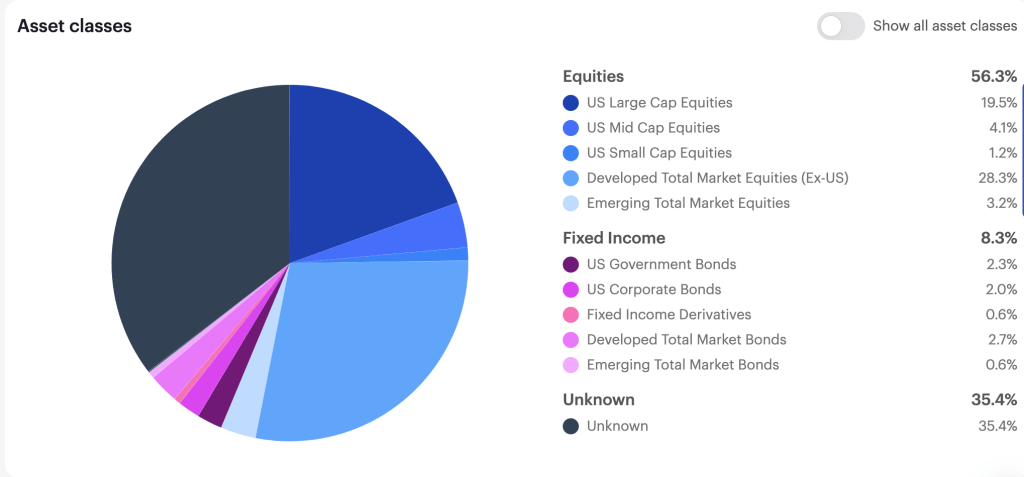
XEQT, like XGRO, is actually investing in thousands1 of different stocks. Unlike XGRO, it does not hold any bonds at all. I thought it would be interesting to see what, exactly, is underneath every $100 you invest in XEQT. See the results below:

FundWhat is it?How much?Compare with XGRO23
ITOT/ XTOT4Broad US stock coverage that tracks the S&P Total Market Index, about 2529 companies (top holdings: Apple, Nvidia, Microsoft, Amazon, Meta)$43.62 of your $100 investment$36.32 of your $100 investment
XEFBroad international (Europe, Asia, Australia) stock coverage that tracks the MSCI EAFE Investable Market Index, about 2500 holdings$25.25 of your $100 investment
$19.76 of your $100 investment
XICBroad Canadian stock coverage that tracks the S&P/TSX Capped Composite Index, about 223 companies (top holdings: RBC, Shopify, TD, Enbridge, Brookfield)$25.71 of your $100 investment
$20.09 of your $100 investment
XEC3000+ emerging market stocks that track the MSCI Emerging Markets Investable Market Index$5.04 of your $100 investment$4.07 of your $100 investment

The top 10 stocks of XEQT as of today looks like this:

TickerCompanyInvestment for every $100
NVDANvidia$2.99
MSFTMicrosoft$2.70
AAPLApple$2.26
RYRoyal Bank$1.67
AMZNAmazon$1.54
SHOPShopify$1.35
TDTD Bank$1.15
METAMeta$1.09
AVGOBroadcom$0.96
ENBEnbridge$0.88
Total$16.59
Top 10 holdings of XEQT as of July 25, 20255

The top stock holding outside North America belongs to Taiwan Semiconductor, at 46 cents for every $100 invested. Additionally, the geographic exposure looks like this:

Geographic exposure of XEQT as of July 25, 2025

One other little tidbit that might be interesting: the distribution yield of XEQT is 2.94% compared with 2.91% for XGRO. This I find a bit surprising, since I would have expected XGRO’s yield to be quite a bit better.

  1. 8,550 to be precise, as of today ↩︎
  2. As of today, might be different from when I wrote https://moneyengineer.ca/2025/01/30/whats-the-deal-with-xgro/ ↩︎
  3. And, if you’re really paying attention, you’ll see that the dollar amounts of this column add up to roughly $80, in keeping with the 80/20 philosophy of XGRO. ↩︎
  4. i lump these together because they hold exactly the same thing. Some loophole that iShares needs to exploit, I gather. ↩︎
  5. On the date I pulled these numbers, cash cracked the top 10 for a holding of $1.34, which is not usual, so I just dropped it. Not sure why that is…perhaps by the end of the month it will resolve itself. ↩︎

Taxes in Retirement

There’s really no avoiding paying taxes, even in retirement. You probably have to do some budgeting to make sure you aren’t being caught unaware, though.

My retirement today is funded from a combination of my spouse’s part-time salary, my/my spouse’s RRIF, selling off assets from my non-registered account, and interest/dividend income from non-registered accounts.

The big difference, as I’m slowly becoming aware, is that aside from my spouse’s paycheque (which has the usual tax deductions / CPP contributions / EI contributions), there is nothing being set aside to pay my tax bill come April 2026. So it goes without saying that I had better make sure there’s a nugget somewhere that I set aside for the upcoming tax bill.

How much should that be? Enter a tool I use to help figure out that sort of thing, referenced in the “Tools I Use” section of this blog: namely, the Basic Canadian Income Tax Calculator1.

The Basic Canadian Income Tax Calculator, from TaxTips.ca

The basic tool, as implied, is pretty basic. It doesn’t include any sorts of deductions aside from the basic personal deduction and dividend tax credits. There’s an advanced calculator that has a bunch more inputs, but for the purposes of this article, the basic tool is good enough.

For the purposes of this tool, your income is in 4 buckets:

  • Other income: This is how 100% of RRIF payments are treated, as well as interest from non-registered assets (e.g. interest from a GIC, bank account, HISA, some ETFs)
  • Capital gains: This is only applicable to non-registered accounts. Note that many ETFs actually generate capital gains and a corresponding T3/T5 slip even if you don’t touch the fund at all2. Larger capital gains are typically generated when you sell an ETF that you’ve held for a while, which includes everything I hold in my non-registered accounts.
  • Canadian eligible dividends: This includes dividends paid by all public companies in Canada.
  • Canadian non-eligible dividends: I don’t have any of those, but if you own shares in a private corporation, you might.

Since my 2025 strategy is to simply collect RRIF minimum payments, I already know what that dollar amount is. I also execute non-registered asset sales monthly to fund my retirement, as I mentioned here. This generates capital gains every month; the exact amount this will sum up to in 2025 is unknowable in advance since it depends on factors like:

  • what specific asset I choose to sell
  • the price of the asset at the time I choose to sell
  • how many shares of the asset I sell at that price

I do track a metric I call “capital gain dollars per dollar of asset sold3” so I can compare the capital gain impact of generating (say) $1000 cash for every asset I own in my non-registered account. So I have a bit of control over the capital gain metric for a given year, but not a lot. My spouse also has non-registered assets in her name, but since she’s earning a salary, I’ll let that be for now.

Some examples might help illustrate the different tax impacts of different withdrawal strategies.

Let’s consider 4 examples, all of which give you 100k gross salary, before taxes:

  • The “RRIF and interest only” strategy: All income for the year is generated by either RRIF payments or interest payments from non-registered accounts.
  • The “non-registered asset sale only” strategy: All income for the year is generated by selling assets in non-registered accounts that create 70 cents of capital gain for every dollar of income thus generated4.
  • The “Dividends only” strategy: All income for the year is in the form of dividends. You’d need a pretty large portfolio to generate 100k of dividend income, just sayin’.
  • The “Blended Approach” strategy: Income comes from a mix of RRIF payments, non-registered asset sales, and dividends. You could play with the percentages yourself; this is an excellent way to see how different liquidation strategies generate (in some cases) very different tax bills.

The table below uses the basic tax calculator to generate the tax bill of the different payment strategies.

Withdrawal strategyRRIF + Interest incomeIncome from asset salesActual Capital GainDividendsTotal Gross IncomeTotal Tax Bill (ON)Avg Tax Rate
RRIF and Interest only100k000100k21.4k21.4%
Non Registered asset sales only0100k70k0100k3.9k5.6%
Dividends only00100k100k3.3k3.3%
A blended approach50k25k17.5k25k100k10.6k11.5%

Fair warning: don’t try to use this table to estimate your own situation. I chose 100k to keep the math easy, but since Canadian tax brackets have different tax rates, the overall gross salary chosen makes a huge difference in the tax bill — enter the numbers yourself!

My retirement planner advised me to target an average tax rate of no more than 15%, and besides the “RRIF and interest only” approach, all of the withdrawal strategies in the table accomplish that. The other takeaway is that on an income of $100k, all of the approaches generate a tax bill in excess of $3k — which happens to be the magic number CRA uses to determine whether or not you have to pay tax in installments.

As a result of doing this exercise, I’ve started a monthly automated contribution to a separate “tax” account5 so that I have money at the ready to pay my tax bill next year. All DIY retirees may want to do the same!

  1. You will probably have to close a bunch of ads before ultimately getting to the page that matters. It’s a forgivable tax to for this useful site, IMHO. ↩︎
  2. If you prefer to avoid annual capital gains, dividends and interest payments, then Global X has ETFs that are designed to do just that. I hold HXT (for Canadian Equity) and HXS (for US Equity) in my non-registered accounts for this reason. ↩︎
  3. This is just the per share capital gain divided by the current share price. I use Adjusted Cost Base to keep track of my capital gains. ↩︎
  4. This is a bit higher than the average of my portfolio, which is about 60 cents for long-held assets. You could choose a different number based on your own holdings. You only pay tax on half of your capital gains, and the calculator knows this. ↩︎
  5. I used Wealthsimple for this since it’s stupidly easy to create a new investment account. And they pay a reasonable amount of interest. ↩︎

Death, Taxes and Estates: Part 3

I am not a lawyer, accountant or tax expert. Your situation may be a lot different than mine. Seek professional guidance if needed.

Part 1 of this blog is found here, and Part 2 is here.

I’m in the tax season stage of wrapping up my Mom’s estate, who died a little over a year ago, a year and a bit after my father died.

Current status

I decided to hire a pro to do the Final Return and the Estate Return since I couldn’t figure out the fine details1 of doing an Estate Return. The Final Return (that’s the easy one, it’s just a regular tax return, except you have to inexplicably file it on paper) would have been within my skill set, but the Estate Return (the one that you have to file to deal with any income generated by the estate after death) was new and confusing to me.

I knew I was going to have to pay taxes on both returns, and using the tax calculators referenced here, I had a pretty good idea of what tax was going to be owed. In essence,

  • The Final Return takes the full value of the RRIF on the day of death as income. This will mean a lot of tax if the RRIF is sizable.
  • The Final Return also assumes any non-registered assets are liquidated on the day of death, which in the case of equity holdings, typically attracts capital gains and the associated taxes2.
  • The Estate Return is going to have to pay tax on any dividends, interest, or capital gains realized by the assets in the estate. Here the tax rate is high, because an Estate is treated as a Trust, and trusts don’t get personal deductions, meaning you get taxed on the first dollar of gains you manage.

A few wrinkles

Submitting the necessary paperwork to the accountant was the usual tedium of getting scans of T-slips, charitable donations and the like to the accountant. I did encounter a few problems.

BMO Investorline Problem 1: Sending T-slips to invalid addresses

My Mom’s assets were all held with BMO Investorline. Imagine my surprise when her retirement home let me know that snail mail from BMO (not BMO Investorline) had arrived at the home. I changed the address of all communications with BMOI to me nearly a year ago at that point, so you can imagine I was less than happy about having to drive across town to pick up what turned out to be a T-slip for the HISA I bought in her self-directed account. At that point, I was a few steps away from livid.

After spending some time with hapless agents who could not tell me why the mail ended up at an invalid address, I penned a note to the formal complaint department of BMO. I just figured that if there was some systemic issue at play here, that at least I could help those who followed me.

The complaints department ultimately admitted it was a screwup on their part and offered their apology. Whether or not it will happen to someone in my shoes in the future is unknown to me, but beware.

BMO Investorline Problem 2: Not providing an RC249 slip

The RC249 is a CRA slip that covers the losses incurred by a RRIF post-death.

It makes some sense: as mentioned above, the owner of the RRIF is assumed to get income equal the the value of the RRIF on day of death. But the RRIF assets aren’t automatically liquidated; they remain invested in whatever they were invested in. If that includes stocks/ETFs and the like, then it’s possible for the value of the RRIF to actually decline post-death. And that is what happened in my case. This loss becomes a tax benefit to the estate return, but only if you have an RC249 to prove it.

Now, the RC249 is clearly intended to be filled out by the issuer/carrier of the RRIF, in my case BMOI. And so, you would expect that to be automatically provided, wouldn’t you? Wrong again.

Another set of back and forth, first with the standard BMOI agents, and then the BMOI estate department, eventually produced a valid RC249 that I could send to the accountant.

Paying taxes owed

As much as I disliked the entire process of working with BMOI’s estate department, the one thing I did like about BMOI was that their non-registered accounts can be linked with a bank account (AccountLink) against which cheques can be written3. (This is something I set up months ago to help distribute some assets early to the beneficiaries). So once the accountants informed me of the eye-watering tax bill (which was pretty much aligned with what I expected), I was able to write the cheques and drop them off with little fuss. Thinking about how you will do that is something to consider in dissolving the estate.

Final Return Notice of Assessment

This was received in pretty short order, a few weeks after it was submitted, and the tax bill was correct.

Next steps

I await the Notice of Assessment for the Estate Account, at which point my accountant will be able to apply for a clearance certificate from CRA. This certificate essentially tells me that CRA considers all business with my mom and her estate closed. Once I have this, I can fully distribute all funds from the estate without having the CRA come after me for monies owed. This takes “up to 120 days” per the website.

  1. More accurately: I couldn’t bear spending hours reading arcane text on various CRA websites hoping I didn’t make a mistake ↩︎
  2. Note that unless directed, the liquidation doesn’t ACTUALLY take place. In my case, I moved all assets to HISA accounts once I gained control of the assets via probate, (a delay of a few months) and then liquidated the assets at the end of 2024. This I did to avoid earning any income from the estate holdings in 2025, which would have delayed the estate return. ↩︎
  3. No matter how hard I tried, I could not convince anyone at BMOI/BMO to send me a debit card for the account, which would have allowed me to “Bill Pay” CRA instead of writing cheques. ↩︎

Example: Using iShares ETFs to Hit Your Asset Allocation Targets

Previously, we talked in broad terms about the categories of what you can invest in, namely Equities, Bonds, and Cash. Having % allocation targets for each of these classes is a necessary starting point for making decisions. Here’s a post that talks about how to get there.

Maybe it’s helpful to take a look at some examples of what you can buy to hit each of these categories. I’m going to use iShares as the guinea pig since it offers a lot of products, but you could play the same game with any provider you like.

So if you visit iShares ETF page (this is what I’m looking at as I write this), you are presented with a list of (and I’m not joking here), 169 different ETFs. Ouch. How can anyone decide which of these is the best fit?

Helpfully, the page includes an “Asset Class” Filter:

iShares “Asset Class” classifcation for their 169 ETF products (May 2025)

…and now you can quickly recognize “Equity” (with 105 different ETFs to choose from). “Fixed Income” is the other term of interest — this will include bonds and probably something that looks more like cash. So this is now looking a little more sane. Wait, what’s this? They each have “sub classes”?

iShares ETFs Equity and Fixed Income Sub Classes as of May 2025

This narrows things down somewhat. Let’s break these down further.

Equity Sub-Classes

The term “Cap”1 comes up here. This is short for “capitalization” or, in plain English, “How big is the company we’re investing in?”. I don’t like to place bets on which companies are the most appropriate, so I would gravitate to the “All Cap” sub asset class here. “Large Cap” is probably the next best bet, since large companies tend to dominate the returns in the markets they serve. So let’s select both2.

We’re still left with 75 ETFs with that filter. Still a lot to take in. I suggest sorting by “Net Assets” with the largest on top by clicking in the appropriate column. I figure if other people are investing in these funds, why shouldn’t I?

So here’s my take on the ETFs I see on my screen:

ETF SymbolClassConsider? Comments
XIU, XICCAD EquityYBoth variations of TSX. I would lean towards XIC because it is cheaper to own.
XSP, XUS, XUUUS EquityYXSP is “hedged” meaning it tries to take away the FX variations, and I normally don’t worry about that. XUU would be my top pick here.
XEF, XFH, XSEM, XECInt’l EquityYXSEM/XEC are solely emerging markets, and I would never just hold it absent something like XEF/XFH as well. If I had to pick one, it would be XEF since it’s unhedged. If I could add a second, it would be XEC because it’s cheaper to own.
XQQUS EquityNThis is too narrowly focused on 100 Nasdaq stocks; the point of buying a asset category is to buy as many companies as possible
XAWUS Equity + Int’l EquityYAn easy way to get non-Canadian Equity exposure with one ETF
XGD, XEI, XDV, XFN, XEG, CPD, CDZ, CIF, XIT, XHCCAD EquityNThese are all too narrowly focused and/or trying to make bets on specific parts of the market. Asset allocation is about buying the whole market.
Everything elseNo ideaNThere are probably funds that I would consider further down the list but there’s only so many hours in the day, ya know?
Assessing the largest iShares All-Cap/Large Cap ETFs

Fixed Income Sub-Classes

One thing I’ve learned is that Fixed Income is harder to parse than Equity. My quick impression of the names I see on my screen:

  • Credit: No idea what this might mean
  • Flexible: ibid
  • Government: ok, that’s easy, this is only looking at bonds issued by governments. This tends to be the most popular segment of the bond market because (a) there’s a lot of them3 and (b) they are seen as safe investments.
  • High Yield: This is code for “junk bonds”. More risky, but higher rates of interest.
  • Inflation: My guess is that this is what is intended to mean “cash”
  • Multi-Sectors: My guess is that this trying to build a broad universe of bonds.

So, for simplicity, I think I’ll ignore the sub-segments but give you my take on the largest offering here again.

ETF SymbolSub Asset ClassConsider?Comments
XBBMulti-SectorY“Core Canadian Universe” sounds like it’s got a lot of holdings across the spectrum, and it’s cheap to own. Perfect. This is clearly “Bonds” in my nomenclature.
XSBMulti-SectorY“Short Term Bond Index” makes me wonder if this is leaning towards a cash-like investment. The fact sheet puts the loan duration at “1 to 5 years” which isn’t cash-like enough for me. This is “Bonds”, albeit rather conservative ones.
XCB, XSHCreditYThis is just the corporate bond market with no government. XSH is less risky because its bonds have a shorter duration on average.
CMRMulti-SectorY“Premium Money Market” sounds like “Cash” to me, and reading the fact sheet4 makes it sound a lot like ZMMK which was my previous winner in this category.
XGBGov’tNNothing wrong with it, but I don’t buy “just” government bond ETFs. Without some corporate exposure, they don’t generate enough returns for my liking. I’ll take the risk.
XLBMulti-SectorNThis only buys long-duration bonds. This would be ok if you had holdings elsewhere on the shorter side.
Everything elseNo ideaNThere are probably funds that I would consider further down the list but there’s only so many hours in the day, ya know?
Assessing the largest iShares Fixed Income ETFs

I do have to break away from the largest list to mention some ETFs on the Fixed Income chart that I didn’t know you could buy on the Canadian Market: XSTH and XSTP, which track the TIPS Bond Index. The TIPS index is well known to US investors5 because it’s a very cheap way to buy an inflationary hedge — it’s in the name, as TIPS stands for “Treasury Inflation-Protected Securities”. Now, of course, this refers to US Inflation, and unless you’re buying XSTH (which is the same as XSTP, except hedged to avoid FX changes) you’re also buying into a security that will vary with the CAD/USD exchange rate. So, not sure it’s of interest to the average Canadian investor, but it’s something I didn’t know about before.

Other classes in the iShares List

We only looked deeply at the Equity and Fixed Income categories, but what about the others?

  • The Commodity category holds ETFs that trade in one of Gold, Silver or Bitcoin. None of these provide predictable returns and are very narrow bets, so for that reason, I have no interest.
  • The Multi-Asset category contains funds that are a mix of Equity and Fixed Income, with the exact ratios depending on which specific fund you buy. This category contains funds I invest heavily in, namely XGRO and XEQT. I cover “all-in-one” funds like this in this article. Multi-asset funds basically take all the work of trying to balance your Equity and Bond percentages out of your hands for a very low price.
  • The Real Estate Category is just another segment of the Equity category and like other sub-segments, I don’t pay any attention to this one either.

A Final Word

Dividing Investments into asset classes (a short example)

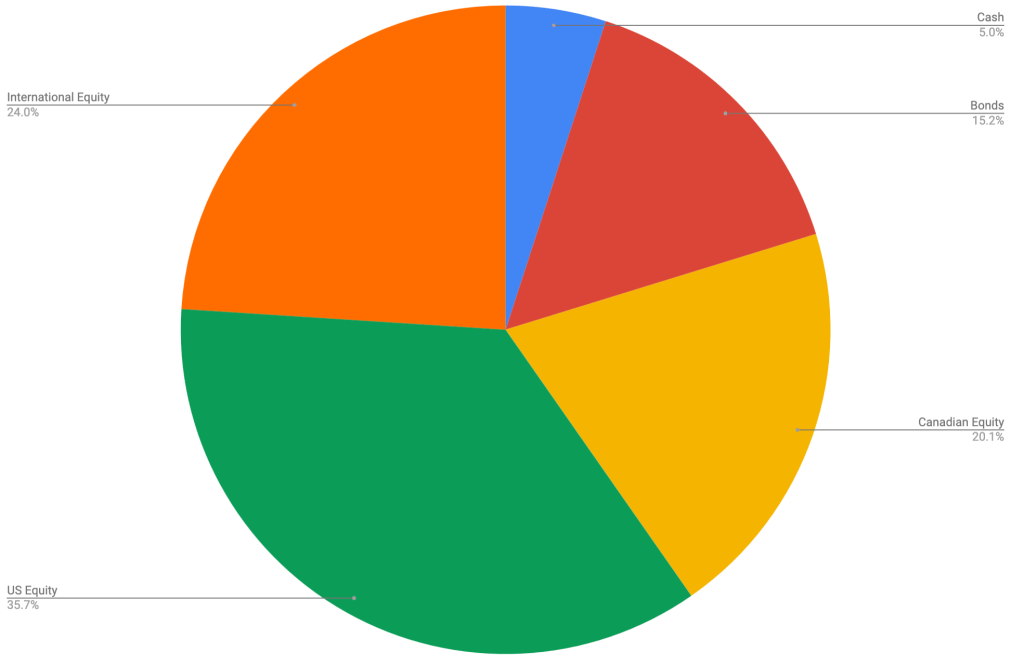
It’s easy to slice and dice the three broad asset categories (Equity, Bonds, Cash) many different ways and you can spend many pleasurable6 hours finding the absolute “best” ETF for any subsegment listed above, or you could invent your own (Ultra Short Term Emerging Market High Yield Bonds Canadian Hedged?). It’s easy to go overboard here, and in the course of simplifying my portfolio, I have restricted myself to 5 broad categories when i think about my investments:

  • Equity: divided into 3 buckets for Canadian, US and International Equity
  • Bonds: There are no sub-buckets here, but the products I buy have broad geographic, segment, and duration coverage. Are they allocated optimally? No idea.
  • Cash: Everything in this category is held in either USD or CAD ultra-short term bonds.

You can see the specific holdings in my portfolio by looking at any of the “What’s in my Portfolio” posts (April 2025 is here or a series of 3 videos is found here) or you can just see the 4 ETFs I hold for the long term here.

And in the course of writing this article, I discovered this fun Asset Mixer you can use to experiment with different asset allocations yourself. It’s like making cocktails, except with money 🙂

  1. Bill Barilko disappeared… ↩︎
  2. Full disclosure: I cheated here. I couldn’t figure out why I wasn’t seeing TSX funds under “all Cap” but that’s because the usual TSX 60 fund is listed as a large cap fund. ↩︎
  3. Governments do love deficit spending ↩︎
  4. In Feb 2025, CMR added commercial paper to its holdings, making it look a lot more like ZMMK. I’ll have to take a closer look at this one. ↩︎
  5. Especially Bogleheads. Look it up. ↩︎
  6. Well, for some of us ↩︎

Investment basics: Asset Allocation

We’ve talked about asset allocation / asset classes before in this space, most recently here. But while watching a recent post1 from one of my favourite experts, The Loonie Doctor2, it occurred to me that it might be helpful to start right from the beginning.

And to me, that beginning is understanding WHAT to invest in. Broadly speaking, you can choose between three categories: “Equity”, “Bonds” and “Cash”.

“Equity” refers to stocks of publicly traded3 companies. Owning stock means you own a piece of the company you invest in. This allows you to collect dividends if and when the company pays them out. If the company fails/goes bankrupt, the stock becomes worthless.

“Bonds” are essentially loans to companies or governments4. When you buy a bond, you’re buying into a stream of interest payments that stop when the bond is paid off. If a company who issued the bond fails/goes bankrupt, bond holders legally get first dibs on whatever assets remain in an effort to get their money back, but it’s possible that there isn’t anything left to fight over. Bonds can be fully paid off in various timeframes, from very short (30 days) to very long (20 years).

Cash” is the money that’s left. Cash can be invested in things like high interest savings accounts, GICs/Term Deposits, Treasury bills (aka T-Bills), or stuffed under a mattress5. There is definitely a grey area between “Cash” and “Bonds” since both involve lending money to an entity. Shorter duration loans are more cash like. Lending to governments and large corporate entities (like banks, which is what you’re doing when you buy a GIC) is more cash-like. Money under a mattress is absolutely cash, albeit not really an investment at that point.

Using the data tabulated here, you can build a chart like the one below to see how much the $1000 investment you made in each of these categories would be worth 50 years later6.

The chart shows that Equities outperform Bonds and Cash by a wide margin when looking at an investment time period of 50 years. Bonds also outperform Cash substantially.
Historical returns for Canadian equities, bonds, and cash (as of December 2024)

Looking at this chart, it should be reasonably obvious that equities, represented here by Canadian Stocks, over time, generate the best bang for your invested buck. The “over time” phrase is very important, because otherwise, one could rightly ask, “why would anyone ever invest in anything other than stocks?”. The reason is volatility — in any given short time period, your returns could look very, very bad indeed. Just one example (of many) — the TSX has LOST money in 3 of the last 10 calendar years per https://en.wikipedia.org/wiki/S%26P/TSX_Composite_Index.

Bonds, generally speaking7, have a much steadier and predictable return, often uncorrelated with stocks. When stocks go up, bonds often move in the opposite direction. And cash, well, its benchmark is the inflation rate. If cash is returning the inflation rate8, then at least you’re standing still.

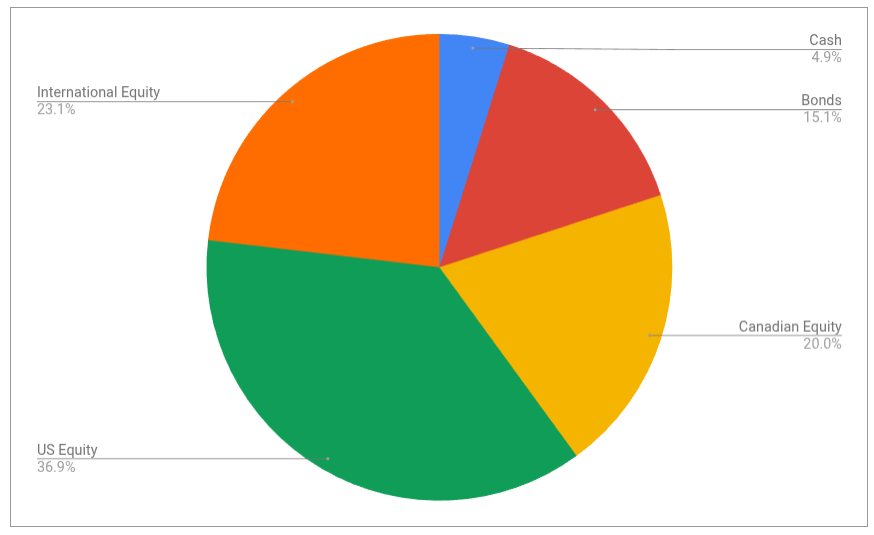
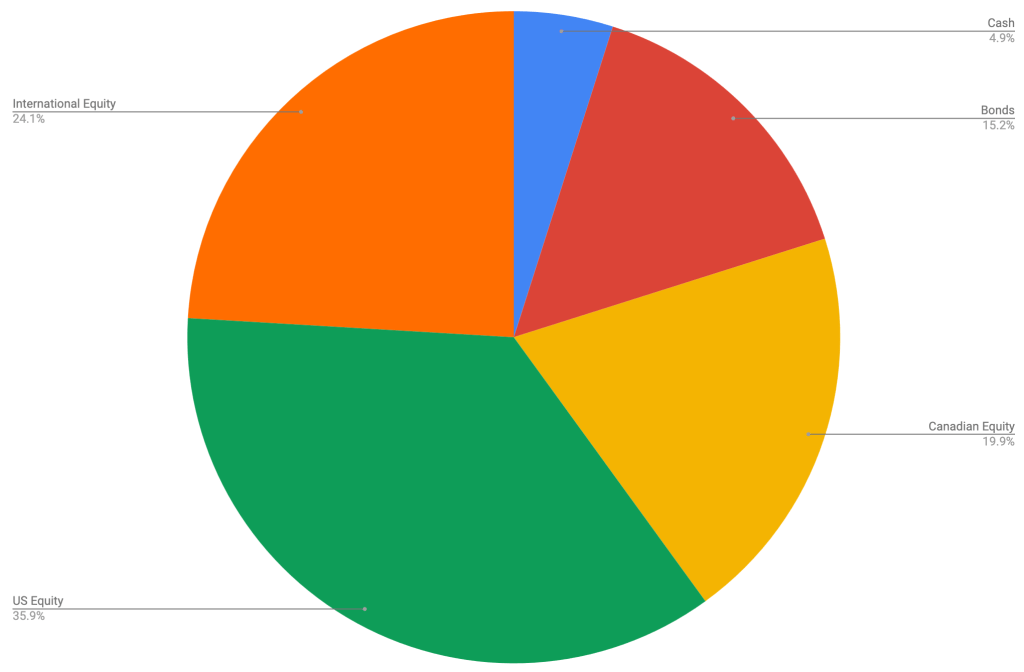
In my investment portfolio, my target allocations are 80% Equity, 15% Bonds, 5% Cash. Using products like all-in-one ETFs and my handy-dandy multi-asset tracker spreadsheet make this relatively easy to track. In my next post, I’ll show how to identify ETFs in each of the categories.

  1. Which provides further justification that using all-in-one ETFs is really the best approach. ↩︎
  2. Which, while positioning itself as being for doctors, has a ton of useful information for those of us who are not physicians as well. ↩︎
  3. And of course it is possible to buy stock in private companies (so-called private equity) but since I don’t know very much about that world, I figured I’d keep it simple and just talk about things that are available to the general public. ↩︎
  4. And the financial stability of those companies and governments can vary a lot. That’s where bond rating services can point you to higher quality entities (with a low risk of not paying) or lower quality entities (with a higher risk of not paying, but a better interest rate — the bottom of the barrel here are called “junk bonds”). ↩︎
  5. AKA “the chequing account of most major banks”, which don’t pay any interest ↩︎
  6. For “Canadian Stocks” this is the TSX Composite index (former name: TSE 300). “Canadian Bonds” is 10 year Government Bonds. ↩︎
  7. Let’s forget 2021-2 ever happened to the bond market. ↩︎
  8. And it doesn’t always do so! ↩︎