
The HISA table April 2025

Summary: High Interest Savings Accounts (HISAs) are a way for cash to earn half-decent, risk-free interest. These “Series F” HISAs are likely available through your online broker, but you may have to ask how to get at them, exactly.

We talked about HISAs in February over here if you need a quick reminder: https://moneyengineer.ca/2025/02/14/earn-money-with-your-cash-the-hisa-table-february-2025/

On March 12, the Bank of Canada reduced their overnight rates by another 0.25%.1 Unsurprisingly, this had a knock-on effect to the interest rates provided by the series F HISAs I track.

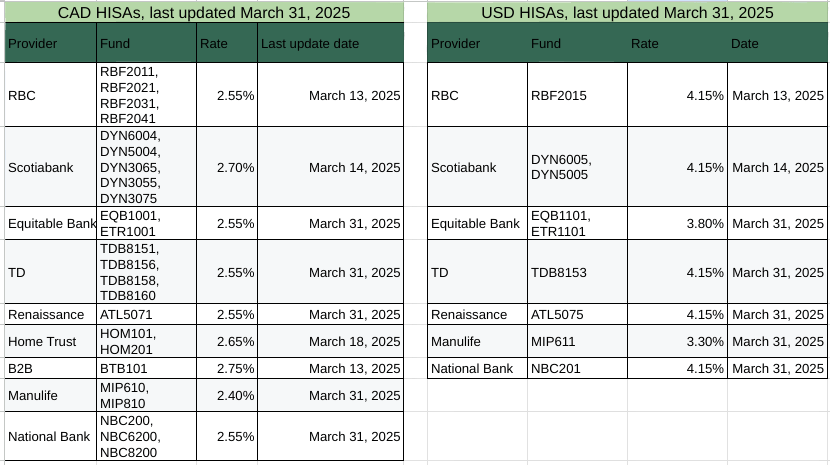
Equally unsurprisingly is that the US Federal Reserve didn’t touch their rates, and as a result, there were no changes in the HISA rates paid out for USD accounts. Here’s the full breakdown:

Current HISA rates for HISAs available via QTrade

There’s also a Google Sheets version with a bit more detail (source links) if you prefer.

For Canadian Dollar HISAs, B2B bank remains top of the heap: https://b2bbank.com/advisor-broker-rates/banking-rates.

For those of you who hold US cash in your brokerage accounts, you can benefit from the much higher US interest rates, and you have multiple choices since multiple providers are paying the same rate.

  1. You can also say “25 basis points” if you want to impress your friends ↩︎

How I think about investing: Asset classes

Passive investing while ensuring good diversification has been my strategy for decades. But how do I define “diversification”? For me, it’s always been about paying attention to how much of my total portfolio was invested in each of five1 asset classes and keeping them aligned with my targets:

  • Cash or cash equivalents
  • Bonds2
  • Canadian Stocks
  • US Stocks
  • International Stocks3

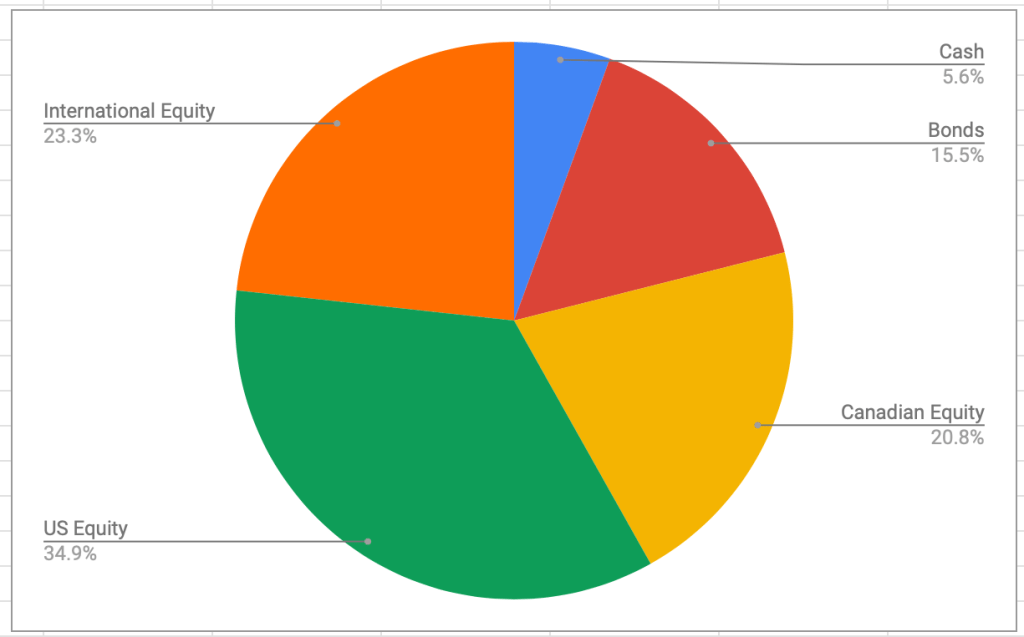
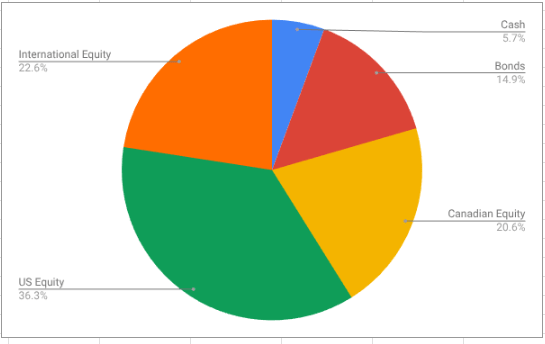
I got this idea from my last financial advisor who provided me with a lovely Cerlox4 bound annual report showing me how hard they were working on my behalf5. The report included a pie chart of how my investments broke down. This is what that pie chart looks like in my portfolio this morning:

Retirement portfolio by asset class, March 28, 2025

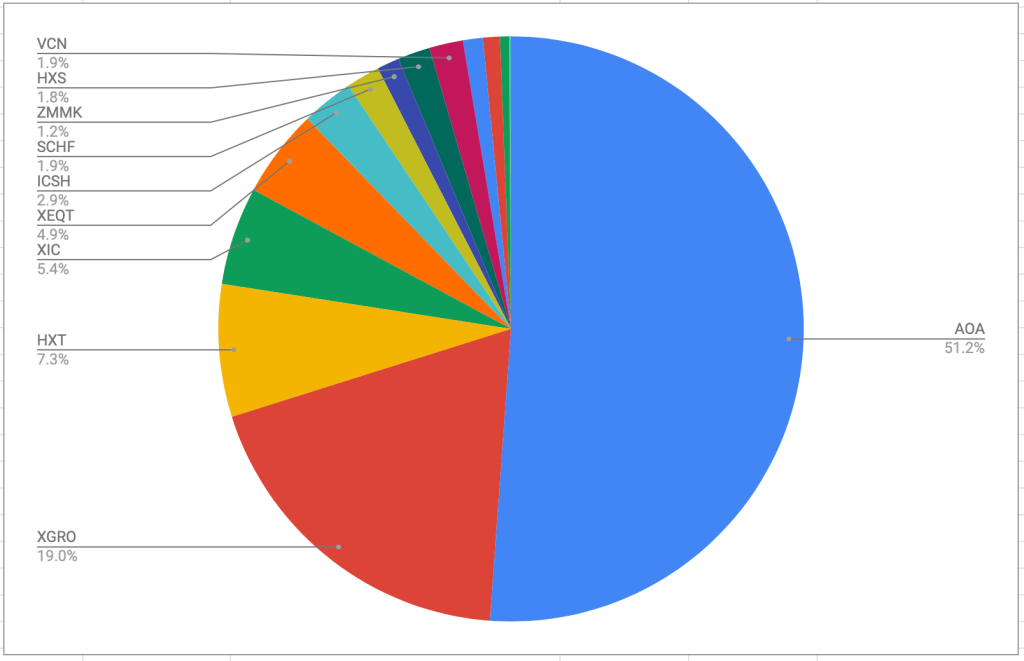
This pie chart has been my guiding principle: have a target percentage for each asset class in mind, and adjust your portfolio as needed to keep the percentages in line. This simple principle has been adopted by so-called asset allocation ETFs aka “all-in-ones” like (my personal favourites) XGRO6 and AOA7.

But are these even the right asset classes? Where are REITs8? Where’s precious metals? Where’s Bitcoin9? What’s your bond duration? Do you have enough exposure to high-growth geographies?

Short answer: just like I’m too lazy to pick stocks, I’m too lazy (and not smart enough) to pick a “winner” of a given asset class. The “periodic table” of investment returns by asset class is a must-read for DIY enthusiasts out there: https://themeasureofaplan.com/investment-returns-by-asset-class/ (go ahead, take a look, I’ll wait).

The folks at Measure of a Plan agree that trying to figure out the “hot” asset class is a very difficult task:

It’s no easy feat to pick the winner in a given year. The asset class rankings appear to be randomly tossed about over time, with the top performer in one year often falling down to the middle or bottom of the table in the next year.

https://themeasureofaplan.com/investment-returns-by-asset-class/

By keeping an eye on the pie chart, and shifting investments to align with my targets, I’m never at risk at being overweight in any one asset-class, and beaten-down asset-classes naturally get more funds to get the percentages right. It’s naturally causing “buy low, sell high” behaviour.

So: what about the asset classes I’m using? Are 5 asset classes too many? Too few? I don’t know. “Good enough” is sort of my philosophy in the spirit of trying to keep things simple.

The spreadsheet I’ve used to help me track my portfolio breakdown is found here. In future posts, I’ll talk a bit about how to make it work for you.

  1. For a long time, “cash” was not part of the consideration. Leading up to retirement, I started to carry a 5% cash weighting to help cushion market swings. ↩︎
  2. In years past, I did try to keep track of short-term versus mid-term versus long-term bonds. I gave up on that. ↩︎
  3. In years past, I did try to keep track of developed markets versus emerging markets. I gave up on that. ↩︎
  4. I had to look up how this was spelled. https://www.collinsdictionary.com/dictionary/english/cerlox ↩︎
  5. The fact that this report looked the same as the reports generated by two other advisors led me to the conclusion that my hard working advisor was perhaps being assisted by commercial software. ↩︎
  6. Overview of XGRO’s asset allocation strategy: https://www.blackrock.com/ca/investors/en/literature/product-brief/ishares-core-etf-portfolios-brochure-en.pdf ↩︎
  7. Overview of AOA’s asset allocation strategy: https://www.ishares.com/us/literature/product-brief/ishares-core-esg-allocation-brief.pdf ↩︎
  8. My first list of asset classes prepared circa 20 years ago did include REITs but I dropped that class, figuring (perhaps incorrectly) that the bond portion of the portfolio was good enough. Doing a bit of digging, I see that both AOA and XGRO hold REITs, and both consider them “equity” investments. ↩︎
  9. It’s actually obligatory for any article on investing to mention one (or more) cryptocurrencies, and/or one (or more) meme stocks 😉 ↩︎

Questrade Bonus Capability: Passiv

**** Update: Per email communication on October 24 2025, as of January 31, 2026, Passiv will not be offered at all by Questrade, as they are planning to launch their own integrated portfolio monitoring and rebalancing tools”.

**** Update: As of June 1, 2025, Passiv Elite is no longer offered for free for Questrade Clients. It’s now part of a subscription service called Questrade Plus***

As you may have heard, I’m in the middle of a transition between online brokers1. And so I’ve been spending some more time getting to know what Questrade offers to the DIY investor besides free buying and selling of stocks and ETFs.

One thing I looked into lately was Passiv, a service that is offered for free for all Questrade clients.

In brief, Passiv is a 3rd party web application2 that allows you to track your investments from a single screen, no matter if they are found in multiple investment vehicles (e.g. TFSA, RRSP, RRIF) or if they are found across multiple providers (full list of supported brokers is here)3.

What’s more, it also evaluates your portfolio against a model that you define. For example, if you (like me) have an investment portfolio with a target allocation of 5% cash, 15% bonds, 20% Canadian equity, 36% US equity, and 24% international equity, Passiv can assess your current holdings against these targets, and even do the trades to rebalance the portfolio!

Astute readers will note these are a lot of the same benefits I’m a fan of — and one of the big reasons most of my portfolio is invested in all-in-one asset allocation ETFs. (Are these ETFs unfamiliar? You can read about them here.)

I tried to use Passiv to model my own portfolio, but discovered that all-in-one asset allocation ETFs aren’t really supported by the tool4. Once I thought about it some more, it’s clear why — Passiv really markets itself as an ALTERNATIVE to using all-in-ones. Here’s a clear marketing pitch from Passiv that demonstrates its approach: https://passiv.com/feature-posts/model-portfolios-that-cost-less-than-all-in-one-funds-or-robo-advisors.

So to get the full benefit of Passiv, instead of holding XGRO, you would instead hold the constituent components of XGRO, a fund I’ve broken down previously. This would save you some management fees over time. Passiv helpfully does the math to calculate how much here5.

As a certified cheapskate, I’m always interested in saving a bit of money. But there are some downsides I could see in the Passiv approach:

  • You have to actually DO the rebalancing now and then. Not a big deal, but a fund like XGRO does this as part of their offer6.
  • You have to do the rebalancing no matter what. By this I mean that you have to buy when others are selling, and sell when others are buying. You can’t get overly attached to any one segment of your portfolio, because then you start making bad decisions based on “gut instinct”. Humans are notoriously bad at this7.

On the plus side, you will definitely save on management fees, and you could certainly tweak the contents to avoid products you wouldn’t normally buy (e.g. XGRO has some hedged funds, which I don’t like, typically).

An unknown for me is how foreign exchange is handled. That’s always something I consider since a lot of my retirement savings are in USD. Some experiments required 🙂

Anyway, it’s given me something to think about. I’ll have to see how easy it is to use in practice once all my accounts are back in place. Any Passiv users out there? I’m interested in your take — just drop a line to comments@moneyengineer.ca.

  1. And some (not all) of the funds are now showing up in Questrade, about 3 weeks after starting the process. Switching providers is not for the impatient. ↩︎
  2. WARNING: they don’t have an app. But someone named “Pasiv” does, and it looks very similar. ↩︎
  3. Other benefits include tracking of dividends, performance charts, etc. All stuff Questrade is apparently not very good at. ↩︎
  4. One asset class per stock symbol. My home-grown spreadsheet supports dividing symbols by asset class. ↩︎
  5. The calculation doesn’t include Passiv’s fees for the service, which are waived if you are Questrade client. ↩︎
  6. Per BlackRock “XGRO’s portfolio will be monitored relative to the asset class target weights and will be rebalanced back to asset class target weights from time to time at the discretion of BlackRock Canada and/or BTC. Generally, XGRO’s portfolio is not expected to deviate from the asset class target weights by more than one-tenth of the target weight for a given asset class.” [source] ↩︎
  7. If you’re interested in how behavior shapes investing, https://www.looniedoctor.ca/2024/12/13/etf-investor-behavior/ is a very good introduction to the topic. ↩︎

News: Extended Tax Filing Deadline for some of us

Summary: If you have capital gains to report for the 2024 tax season, your tax filing deadline has been extended by a little over a month, until June 2, 2025.

Much ink has been spilled about the proposed/delayed/killed changes in the tax treatment of capital gains in Canada. All the fuss simply means that some of us get an extension to our 2024 tax filing deadline. Does it apply to you? It might. Here are some1 scenarios where you might get a chance to file a bit later.

You Have a Non-Registered Investment Account? Read on.

Some people get confused over capital gains. Capital gains don’t apply to TFSAs, RRSPs, RRIFs, LIRAs or FHSAs. So if that’s all you have for your investments, you don’t need to worry. But if you do have a non-registered account, then the extended deadline may apply to you.

Did you get a T3 or T5 slip? Read on.

Box 21 of the T3 slip and box 18 of the T5 slip shows capital gains realized by funds you held in 2024. If you have values in these boxes, then you can procrastinate!

These boxes will be non-zero if you held ETFs or mutual funds that sold shares behind the scenes and made a profit. My go-to investment asset-allocation ETF (XGRO) made capital gains of nearly 15 cents per unit held2, per https://www.blackrock.com/ca/investors/en/literature/tax-information/distribution-characteristics.pdf.

Some people are confused by the idea of having to declare a capital gain on an asset they didn’t touch in the course of the year. While you didn’t do anything, the people who manage the fund on your behalf did. The alternative would be to hold individual stocks yourself, but I myself prefer the massive diversification of funds like XGRO.

Did you SELL an asset in a non-registered account in 2024? Read on.

In many circumstances, the sale of a stock/ETF/mutual fund/foreign currency3 in a non registered account will generate a capital gain. While this scenario doesn’t apply to me in 2024, in 2025 it certainly will since part of my retirement income comes from this exact source.

None of this applies? No extension for you, probably.

If you answered “no” to all the previous questions, then you should file your taxes per the usual deadlines. And even if you answered “yes”, there’s no harm in filing your taxes anyway, since modifying a filed return is pretty easy to do online. Be aware, though, that some providers may delay getting T3s and T5s to you, so if you’re expecting these documents and haven’t seen them yet, you should probably wait for them before attempting to file. The providers I deal with typically don’t issue all documents until the last week of March, so I’ll get started on filing my own taxes starting in April.

  1. There are almost certainly other scenarios where you get an extension. I’m not an accountant or a tax lawyer. Caveat emptor. ↩︎
  2. In my case, I don’t actually hold XGRO in any non-registered account at the moment. It’s all in RRIFs/TFSAs where I don’t have to worry about such things. ↩︎
  3. Interactive Brokers issued me a statement showing me the money I made buying and later selling a chunk of USD in 2024. That counts too. ↩︎

Death, Taxes and Estates: Part 2

I am not a lawyer, accountant or tax expert. Your situation may be a lot different than mine. Seek professional guidance if needed.

Part 1 of this blog is found here.

I’m still wrapping up the estate of my late mother, who died a little over a year ago, a year and a bit after my father died.

My situation

All my mom’s worldly assets were held with BMO Investorline: RRIF, TFSA and a non-registered account. This was a self-directed account; the relationship with BMO (as I came to learn) was pretty informal. Me and my siblings were named as beneficiaries of the estate, and my Mom had taken steps to name us as beneficiaries for the RRIF and TFSA. More details about how that works were covered in a previous post.

First weeks

I had ready access to estate cash because I was named as a joint account holder on my Mom’s chequing account1. This is a very useful thing to have in place, since it can cover expenses incurred after death: funeral costs, moving expenses are two that come to mind. I treated this account as part of the estate, but it allowed me to spend the estate’s money instead of my own for these things.

DIY Estate Handling

Informing BMO Investorline2 of my mother’s death was required, and that took a single call to the general help desk. After about a week I had an initial meeting with their estate department.

Once I provided proof of death, all accounts were frozen and I could no longer even see what was in them. BMOI correctly noted that we were the beneficiaries of the TFSA and RRIF and we started the paper-intensive3work of liquidating and distributing the assets held in those accounts. I checked my notes — it took about 2 months for that step to be fully completed.

What was unexpected was that BMOI gave us ALL the money in the RRIF, with no taxes withheld. From a tax perspective, a RRIF is treated as income in the hands of the deceased on the day they die. For most people, that means a substantial tax bill for that tax year. So as an executor4, I had to be VERY sure that my Mom’s non-registered account could cover the tax bill that would eventually come. Using a tax calculator helped a lot.

The non-registered account, where the bulk of the assets lay, would require a probated will, as I expected. This account remained locked and frozen.

Probate and probate fees

In the very simplest terms, probate means getting a court to certify a will as accurate. And when you think about it, it makes sense that financial services companies want to be VERY sure that the executor (aka estate trustee) is in fact the correct person.

After doing a bit of reading (mostly this source) I decided I could tackle it on my own. This was made significantly easier by the fact that I lived in the same city as my mother, and I had access to a courthouse were I could take my completed forms.

When filing your probate papers, you also have to pay probate fees (aka Estate Administration Tax), which means you have to know the total value of the estate on the day of death. BMOI was able to provide me statements up to that day so I had a to-the-penny accurate assessment of the value held there. BMOI was also able to write a cheque to the Ontario Minister of Finance for these fees using funds available5 in the non-registered account. This meant I wouldn’t have to front the money myself.

Probate fees, in my Mom’s case, were not particularly large (not compared to the estimated tax bill), and since RRIF and TFSA were not part of the estate, they were also lower than they could have been.

After filing, the wait for the court-certified document began. I had very low expectations (I had conservatively estimated a 6 month delay here), but I actually had the probated will arrive in the mail a month later, which was about 4 months after my mother’s death.

Using the Probated Will

With a probated will in hand, I could now unlock the non-registered funds in my Mom’s estate. This required me to open an estate account with BMOI and then transfer the non-registered funds to it. After all that paperwork, I once again had full access to the assets that were formerly held in my Mom’s non-registered account — I could log in to the portal, see the holdings, and most importantly, perform transactions myself at the usual self-directed transaction fees.

I sold all the assets (mostly ETFs, naturally) and partially distributed them to the beneficiaries. Distributing the assets was admittedly (again) more challenging than I thought. Since I was quite familiar with how BMOI worked, I requested AccountLink cheques for the estate account, figuring this would be the easiest way to distribute the funds6. This resulted in a bit of a runaround, but eventually I got a box of cheques sent to me. I held some money back7 so I could pay the 2025 tax bill; this money I invested in a HISA.

Preparing for Tax Season

In late 2024, I removed the remainder of the estate from the HISA account. This was done so as to not have any income generated by the estate in 2025. This simplifies the tax filing considerably.

After doing a bunch of reading, I gave up on the idea of attempting to do the taxes myself. I knew there would have to be both a Final Return (for my Mom) and an Estate Return (aka a T3 return) but I wasn’t really sure about all the steps, and of course CRA’s website isn’t really designed for the layperson to figure this stuff out easily. There was also the matter of filing a CRA clearance certificate. I hired a pro to figure all this stuff out. As it turns out, my Mom’s estate qualified as a GRE Trust, which is, as I understand it, pretty typical. That would appear to offer some potential tax benefits, but I’ll have to wait and see and this point.

  1. It didn’t hold a significant amount of money. Larger sums could conceivably attract the attention of CRA as a bare trust. ↩︎
  2. Hereafter referred to as “BMOI”. Laziness. ↩︎
  3. Actually, mostly filling out PDFs and sending them back over secure messaging ↩︎
  4. If the estate can’t pay the taxes, then the executor is legally obligated to pay ↩︎
  5. Like all matters estate-related, this took a lot of effort. Having sufficient funds when my mother was alive was a very simple process: log on to the portal, sell some shares, wait a few days, get the money. In an estate scenario you have to write a letter of direction to indicate what, exactly, to sell. Then you wait a week or two. Then you get angry at the fact that they charged you $40/trade. Then you write another letter of direction to indicate who to write the cheque to. Then you wait a week for the cheque to arrive. ↩︎
  6. I’m not really sure how the mechanics would work with a broker that doesn’t have bank services. EFT I guess? ↩︎
  7. Probably more than I needed to hold back, but I wasn’t taking chances. ↩︎