These rates underpin things like the HISA table I update monthly; as a result, I wouldn’t expect much in the way of change for my upcoming August update.
The next announcements from the two are scheduled for September 17.
HISAs, for those in the know, are “High Interest Savings Accounts” and offer a nearly zero risk way to earn some interest on your cash holdings. Read all about them here. “Class F” funds are usually available via your online broker, often bought and sold in the same module as mutual funds, although they are NOT mutual funds.
The table hasn’t changed since May1, but I’m going to start adding HISA-alternative ETFs to the table just for comparison purposes. CASH and HISA are frequently-used Canadian ETFs that buy HISAs exclusively. I instead use ZMMK, which does not invest in HISAs at all, but instead uses very short term bonds to generate income. This is admittedly a bit riskier than the alternatives but as long as it pays me a bit of a premium, I’m ok with that. I did a market overview of cash and cash-like ETFs back in March, if you’re interested.
UCSH and HISU invest in HISAs exclusively; I instead use ICSH which is a rough equivalent of ZMMK in terms of portfolio makeup. Like ZMMK, I enjoy a slight premium in yield as a reward for taking a bit more risk.
The next possible change to Canadian interest rates will be on July 30. The next possible change to US interest rates will be on July 29 or 30, so next month’s table may have some changes, most likely downward. ↩︎
Calculated by dividing most recent distribution (June 30, 2025) by NAV price and multiplying by 12. What the providers show on their ETF fact sheet seems a bit random. ↩︎
Based on July 1 distribution. The 30 Day SEC Yield as of July 2, 2025 shows 4.73% which is in the right ballpark. The SEC Yield appears to be a US effort to provide the investor with apples-to-apples comparisons of current yield. ↩︎
You can see last month’s table overhere, with a newly updated “last update” date 🙂
Since my provider (Questrade) doesn’t provide a way to buy HISAs on the cheap, I use ZMMK for my Canadian cash holdings and ICSH for my USDs. These ETFs are part of my ETF all-stars. ZMMK’s last distribution was $0.12 per share, which works out to a yield of 2.89%2 and ICSH’s last distribution was $0.198284 per share, which works out to a yield of 4.71%.
As expected, I’m getting a slight premium on my interest rate for taking on a slightly more risky investment. I’ll keep on eye on that in future posts!
Happy May to all, here’s some news from the world of Canadian DIY investing.
HISA rates are stable
HISAs, for those in the know, are “High Interest Savings Accounts” and offer a nearly zero risk1 way to earn some interest on your cash holdings. Read all about them here. “Class F” funds are usually available via your online broker, often bought and sold in the same module as mutual funds, although they are NOT mutual funds.
The periodically updated HISA table I maintain has been updated for May. No changes seen from last month, which is unsurprising, given both Canada and the USA have held interest rates steady over the past month. Here it is:
As a newly-minted Questrade user (got my first bonus payment yesterday, yay!) I see this as a net negative. Let’s look at why.
Passiv Elite is no Longer Free
One nifty (and unexpected) bonus I discovered being a Questrade client was getting access to Passiv’s advanced features. Questrade Plus means that particular freebie is coming to an end. Passiv’s “community” (i.e. free) service is still somewhat useful, but if you want automated rebalancing, you’re going to have either pay Questrade (and subscribe to Questrade Plus) or Passiv (currently $99/year) for that privilege in the near future.
Unlimited Journaling of Limited Use
The unlimited journaling feature of Questrade Plus targets people like me who do Norbert’s Gambit to convert USD to CAD on the cheap, but since I don’t do this sort of thing super-frequently (maybe 5-6 times a year at most), I’d rather pay-as-I-go (currently priced at $9.95 per request).
Real Time Data Streaming of No Interest
The “real time data streaming” feature targets the day trader. Other providers include this sort of thing for free (QTrade, Interactive Brokers). That’s not my thing. It does make me wonder who Questrade sees as their ideal client. Are they trying to be Wealthsimple? Or are they trying to be Interactive Brokers?
Wealthsimple Self-Directed RESPs, coming soon
Wealthsimple continues to chip away at the gaps in their self-directed portfolio offerings. RESPs were one of those gaps, but now it’s been filled, and the main website has been updated to reflect this. I can confirm that I have been offered a spot on the beta launch, so its release to the general public is imminent. Wealthsimple has offered robo-advisor RESPs for a while, but the DIY investor has been forced — until now — to look elsewhere for this.
Unless banks fail. We are all in a lot more trouble if that happens. ↩︎
Because, we all know, you can never have enough subscriptions, right? ↩︎
Summary: High Interest Savings Accounts (HISAs) are a way for cash to earn half-decent, risk-free interest. These “Series F” HISAs are likely available through your online broker, but you may have to ask how to get at them, exactly.
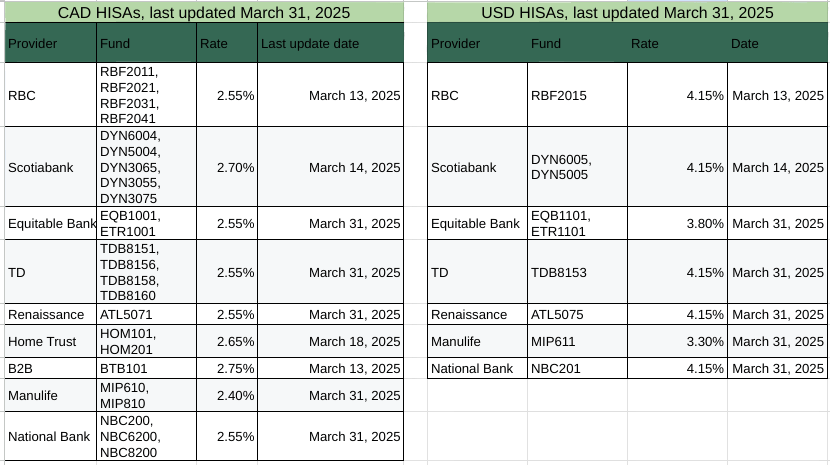
On March 12, the Bank of Canada reduced their overnight rates by another 0.25%.1 Unsurprisingly, this had a knock-on effect to the interest rates provided by the series F HISAs I track.
Equally unsurprisingly is that the US Federal Reserve didn’t touch their rates, and as a result, there were no changes in the HISA rates paid out for USD accounts. Here’s the full breakdown:
Current HISA rates for HISAs available via QTrade
There’s also a Google Sheets version with a bit more detail (source links) if you prefer.
For those of you who hold US cash in your brokerage accounts, you can benefit from the much higher US interest rates, and you have multiple choices since multiple providers are paying the same rate.
You can also say “25 basis points” if you want to impress your friends ↩︎






 The Money Engineer