How much can I afford to spend in retirement?

Summary: Variable Percentage Withdrawal (VPW) is a safe way to draw down your retirement investments, and feels a lot more reasonable than relying on a fixed budget.

When I finally decided to pull the plug on the “working to earn a living” world, (and you can read about how I came to that decision here) I was still left with lingering doubts over my retirement spending plans.

Of course, I had prepared a retirement budget as part of the exercise.

Of course, I had hired an advisor to take a look at the numbers.

And as a result, of course, I had a tidy year by year breakdown of my inflation-adjusted budget and net worth. The charts always look something like the one on PERCs home page.

But my own experience made me really uneasy about this approach — in 2023 that forecast showed I couldn’t retire until 2027, but then back-to-back stock market silliness (in a good way) allowed my 80/20 investment portfolio blow through “the number” two years early!

So, on the one hand, hooray for me, but on the other hand, the story could have happened in precisely the opposite way with a (temporary, they are always temporary) market meltdown, and the moneyengineer.ca domain would have been snapped up by the Canadian Mint, and I’d still be working for a living. The variability of year to year returns isn’t a big deal over a long period of time, but it makes a huge difference in the immediate future1, and by “immediate” I mean, “how much will I take out of my retirement portfolio this month?”

And then I stumbled upon Variable Percentage Withdrawal (VPW).

In plain language,

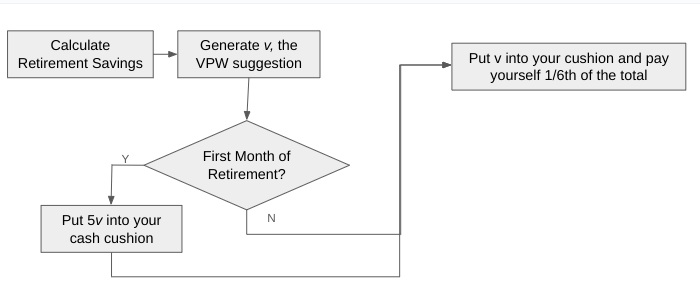
VPW offers you a sustainable salary in retirement; if the market is doing well, you can afford to spend more, but if the market is doing less well, tighten the belt.

VPW uses your net worth, your age, your portfolio and any current or future pensions to dynamically calculate what you can afford to spend in a given month, quarter or year.

The key is “dynamically”. Every month, quarter or year, you calculate your net worth, and the VPW Accumulation and Retirement worksheet generates two numbers: what you can afford to spend, and what that number would look like in the event of a market meltdown.

And all of a sudden, my unease evaporated. This was just like REAL (pre-retirement) LIFE! I’ve never had a “constant” budget, I’ve never had a “constant” salary, and I’ve never been able to predict what either would look like 6 months from now, let alone 15 years from now. So why pretend I had all the answers in retirement? VPW gives a boring, emotion free algorithm2 for doing the work, and is perfectly aligned with my boring, emotion-free algorithm for investing.

You can watch a simulated VPW-based retirement, in real time over at https://www.financialwisdomforum.org/forum/viewtopic.php?p=638130#p638130. It’s been running since July 2019. An outstanding effort!

In future posts, I’ll talk a bit about how the mechanics of VPW work in practice with my own situation. NB: my first VPW-calculated retirement payment will be in January, 2025!

  1. Interested readers should take a look at the many writings out there on “sequence of returns” risk. Basically, it’s the risk that the retiree gets really unlucky and suffers a big stock market meltdown at the very start of retirement, the worst possible time. ↩︎
  2. AND spreadsheets 🙂 ↩︎

How did you know you had enough to retire?

As a recent and relatively young retiree, I get this question a lot. I’ll try to break down the significant steps in the journey….

It started with knowing how much I actually had saved and tracking it

When you have multiple accounts across multiple providers, this can be more difficult than it should be. The full list circa 5 years ago looked something like this:

  • Joint investment account in Canadian Dollars
  • Joint investment account in US Dollars1
  • My spouse’s investment account2
  • My TFSA account
  • My spouse’s TFSA account
  • My RRSP in Canadian dollars
  • My RRSP in US dollars
  • My wife’s Spousal RRSP in Canadian dollars
  • My wife’s Spousal RRSP in US dollars
  • My spousal RRSP
  • My RRSP at my employer-mandated provider3
  • My DPSP4 at my employer-mandated provider

So yeah, a lot of accounts to keep track of. Not to mention that the RRSPs and TFSAs still had active monthly contributions, so aside from stock market changes, the actual amount being invested kept changing, too.

I built a partly-automated Google Sheets spreadsheet to keep track of everything. The template I used is over here if you’re interested.

Knowing how much I had saved for my retirement allowed me to start charting progress, and even allowed me to build models with calendar predictions for hitting milestones.

Then, I started researching how others figured this out

A book that made a lot of sense to me at the time was Fred Vettese’s great book, “Retirement Income for Life“. This started me down the rabbit hole of the many, many forecasting tools out there. A small sample included:

These tools provided me with three very important pieces of information.

First, it forced me to think about what retirement might look like from a budget perspective. What will I spend per month/per year in retirement on housing, utilities, transportation, entertainment, medical expenses, charitable giving, clothes, subscriptions….the list can be very long.

Second, it also forced me to think about how income would work in retirement. Would I radically change what I was investing in? Would I still earn money part-time? How much would that bring in? For how long?

Third, every simulation I ran showed me that I was quite close to retiring. But honestly, the amount of effort I put into running the numbers through these free tools was not very high. So I was still not feeling very sure I really had a handle on things.

I paid for a professional assessment

One habit of mine is that unless I have money invested in something, I’m unlikely to follow through. I want to learn piano, so prepaying for a year of lessons provides me with the incentive to put in time at the keyboard every day without fail. The same held true for making a retirement plan. Until and unless I put some money against it, I was likely to keep putting off making a decision. So I started searching for an independent financial planner who specialized in retirement. Someone local to me was Retirement in View5 and with appointment booked and payment sent, I was on my way to have a pro look at what I had concocted. How did I pick this provider? I had a short list of must-haves:

  • They didn’t sell products, only services. Providers who sell products (e.g. mutual funds, ongoing subscriptions) are always going to have some degree of a conflict of interest. I wanted to pay for advice, not stuff I didn’t need.
  • They had professional designations (CFP is the usual one)
  • They seemed to have a clue about retirement

The process of producing a detailed plan forces you to put a stake in the ground with respect to the questions I raised in the previous section: what’s your net worth, what’s it invested in, what’s your budget, what’s your work plan and so on.

The net result of the assessment from two years ago was that I was in good shape to retire two years from now, in 2027. It also provided me with the specific, per account totals I should have in place in my retirement savings. Those totals became my obsession, since they represented “the number” I needed to retire. The assessment also gave me a realization that the mechanics of withdrawing from your holdings isn’t trivial if you’re also trying to reduce taxes (and who isn’t, right?). The big things I learned from my encounter were:

  • I had become accustomed to thinking of taxes in terms of marginal rates, i.e. the rate of tax you are paying for the last dollar you earn. For retirement, it makes a lot more sense to think of overall tax rates, meaning the average rate of tax you’re paying. And since RRIF/RRSP income is treated differently from capital gains income which is treated differently from dividend income, you can play with sequencing to have some control over your annual tax bill.
  • Start with drawing down your RRSP6 holdings. Otherwise, by the time you start collecting CPP and OAS, you’re going to be paying a lot of tax, and maybe foregoing the income-tested OAS.
  • Delay CPP and OAS as long as possible, since this income may be the only income you have that is inflation-adjusted. (ok, this wasn’t really new, just about every pundit out there recommends you do this)

Some Lingering Doubts, But Onward!

And so, in 2023, I resigned myself to retiring sometime in 2027 and continued doing what I was doing, namely tracking my retirement savings and contributing to TFSA and RRSP. I even built a little “number tracker” to show how close I was to the targets I had for retirement.

And then, in 2023 and 2024, the stock market had back-to-back banner years, and early in 2024, barring a total disaster, it was looking quite promising that I would hit “the number” in the next 6 months. What? The assessment I paid for showed quite clearly that I shouldn’t have hit that number until 2027!

Total return of AOA and XGRO, Jan 1 2023 to Jan 1 2025, all dividends reinvested, courtesy https://dqydj.com/etf-return-calculator/ and https://www.canadastockchannel.com/compound-returns-calculator/

I realized that ALL the modeling, ALL the assessments, ALL the forecasts are based on static assumptions. Static inflation. Static growth from your portfolio. Static spending budgets, adjusted for inflation. And while static assumptions certainly make modeling easier, real life does not work that way, proven, in my mind, by the fact that my portfolio was a full 2 years ahead where it was predicted to be 2 years prior. And sure, you could build models that account for all kinds of changes, but you’re at that point building guesses on guesses. It all left me feeling rather unsatisfied.

Regardless, at that point, I made the decision that I would “officially” retire at the end of 2024 as long as the numbers held up midway through 2024. And they did. And I did.

But there was still the nagging problem I felt. 2023 and 2024, were certainly to my advantage, but what about the next two years? And the ten years after that? What happens if the stock market were to take a large beating the week after I stopped collecting a paycheque? Would I have to stock up on cheap ramen as a fallback?

It was in the last 12 months or so I discovered the concept of VPW — variable percentage withdrawal. A concept that much better models the real world. More on that next time.

  1. My provider (QTrade) treats US dollar and Canadian dollar accounts completely separately. Other providers blend them into one account. There are pluses and minuses for each. ↩︎
  2. Totally funded by a fully documented and interest-paying spousal loan. A topic for another blog post, but it’s a way to split income with a spouse. ↩︎
  3. In order to get automatic per paycheque contributions and automated matches, I had to use Manulife, a fate I would not wish upon my worst enemy. ↩︎
  4. “Deferred Profit Sharing Plan”. Not sure how common this vehicle is anymore, but my employer included it as part of my total compensation. Their modest RRSP matching contributions had to go into this separate account which is for all intents and purposes an RRSP account, except for the fact that you cannot touch the funds until your employment is terminated. I’m 22 days into my retirement, and still waiting for my funds to arrive… ↩︎
  5. Give Ayana my best regards! ↩︎
  6. Or RRIF ↩︎

Why you can fire your advisor: Asset allocation ETFs

Summary: Asset allocation ETFs1 let you buy exactly ONE fund to meet your investing needs. Buy ONE fund, and forget about it. Really? Really.

In the run-up to getting ready for retirement, I greatly simplified my portfolio. On the Canadian dollar side, it’s almost all invested in two places: XGRO and DYN6004 (a Canadian high-interest savings account). On the US dollar side, it’s almost all invested in two equivalent places: AOA and DYN6005 (a US high-interest savings account). XGRO is an example of an Asset Allocation ETF that trades in Canadian dollars, whereas AOA is an example of an Asset Allocation ETF that trades in US dollars. The overarching objective of my retirement portfolio is to keep allocations at 5% Cash and the rest in XGRO or AOA. Effectively, this puts me at about 80% stocks.

What’s an Asset Allocation ETF?

Very simply, they are a kind of ETF that allow you to make one investment decision based on your desired risk profile. Risk is a personal decision, based on factors like timeline before needing the money, how much you agonize over stock market fluctuations and so forth.

More risk means better long-term growth prospects means more stocks.

Looking for higher long term growth? Choose an asset-allocation ETF that has a higher percentage of stocks. Looking for lower long term growth with less volatility? Choose an asset-allocation ETF that has a lower percentage of stocks.

There are many Canadian providers out there who provide their own families of asset allocation ETFs.

Which provider you choose may boil down to which is the most convenient / least expensive to buy and sell. For example, BMO Investorline clients can buy and sell the BMO family with no charges, while QTrade clients can trade the iShares family with no charges.

I personally don’t think that there is much to differentiate each of the families. Each provider is just trying to capture your business. So whether you buy ZEQT or XEQT or HEQT or VEQT 2 probably doesn’t matter very much in the big picture.

I summarized them below:

ProviderETF SymbolsRead more
BMO100% Stocks: ZEQT
80% Stocks: ZGRO
60% Stocks: ZBAL
40% Stocks: ZCON
https://bmogam.com/ca-en/products/exchange-traded-funds/asset-allocation-etfs/
iShares100 % Stocks: XEQT
80% Stocks: XGRO
60% Stocks: XBAL
40% Stocks: XCNS
20% Stocks: XIC
https://www.blackrock.com/ca/investors/en/learning-centre/etf-education/asset-allocation-etfs
Global X3100% Stocks: HEQT
80% Stocks: HGRW
60% Stocks: HBAL
40% Stocks: HCON
https://www.globalx.ca/asset-allocation-etfs
TD90% Stocks: TGRO
60% Stocks: TBAL
30% Stocks: TCON
https://www.td.com/ca/en/asset-management/insights/summary/all-in-one-td-etf-portfolio-solutions
Vanguard100% Stocks: VEQT
80% Stocks: VGRO
60% Stocks: VBAL
40% Stocks: VCNS
20% Stocks: VCIP
https://www.vanguard.ca/en/product/investment-capabilities/asset-allocation-etfs

The magic? Reallocation.

The real magic of asset allocation ETFs is that they do the work of reallocation for you. This is subtle, but crucial. Automatic reallocation takes the emotion out of investing, and means you’re buying low/selling high, every quarter. What?

Take for example XGRO. Per the product brief you can see that its target composition is

  • 20% XIC (the TSX 60)
  • 36% ITOT (the S&P total US stock market, about 2000 companies)
  • 20% XEF (international developed stock market)
  • 4% XEC (international emerging stock market)
  • 16% Canadian bonds (XBB and XSH)
  • 4% Non-Canadian bonds (GOVT and USIG)

The observant reader will note that 80% of this list is made of stocks, divided up over multiple geographies. Anyway, the “target composition” is key here. What this means is that every quarter stocks get bought and sold to re-establish the targets. If the US stock market goes on a tear while the Canadian stock market is tanking, the US gains will be locked in and the Canadian market will get picked up at a discount. It’s a perfect system. No emotion. Just ratios. No work on your part.

What’s the catch?

There is a small cost associated with owning an asset-allocation ETF. Most charge you about 0.20% every year. If you instead decided to own the underlying assets you could probably save on the order of 0.10%. (This is, more or less, what I had in place before I started simplifying my portfolio). But that assumes that you do the rebalancing yourself in a timely way, and the trading fees are negligible.

Wrap up

Asset Allocation ETFs are a great way to get a diversified, risk-appropriate, emotion-free, inexpensive investment portfolio. They are the ultimate tool in the DIY investor’s toolkit.

  1. Also known as “all in one” ETFs. Also known as “funds of funds”. They all mean the same thing. ↩︎
  2. Geez, no points for originality on the ETF names… ↩︎
  3. Global X has additional ETFs on the same page that add leverage to amplify returns. I don’t use them, since the amplification works both ways — in good AND bad markets. ↩︎

Thanks, Wealthy Barber

My investment journey started a long time ago, when I somehow got myself a copy of The Wealthy Barber. I can no longer recall the specific lessons I picked up from that bestseller, save one:

“Pay Yourself First”.

It’s a really simple tenet that reminds me that the only person funding my retirement is me. If you fail to pay yourself first, “future you” will pay the price. It doesn’t have to be a lot, but it does have to be a regular and prioritized occurrence.

One way to prioritize saving is to make it automatic. Every paycheque, carve off a fixed amount to redirect to your firewalled retirement account. At the beginning, maybe that’s just a savings account, but it could just as well be an online broker, as long as that broker is helping you by paying you interest on the money you’ve saved.

As time went on, I came to realize that paying myself first also meant NOT paying advisor fees for my managed retirement portfolio and instead investing that money in future me. It was, at the time, a bit of a scary decision, but one that I do not regret at all.

I was reminded of this very influential book because I discovered you can download the updated version, “The Wealthy Barber Returns” for free from RBC Direct Investing. Do check it out! https://www.rbcdirectinvesting.com/_assets-custom/includes/wealthy_barber.pdf

What’s in my retirement portfolio?

So what’s in my retirement portfolio these days? A fair question. My portfolio is 100% in ETFs excepting the cash position. For historical reasons, a lot of my retirement savings are in US dollars. As as result, you’ll see ETFs listed here that trade on the US stock exchange, in US dollars. It’s not an approach I’d recommend for most people as it adds a lot of complexity to the mechanics of moving money around, which is really what decumulation boils down to!

The pie

The chart shown below is the summary of all my accounts: personal and spousal RRIFs in CAD and USD, TFSAs for me and my spouse, and non-registered accounts in USD and CAD. It comes pretty close to my target of 80/15/5: 80% equity, 15% bonds, 5% cash. Let’s visit how that comes about.

Summary of funds held in my retirement portfolio

What’s in the pie?

AOA: This is what I call an “All-in-one” ETF that trades on the US stock exchange. It’s an 80/20 fund, 80% equity, 20% bonds. Its US weighting is pretty high, its Canadian weighting is pretty small (about 2.4% by my calculation).

XGRO: This is the Canadian sibling of AOA. An “all-in-one” ETF that trades on the Canadian stock exchange. It’s also an 80/20 fund, with a much stronger tilt to the Canadian equity market.

HXT: Is a fund that I only hold in my non-registered account. Through behind-the-scenes accounting and swap contracts, it provides no-dividend access to the S&P/TSX 60. This is useful from a tax perspective if you’re still earning a salary since it effectively defers any tax impact until you sell shares.

XIC: A variant of the S&P/TSX 60 that caps the contribution of any one company to prevent the “Nortel effect” seen in the late 1990s. I’ve been too lazy to clean this out of the account.

DYN6004/DYN6005: Are Scotiabank HISAs in Canadian and US funds (High Interest Savings Accounts). On my provider’s trading platform, they look like mutual funds, but are just savings accounts that pay a decent interest rate, monthly. They have consistently provided the best rates of all the HISAs available on my provider’s platform.

SCHF: A very low cost equity fund that trades in USD. It provides exposure to international developed markets except the USA. It has about 8.5% weighting for the Canadian equity market. I used to have this in my registered accounts, but dropped it in favor of AOA. It’s still in my non-registered accounts so I don’t have to take an unnecessary capital gain.

HXS: The sibling of HXT, but it covers US markets. Only held in non-registered accounts.

VCN: Provides broad exposure to the Canadian market including smaller companies.

In an ideal world, my portfolio would just hold AOA/DYN6005 for US funds and XGRO/DYN6004 in Canadian funds. Eventually, as I decumulate my holdings, that’s what it will look like. Simple is best.

So why is my portfolio not aligned with my ideal model? Three main reasons:

  • Some of the “extraneous” holdings are in my non-registered accounts and I don’t want to incur a capital gain just to make the portfolio simpler.
  • I want a little bit more Canadian market exposure since I do live and spend money here.
  • No pressing need to. The splits between Canada/US/International equities are fine where they are. I try to trade only when necessary.

I’ll revisit this post from time to time as I go through decumulation to see how it evolves. Prior to hitting the button on retirement, I had a lot more ETFs in the list, basically attempting to build the equivalent of XGRO and AOA through other ETFs. For a small cost, (roughly 0.15%) AOA and XGRO rebalance their holdings quarterly so I can just let them run on autopilot, confident that they will always be close to my desired 80/20 splits. That’s why these two ETFs make up the lion’s share of my retirement portfolio.