

It’s all well and good to leave the working world, but unless you have a way to start tapping into your retirement savings, it’s going to be tough sledding. Here is what I did to prepare.
Preparation step 1: Try to keep your RRSP aligned with your spouse’s RRSP
By “aligned” I mean “try to keep your retirement income equal to your spouse’s retirement income”. This only matters if you’re planning on retiring before the age of 65; those who are 65+ can achieve similar results via pension splitting. For me, this is rather easy to work out since I’m the same age as my spouse and we don’t have workplace pensions. So for me, that meant keeping the value of my RRSP close to my spouse’s RRSP.
This step isn’t so easy to do if you’re in the last stages before retirement, admittedly, since the only way to “fix” the numbers is by contributing to a spousal RRSP. But I figured I’d mention it anyway as it can reduce your household income tax bill once you are retired.
Preparation step 2: Simplify the portfolio
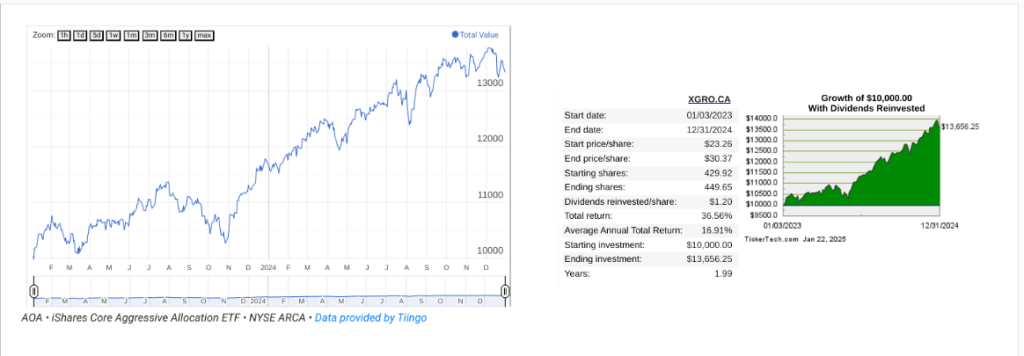
As shown over here, the vast majority (about 80%) of my holdings are in four investments: two asset-allocation ETFs (one in CAD, one is USD) and two high interest savings accounts (one CAD, one USD).
It didn’t always look like that. Prior to moving to XGRO and AOA, I had holdings that attempted to mirror (more or less) what these all-in-ones actually invest in under the hood — US Equity funds, Canadian Equity funds, International Equity funds, short-, mid- and long term bond funds….The list was pretty long. This for me caused three problems:
- Trying to keep the holdings at the ratios I wanted while actively selling the assets seemed like too much effort, too much trading, and too many opportunities for emotion1 to get in the way.
- The folks behind VPW (my chosen method of budgeting in retirement) recommended using an all-in-one which is based on “no market timing, no concentration into any asset, no investment into alternative assets, no factor investing, and no modulation of asset allocation or withdrawals based on guru prognostications or metrics“2
- The random bus principle3 meant I had to make things easier for my spouse and/or my heirs
And so, with a bit of trepidation, I started the work, one account at a time — bearing in mind that between RRSPs, TFSAs, and non-registered accounts, many of which had USD and CAD variants, there were around a dozen accounts to take the simplification knife to.
These were big trades! To mitigate market volatility somewhat (I didn’t want to get caught on an overly good or overly bad market day), I made progress account by account and after about a month, my portfolio was more or less what it is today.
Preparation Step 3: Open and fund RRIFs
If you’re new to RRIFs, you may want to take a detour to Demystifying RRIFs. I’ll wait here.
Part of the retirement plan I paid for recommended that I fund the early part of my retirement with a combination of RRSP money and non-registered money. My plan didn’t say anything about when to convert to a RRIF, and I figured that a RRIF was something for much older me to worry about.
As I started to investigate the mechanics of taking money directly out of an RRSP, I discovered two things:
- My provider, and I suppose most providers, charge a fee for making this sort of “exceptional” request, known as a “deregistration fee“. I hate fees.
- RRSP withdrawals attract withholding tax. I hate loaning the government money interest-free.
And so, I set out to open RRIFs. (Don’t forget to designate a beneficiary or successor annuitant!) This was a bit more involved than I imagined, and due to a number of snags unique to my provider4, it took about 4 weeks from beginning to end. I already had set up EFT connections5 between my provider and my bank, so that wasn’t something I had to do as well.
At the time of opening the RRIF, I also had to designate the frequency of payment. I presume (you tell me) that most providers offer the same options of annually, quarterly or monthly. I chose monthly, which makes cash flow a bit easier to manage, it does create extra work to make sure funds are in place every month.
Preparation Step 4: Move employer based holdings to your control
My private-sector employer offered no pension plan. They did offer an RRSP matching program with associated DPSP at a provider dictated by them. Anyway, the instant I could break off that association (my last day of work) I did, and planned to move the money to my usual provider. Unfortunately, I got caught in a situation I describe in my cautionary tale, and this money will not be part of my RRIF holdings in 2025. A minor hiccup, but if you’re counting on having access to this money shortly after pulling the plug, be very careful!
Preparation Step 5: Have potential capital gains insight into your non-registered accounts
Capital gains are only a concern in non-registered accounts. If you don’t have any, ignore this step.
Part of my retirement funding in the early days will come from non-registered accounts. Any time you sell a stock/ETF in a non-registered account, it generates capital gains (or capital losses) which are reported on your tax return. Knowing up front what the potential capital gains are for each ETF/stock you hold will help you optimize your taxes. You can only know that if you know the Adjusted Cost Base (ACB) of your holdings and the current price. Your provider probably shows a “gain” number, but it’s not always accurate. Best to track it yourself using a tool like https://www.adjustedcostbase.ca/.
This I think captures the main steps I went through to get “retirement ready”. My first RRIF payment is due January 31, 2025 — I’ll believe it’s “done” when I see the entry in my chequing account!
- “I’m sure if I wait a week, this ETF will go lower/higher” is a good sign you’re using emotion rather than cold, hard, numbers to make your investment decisions. ↩︎
- As stated at Re: A Simple Retirement Using Variable Percentage Withdrawals (VPW Forward Test) ↩︎
- A lifetime guiding principle of mine: “what would happen if I got hit by a random bus today”? Thankfully, it hasn’t happened yet. ↩︎
- Dear QTrade, please fix your RRIF application forms so you can properly fund both CAD and USD accounts. And make sure you can designate a successor annuitant correctly when filling out the application. ↩︎
- EFT = “Electronic Funds Transfer”. It’s a connection that allows the RRIF payment to land directly in your usual bank account where it can do useful things, like, you know, pay bills. If your RRIF provider is also a bank, you probably (?) needn’t worry about this. ↩︎




 The Money Engineer