Under the hood of XEQT et al

In a previous post, I took a look at the major fund companies’ all-in-one-funds with a focus on what passive indices each of them folllowed with regards to Canadian equity, US equity, International equity, and bonds. That assessment found that iShares and BMO were very similar, but TD and Vanguard looked very different.

But do different indices really make a difference in terms of what each of these companies hold when it comes to equities? That’s what we’re trying to find out. Let’s take a look at each of the categories in turn.

Canadian Equity

Let’s take a look at the top Canadian equity holdings of TEQT, XEQT, ZEQT and VEQT1:

StockTEQT %XEQT %ZEQT%VEQT%
RBC1.651.731.621.80
Shopify1.551.691.621.49
TD1.121.161.101.16
Enbridge0.840.880.850.92
Brookfield0.820.820.780.81
BMO0.740.770.720.77
Agnico0.660.690.680.63
Scotiabank0.640.670.630.68
CIBC0.600.630.600.63
CP KC0.570.580.570.62
# held292215215156
Top 10 %9.199.629.179.51
Top Canadian Equity Holdings for TEQT, XEQT, ZEQT, VEQT per ETF factsheets, October 2025

VEQT has fewer holdings than the others, and this indicates slightly more concentration/slightly less diversification than the other funds. TEQT is at the top of the heap when it comes to the number of companies held, with XEQT and ZEQT looking pretty similar. My take here is that the differences between TEQT/XEQT/ZEQT/VEQT are pretty slight when it comes to Canadian equity. The Canadian equity indices these funds track may be different, but the differences are pretty minor, and might simply be attributable to tracking errors; how often and when these funds rebalance their holdings may explain the differences shown here.

But just for fun, I looked at comparing VCN (which is underneath VEQT, and tracks the FTSE Canada all cap) to XIC (which is underneath XEQT, and tracks the S&P/TSX Capped Composite) and found this using https://www.dividendchannel.com/drip-returns-calculator/ (which is also listed in Tools I Use).

This indicates a tiny advantage to XIC aka the capped composite index, but there’s not a lot of daylight between these two returns!

On the Canadian Equity front, I declare the 4 funds EQUIVALENT!

US Equity

The US weighting is NOT the same for each of these funds, so making a one-to-one comparison is a bit tricky.

  • TEQT: 55% US
  • ZEQT: 50% US
  • XEQT, VEQT: 45% US

What I show in the table below is the percentage of the US portion held by the fund. So in other words if stock XYZ makes up 5% of the US holdings of TEQT and XEQT, it means that TEQT actually holds more of XYZ because 55 cents of every dollar of TEQT is invested in XYZ as compared to 45 cents for XEQT et al.

StockTEQT: TPU %XEQT: XTOT %ZEQT: ZSP/ZMID/ZSML%VEQT: VUS%
NVIDIA7.816.917.356.45
Microsoft6.625.716.266.02
Apple6.385.535.995.54
Amazon3.733.243.453.49
Broadcom2.752.382.512.23
Meta2.742.332.512.56
Alphabet Cl A2.432.072.261.97
Alphabet Cl C2.131.671.821.59
Tesla2.121.801.911.46
JP Morgan1.461.241.361.29
Eli Lilly 1.251.001.091.00
Berkshire1.151.331.471.43
# held504249415113524
Top 10 %38.1732.9735.5432.74
Top US Equity Holdings for TEQT, XEQT, ZEQT, VEQT per ETF factsheets, October 2025

What’s clear here is that TEQT is an outlier insofar as it only focuses on the largest US companies, with the other three funds including smaller companies. This also impacts how much money is found in the top 10 US holdings of TEQT, with 38% of holdings invested in names like NVIDIA, Microsoft, Apple et al.

This has proven beneficial of late since smaller US companies have not kept pace with the larger ones. Per spglobal.com, the 10 year performance as of Oct 13, 2025 of the three US market segments has been:

  • S&P SmallCap 600 = 7.65%
  • S&P MidCap 400 = 8.49%
  • S&P 500 = 12.75%

Meaning that any fund that holds smallcap and midcap US stocks has had their returns dragged down in the past 10 years.

So my conclusion for US Equities is that TEQT is the performance champion, but this comes with a less diversification than the alternatives: not only does TEQT focus on the highest-performing portion of the US equity market, it also puts more money overall into the US equity market. This has worked well for the last ten years, but it’s anybody’s guess as to whether this is a good idea for the future.

International Equity

The International2 weighting is NOT the same for each of these funds, so making a one-to-one comparison is a bit tricky.

  • TEQT: 20% International
  • VEQT: 25% International
  • ZEQT: 25% International
  • XEQT: 30% International

BMO gets the “lack of transparency” award from me for their complex structure. ZEQT holds ZEA which holds European stocks as well as IEFA, which is their USD fund holding the same things. It also holds ZEM which holds emerging markets stocks as well as EEM, which holds similar things in USD. Nowhere can you find a BMO/ZEQT consolidated view like what I’m showing below.

Like in the previous examples, what I show in the table below is the percentage of the International portion held by the fund.

StockTEQT: TPE %XEQT: XEF/XEC %ZEQT: ZEA/IEFA/ZEM/EEM%VEQT: VIU/VEE%
Taiwan Semi01.735.884.19
ASML1.981.432.111.59
SAP1.431.031.371.14
Nestle1.300.931.240.96
Roche1.240.871.120.95
Novartis1.240.901.170.98
AstraZeneca1.240.931.260.94
HSBC1.150.831.221.02
Shell1.110.801.090.87
Toyota1.060.700.970.85
Siemens1.020.771.080.82
Tencent00.802.752.10
Samsung00.372.031.16
Alibaba00.401.871.59
# held893562638643524
Top 10 %12.7710.2520.8915.68
Top International Equity Holdings for TEQT, XEQT, ZEQT3, VEQT per ETF factsheets, October 2025

Here you see some pretty significant differences. BMO and Vanguard (especially BMO’s ZEQT) have a much heavier emphasis on “emerging” markets than XEQT does; TD’s TEQT has NO exposure to emerging markets at all.

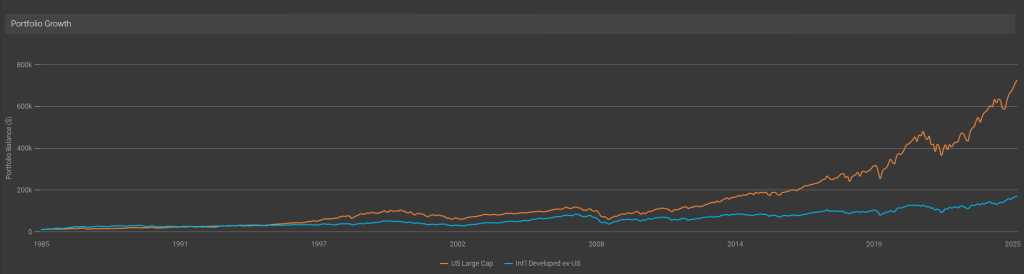
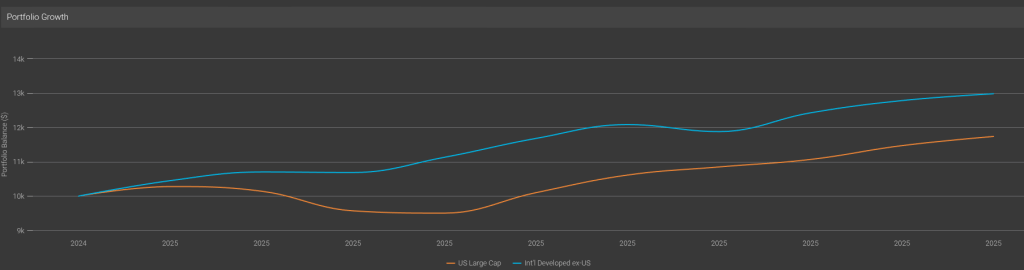
That’s an interesting strategic choice being made here. Let’s compare emerging market performance to mature international markets. We cand do that by looking at IEFA (mature markets) versus EEM (emerging markets)4:

Emerging markets have been a serious lag to global performance, so perhaps TD is on to something here. I played with this chart quite a bit and it’s only very lately (last 2 years or so) that emerging markets have outperformed the established ones. Long term trend? ZEQT certainly hopes so.

So on the international front, you have choices

  • TEQT only focuses on mature markets
  • XEQT allows some (not much) exposure to emerging markets
  • ZEQT and VEQT make much bigger bets on emerging markets

Which is the correct call? TEQT historically has made the right choice, but as the old adage goes “past performance does not guarantee future results” (or something like that).

  1. I’m using the all-equity versions of these to make the comparison more apples-to-apples. VEQT has a larger Canadian percentage (30%) than the other 3 (25%), so I muliplied VEQT’s holdings by 25/30 to make the comparison meaningful. ↩︎
  2. In this analysis, I’m not making a distinction between “mature” and “emerging” markets. Some of the funds do. In all cases, “International” means “no US, no Canada”. ↩︎
  3. And EEM, and IEFA, and ZEA and ZEM fact sheets ↩︎
  4. You could also compare XEF to XEC and come up with a similar picture. ↩︎

What’s in my retirement portfolio (Oct 2025)

This is a monthly look at what’s in my retirement portfolio. The original post is here. Last month’s is here.

Portfolio Construction

The retirement portfolio is spread across a bunch of accounts:

  • 7 RRIF accounts (3 for me, 3 for my spouse, 1 at an alternative provider as a test)
  • 2 TFSA accounts
  • 4 non-registered accounts, (1 for me, 1 for my spouse, 2 joint)

The target for the overall portfolio is unchanged:

  • 80% equity, spread across Canadian, US and global markets for maximum diversification
  • 15% Bond funds, from a variety of Canadian, US and global markets
  • 5% cash, held in savings-like ETFs.

You can read about my asset-allocation approach to investing over here.

The view post-payday

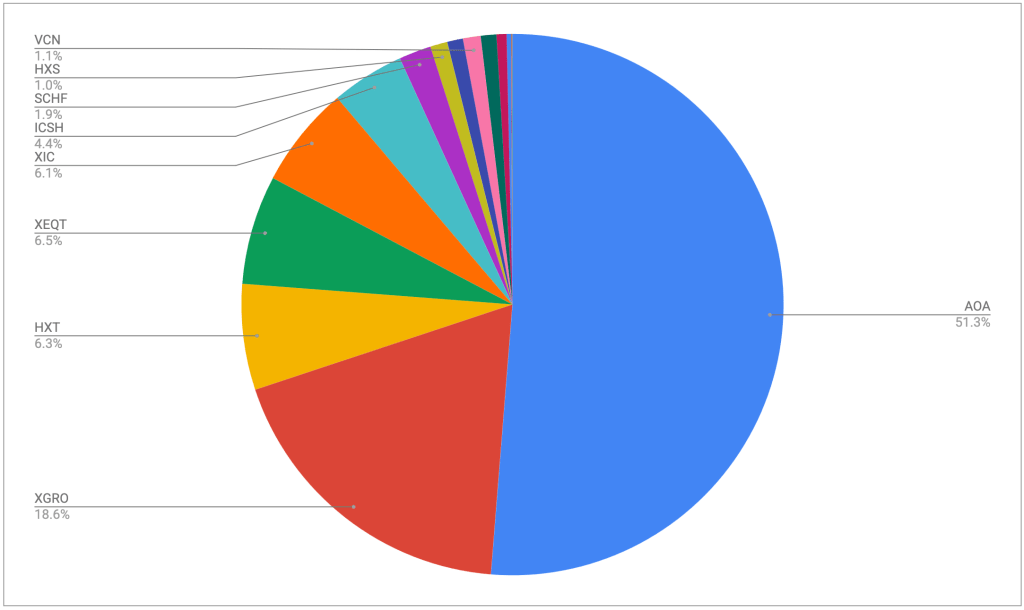
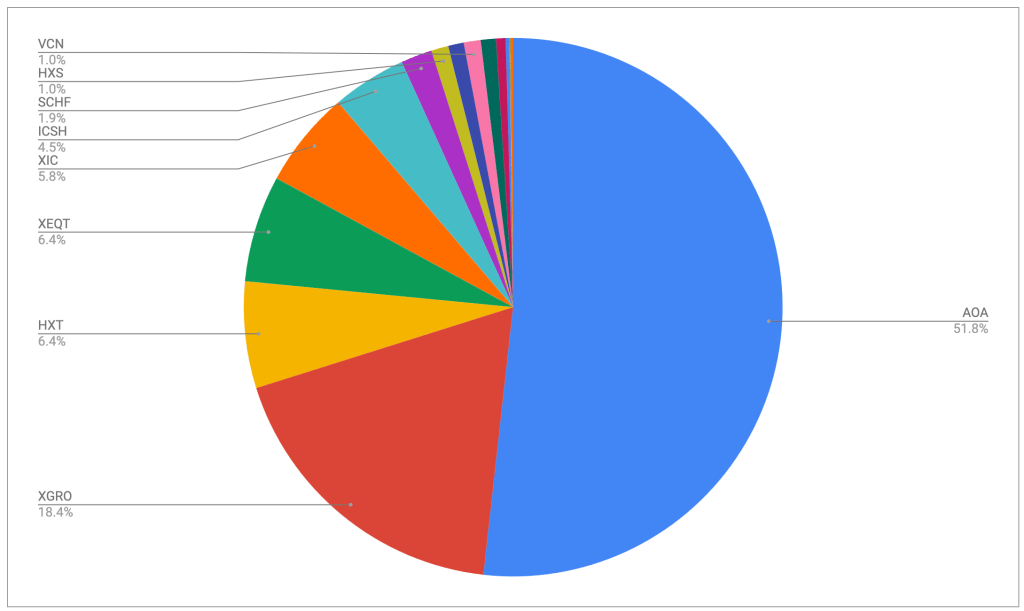
I pay myself monthly in retirement, so that’s a good trigger to update this post. On October 27th, this is what it looks like:

The portfolio is dominated by my ETF all-stars; anything not on that page is held in a non-registered account and won’t be fiddled with unless it’s part of my monthly decumulation. Otherwise I’ll rack up capital gains for no real benefit.

No massive changes this month; the one you might notice is a slight shift from AOA to XGRO. I move some of my USD holdings into CAD every quarter, and last month was when I did it. The majority of my spending is in CAD, so I use Norbert’s Gambit to move funds around.

Plan for the next month

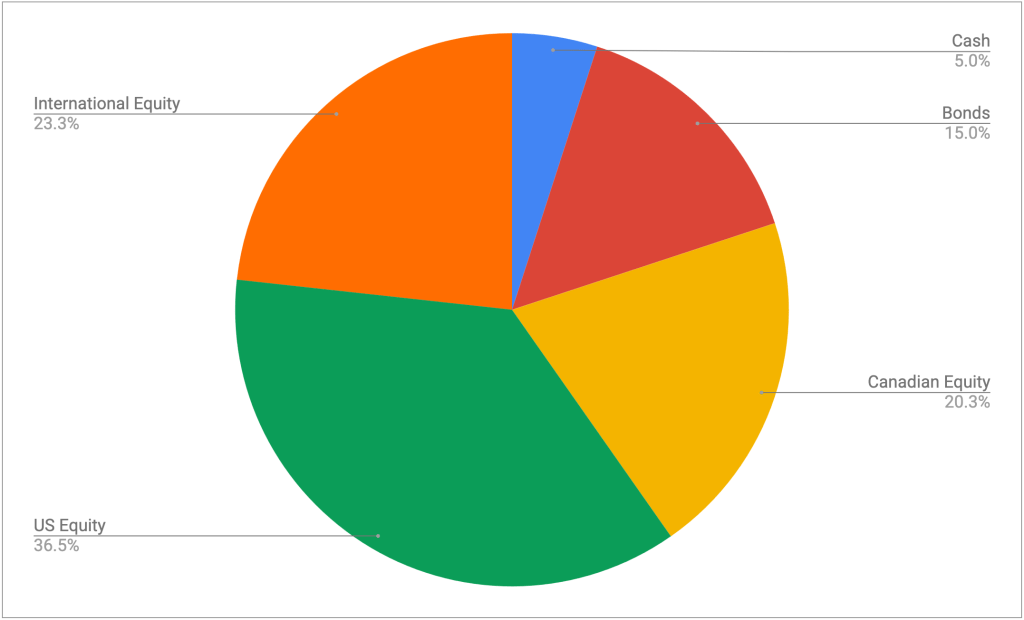
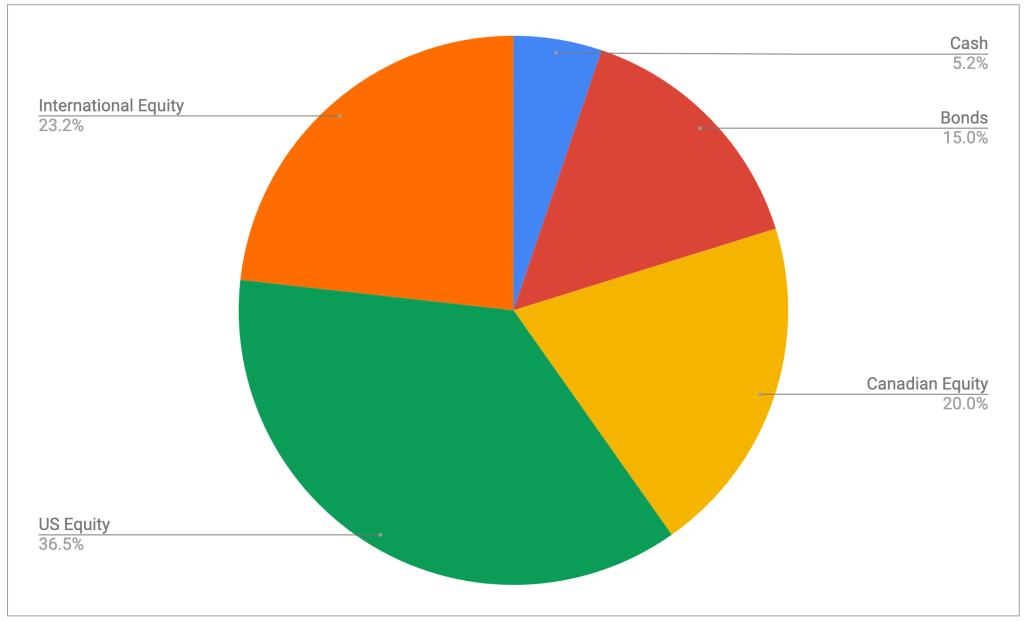
The asset-class split looks like this

It’s looking pretty close to the targets I have, which are unchanged:

  • 5% cash or cash-like holdings like ICSH and ZMMK
  • 15% bonds (almost all are buried in XGRO and AOA)
  • 20% Canadian equity (mostly based on ETFs that mirror the S&P/TSX 60)
  • 36% US equity (dominated by ETFs that mirror the S&P 500, with a small sprinkling of Russell 2000)
  • 24% International equity (mostly, but not exclusively, developed markets)

All looks to be in order from an asset allocation perspective, no need to do anything here.

Overall

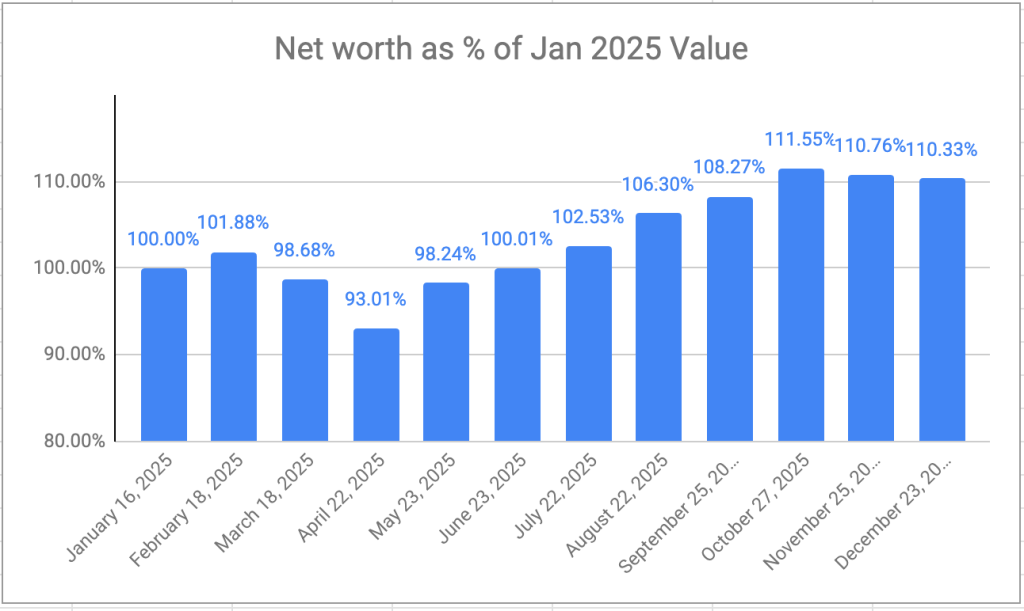
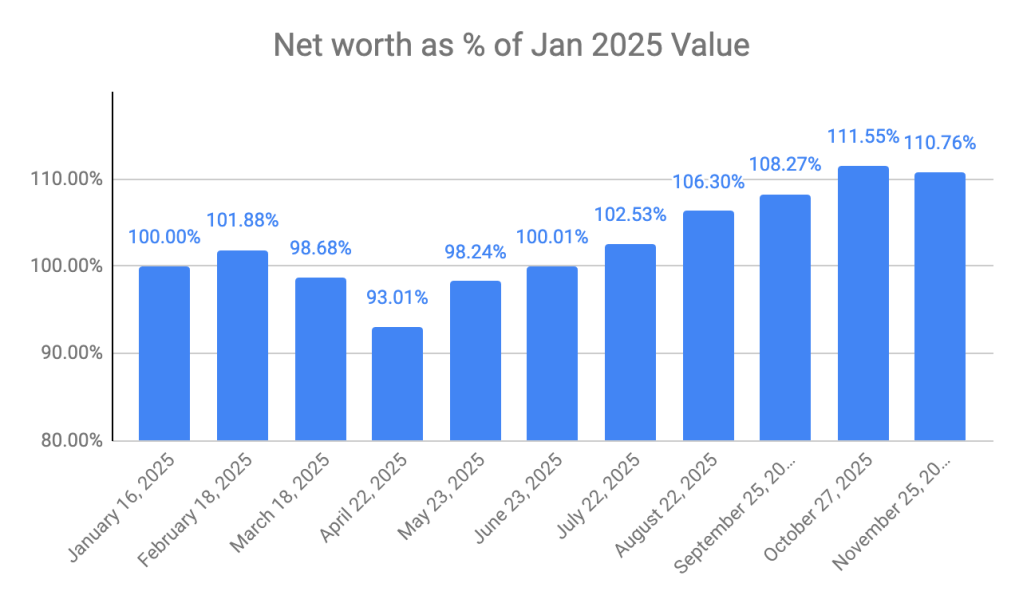
The retirement savings had a great month, again — a 6-month growth streak at this point. Overall, I’m now 11.5% ahead of where I started even though I’ve been drawing a monthly salary since the beginning of the year. I don’t really expect the winning streak to continue, but VPW allows me to take some benefit from the frothy stock markets at moment.

Net Worth as a percentage of starting point

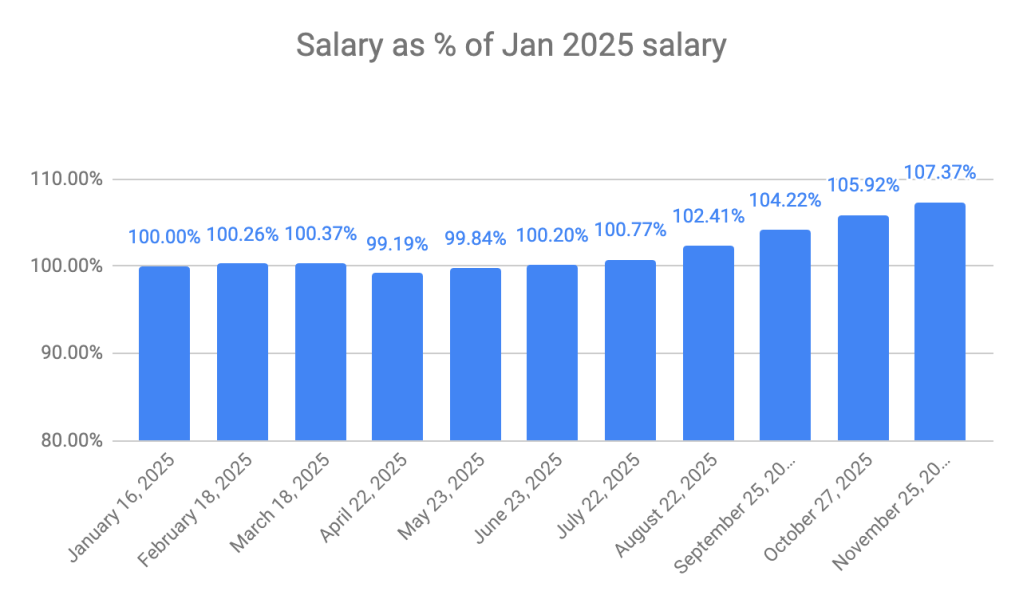
My VPW-calculated salary has hit a new high this year, 5.92% higher than my first draw in January. The monthly salary is also on a 6-month growth streak.

Monthly Salary as a Percentage of Jan 2025 salary

The months ahead will see the final “goodbye” to QTrade1 as the last of my RRIF investments will move to (mostly) Questrade2.

  1. I didn’t have a great deal of issue with QTrade as a provider, but their support (lack thereof) was beginning to become irritating. ↩︎
  2. My own QTrade RRIF will join the RRIF holdings I already have with Wealthsimple. They remain a potential backup provider of my retirement savings. I would have moved more to take advantage of their cashback promotion, but they still, inexplicably, do not support self-directed spousal RRIF accounts. ↩︎

What’s in my non-registered portfolio? (Oct 2025)

Every month, I try to share with you what’s in my overall retirement portfolio (September 2025 post is here). That retirement portfolio is actually distributed over a bunch of accounts held by me and my spouse and includes RRIFs, TFSAs and non-registered accounts. This is what it looks like at the moment:

Retirement savings as of October 1, 2025 by account type

(My multi-asset tracker is a handy tool to help you quickly create charts that look like the above one).

My current strategy for these three account types looks like this:

  • RRIF: This is 100% invested in my ETF all-stars. I’m currently withdrawing RRIF minimum payments for two main reasons:
    • To avoid problems with attribution. I cover that topic over here.
    • To avoid withholding tax. RRIF minimum payments don’t attract withholding tax, but I am setting aside some of my payments to deal with the unavoidable tax bill come April 2026. I talked about that topic over here.
  • TFSA: This is mostly invested in the ETF all-stars, but there’s a few stragglers in here1 that I really ought to get rid of. Nothing wrong with the funds in there, but it’s a needless complexity. The TFSA continues to get new funds since it’s hard to beat tax-free growth, and I only buy all-stars with those funds. It will get drawn down last in my retirement planning.
  • Non-registered accounts: Here it’s a bit of a dog’s breakfast, with very little invested in the all-stars, mostly because most of the equity found here was bought long ago, and changing what I hold would attract capital gains that I would prefer to take on my own terms. It’s where the majority of my early-retirement decumulation takes place.

Here’s what that breakfast looks like:

What’s in my non-registered portfolio, October 2025

Here’s a look at each holding, from highest to lowest percentage.

HXT: This is a Canadian equity ETF that does not pay dividends, instead using some wizardry to bury it all in the per-unit price of the ETF. This simplifies taxes, and I have held this fund for a long time. Due to increasing costs of this ETF, it’s among the first to get liquidated as I need funds.

XIC: Canadian equity fund, very popular. I think I bought it to create a bit of dividend income. It will get liquidated after the Horizons funds go (HXS, HXT, HXDM).

SCHF: A very low-cost international equity2 fund in USD that I’ve held for a very long time. It’s funds like SCHF that attracted me to investing in USD, which, at present, adds a lot of complexity.

ICSH: This is one of the all-stars. It is what my VPW cash cushion is invested in3. I use ICSH more than ZMMK in the cash cushion because US interest rates are quite a bit higher than Canadian rates at the moment. I talked about that here.

HXS: Same idea as HXT, except it invests in the S&P 500. This one is held only by my spouse who is still working for a living, so this will just stick around a while, until she stops working and can take on the capital gains.

VSC: A bond fund held by my spouse. I may sell this to harvest some capital gains losses.

HXDM: Same idea as HXT, except international equity. It is on the list to liquidate.

ZMMK: An all-star, held in the same account as ICSH.

The rest (XEQT, TEQT, XGRO) are all new arrivals in the portfolio, purchased using dividends4 from the other funds as well as the bonus payments I keep collecting from Questrade for switching to them.

My non-registered accounts are only a small portion of my retirement holdings, but there’s a fair bit of complexity there. Over time, these accounts will go to zero other than the cash cushion portion (ZMMK, ICSH or whatever replacements I discover) which will remain as long as VPW is my decumulation strategy.

  1. Mostly pure Canadian equity funds. This is to offset AOA that has next-to-no Canadian equity component. ↩︎
  2. 0.03% MER. Cheap! ↩︎
  3. VPW = Variable Percentage Withdrawal, an absolutely brilliant strategy for making sure you don’t run out of money in retirement and don’t leave a lot on the table. Read all about it here. ↩︎
  4. With all ETF trades being free, I hold very little actual cash in any of my accounts. ↩︎

What’s in my retirement portfolio (Sept 2025)

This is a monthly look at what’s in my retirement portfolio. The original post is here. Last month’s is here.

Portfolio Construction

The retirement portfolio is spread across a bunch of accounts:

  • 7 RRIF accounts (3 for me, 3 for my spouse, 1 at an alternative provider as a test)
  • 2 TFSA accounts
  • 4 non-registered accounts, (1 for me, 1 for my spouse, 2 joint)

The target for the overall portfolio is unchanged:

  • 80% equity, spread across Canadian, US and global markets for maximum diversification
  • 15% Bond funds, from a variety of Canadian, US and global markets
  • 5% cash, held in savings-like ETFs.

You can read about my asset-allocation approach to investing over here.

The view post-payday

I pay myself monthly in retirement, so that’s a good trigger to update this post. At market close, September 25, this is what it looks like:

Retirement holdings by ETF, September 2025

The portfolio is dominated by my ETF all-stars; anything not on that page is held in a non-registered account and won’t be fiddled with unless it’s part of my monthly decumulation. Otherwise I’ll rack up capital gains for no real benefit.

No massive changes this month; the one you might notice is a reduction in HXS, which holds US stocks exclusively. I picked this one to sell out of my non-registered accounts as my US equity allocation was a bit high.

Plan for the next month

The asset-class split looks like this

It’s looking pretty close to the targets I have, which are unchanged:

  • 5% cash or cash-like holdings like ICSH and ZMMK
  • 15% bonds (almost all are buried in XGRO and AOA)
  • 20% Canadian equity (mostly based on ETFs that mirror the S&P/TSX 60)
  • 36% US equity (dominated by ETFs that mirror the S&P 500, with a small sprinkling of Russell 2000)
  • 24% International equity (mostly, but not exclusively, developed markets)

I don’t need to make serious changes at this juncture, but there will be some need to make some noticeable tweaks in the coming month:

  • Q3 dividends will flow in to the account which will make for some movement, especially in XGRO and AOA. (Payout date for XGRO is September 29th , AOA is estimated to be October 8th.
  • I will need to convert some of my US RRIF holdings into CAD. I do this quarterly. Why quarterly? It allows me to smooth out any big swings in the FX rate over the course of the year. This will show up as a reduction in AOA and an increase in XGRO next month.
  • And, at the very end of October, AOA will rebalance. This is not foreseen to be a big deal.
  • All these moves will be tracked through my multi-asset tracker; it may be I have to buy a bit more foreign equity as I see I’m a touch light in that category.

Overall

The retirement savings had a great month, again. Overall, I’m now 8% ahead of where I started even though I’ve been drawing a monthly salary since the beginning of the year. This is aligned with what my retirement planner told me to expect, but as you can see, the journey has had some interesting ups and downs already.

Monthly retirement savings, as percentage of Jan 2025 value

My VPW-calculated salary has hit a new high this year, 4.22% higher than my first draw in January1. This is also expected, since it tracks the value of the retirement portfolio, albeit in a much more controlled way. The VPW “cash cushion” smooths out the ups and downs of the monthly returns. I suppose I really should see an increase in my salary on par with inflation so that I maintain my spending power. I’ll have to think about how to track that2.

Monthly salary, as percentage of Jan 2025 salary

ZGRO versus ZGRO.T: what’s the difference?

ZGRO and ZGRO.T are both asset allocation funds (aka all-in-ones1) offered by BMO. They hold the same assets, and they both generate the same (dividends-reinvested) returns. But ZGRO.T says it has a yield of 5.65% whereas ZGRO has a yield of 1.73%2. How is this possible? Full disclosure: I don’t own either of these funds because I have historically invested in a very similar-to-ZGRO product, XGRO, instead3.

Let’s start with a really high level look at these funds4.

ZGRO vs ZGRO.T, Overview Tab (source bmogam.com)

The first thing I’ll point out is one of caution: ZGRO and ZGRO.T have very similar tickers and it’s all-too-easy to mix them up. The fund names are also very similar, although ZGRO.T adds the words “Fixed Percentage Distribution Units” to the mix. That’s a clue. The other things we can learn from this first glance is that ZGRO.T is pretty new (Inception Date), is about 1/20th the size of ZGRO in terms of investments (Net Assets), has an identical MER to ZGRO, but whoa, that distribution yield is off the charts. Put simply, if you had $1000 in ZGRO, and $1000 in ZGRO.T, and the last distribution paid was assumed to be constant5, you’d get $11.73 from ZGRO and $56.50 from ZGRO.T over the next twelve months. Huh?

This is even more puzzling if one takes a look at what each of the two ETFs hold: it’s identical:

ETF HeldZGRO %6ZGRO.T %
ZSP – S&P 50037.037.0
ZCN – TSX Capped20.420.4
ZAG – CAD Bond13.813.8
ZEA – MSCI EAFE13.413.4
ZEM – MSCI Emerg6.76.7
ZUAG – US Bond5.85.8
ZMID – US Mid Cap2.02.0
ZSML – US Small Cap1.01.0
Cash00

Comparing top holdings, ZGRO versus ZGRO.T. Can you see a difference? I can’t see a difference.

I spent quite a bit of time searching on the BMO website trying to get their take on the difference. In a lot of places, (e.g. the simplified prospectus7), the two funds are treated as the same. After nearly giving up, I did come across this document which has a teeny tiny footnote, which I reproduce here:

These units are Fixed Percentage Distribution Units that provide a fixed monthly distribution based on an annual distribution rate. Distributions may be comprised of net income, net realized capital gains and/or a return of capital. The monthly amount is determined by applying the annual distribution rate to the T Series Fund’s unit price at the end of the previous calendar year, arriving at an annual amount per unit for the coming year. This annual amount is then divided into 12 equal distributions, which are paid each month.

BMO Asset Allocation ETFs Whitepaper

So the big difference as I see is is that ZGRO.T attempts to give a stable yield in 12 month chunks. It does this by

  1. Giving you dividends from the underlying assets (so does ZGRO)
  2. Selling underlying assets (and generating a capital gain)
  3. Giving you back your own money (this is known as as return of capital)

Let’s take a look at the two from a tax perspective (note that this only matters if you were to hold these funds in a non-registered account):

ZGRO vs ZGRO.T 2024 Distribution Tax Tab (source bmogam.com)

And here the distinction between the two becomes clearer: ZGRO.T is making good use of Return of Capital (RoC) to distribute a dividend with limited near-term tax implications. But as always, there’s no free lunch — using RoC means that future capital gains will be higher since RoC reduces the ACB8 of the funds in question, and if your ACB drops to zero, you have to treat RoC as a capital gain.

So when might you consider using ZGRO.T instead of ZGRO?

ZGRO.T makes sense in a RRIF account. It’s essentially automating some of the steps I have to take every month to get paid (you can see the mechanism I use here). Every month, I have to sell some of my holdings in order to get the RRIF-minimum payment out.

In a non-registered account, ZGRO.T’s monthly distributions might be useful if you had the need for consistent monthly cash flow; in addition, if you expect to at some point be in a lower tax bracket, it might help you save future tax, since it’s deferring some gains by using Return of Capital. In my case, I don’t see a good reason to use it since I would have to sell existing assets in order to raise funds to buy it, which generates capital gains.

So, in summary, the two funds are the same from a total return perspective, with ZGRO.T more monthly cash and ZGRO providing more paper gains. In a RRIF account, ZGRO.T automates some of the manual selling needed to execute decumulation. In a non-registered account, the tax treatment of the two is different, and you’d have to work out the numbers to see if it’s a benefit or not.

  1. If you want to read about all-in-ones, https://moneyengineer.ca/2025/01/21/why-you-can-fire-your-advisor-asset-allocation-etfs/ is a good place to start. ↩︎
  2. This yield is calculated by dividing the most recent per share distribution by the share price and multiplying by 12. In essence, this number is the value of the most recent (monthly in the case of ZGRO.T, quarterly in the case of ZGRO) dividend payout extrapolated over the full year. It may or may not represent what kind of yield you get in the future. ↩︎
  3. Why? Inertia. There are minor differences in the makeup of XGRO versus ZGRO but either is a fine choice for the lazy investor. ↩︎
  4. All the tables here are right off BMO’s ETF selector, which is excellent, by the way. ↩︎
  5. ZGRO is currently paying 7.3 cents per share every quarter and this has been stable since 2020. ZGRO.T is currently paying 6 cents per unit held every month and this has been stable since March 2025. ↩︎
  6. As of September 18, 2025 ↩︎
  7. which weighs in at ~450 pages. I’d hate to see the non-simplified prospectus. ↩︎
  8. Adjusted Cost Base. The average per unit price you pay for a share, necessary to track in order to accurately calculate capital gains (or losses). I use adjustedcostbase.ca for this, found in Tools I Use ↩︎