What’s in my retirement portfolio (Feb 2025)

This is a (hopefully monthly) look at what’s in my retirement portfolio. The original post is here.

Portfolio Construction

The retirement portfolio is spread across a bunch of accounts:

  • 7 RRIF accounts (3 for me1, 3 for my spouse, 1 at an alternative provider as a test)
  • 2 TFSA accounts
  • 5 non-registered accounts2, (2 for me 1 for my spouse, 2 joint)

The target for the overall portfolio is unchanged:

  • 80% equity, spread across Canadian, US and global markets for maximum diversification
  • 15% Bond funds, from a variety of Canadian, US and global markets
  • 5% cash, held in high interest savings accounts (list available to me shown here)

The view as of this morning

As of this morning, this is what the overall portfolio looks like:

Overall retirement portfolio by holding, February 2025

The portfolio, as always, is dominated by AOA and XGRO which are 80/20 asset allocation funds in USD and CAD, respectively. The rest are primarily either cash holdings in HISAs (DYN6004/5 in CAD and USD) or residual ETFs held in non-registered accounts for which I don’t want to create unnecessary capital gains just for the sake of holding AOA or XGRO.

The biggest month over month change is due to a small re-balancing exercise. I replaced some of my XGRO (which is an 80/20 equity/Bond asset allocation fund) with XEQT (a 100% equity asset allocation fund). I do re-balancing any time my asset allocation drifts more than 1% off my target allocations3. The trigger for me was an overweighting in bonds, which had drifted to represent 16% of my portfolio instead of the desired 15%. Upon reflection, the reason was obvious: both AOA and XGRO are 20% bonds, and if I want only 15% bonds, I will periodically need to fund an all-equity alternative. The net effect will be that you will see more XEQT show up in the portfolio over time.

The observant reader will also notice a bit of a shift between DYN6004 and DYN6005. The reason? I raided some USD from DYN6005 to pay my US credit card bill and replaced it with CAD in DYN6004 using the spot FX rate at the time. Seemed the easiest way to get some USD4 without having to resort to my friends at Knightsbridge.

SCHF percentages drifted down a bit since that’s the ETF I’m selling in my non-registered portfolio to augment my monthly RRIF payments. That will continue for the next few months at least since the USD payouts are needed to fund a few holidays5 I’m taking that are billed in USD.

Otherwise, nothing interesting to see in the month to month changes.

Plan for the next month

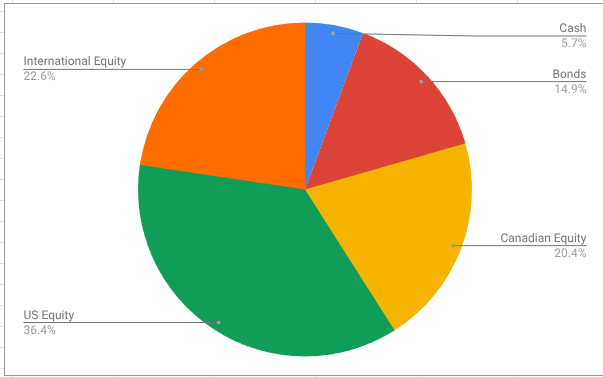
The geographic split looks like this

Overall retirement portfolio by market, February 2025

The international equity percentage is below my target of 24%, and so I’ll have to fix that. SCHF seems a good choice in USD6 since it’s free to trade with QTrade. XEF would be a perfect fit in the Canadian market.

A quarterly activity that I’ll be performing this month is to shift some of my USD RRIF holdings into my CAD RRIF. This wasn’t something I had planned to do but since my provider has backtracked on allowing me to get paid out of my USD RRIF in USD, I needed a way to keep the USD exposure at a constant-ish level in the overall portfolio. I’ll talk about the USD in my portfolio in a future dedicated post.

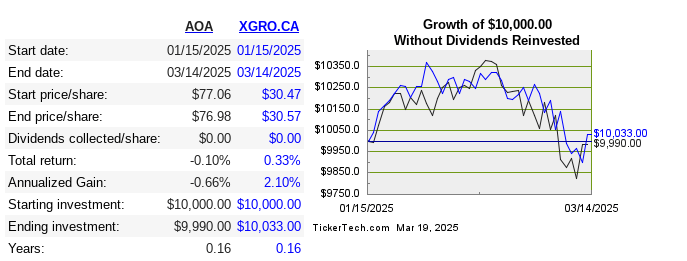
One final note: my retirement savings continue to grow even though I’m now actively removing assets out of it. On paper, this makes perfect sense since an 80/15/5 portfolio ought to grow at a rate greater than my rate of removal. In practice, of course, it’s rather stock market dependent. Here’s the monthly returns for the 2 ETFs that make up the lion’s share of my portfolio7.

XGRO and AOA monthly returns so far8
  1. For me, that’s one personal RRIF that has 2 accounts, one for CAD, one for USD, and one spousal RRIF. My spouse has one spousal RRIF in two currencies, and a personal RRIF. The alternative provider RRIF exists because I wanted to give Wealthsimple a try. ↩︎
  2. For me, two because one each for CAD and USD. The 2 joint accounts are my cash cushion accounts for the VPW methodology outlined here and here. ↩︎
  3. Completely spreadsheet-driven. I don’t trade on news, analyses, gut feelings, hot tips, or guesses. ↩︎
  4. I did hesitate a bit because the interest rate on DYN6005 is over 1% higher, but given the amounts involved, I’m clearly overthinking things. ↩︎
  5. All booked before this current tariff nonsense. Sorry. ↩︎
  6. Although it does have a 9% exposure to the Canadian market so not 100% “international”. Hard to beat the MER of this, though. ↩︎
  7. I don’t think this tool accounts for FX so it’s probably not totally accurate. Check out https://moneyengineer.ca/tools-i-use/ for other useful tools. Canadian dollar gained 1.4% against the USD in the past 30 days, per https://www.bankofcanada.ca/rates/exchange/daily-exchange-rates/ so that will reduce the effective return of AOA by the same amount. ↩︎
  8. “Without dividends reinvested” since these two ETFs only pay out quarterly. There haven’t been any yet. ↩︎

Ok, I’m ready to fire my advisor. What do I need to do?

So you’ve decided to make the leap and keep more of your own money. Congratulations! Here’s a list of things you need to do to put that plan into action.

Disclaimer: I treat my retirement assets separately from any other assets (rainy day funds, day-to-day expenses). If you blend these sort of things together, it may change things like step 1.

1. Determine your desired asset mix

“Asset mix” is just another way of describing your risk profile, or in really plain English, what percentage of your portfolio is going to be invested in equity. There’s a quick questionnaire over here that will put you in one of 5 buckets:

  • Very Conservative: This means 20% Equity.
  • Conservative: This means 40% Equity.
  • Balanced: This means 60% Equity.
  • Growth: This means 80% Equity.
  • Aggressive Growth: This means 100% Equity.

If you’re happy with the way your existing portfolio is performing, then you can instead calculate the percentage of equity in it and use that as your asset mix. For simplicity, I would consider any stock as “equity” and any cash, HISA, Bond fund or GIC as “not equity”. If your portfolio holds ETFs, then you need to see what’s inside them. You can typically read that on the “fund facts” page. They are usually one or the other, unless you already hold funds like XGRO.

2. Choose your platform and create login(s) for it

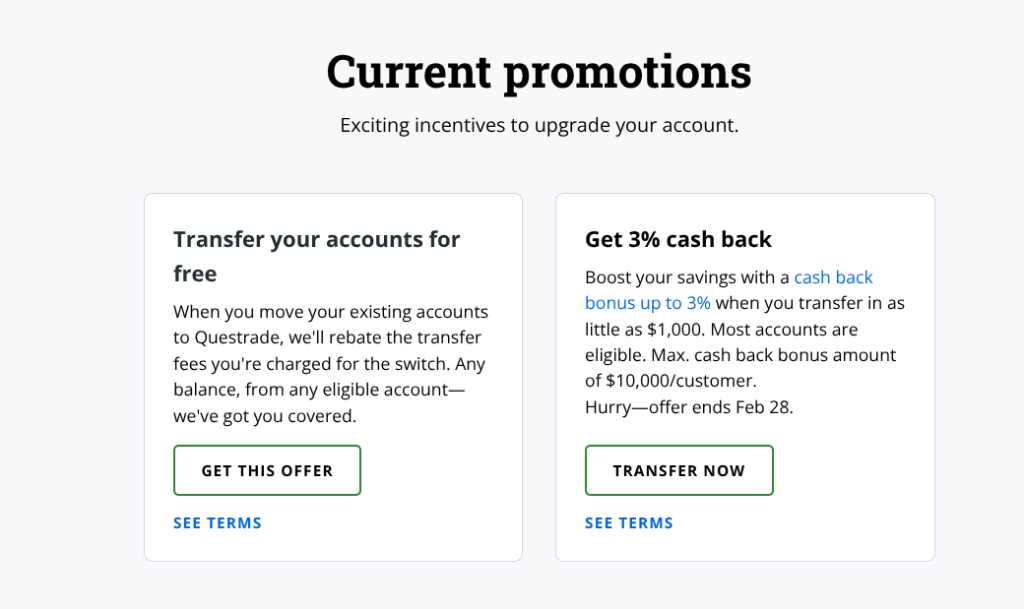
But which one? I talk about some of the things to consider over here, or you can investigate a trustworthy source like the Globe and Mail’s annual rankings. Some providers (e.g. QTrade, Questrade) allow you to make trial accounts to test drive them. I myself use QTrade for my investments. Like all providers, it does some things really well, and others, not so much. I have either personal experience or friends using (in alphabetical order) BMO Investorline, Interactive Brokers, iTRADE, QTrade, Questrade and Wealthsimple. Any of them will do. Many of them run promotions1 trying to entice you to switch. Might as well take advantage of that if it makes sense23. Also consider if they will reimburse you the transfer fees imposed by your soon-to-be-ex provider of choice4.

The heading of this section says “login(s)” because if you’re part of a spousal team, you should really do this as a team.

This step also usually entails form-filling and proof of life uploads/emails/faxes5 (photo ID, banking info….). Put on your favourite tunes and the time will be filled with pleasant sounds.

3. Figure out how to move money to and from your new platform

If you’re still contributing to your TFSA/RRSP/RESP, or if you have non-registered accounts, or are close to retirement and about to set up a RRIF, then it’s pretty important to know how money will move in/out of these accounts. Typical things you’ll have to do are

  • set up your new account(s) as “Bill Payees” online banking6
  • set up EFTs7 between your bank account and new platform
  • set up new Interac eTransfers8
  • Get cheques/bank card for your non-registered account, if applicable9

4. Collect all your existing account information

To successfully complete the transfer, you are going to need to know the details of all your existing accounts. The usual information requested is found on your monthly/annual statements. Client number, account number, rough value of what’s in each.

If applicable, you’ll also want to have a very good handle on exactly how much you’ve contributed to capped government savings vehicles (e.g. RRSP, TFSA) so you don’t inadvertently over contribute in the year you make the shift10.

There may be a snag at this step. You may hold assets at your old provider that are not supported at your new provider. This may or may not be a big deal. Typical issues are caused by

  • GICs11. The reason you get good interest rates from them is because the money is locked away. You may or may not be able to move them without incurring penalties. You’ll have to ask your new provider what they are willing to do. In most cases, the answer will be “sorry, can’t help you, if you want to move them, you’ll have to sell them first”12.
  • Mutual Funds. Many of these are private to that provider,13 and constitute, in their estimation, considerable value add. For these, you are almost certainly going to have to say goodbye (and good riddance) .

For GICs, you can choose not to move those assets, wait until they mature, or eat the cost of cashing them in early.

For Mutual Funds, selling them usually isn’t a concern, unless you hold them in a non-registered account, in which case there may be undesirable capital gains that will cause a tax hit.

For most people, the costs involved in moving assets are small compared to the money you’ll ultimately save by firing your advisor. But don’t say I didn’t warn you.

5. Initiate account transfers from your newly selected platform

This is the first step where things get real.

Different providers will do this somewhat differently, but it’s usually called something like “Transfer Account”. In my experience, providers are highly motivated to be highly helpful at this stage ;-).

But in essence, initiating an account transfer will involve two things:

  • The creation of the kind of account you’re moving (e.g. TFSA, RRSP, Spousal RRSP, RRIF14) AND
  • The details of that account (client number, account number….all collected in the previous step)

It’s also possible you have to create the account (TFSA, RRSP….) on your new platform FIRST, and once it’s created THEN you can initiate a transfer.

You will have to answer a question of moving the existing assets “in kind” or “as cash”. If you hold portable assets at your old provider (e.g. cash, stocks, ETF), “in kind” is fine. If you don’t (e.g. GICs, mutual funds) then “as cash” will allow your new provider to trigger a sale of those assets.

You will have to do this for EVERY account you’re moving. Were I to switch, I’d have to move

  • 4 RRIF accounts (2 each for me and my spouse; one in CAD, one in USD)
  • 2 spousal RRIF accounts (1 for each spouse)
  • 2 TFSA accounts (1 for each spouse)
  • 5 investment accounts (2 for me, 1 for my spouse, and 2 joint15)
  • 1 RESP account

6. Wait for the funds to arrive

This always seems to take forever. Expect a delay of 5-10 business days at this point. Expect a panicky call from your soon-to-be-ex advisor. Take the time to set up Trading Authority (TA) for your personal accounts (spouse, adult child, other relative) so they can make trades on your behalf. There’s a form for that. Having TA for my spouse’s accounts means I can see our ENTIRE retirement portfolio from my login which is Highly Desireable.

7. Buy the correct ETF in line with step 1.

As as example, if you were to use the Blackrock family of asset allocation funds:

  • Very Conservative: This means 20% Equity. This means XINC.
  • Conservative: This means 40% Equity. This means XCNS.
  • Balanced: This means 60% Equity. This means XBAL.
  • Growth: This means 80% Equity. This means XGRO.
  • Aggressive Growth: This means 100% Equity. This means XEQT.

The reason for choosing an asset allocation fund is for automatic re-balancing. You pay about 0.15% for that service, which is baked into the price of the fund. It’s more or less what your advisor should do for you today.

8. Pay as much or as little attention as you like

As you invest new funds (e.g. for TFSA/RRSP), buy more units. You might also consider setting up a DRIP at this stage so as dividends roll in (typically, monthly or quarterly), you automatically purchase more of the same. Autopilot.

If you want a second set of eyes to assess your holdings, then dropping some cash on a fee-for-service advisor from time to time may make sense.

Eight steps to save potentially thousands of dollars. You’re worth it!

  1. Googling (for example) “Wealthsimple promotion” would be one way to find the current one. ↩︎
  2. Read the fine print, there are almost always caps on rewards, as well as obligations to stick with the provider for a period of time. ↩︎
  3. Here is one rare case where there may indeed be something pretty close to a free lunch. ↩︎
  4. Almost all providers do this; there is almost always some sort of lower limit…$15k is pretty typical. ↩︎
  5. Any provider wanting faxes should disqualify them as a provider, just sayin’. ↩︎
  6. This is how QTrade does it. ↩︎
  7. Electronic fund transfers. You provide institution/transit/bank account number using a blank cheque. That’s how QTrade knows where to put my RRIF payments. Another form to fill. ↩︎
  8. Only Wealthsimple seems to allow this. It’s fast, but has upper daily/weekly/monthly limits that may make it impractical. ↩︎
  9. Both BMO Investorline and Wealthsimple allow this. I’m guessing that it’s a common feature for providers that also operate bank services (e.g. CIBC, TD, National Bank, Scotiabank). My provider (QTrade) does not. ↩︎
  10. Your new provider will have no idea what your TFSA limits are; only CRA knows that. Most providers will track what you contribute IN THEIR ACCOUNT in a given year, so that’s somewhat helpful. ↩︎
  11. The lack of liquidity of GICs is the main reason I don’t use them. ↩︎
  12. The one exception I’ve encountered thus far is that BMO Investorline was willing to accept the GICs purchased via BMO Advisor Services. There may be others. ↩︎
  13. Manulife and Sunlife, much loved by employers for DPSPs, are notorious for their 1.5% MER index funds. ↩︎
  14. Don’t forget to properly designate beneficiaries or survivor annuitants. ↩︎
  15. These are CAD and USD versions of the cash cushion required by the system I use to pay myself in retirement. ↩︎

What broker(s) do you deal with?

I hang out a bit on Reddit1 to see what people are talking about. Often times, the post reads something like

“I am new to investing, I have $x to invest, who should I use ?”.

The crux of every 5th question posted to r/PersonalFinanceCanada

Personally, I find this kind of question a bit odd. “Investing” is a noble pursuit but it’s a term that means a lot of things to a lot of people. For me, “investing” is reserved for retirement savings since the timelines are long and I don’t need immediate access to the funds therein. A lot of people who ask this question want very near term access to the money, and to me that’s not investing. It’s saving. Timeline matters. The answer I’d give to a saver2 is a lot different than the answer I’d give to an investor.

I suppose the amount of money involved may influence the decision of platform provider (especially if there are freebies associated with having a balance above a certain amount, a common-enough practice), but it’s not the first thing I’d have in mind. Here are the main things I think about when it comes to choosing a financial provider, either for the first time, or if you’re thinking about making a change.

Does the provider have the account types you want?

Any provider I use has to offer Investment accounts, RESP, TFSA, RRIFs and spousal RRIFs. USD options for Investment accounts and RRIFs would be useful to me as well. Your own circumstances will offer up a different list. But don’t dismiss the RRIF if you’re nearing retirement. You may want one sooner than you think!

Does the provider have the products you want?

My needs here are really simple. I need access to trade a handful of ETFs on the US and Canadian markets, and I need a way to get a good interest rate on cash holdings. My assumption is that every major provider has a way to accomplish this. I don’t need access to bond markets3, options trading, fractional trading, margin trading or crypto. You might.

What fees that matter to you are charged by the provider?

The list of fees for any provider can get pretty long, but I only consider the things that impact me in my normal usage of the platform. The things I look for and expect are:

  • They don’t charge anything for “account maintenance”
  • The don’t charge fees for trading the ETFs I care about4
  • They need to offer a way to access daily interest rates in the neighborhood of the Bank of Canada overnight rates (some do this by paying good rates on any cash lying around your accounts, some do this by offering access to purchase HISAs, and as a last resort, there are ETFs that buy HISAs, too5)
  • They need a “much more generous than the bank”6 way of doing forex7

I’ve used QTrade8 as my main provider for the last 15 years or so. They offer the things I need. But for the first time, I’m seriously considering making a switch to Wealthsimple9. I’m test driving them now with part of my retirement portfolio, but I’ve found at least one show-stopper that make them unsuitable for me — they don’t offer spousal RRIFs10 in their self-directed product offering!

Switching providers can be quite onerous, so it’s not something I take lightly, especially since my holdings are paying my monthly salary! The DIY market is getting more competitive, so it can pay to take a look around. What do you like/dislike about your current provider? Drop me a line at comments@moneyengineer.ca.

  1. Specifically, r/PersonalFinanceCanada mostly ↩︎
  2. Put your money in the highest interest rate savings account you can find, or buy a GIC. ↩︎
  3. Beyond bond ETFs. I don’t need to own individual bonds. ↩︎
  4. Had I written this phrase 5 years ago, I would have said “low fees”. However, in today’s competitive landscape, many brokers charge nothing to buy and/or sell ETFs. If yours does, maybe it’s time to take a look around. ↩︎
  5. e.g. CASH by GlobalX, HISA by Evolve ↩︎
  6. Most banks happily tack on 1.5% to spot rates on currency exchanges, just like most credit cards do ↩︎
  7. Norbert’s gambit would apply here, although it’s somewhat cumbersome. I’ll cover forex in some future post. ↩︎
  8. But I’m also somewhat familiar with BMO Investorline, Interactive Brokers and Wealthsimple. ↩︎
  9. Free ETF trading, good interest rates for cash holdings, just-launched zero fee FX transactions for amounts over $100k, and their currently running promo are all rather attractive features. ↩︎
  10. And, as I write this, I get a friendly email from Wealthsimple support confirming this, with a promise to let the development team know about it. ↩︎

Caution! Spousal RRSP/RRIF Attribution Rules

Summary: The spousal RRSP is a great way to reduce current taxes, but if you’re planning on using the money in that spousal RRSP soon, be aware of the rules concerning who declares the income!

Disclaimer: As this article will demonstrate, I’m not a tax expert, lawyer, CPA or anything else. Use with discretion, some assembly required.

I made substantial use of spousal RRSPs during my working life. Spousal RRSPs are a way for the higher earning spouse to take advantage of the lower earning spouse’s unused RRSP contribution room, thus leading to a lower overall tax bill1. All good so far.

Some vocabulary will help with the next bit.

  • The contributor is the person providing the cash for the spousal RRSP and is the one who gets the tax deduction. Usually this is the higher income spouse.
  • The annuitant is the person whose name is on the spousal RRSP statements. This is usually the lower income spouse.

What most primers on spousal RRSPs don’t mention is that there is a restriction when it comes to withdrawing from the RRSP2. Paraphrasing the source material:

If the annuitant withdraws from a spousal RRSP within three years of the last contribution, the income from that withdrawal is considered to belong to the contributor, not the annuitant.

What? Why?

As with all things, there’s no free lunch. CRA doesn’t want to make tax avoidance so easy3, so this little detail will prevent the purely hypothetical scenario of a higher earning spouse making a large spousal RRSP contribution in the last year of their employment, and then getting the lower earning spouse to take out that same money at a much lower tax rate when the calendar moves from December to January.

There is one, small, bone that CRA throws our way in this case. Paraphrasing again:

If the annuitant withdrawal is instead made via a spousal RRIF, and the payment is RRIF minimum, then fine, the annuitant can declare that income.

So, as long as our lower income annuitant spouse opens a spousal RRIF, and as long as for the three years4 following the last spousal contribution, that spousal RRIF only pays out RRIF minimums, then all is well. The annuitant spouse declares the income, as expected.

Now of course, this rule may not matter to you. If you’re newly retired and don’t have much in the way of income, then it may not trouble you that you have to declare the income from your spouse’s spousal RRIF/RRSP. It’s just a bit more paperwork (a T2205, looks like).

In my case, I’m only taking RRIF minimums for the time being. So no extra paperwork for me.

  1. And future income splitting before the age of 65 when the option becomes available to all. ↩︎
  2. I’ve never myself made a withdrawal from an RRSP. That would break my rule of keeping retirement savings firewalled. And it looks to me to be an expensive proposition — your provider will surely charge a deregistration fee, your provider will have to withhold tax, and you have declare the full amount as income in the year you grab it. ↩︎
  3. I have learned to be guided by the humbling tenet of: “If I think I’ve figured out a way to outsmart the taxman, it’s probable that I’m simply demonstrating an incomplete understanding of how it actually works….” ↩︎
  4. To illustrate/clarify: the rule applies in the year the contribution is made, and the previous two years. So the contribution I made in 2024 will be free from all constraints in the 2027 tax year. ↩︎