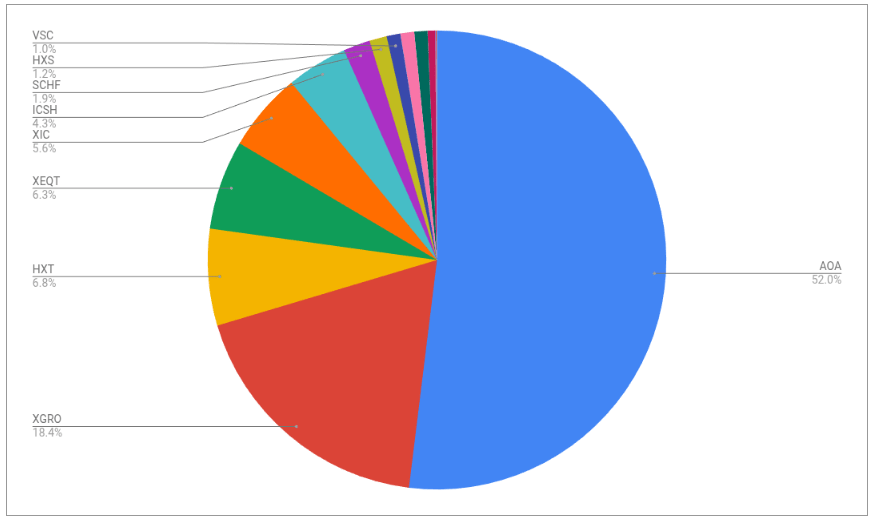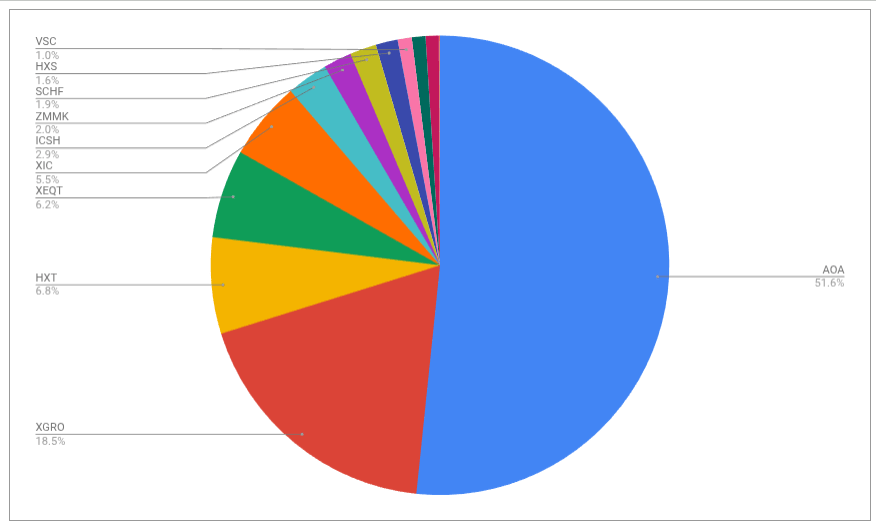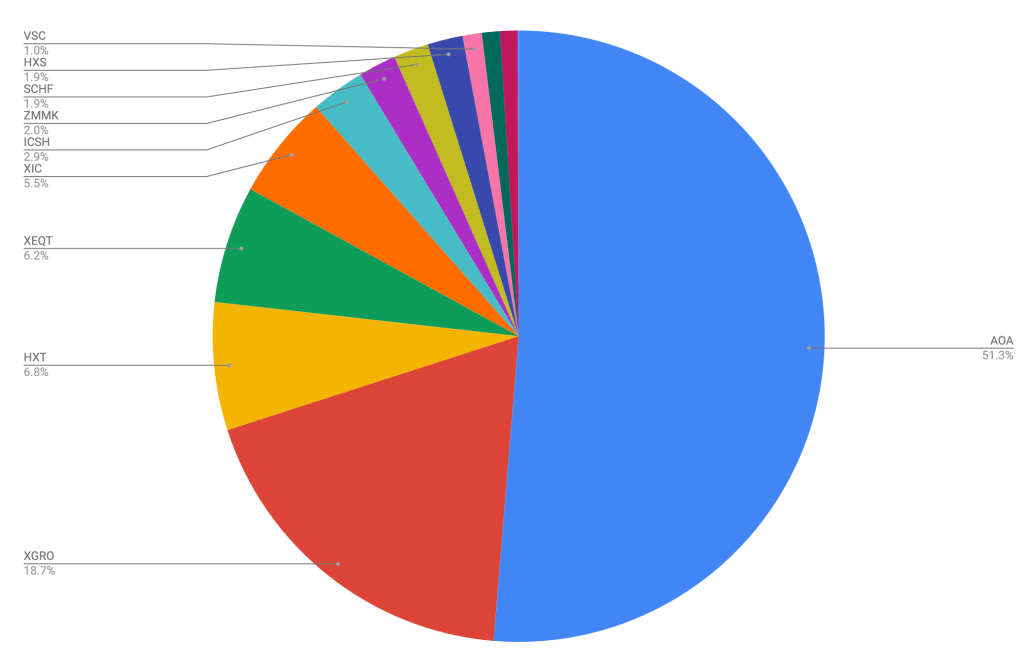

As of this morning, this is what the overall portfolio looks like:
Retirement holdings by ETF, May 2025
The portfolio is dominated by my ETF all-stars; anything not on that page is held in a non-registered account and won’t be fiddled with unless it’s part of my monthly decumulation. Otherwise I’ll rack up capital gains for no real benefit.
The biggest changes were caused by two events that happened over the past 30 days:
I did a small rebalancing exercise to reduce my exposure to the Canadian equity market, selling VCN in favor of XEQT. (XEQT is only 23% Canadian equity per dollar invested; VCN was 100%). This sort of rebalancing happens whenever I drift more than 1% off of my target allocations.
I took some cash from a HISA and invested it in ZMMK; for reasons too boring to report here, that money was effectively not being tracked in these pages until this month — that anomaly won’t be repeated in subsequent months since ZMMK and ICSH are where I park the “cash” position of my portfolio.
Plan for the next month
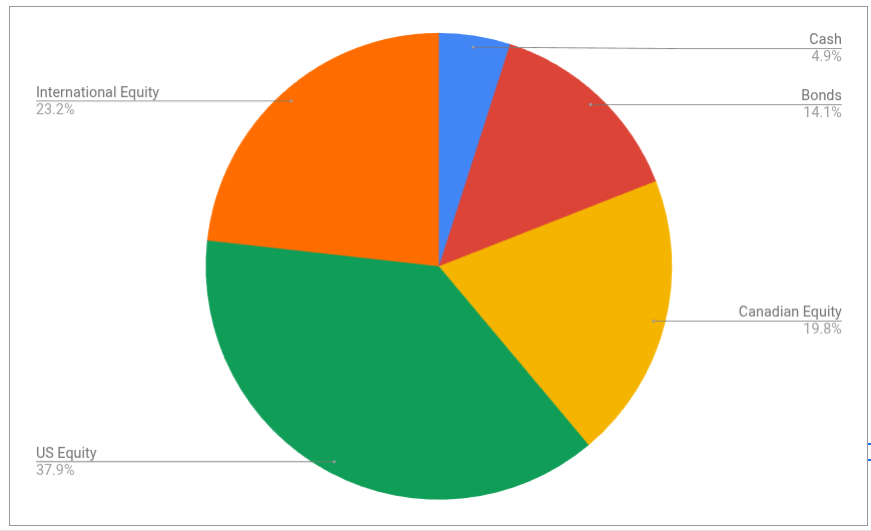
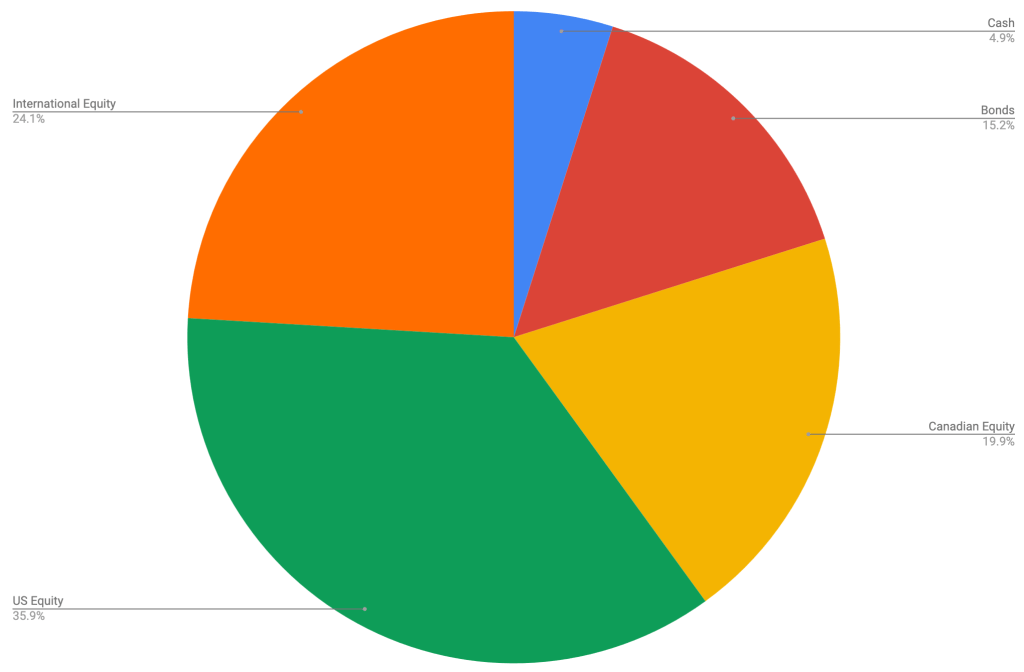
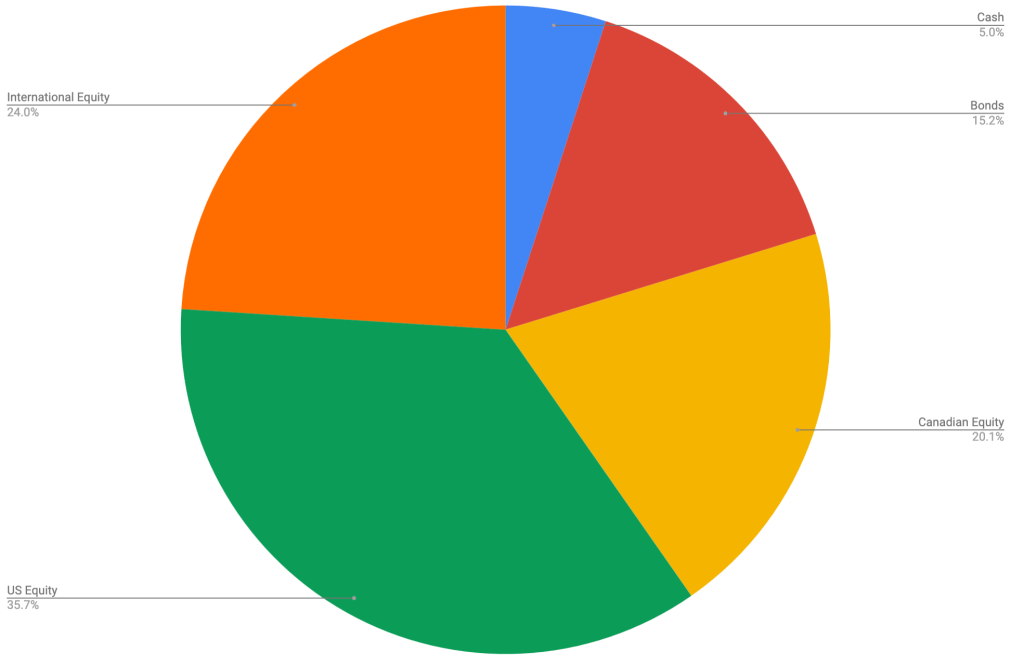
The asset-class split looks like this
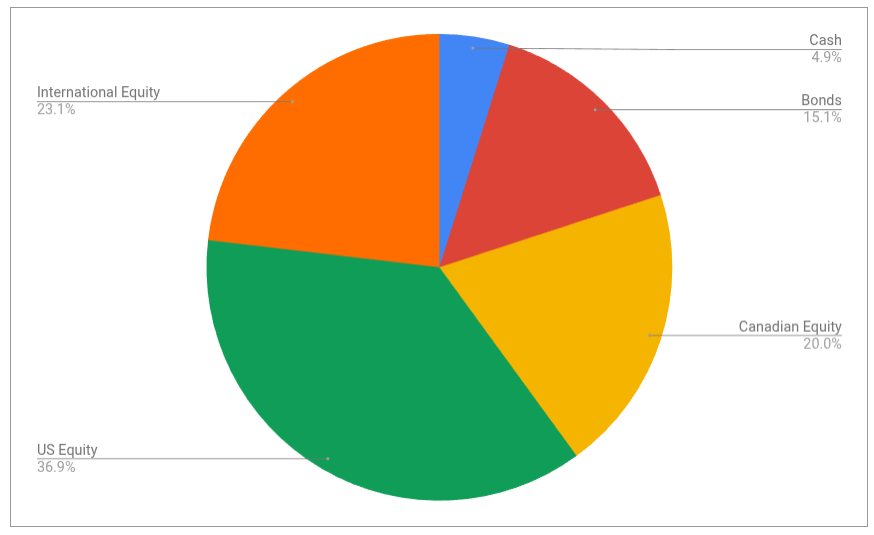
This looks to be pretty close to my target percentages which haven’t changed:
5% cash or cash-like holdings like ICSH and ZMMK
15% bonds (almost all are buried in XGRO and AOA)
20% Canadian equity (mostly based on ETFs that mirror the S&P/TSX 60)
36% US equity (dominated by ETFs that mirror the S&P 500, with a small sprinkling of Russell 2000)
24% International equity (mostly, but not exclusively, developed markets)
So, the plan for next month is, do nothing out of the ordinary. Reinvest cash (dividends, TFSA contributions) in one of AOA, XEQT/XGRO, ICSH or ZMMK depending on the asset category most in need on the day of the reinvestment. All these ETFs are covered on my ETF All-Stars page.
One thing I may do is to try to make shifts2 to get a little more return out of my cash position. US interest rates are quite a bit higher than Canadian rates, and so if my cash position is held in USD, I stand to eke a few more points of return there. TBD.
Overall
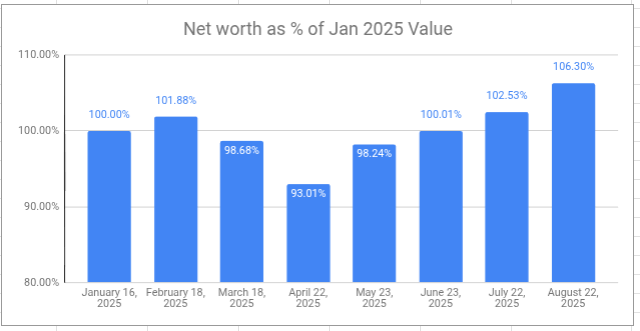
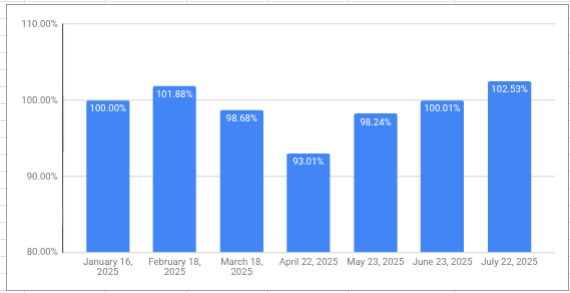
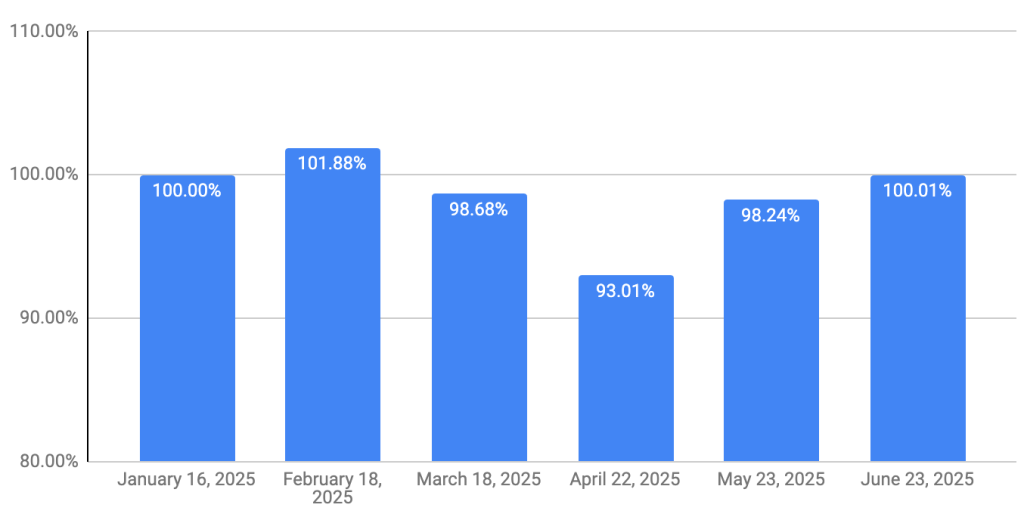
My retirement savings had a nice bounce-back this month, looks like I can cancel the mega-pack of pot noodles I had on order.
Monthly retirement savings, as percentage of Jan 2025 value
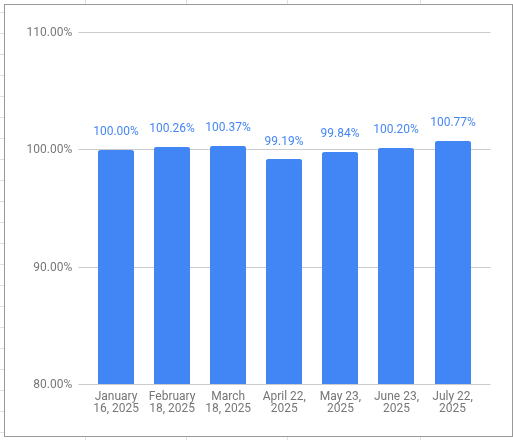
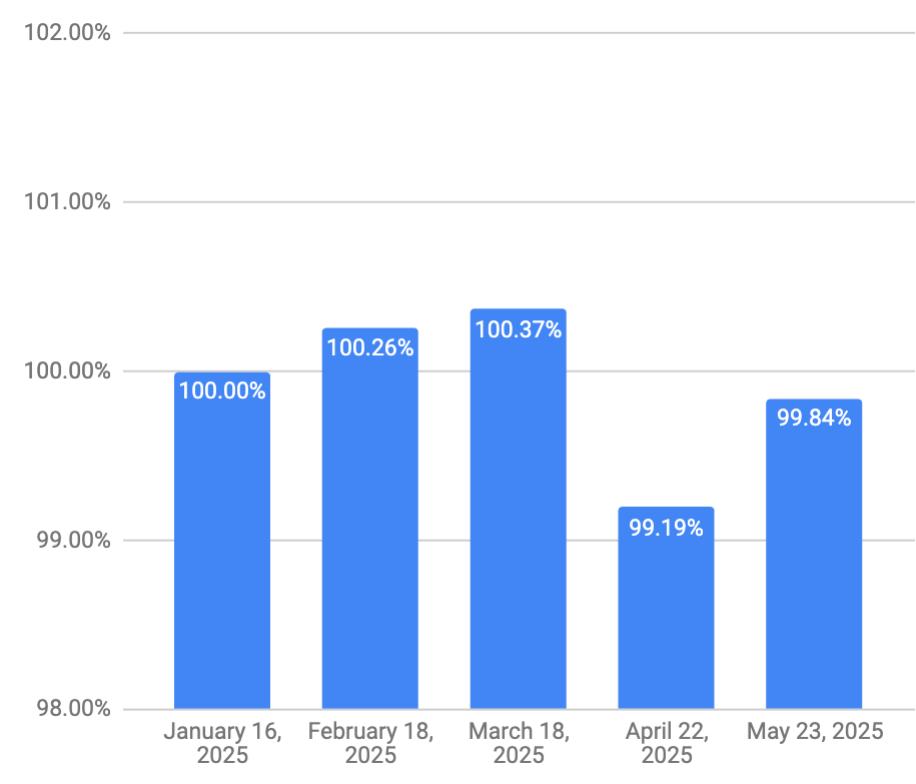
The salary I collect month to month recovered a bit, too, although not as quickly. That’s the magic of using VPW’s cash cushion — neither boom nor bust months translate into large changes in the take-home pay.
Monthly salary, as percentage of Jan 2025 salary
That’s up one from the previous month. In order to collect on Questrade’s transfer bonus, (which they have yet to pay me, they are apparently in a world of hurt on the IT front) you have to have a non-registered account to get paid into. The other 3 are “normal” — one non-registered account for me, one for my spouse, and jointly held one that serves as a cash cushion to smooth out month to month variations in my retirement salary. Read more about that over at https://moneyengineer.ca/2025/01/31/im-retired-now-how-do-i-get-paid/↩︎
With Questrade, all ETF trades are free to make, so I don’t have any real reason not to make such changes. ↩︎
***updated this post to reflect the fact that XEQT has dropped XUS from its portfolio as of July 2, 2025***
This post is inspired by my original on the topic, “What’s the deal with XGRO“? XGRO is great, but since my target asset allocation is only 15% bonds, and XGRO’s bond target is 20%, there’s some tweaking I have to do in order to reduce the bond exposure. That tweak is increasingly being provided by XEQT, part of the same iShares family that produced XGRO.
(As mentioned elsewhere, I rely heavily on all-in-one ETFs in my retirement portolio. New to all-in-ones? Read a bit about them here.)
XEQT, like XGRO, is actually investing in thousands1 of different stocks. Unlike XGRO, it does not hold any bonds at all. I thought it would be interesting to see what, exactly, is underneath every $100 you invest in XEQT. See the results below:
The top stock holding outside North America belongs to Taiwan Semiconductor, at 46 cents for every $100 invested. Additionally, the geographic exposure looks like this:
Geographic exposure of XEQT as of July 25, 2025
One other little tidbit that might be interesting: the distribution yield of XEQT is 2.94% compared with 2.91% for XGRO. This I find a bit surprising, since I would have expected XGRO’s yield to be quite a bit better.
And, if you’re really paying attention, you’ll see that the dollar amounts of this column add up to roughly $80, in keeping with the 80/20 philosophy of XGRO. ↩︎
i lump these together because they hold exactly the same thing. Some loophole that iShares needs to exploit, I gather. ↩︎
On the date I pulled these numbers, cash cracked the top 10 for a holding of $1.34, which is not usual, so I just dropped it. Not sure why that is…perhaps by the end of the month it will resolve itself. ↩︎
Summary: It’s possible for you to collect income from a RRIF at the same time as contributing to (and taking deductions from) an RRSP.
If you’re new to world of RRIFs, or think that they only come into play once you turn 71, then you might want to give Demystifying RRIFs a read.
In my case, I worked until the end of 2024, having opened RRIF accounts and funding them with my RRSP holdings1 in the last quarter of 20242. Unsurprisingly, my Notice of Assessment for the 2024 tax year included the usual “new” RRSP contribution room based on salary earned during the 2024 tax year.
But what to do with that RRSP room? And if I use it, when should I take the deductions?
Can I even take advantage of it?
Answer: yes, as long as i do it before I turn 71.
The CRA rules are pretty clear on this topic. You can make and deduct contributions up until the year you turn 71, even if you’re retired.
Ok, but then there’s the problem of coming up with the money to MAKE the contributions.
Making contributions to the RRSP in retirement
One of the reasons you seem to have “more” money when you retire is that you stop saving money for retirement. RRSP contributions constituted a significant line item in my annual budget while working. In retirement, I don’t really need to save the money, but taking advantage of the possibility to defer taxes seems like a good idea.
One way to tackle the issue is to initiate a small monthly contribution to my RRSP; at least this starts to build up deductions I can use when it makes sense to; I don’t need to make it a huge amount, but over time it will build up a deduction that could come in handy later.
So, when is “later”, exactly?
When to take the RRSP deduction when retired
My annual salary in retirement, by design, is variable, based on my net worth calculated every month. You can read about it here. I expect that over time my salary will increase3, so “future me” will be the one taking the deduction.
My guess is that there will be a few places where having a deduction ready might come in handy:
Generally, I’m just trying to reduce my overall tax bill. My advisor suggested that I try to optimize my income every year to get to an overall (not incremental) tax rate of 15% for the household. The RRSP deduction is another lever I’ll be able to use to help accomplish that.
I’m trying to avoid paying tax by instalments. Looks like if your tax owing is >$3000 in two consecutive years, then you’re going to be asked to pay your taxes four times a year. Taking RRIF minimum payments (as I do) means no withholding tax, so it’s rather likely that at some point I’m going to be faced with this. Having the possibility to delay this is a nice thing; I hate giving the government access to my money any sooner than strictly necessary.
Most writing on this topic talks about “converting” RRSPs to RRIFs. But that’s not really how it works, at least not with two providers I have dealt with. In reality, you open new RRIF accounts and move the RRSP assets in-kind to those RRIF accounts. The RRSP account remains intact, albeit with nothing in it. ↩︎
RRIF payments become obligatory in the calendar year AFTER the year in which you open them. You can take payments sooner, but that’s a manual process, and any payment so taken will be subject to withholding tax. Since I wanted to take RRIF minimum payments in 2025, I had to have the RRIFs ready in 2024. ↩︎
The percentage of my net worth used to fund my monthly salary increases every year, just like how a RRIF calculation works. In theory, the rate of return of my retirement investments is currently higher than my percentage withdrawal, meaning that future salaries are likely to be higher than current ones, but that’s not an ironclad guarantee. ↩︎
Previously, we talked in broad terms about the categories of what you can invest in, namely Equities, Bonds, and Cash. Having % allocation targets for each of these classes is a necessary starting point for making decisions. Here’s a post that talks about how to get there.
Maybe it’s helpful to take a look at some examples of what you can buy to hit each of these categories. I’m going to use iShares as the guinea pig since it offers a lot of products, but you could play the same game with any provider you like.
So if you visit iShares ETF page (this is what I’m looking at as I write this), you are presented with a list of (and I’m not joking here), 169 different ETFs. Ouch. How can anyone decide which of these is the best fit?
Helpfully, the page includes an “Asset Class” Filter:
iShares “Asset Class” classifcation for their 169 ETF products (May 2025)
…and now you can quickly recognize “Equity” (with 105 different ETFs to choose from). “Fixed Income” is the other term of interest — this will include bonds and probably something that looks more like cash. So this is now looking a little more sane. Wait, what’s this? They each have “sub classes”?
iShares ETFs Equity and Fixed Income Sub Classes as of May 2025
This narrows things down somewhat. Let’s break these down further.
Equity Sub-Classes
The term “Cap”1 comes up here. This is short for “capitalization” or, in plain English, “How big is the company we’re investing in?”. I don’t like to place bets on which companies are the most appropriate, so I would gravitate to the “All Cap” sub asset class here. “Large Cap” is probably the next best bet, since large companies tend to dominate the returns in the markets they serve. So let’s select both2.
We’re still left with 75 ETFs with that filter. Still a lot to take in. I suggest sorting by “Net Assets” with the largest on top by clicking in the appropriate column. I figure if other people are investing in these funds, why shouldn’t I?
So here’s my take on the ETFs I see on my screen:
ETF Symbol
Class
Consider?
Comments
XIU, XIC
CAD Equity
Y
Both variations of TSX. I would lean towards XIC because it is cheaper to own.
XSP, XUS, XUU
US Equity
Y
XSP is “hedged” meaning it tries to take away the FX variations, and I normally don’t worry about that. XUU would be my top pick here.
XEF, XFH, XSEM, XEC
Int’l Equity
Y
XSEM/XEC are solely emerging markets, and I would never just hold it absent something like XEF/XFH as well. If I had to pick one, it would be XEF since it’s unhedged. If I could add a second, it would be XEC because it’s cheaper to own.
XQQ
US Equity
N
This is too narrowly focused on 100 Nasdaq stocks; the point of buying a asset category is to buy as many companies as possible
XAW
US Equity + Int’l Equity
Y
An easy way to get non-Canadian Equity exposure with one ETF
XGD, XEI, XDV, XFN, XEG, CPD, CDZ, CIF, XIT, XHC
CAD Equity
N
These are all too narrowly focused and/or trying to make bets on specific parts of the market. Asset allocation is about buying the whole market.
Everything else
No idea
N
There are probably funds that I would consider further down the list but there’s only so many hours in the day, ya know?
Assessing the largest iShares All-Cap/Large Cap ETFs
Fixed Income Sub-Classes
One thing I’ve learned is that Fixed Income is harder to parse than Equity. My quick impression of the names I see on my screen:
Credit: No idea what this might mean
Flexible: ibid
Government: ok, that’s easy, this is only looking at bonds issued by governments. This tends to be the most popular segment of the bond market because (a) there’s a lot of them3 and (b) they are seen as safe investments.
High Yield: This is code for “junk bonds”. More risky, but higher rates of interest.
Inflation: My guess is that this is what is intended to mean “cash”
Multi-Sectors: My guess is that this trying to build a broad universe of bonds.
So, for simplicity, I think I’ll ignore the sub-segments but give you my take on the largest offering here again.
ETF Symbol
Sub Asset Class
Consider?
Comments
XBB
Multi-Sector
Y
“Core Canadian Universe” sounds like it’s got a lot of holdings across the spectrum, and it’s cheap to own. Perfect. This is clearly “Bonds” in my nomenclature.
XSB
Multi-Sector
Y
“Short Term Bond Index” makes me wonder if this is leaning towards a cash-like investment. The fact sheet puts the loan duration at “1 to 5 years” which isn’t cash-like enough for me. This is “Bonds”, albeit rather conservative ones.
XCB, XSH
Credit
Y
This is just the corporate bond market with no government. XSH is less risky because its bonds have a shorter duration on average.
CMR
Multi-Sector
Y
“Premium Money Market” sounds like “Cash” to me, and reading the fact sheet4 makes it sound a lot like ZMMK which was my previous winner in this category.
XGB
Gov’t
N
Nothing wrong with it, but I don’t buy “just” government bond ETFs. Without some corporate exposure, they don’t generate enough returns for my liking. I’ll take the risk.
XLB
Multi-Sector
N
This only buys long-duration bonds. This would be ok if you had holdings elsewhere on the shorter side.
Everything else
No idea
N
There are probably funds that I would consider further down the list but there’s only so many hours in the day, ya know?
Assessing the largest iShares Fixed Income ETFs
I do have to break away from the largest list to mention some ETFs on the Fixed Income chart that I didn’t know you could buy on the Canadian Market: XSTH and XSTP, which track the TIPS Bond Index. The TIPS index is well known to US investors5 because it’s a very cheap way to buy an inflationary hedge — it’s in the name, as TIPS stands for “Treasury Inflation-Protected Securities”. Now, of course, this refers to US Inflation, and unless you’re buying XSTH (which is the same as XSTP, except hedged to avoid FX changes) you’re also buying into a security that will vary with the CAD/USD exchange rate. So, not sure it’s of interest to the average Canadian investor, but it’s something I didn’t know about before.
Other classes in the iShares List
We only looked deeply at the Equity and Fixed Income categories, but what about the others?
The Commodity category holds ETFs that trade in one of Gold, Silver or Bitcoin. None of these provide predictable returns and are very narrow bets, so for that reason, I have no interest.
The Multi-Asset category contains funds that are a mix of Equity and Fixed Income, with the exact ratios depending on which specific fund you buy. This category contains funds I invest heavily in, namely XGRO and XEQT. I cover “all-in-one” funds like this in this article. Multi-asset funds basically take all the work of trying to balance your Equity and Bond percentages out of your hands for a very low price.
The Real Estate Category is just another segment of the Equity category and like other sub-segments, I don’t pay any attention to this one either.
A Final Word
Dividing Investments into asset classes (a short example)
It’s easy to slice and dice the three broad asset categories (Equity, Bonds, Cash) many different ways and you can spend many pleasurable6 hours finding the absolute “best” ETF for any subsegment listed above, or you could invent your own (Ultra Short Term Emerging Market High Yield Bonds Canadian Hedged?). It’s easy to go overboard here, and in the course of simplifying my portfolio, I have restricted myself to 5 broad categories when i think about my investments:
Equity: divided into 3 buckets for Canadian, US and International Equity
Bonds: There are no sub-buckets here, but the products I buy have broad geographic, segment, and duration coverage. Are they allocated optimally? No idea.
Cash: Everything in this category is held in either USD or CAD ultra-short term bonds.
You can see the specific holdings in my portfolio by looking at any of the “What’s in my Portfolio” posts (April 2025 is here or a series of 3 videos is found here) or you can just see the 4 ETFs I hold for the long term here.
And in the course of writing this article, I discovered this fun Asset Mixer you can use to experiment with different asset allocations yourself. It’s like making cocktails, except with money 🙂
Full disclosure: I cheated here. I couldn’t figure out why I wasn’t seeing TSX funds under “all Cap” but that’s because the usual TSX 60 fund is listed as a large cap fund. ↩︎
We’ve talked about asset allocation / asset classes before in this space, most recently here. But while watching a recent post1 from one of my favourite experts, The Loonie Doctor2, it occurred to me that it might be helpful to start right from the beginning.
And to me, that beginning is understanding WHAT to invest in. Broadly speaking, you can choose between three categories: “Equity”, “Bonds” and “Cash”.
“Equity” refers to stocks of publicly traded3 companies. Owning stock means you own a piece of the company you invest in. This allows you to collect dividends if and when the company pays them out. If the company fails/goes bankrupt, the stock becomes worthless.
“Bonds” are essentially loans to companies or governments4. When you buy a bond, you’re buying into a stream of interest payments that stop when the bond is paid off. If a company who issued the bond fails/goes bankrupt, bond holders legally get first dibs on whatever assets remain in an effort to get their money back, but it’s possible that there isn’t anything left to fight over. Bonds can be fully paid off in various timeframes, from very short (30 days) to very long (20 years).
“Cash” is the money that’s left. Cash can be invested in things like high interest savings accounts, GICs/Term Deposits, Treasury bills (aka T-Bills), or stuffed under a mattress5. There is definitely a grey area between “Cash” and “Bonds” since both involve lending money to an entity. Shorter duration loans are more cash like. Lending to governments and large corporate entities (like banks, which is what you’re doing when you buy a GIC) is more cash-like. Money under a mattress is absolutely cash, albeit not really an investment at that point.
Using the data tabulated here, you can build a chart like the one below to see how much the $1000 investment you made in each of these categories would be worth 50 years later6.
Historical returns for Canadian equities, bonds, and cash (as of December 2024)
Looking at this chart, it should be reasonably obvious that equities, represented here by Canadian Stocks, over time, generate the best bang for your invested buck. The “over time” phrase is very important, because otherwise, one could rightly ask, “why would anyone ever invest in anything other than stocks?”. The reason is volatility — in any given short time period, your returns could look very, very bad indeed. Just one example (of many) — the TSX has LOST money in 3 of the last 10 calendar years per https://en.wikipedia.org/wiki/S%26P/TSX_Composite_Index.
Bonds, generally speaking7, have a much steadier and predictable return, often uncorrelated with stocks. When stocks go up, bonds often move in the opposite direction. And cash, well, its benchmark is the inflation rate. If cash is returning the inflation rate8, then at least you’re standing still.
In my investment portfolio, my target allocations are 80% Equity, 15% Bonds, 5% Cash. Using products like all-in-one ETFs and my handy-dandy multi-asset tracker spreadsheet make this relatively easy to track. In my next post, I’ll show how to identify ETFs in each of the categories.
Which provides further justification that using all-in-one ETFs is really the best approach. ↩︎
Which, while positioning itself as being for doctors, has a ton of useful information for those of us who are not physicians as well. ↩︎
And of course it is possible to buy stock in private companies (so-called private equity) but since I don’t know very much about that world, I figured I’d keep it simple and just talk about things that are available to the general public. ↩︎
And the financial stability of those companies and governments can vary a lot. That’s where bond rating services can point you to higher quality entities (with a low risk of not paying) or lower quality entities (with a higher risk of not paying, but a better interest rate — the bottom of the barrel here are called “junk bonds”). ↩︎
AKA “the chequing account of most major banks”, which don’t pay any interest ↩︎
For “Canadian Stocks” this is the TSX Composite index (former name: TSE 300). “Canadian Bonds” is 10 year Government Bonds. ↩︎
Let’s forget 2021-2 ever happened to the bond market. ↩︎