XEQT Shifts again

Stop me if you’ve heard this before, but XEQT, one of my ETF all stars, recently made some changes under the hood1. Specifically, in their words:

XEQT primarily accesses its broad market U.S. equity exposure using …ITOT, a U.S.-domiciled ETF. In certain circumstances, U.S.-domiciled ETFs … are subject to limits on the sale of their shares to non-U.S. domiciled investment funds such as XEQT. Prior to July 2025, iShares Core S&P 500 Index ETF (XUS) had been held as an additional instrument… Effective July 2, 2025, XEQT has replaced XUS with iShares Core S&P Total U.S. Stock Market Index ETF (XTOT). Going forward, XEQT is expected to hold a mix of XTOT and ITOT.

https://www.blackrock.com/ca/investors/en/literature/product-brief/core-etf-portfolios-product-brief.pdf

So, in other words:

  • XEQT isn’t allowed2 to hold “just” ITOT (a broad US market ETF) to cover the US market3
  • XEQT used XUS (the 500 largest US stocks) to get around this restriction until very lately
  • XEQT now uses XTOT which is 99% the same as ITOT to get around this restriction
  • TL/DR: XEQT is now pretty much what it was at the very beginning of 2025

What this means is that lately4, XEQT has reduced its exposure somewhat to the very largest US stocks. I did a little analysis to convince myself, summarized below:

Stock5% delta change XEQT6% delta change ITOT7delta XEQT/ITOT8
Apple-1.7%1.2%-2.9%
Microsoft-2.9%0.2%-3.0%
NVIDIA3.5%6.5%-3.1%
Amazon-1.3%2.3%-3.6%
META-9.2%-6%-3.2%
Berkshire Hathaway-6%-3.4%-2.6%
Alphabet A2.6%6.4%-3.8%
Broadcom-1.0%2.3%-3.3%
Tesla-6%-4%-1.9%
Alphabet C1.6%6.5%-4.9%

The change in the contribution of the largest 10 US stocks has been consistently reduced in XEQT in the past month — that’s what the last column shows. This is what one would expect by removing the “double investing” that was going on previously when XEQT was holding both ITOT and XUS.

To me, that’s all round a good thing, since it provides greater diversification when holding XEQT. I’ve updated the What’s the deal with XEQT? post accordingly!

  1. Thanks to r/JustBuyXEQTfor pointing this out ↩︎
  2. And I don’t know why this is ↩︎
  3. XGRO, my normal go-to in this all-in-family, has not changed at all and continues to hold ITOT and never bothered adding XUS. I guess since the US portion of XGRO is smaller than that of XEQT, it can skirt this restriction. ↩︎
  4. Since July 2 to be precise ↩︎
  5. These are the top 10 US holdings of XEQT, and the top 10 for ITOT. ↩︎
  6. This is % change in the % contribution of each of these stocks between June 30 2025 and July 25, 2025 as reported by the XEQT “underlying aggregate holdings” data on its product sheet. The XEQT change is driven by both the differential in the monthly returns, AND a reduction in the weight of each of the underlying stocks. ↩︎
  7. This is the % change in the % contribution of each of these stocks between June 30 2025 and July 25, 2025 as reported by the ITOT “underlying aggregate holdings” data on its product sheet. The ITOT change is driven purely by differential monthly returns of the stocks. ↩︎
  8. Simply subtract the two previous columns ↩︎

Is XEQT shift a reason to be concerned?

Quite a lot of my portfolio is tied up in all-in-ones. My Canadian holdings are dominated by XGRO. (If you’re new to the concept of all-in-ones, you may want to give this a read.) I noted with interest a post this week about how XEQT was shifting investments from ITOT to XUS. In plain English, the post was concerned about XEQT’s US holdings moving from the “total” US stock market (ITOT is a mix of small, medium and large companies) versus the S&P 500 (XUS holds the largest 500 companies in the US.)

Now, I don’t hold a ton of XEQT1 (which is 100% stocks); instead, I prefer to hold XGRO, which up until now, I figured was (in my simple way of thinking about such things) “XEQT, except with 20% in bonds”.

The post made me look to see if the report was accurate2. Sure enough, referring to the “Holdings” section of both ETFs, you can see the difference easily.

TickerNameXEQT WeightXGRO weightXGRO Adjusted Weight
ITOTIShares Core S&P Total US Stock34.35%35.16%43.73%
XEFIShares MSCI EAFE IMI26.33%20.76%25.82%
XICIShares S&P/TSX Capped Composite25.88%20.55%25.56%
XECIShares MSCI Emerging4.97%3.93%4.89%
XUSIShares S&P 5008.28%0%0%

“XGRO adjusted weight” takes into consideration that you can’t just compare the weight of a given equity component since XGRO is roughly 20% bonds. “XGRO Adjusted weight” can be read as “the % contribution of this stock to the equity portion of XGRO”. This allows an apples to apples comparison between XEQT and XGRO.

Clearly, there’s 8.28% that XEQT is investing in the S&P that isn’t in the XGRO portion. So this means that XEQT has a slight bias towards the larger portion of the US stock market over XGRO. I like diversification, so I was mildly concerned that perhaps this wasn’t a good idea. So I did some number crunching by downloading the detailed assets from both of these ETFs.

And this is what I found

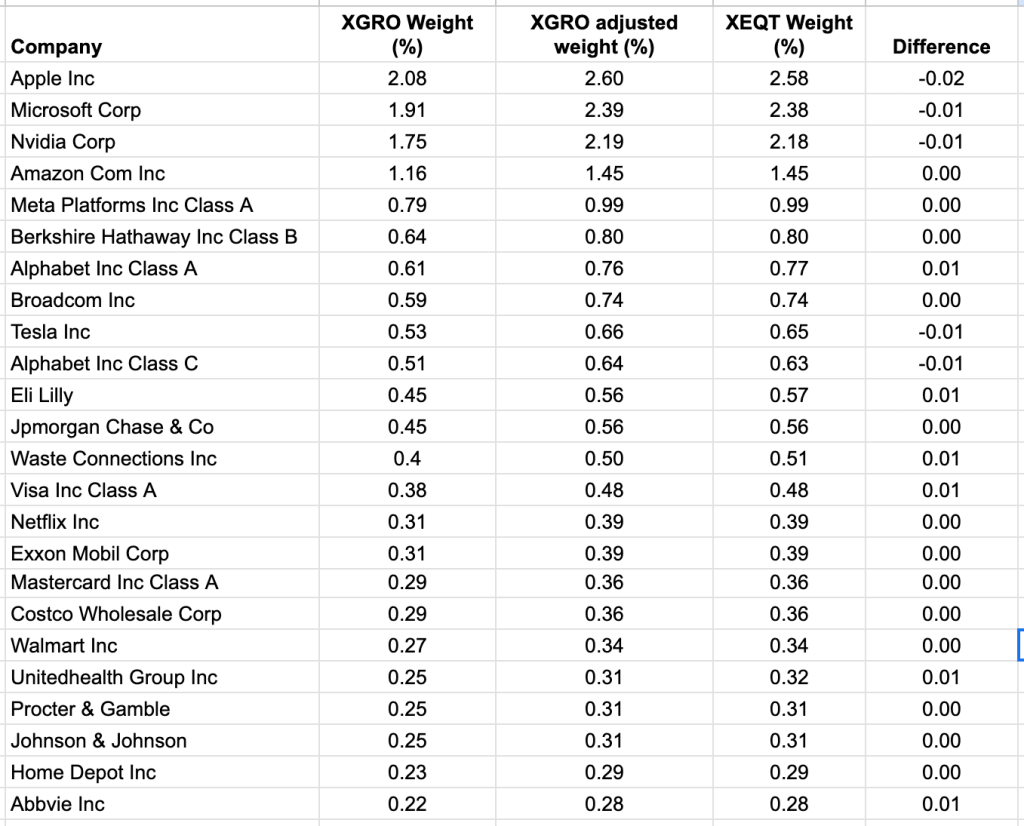
Comparing % contribution of the largest US holdings of XGRO and XEQT, April 2025

So while there are some differences in the largest stocks I looked at, there wasn’t a consistent bias towards the large stocks. In fact, the sum of the “difference” column shown here is precisely zero.

But why? Shouldn’t XEQT’s double purchasing of large US stocks (via both ITOT and XUS) result in a bias towards the large US stocks at the expense of smaller US stocks? It should, but right now, at the moment, it doesn’t.

This is because XGRO, at the moment, actually has a slightly larger US bias than XEQT, and both of them are actually below target (as per their reference guide):

Current XEQT US equity weightTarget XEQT US Equity WeightCurrent Adjusted XGRO US equity weightTarget Adjusted XGRO US Equity Weight
42.63%45%43.73%45%

This, I suppose, will wash out in the coming weeks/months as both XGRO and XEQT buy up more US stocks to get closer to their targets. In short, there isn’t anything to worry about in the near term; in the longer term, owning XEQT will probably tilt the US equity bias a bit towards larger stocks, which I’m not too fussed about.

  1. I do have a growing amount here because otherwise I’d have a hard time keeping my bond allocation to the desired 15% of my portfolio. ↩︎
  2. I believe this is called “doing the research”. ↩︎

What’s the deal with AOA?

As mentioned elsewhere, I rely heavily on all-in-one ETFs in my retirement portfolio. New to all-in-ones? Read a bit about them here.

Previously, I covered what’s in XGRO, which is an all-in-one you can purchase on the Canadian market. Because I also happen to have a lot of US dollar-based retirement savings, I have the majority of those funds invested in AOA. AOA is an 80/20 fund 1 offered by BlackRock. It seems that this sort of all-in-one is not as popular in the US as Canada, not sure why2. I see offerings from State Street that sound similar. BlackRock has other members of their asset allocation family with different equity percentages — there’s something for everyone!3

I thought it would be interesting to see what, exactly, is underneath every $100 you invest in AOA. So by reading AOA’s ETF description, following the ETF descriptions of what’s inside AOA, and doing a little math, I came up with the following breakdown4:

FundWhat is it?How much?Colour Commentary
IVV US stock coverage that tracks the S&P 500 Index, 500 of the largest US companies $46.44 of your $100 investment

(of which ~3$ is in each of Apple, Nvidia, and Microsoft, another $2 is in Amazon and Alphabet and $1 in each of Meta and Broadcom)
The Magnificent 7 and 493 other companies
IDEVBroad international (ex-US) developed market stock coverage that tracks the MSCI WORLD ex USA IMI Index, about 2250 companies $21.90 of your $100 investment

(of which SAP gets 29 cents ASML gets 28 cents…)
This also includes a tiny slice of Canada…top holding is RBC at 16 cents of your $100
IUSBBroad US Bond market exposure, about 16,000 bonds from government and corporate entities$16.37 of your $100 investment

(of which $6.29 is in US Treasury, $1.42 is in the Federal National Mortgage Association…)
12 month trailing yield is 4.07%, not too shabby
IEMG3500 or so international companies from emerging markets, following the MSCI Emerging Markets Investable Market Index $8.37 of your $100 investment

(of which 72 cents is in Taiwan Semi, 36 cents is in TenCent..)
27% China, 19% Taiwan, 18% India, 10% South Korea…
IAGGAbout 5800 international bonds tracking the Bloomberg Global Aggregate ex USD 10% Issuer Capped (Hedged) Index5$2.83 of your $100 investment

(of which 5 cents is Chinese T-Bills)
Trailing 12 month yield = 4.27%, even less shbby
IJHUS Midmarket stocks that track the S&P MidCap 400 Index$2.67 of your $100 investment (of which 2 cents is in Williams Sonoma)21% Industrials, 18% Financials…
IJRUS Small Cap stocks that track the S&P SmallCap 600 Index $1.87 of your $100 investment
(largest holding is Hims Hers Health — 2 cents)
IJH+IJR+IVV is sort of similar to ITOT
Main components of AOA as of February 2025

Like XGRO, investing in an all-in-one like AOA provides you with exposure to a bunch of different asset types across many different geographies in one product, including all of the “hot” stocks you read about ad nauseam. Diversification under one banner.

The big difference from XGRO is the very tiny representation of Canada overall. I worked it out to about 2.5% of the overall number, which makes sense given the size of Canada on a global scale.

I came across the “Three Fund Portfolio” popularized by Bogleheads over 15 years ago. AOA and its family members is more or less that concept.

  1. Shorthand for “80% equity, 20% bonds”. There remains a lot of disagreement about the appropriate asset allocation, e.g. https://www.bogleheads.org/forum/viewtopic.php?t=210178 ↩︎
  2. Instead, I see a lot of “target date” retirement ETFs, which are in some ways similar, but lower the equity percentages as you get closer to the target date. ↩︎
  3. There’s also AOR (60% equity), AOM (40% Equity) and AOK (30% Equity) ↩︎
  4. Compare with the XGRO breakdown at https://moneyengineer.ca/2025/01/30/whats-the-deal-with-xgro/ ↩︎
  5. That’s a mouthful. ↩︎