
Right after the final, final deadline of Wealthsimple’s last free money offer, it appears that Wealthsimple is now offering spousal RRIFs as an account type for the DIY investor (they’ve had them for quite a while in their robo-advisor accounts).
This had always struck me as silly, especially since they have offered spousal RRSPs for a while now.
With this development, Wealthsimple is nearly a viable option to host all of my retirement funds1. My needs are pretty simple:
support for all the account types I need (RRIF/Spousal RRIF, TFSA, joint non-registered, individual non-registered)
zero cost ETF buy/sell
support for Norbert’s Gambit (which implies support for USD accounts, naturally)
Norbert’s Gambit is planned in early 2026 for Wealthsimple, per the very limited info found here.
So, if you’ve been on the fence about Wealthsimple, here’s one more reason to consider them. Once Questrade’s free money gravy train ends for me in March 2027, they become a personal serious contender, especially if they are willing to throw free money my way, which, historically, has certainly been a recurring theme. On that note, if any reader wants to give them a whirl, I have referral codes, just shoot me a note at comments@moneyengineer.ca; if you act quickly2, there might be some free Apple gear in it for you too.
QTrade and Questrade both offer all three. There may be others. ↩︎
Wealthsimple is a broker who holds some of my retirement assets1. They had a “For Nerds Only” (recording here) event on October 22 where they announced a bunch of new features. The most exciting development for me was the pending availability of Norbert’s Gambit. Here’s my take.
Of no personal interest to me as I don’t trade them. There are an increasing number of ETF products that use “Covered Call” strategies in an effort to eke some (or more) yield out of held equities, but I don’t bother with products like that2. I like my investments simple.
I lump these two together since I have the same amount of interest in both of these developments: none. Although people have made huge profits on gold and crypto, I’d rather make money off of companies that make things or provide services.
An interesting product that allows you to buy into the entire index3 (TSX all-cap4 or S&P 5005) and hold individual stocks. The main benefit of this is automated tax-loss harvesting which should reduce your tax bill in a non-registered account. The idea is logical, but it will come down to how well it is executed — how closely will Direct Indexing actually track the underlying index, and how much tax savings can be realized? The benefit will have to be more than the 0.5% MER being charged for investing in the index this way. Of possible interest in a non-registered account, but not otherwise. I’m not actively adding to my non-registered investments, so I don’t think this is for me either, although I’ve often wondered about how many stocks you actually have to hold in order to get “close enough” to the performance of the TSX 60 / S&P 500.
Sounds like an offer ripped from the pages of CIBC, BMO, or RBC. Dedicated advisors, tailored advice. Wealthsimple’s differentiator appears to be in the fee structure. From https://www.wealthsimple.com/en-ca/advice:
Our fees start at 0.75% and drop to 0.4% for clients who have $10M or more with us.
I am not a fan of percentage-of-net-worth-based wealth management. It implies that larger portfolios are more complex. Anyway, this might be the kind of offer future, less-capable-me might be interested in, but at the moment, no thanks.
“Coming Soon”
The other features announced on the event are not available yet. But here’s a view all the same:
Summit Portfolio: sounds like a robo-advisor that also includes private equity. Since I like my investments to be liquid, this is another development that doesn’t really interest me.
Retirement Accelerator: cheap loans to help you with RRSP contributions. Leveraged investing doesn’t fit my risk profile, and, oh, by the way, I’m already retired 🙂
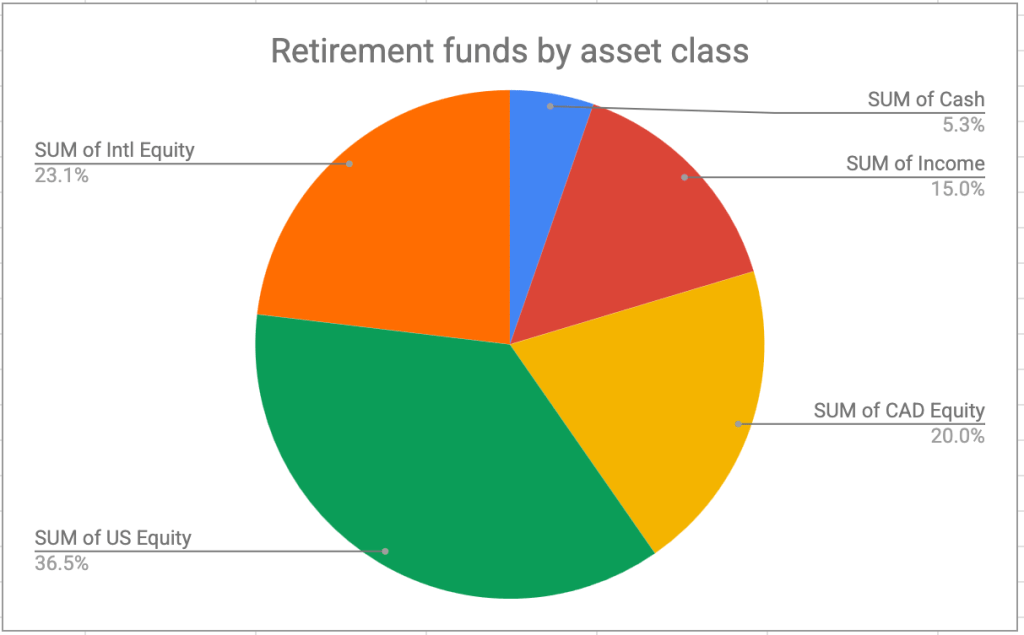
Norbert’s Gambit: This is something I use all the time given that i have a large amount of USD holdings in my retirement portfolio. The best thing about the Wealthsimple webinar is that they actually trotted out Norbert6 himself to talk about it! This is one feature missing from the Wealthsimple portfolio that was a “must have” for me given my current holdings.
AI Trading Features, Advanced Options Strategies: Yawn.
Wealthsimple continues to be a broker I like to watch as they keep the new features rolling out. They are still not a serious contender to be my #1 broker until they support self-directed spousal RRIFs, something they inexplicably still lack.
Mostly because of the DPSP debacle and the fact I needed a new Macbook. ↩︎
On the webcast, it sounded more like they held “a representative sample” of these indices, which makes sense to me; you couldn’t hold ALL the members of the index AND do tax-loss harvesting at the same time. Their FAQ at https://www.wealthsimple.com/en-ca/portfolios/direct-indexing confirms this. ↩︎
VCN is an ETF that holds the same index, as far as I can tell. ↩︎
VFV is an ETF that holds the same index priced in CAD. IVV is the same index priced in USD. I presume the Wealthsimple product is traded in USD, but they don’t explicitly say. ↩︎
If you have no idea what Norbert’s Gambit is, it’s a way to cheaply convert USD/CAD in your online brokerage account. Most brokers support it1.
Because I hold a lot of USD assets in my retirement savings, and since I live and spend most of my money in Canada, I need a way cheaply convert to Canadian funds in my RRIF. So last week, I had to convert some of my AOA holdings into XGRO holdings and so I updated the log I’m keeping. So far, I’ve done the Gambit three times this year, and twice I’ve lucked out on the FX rate changes and actually made money2 on the transaction.
And many people expect Wealthsimple to join this club soon. ↩︎
What I mean: if the funds had converted instantaneously with no fees rather than waiting around for the 3-5 business days for the Gambit to complete, I would have received LESS money than by using the Gambit. Over time, I expect this will even out, but right now I’m about $55 CAD ahead. ↩︎
Since I hold a fair amount of USD in my retirement portfolio and most of my expenses are in CAD, I do have to convert between the two worlds from time to time. Most of the time I’m converting USD to CAD, but because of higher US interest rates, I’ve recently converted some CAD into USD to take advantage of that fact and earn a little more money on my cash positions1. My normal way of dealing with this conversion is using Norbert’s Gambit, which I’ve talked about here and here.
Anyway, I’ve decided to keep track on what these movements are costing me using my current broker of choice, Questrade. The answer is not quite as straightforward as you might think.
Fixed Cost
With Questrade, a journaling2 fee is charged every time you do the Gambit. This costs $9.95 plus HST for a total of $11.24, always charged in Canadian dollars. If you choose to subscribe to Questrade Plus, then your monthly fee covers these costs. I’ve done the Gambit twice this year, with one more planned in the 4th quarter. So for me, the cost of journaling is a pay-as-you-go cost. This cost is the same whether you are journaling one share or 10,000 shares, so larger transactions are better here.
Variable Cost: Changes in USD/CAD rate
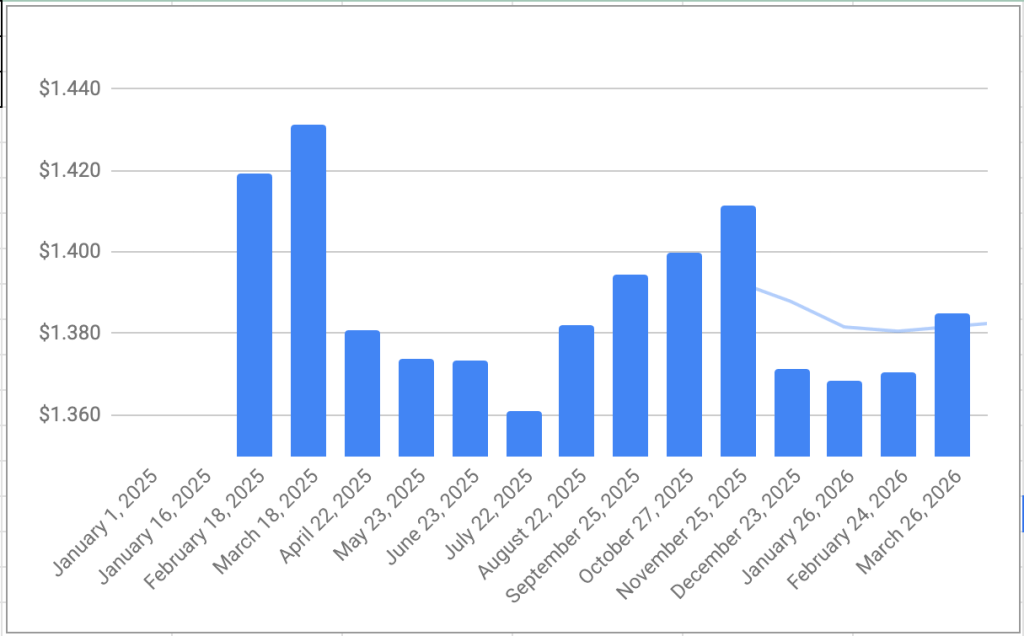
Performing the Gambit using Questrade takes several business days. The foreign exchange rate moves all the time, so by the time you complete the conversion, the rate has almost certainly changed from when you started the process. Sometimes this works in your favour, sometimes not. Most of the reading I’ve done suggests you ignore this variability, since over time it should even out. For kicks, I’m tracking it.
Variable Cost: Buying and Selling DLR/DLR.u
Any trade you do has an inherent cost, even if you pay $0 commissions3, as I do. That cost is buried in the bid/ask spread. You may have noticed this at work immediately after completing a trade — it almost always seems that the market value of what you just bought is a little lower than what you just paid4. This variable cost is buried, but can be estimated by looking at the average bid/ask spread of DLR, which is featured on its fact sheet. It’s currently stated to be 0.07% when buying/selling DLR and 0.1% when buying/selling DLR.U5 . So, on average, you will sustain a total 0.17% cost when doing the Gambit. But I must reiterate — this cost is buried in the actual price per share you get when buying/selling DLR. Now, I actually paid very close attention to the bid/ask pricing last time I did the Gambit and I paid about half that rate but that’s all down to things like the volume of trading on the day, how many shares you’re moving and a whole bunch of other things that I don’t fully comprehend.
Anyway, here’s my tracking table that I’ll update as I do more of these trades:
Some definitions are in order:
DLR Buy: date upon which DLR (or DLR.u) was purchased.
DLR Sell: date upon which DLR (or DLR.u) was sold. There’s a lag because that’s how long Questrade takes to complete the journaling request. Seems like it’s 3 business days.
USD: The USD value of DLR bought or sold as reported by the trade confirmation6
CAD: The CAD value of DLR bought or sold as reported by the trade confirmation7
Effective rate: divide the previous two columns to come up with a USD in CAD rate8
Spot Rate on BUY/SELL date: daily average exchange rate9 as reported by the Bank of Canada
Target currency: what we end up with, USD or CAD. It’s the opposite of what we start with
Ideal in target currency: This is a calculation that takes the starting currency and applies the spot Rate on the DLR buy day to come up with the target amount. The ideal would be what you would have gotten if you had access to a no-cost conversion on the day you decided you wanted it.
Net Cost subtracts either the USD or CAD column from the ideal amount. If it’s negative, it means the foreign exchange rate moved in our favour between the buy and sell dates. Net Cost is given in the target currency.
Journal fee is charged by Questrade
Total cost adds the journal fee and the net Cost and converts everything to CAD using the spot Rate on the buy day. If it’s negative, we actually made money doing the conversion.
% cost takes total cost and divides by the CAD column
If you want a comparative cost, a typical broker charges 1.5% of the amount changing hands. Looks like I’m doing far better than that so far!
And by “cash” I mean either ICSH or ZMMK, which are ultra-short-term bond funds denominated in USD and CAD, respectively. They are both featured as ETF All-Stars.↩︎
“Journaling” is the technical term for moving an interlisted stock/ETF from the CAD side to the USD side of your account or vice versa. ↩︎
An attractive feature of Questrade, among others ↩︎
This effect is often masked by the volatility in the asset you’re buying, but when you buy very stable priced assets like ZMMK or ICSH or CASH it becomes quite noticeable. ↩︎
And 0.07% happens to be one cent divided by the current DLR Canadian price of $14.12. And 0.1% happens to be one cent divided by the current DLR.u price of $10.24 USD. ↩︎
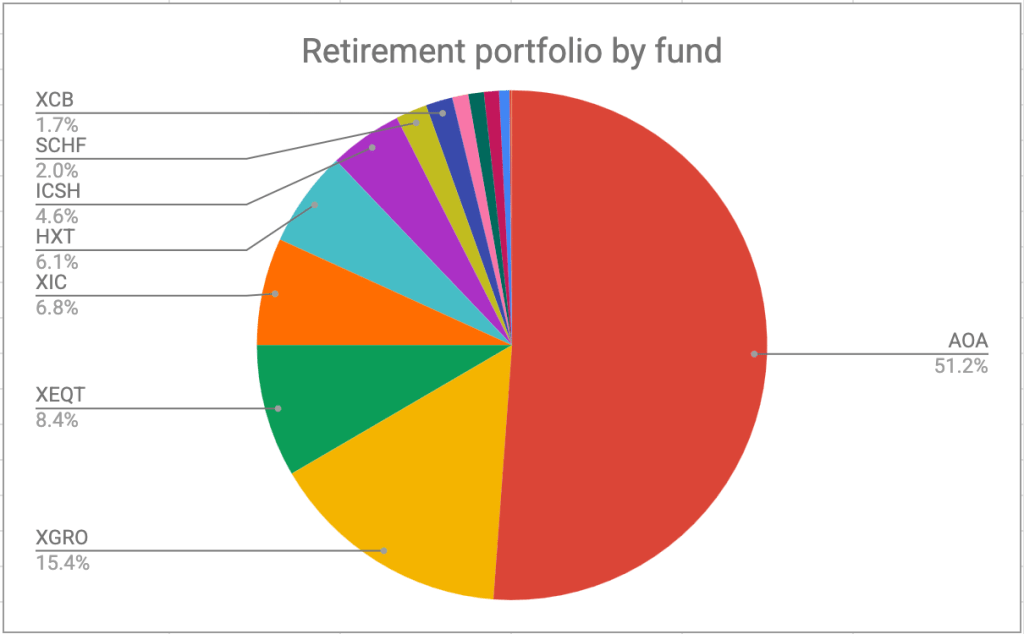
I have a dedicated non-registered account in my retirement portfolio that is the cash cushion for VPW’s decumulation strategy. You can read about the details of how I currently get paid in retirement here.
That non-registered account holds about 85% Canadian dollars, invested in ZMMK, with the remaining 15% invested in ICSH. Both of these ETFs are very short-term bond funds and give me a slight advantage over investing in zero-risk HISAs. ZMMK and ICSH are part of my ETF all-stars lineup, and I track HISA rates on a monthly basis.
The fact is that US interest rates are a lot higher than Canadian interest rates, almost 2% higher as of July 2025. It seems to me that I should take advantage of that fact. Taking advantage of this situation would mean selling some ZMMK, performing Norbert’s Gambit with the resultant cash, and then buying ICSH. There are costs involved at every step of the way1:
Selling ZMMK means I’ll get dinged with the bid/ask spread2
Performing Norbert’s Gambit costs $9.95 plus HST on Questrade to do the necessary journaling
There will be bid/ask spreads to pull off the Gambit…once when buying DLR, once when selling DLR.U
Buying ICSH means another bid/ask spread
So at what point is it worth it? Let’s do a bit of math using the following assumptions:
The delta between US and Canadian rates is 1.8% in favor of the US rate. That’s an annual rate, and I’ll just divide by 12 to get a monthly rate3.
The bid/ask spread for DLR per the ETF fact sheet is 0.1% on the CAD side and 0.07% on the USD side
So clearly, for amounts around $1k this isn’t such an attractive proposition as the costs will take a fair bit of time to be negated by the bump in interest rates. For larger amounts, I’d say it’s worth it. Given ZMMK hasn’t yet paid out its dividend for the month, I guess I’ll wait until I’m ex-dividend (July 30, 2025, per the fact sheet) before doing this transaction.
I’m also ignoring the tax on any capital gains I might pull off. It will be quite small, and will be close to 0. ↩︎
Bid/ask spread is the difference between what the price holders are willing to sell at versus the price offered by a buyer. For ZMMK this is typically 1 cent. ↩︎
Whether this delta continues to hold is anybody’s guess. ↩︎
Which, admittedly, has no hope of being correct. If you do this sort of thing frequently enough, it ought to even out over time. ↩︎
This is true at Questrade. YMMV with your broker. ↩︎