Why you can fire your advisor: Asset allocation ETFs

Summary: Asset allocation ETFs1 let you buy exactly ONE fund to meet your investing needs. Buy ONE fund, and forget about it. Really? Really.

In the run-up to getting ready for retirement, I greatly simplified my portfolio. On the Canadian dollar side, it’s almost all invested in two places: XGRO and DYN6004 (a Canadian high-interest savings account). On the US dollar side, it’s almost all invested in two equivalent places: AOA and DYN6005 (a US high-interest savings account). XGRO is an example of an Asset Allocation ETF that trades in Canadian dollars, whereas AOA is an example of an Asset Allocation ETF that trades in US dollars. The overarching objective of my retirement portfolio is to keep allocations at 5% Cash and the rest in XGRO or AOA. Effectively, this puts me at about 80% stocks.

What’s an Asset Allocation ETF?

Very simply, they are a kind of ETF that allow you to make one investment decision based on your desired risk profile. Risk is a personal decision, based on factors like timeline before needing the money, how much you agonize over stock market fluctuations and so forth.

More risk means better long-term growth prospects means more stocks.

Looking for higher long term growth? Choose an asset-allocation ETF that has a higher percentage of stocks. Looking for lower long term growth with less volatility? Choose an asset-allocation ETF that has a lower percentage of stocks.

There are many Canadian providers out there who provide their own families of asset allocation ETFs.

Which provider you choose may boil down to which is the most convenient / least expensive to buy and sell. For example, BMO Investorline clients can buy and sell the BMO family with no charges, while QTrade clients can trade the iShares family with no charges.

I personally don’t think that there is much to differentiate each of the families. Each provider is just trying to capture your business. So whether you buy ZEQT or XEQT or HEQT or VEQT 2 probably doesn’t matter very much in the big picture.

I summarized them below:

ProviderETF SymbolsRead more
BMO100% Stocks: ZEQT
80% Stocks: ZGRO
60% Stocks: ZBAL
40% Stocks: ZCON
https://bmogam.com/ca-en/products/exchange-traded-funds/asset-allocation-etfs/
iShares100 % Stocks: XEQT
80% Stocks: XGRO
60% Stocks: XBAL
40% Stocks: XCNS
20% Stocks: XIC
https://www.blackrock.com/ca/investors/en/learning-centre/etf-education/asset-allocation-etfs
Global X3100% Stocks: HEQT
80% Stocks: HGRW
60% Stocks: HBAL
40% Stocks: HCON
https://www.globalx.ca/asset-allocation-etfs
TD90% Stocks: TGRO
60% Stocks: TBAL
30% Stocks: TCON
https://www.td.com/ca/en/asset-management/insights/summary/all-in-one-td-etf-portfolio-solutions
Vanguard100% Stocks: VEQT
80% Stocks: VGRO
60% Stocks: VBAL
40% Stocks: VCNS
20% Stocks: VCIP
https://www.vanguard.ca/en/product/investment-capabilities/asset-allocation-etfs

The magic? Reallocation.

The real magic of asset allocation ETFs is that they do the work of reallocation for you. This is subtle, but crucial. Automatic reallocation takes the emotion out of investing, and means you’re buying low/selling high, every quarter. What?

Take for example XGRO. Per the product brief you can see that its target composition is

  • 20% XIC (the TSX 60)
  • 36% ITOT (the S&P total US stock market, about 2000 companies)
  • 20% XEF (international developed stock market)
  • 4% XEC (international emerging stock market)
  • 16% Canadian bonds (XBB and XSH)
  • 4% Non-Canadian bonds (GOVT and USIG)

The observant reader will note that 80% of this list is made of stocks, divided up over multiple geographies. Anyway, the “target composition” is key here. What this means is that every quarter stocks get bought and sold to re-establish the targets. If the US stock market goes on a tear while the Canadian stock market is tanking, the US gains will be locked in and the Canadian market will get picked up at a discount. It’s a perfect system. No emotion. Just ratios. No work on your part.

What’s the catch?

There is a small cost associated with owning an asset-allocation ETF. Most charge you about 0.20% every year. If you instead decided to own the underlying assets you could probably save on the order of 0.10%. (This is, more or less, what I had in place before I started simplifying my portfolio). But that assumes that you do the rebalancing yourself in a timely way, and the trading fees are negligible.

Wrap up

Asset Allocation ETFs are a great way to get a diversified, risk-appropriate, emotion-free, inexpensive investment portfolio. They are the ultimate tool in the DIY investor’s toolkit.

  1. Also known as “all in one” ETFs. Also known as “funds of funds”. They all mean the same thing. ↩︎
  2. Geez, no points for originality on the ETF names… ↩︎
  3. Global X has additional ETFs on the same page that add leverage to amplify returns. I don’t use them, since the amplification works both ways — in good AND bad markets. ↩︎

Do this TODAY with your RRIF, RRSP or TFSA

Disclaimer: I’m not an accountant and I’m not a lawyer. Consult a professional if desired.

Summary: Make sure your RRSPs, RRIFs and TFSAs have named SUCCESSORS or BENEFICIARIES to save those who survive you time, effort and money.

The CRA lets RRSPs, RRIFs and TFSAs of a dead person pass to other people without tax penalties. But the account(s) have to be properly set up. Make sure they are! It only takes a moment.

The CRA does like us to pay taxes. But they are not completely heartless. They’ve set up the concepts of successor annuitant (for RRIFs), successor holder (for TFSAs) and “Beneficiary” (for RRIFs, TFSAs and RRSPs) to help lower the tax burden of someone who has died.

A “Successor Annuitant” for a RRIF basically takes over the account of the dead person. This can only be a spouse. This is similar conceptually to the named successor holder of a TFSA. The benefits?

  • There’s no sale of the assets of the RRIF/TFSA unless desired; everything can pass “in kind” to the successor
  • The successor does not take a tax hit1 (although the dead person does in the case of a RRIF/RRSP2)
  • The funds are not considered part of the estate, which means these funds will avoid probate. That’s good because you won’t have to pay the estate administration tax (aka probate fees) and access to the funds is MUCH quicker since you don’t have to wait for probate to be granted (a months long process, typically)

A “Beneficiary” is someone who gets the money in the accounts. This can be anyone. Or even more than one (e.g. the children of the TFSA holder or children of the RRIF holder). The same benefits apply

  • The named beneficiary or beneficiaries don’t take a tax hit
  • The funds in the TFSA/RRSP/RRIF are not part of the estate

Both the “successor Annuitant” and the “Beneficiary” are set up at the account level by your financial service provider (e.g. your bank, your broker) usually set up at the time the account was created. (Remember those long forms you had to fill out when you first opened a TFSA, RRSP or RRIF? It was on the application form). These can of course be changed at any time. One common situation where a change is warranted is after the death of one spouse — this would be a good time for the surviving spouse to name their children as beneficiaries of their RRSP/RRIF/TFSA.

The actions you should take? Call up the people who manage your RRIF/RRSP/TFSA and make sure that:

  • If you’re the holder of a RRIF/TFSA, are married, and intend to give everything you own to your spouse, make sure you name your spouse as the SUCCESSOR
  • If you’re the holder of an RRSP, are married, and intend to give everything you own to your spouse, make sure you name your spouse as the BENEFICIARY
  • If you’re the holder of a RRIF/TFSA/RRSP and don’t have a spouse, or want to name someone other than your spouse for the funds, then make sure they are named as a BENEFICIARY

This only takes minutes, and can save those who remain after you’re gone time, effort, and money!

  1. Not 100% true. The recipients have to pay tax on the gains made by the holdings between day of death and the day of liquidation. ↩︎
  2. For RRIFs, this is true. Put simply, under tax rules, the dead person is considered to have sold the entire RRIF on the day they died and must declare it all as income. ↩︎

Reduce Travel Costs by Paying Attention to Foreign Exchange

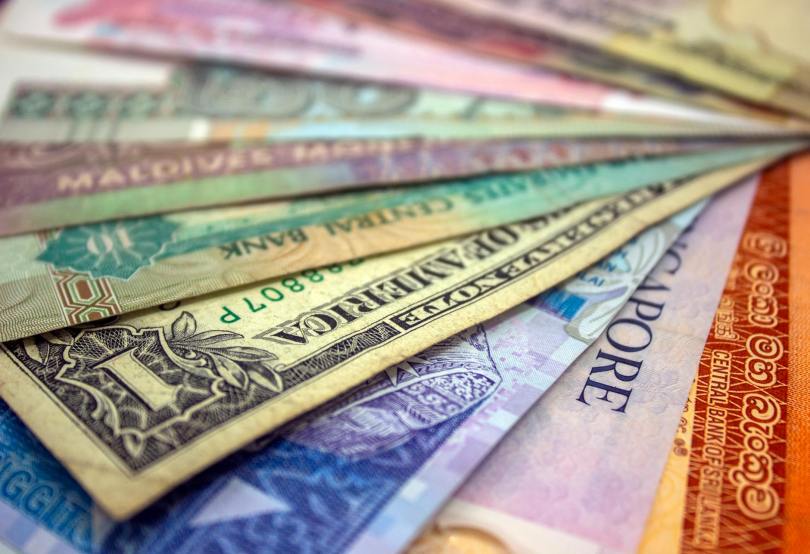
Travel is something I like doing. Spending money on seeing new places, trying new things, all good from my perspective. But spending unnecessary money to line the pockets of a bank? I’m not so good with that.

For many years, I’ve used my credit card everywhere, in every country. Very convenient. I recall my first big trip abroad (circa 1992) where my main source of money was Travelers Cheques, if you can believe it. (Looks like they aren’t even available in Canada anymore).

But I never realized how much this habit was costing me. From https://www.cibc.com/en/personal-banking/credit-cards/articles/foreign-currency-credit-card.html:

It’s common for a credit card company to charge a foreign currency conversion fee between 1% and 3% of the transaction amount.

What’s especially sneaky, and the reason I never gave it much thought, is that the fee is buried in the exchange rate that is posted as part of the transaction. As a result, it’s easy to miss how much you’re giving to the bank.

Now, 1% to 3% extra for a cup of coffee or a taxi ride isn’t going to break the bank, but for a multi-night stay in a hotel? Show tickets? Car rentals? It can start to add up.

Here are two products that I use to help get rid of those fees. There are others out there, but these I have used myself and can recommend them.

Wealthsimple’s Cash Card

I’ve been rather curious about Wealthsimple for a while now. I started with using their “pay what you want” tax service and saw it got a mention from the Globe and Mail’s Rob Carrick (an excellent resource, by the way) which led me to investigate further. This is NOT their “beta” Wealthsimple Infinite Visa credit card that is coming out in 2025.

From https://www.wealthsimple.com/en-ca/spend:

Now you can feel like a local while shopping abroad. With no additional foreign transaction or ATM fees from Wealthsimple, your Cash card is a must-have travel companion.

The Cash Card, as far as a vendor is concerned, looks like a MasterCard. But to you, the card holder, the Cash Card looks like a debit card. Any transaction charged to the Cash Card is instantly debited, so you have to have the money available in your Weathsimple account before you go on a shopping spree.

Signing up for the Cash Card was done online, in minutes. Putting money on your Cash Card can be done using Interac e-transfer from your “usual” bank account, and is available pretty much instantly as well. Cash Card supports Apple Pay and as a nice bonus, also provides you with a “virtual card” accessible from the Wealthsimple app so you can enter credit card details for online purchases. You can also order up a physical card, but I’m still waiting for mine….The Canada Post strike apparently is still being used as an excuse in that regard. (Not a big deal, I rarely use a physical card anymore).

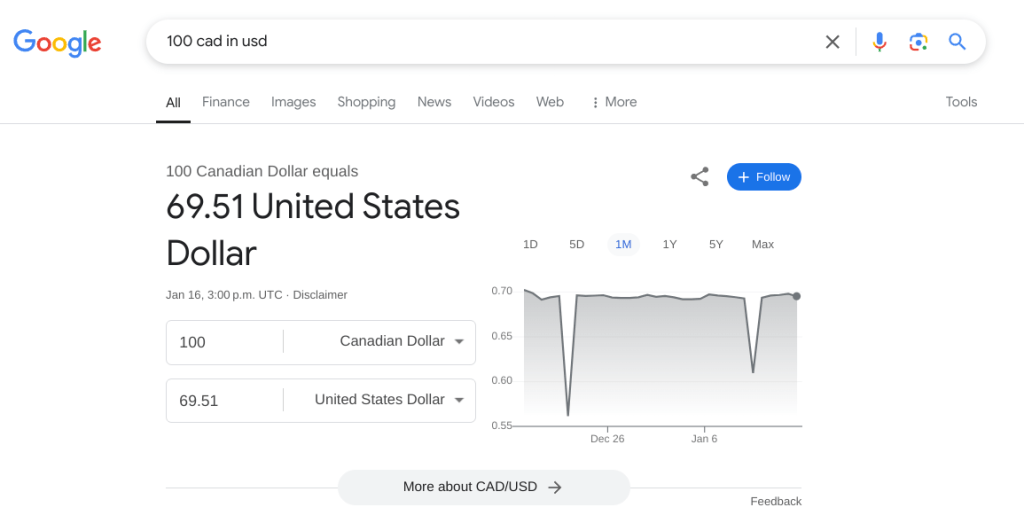
I’ve now successfully used the Cash Card for US dollar and British pound purchases, and the rate I got was exactly the same as the rate I saw in real time from Google (cries quietly at the current exchange rate):

  • Pro: Very easy to set up, does what it says — no extra foreign exchange fees
  • Pro: Supports multiple foreign currencies, with only a few exceptions.
  • Pro: It’s free, and the money in your Cash account actually earns a bit of interest.
  • Con: You have to have the money available up front, it’s not a credit card that you can pay later.

CIBC’s US Dollar Aventura Gold Visa Card + CIBC US Dollar Savings Account

If instead you’re looking for a REAL credit card and you’re only interested in US dollar transactions, then CIBC’s US Dollar Aventura Gold Visa might be a choice. I signed up for this card because a lot of my retirement funds are in US Dollars, I travel and shop in US Dollars pretty regularly, and I happen to bank with CIBC which also makes things easier.

However, unless you already have a US Dollar bank account that can pay off your US Dollar credit card, you’ll need to set that up at the same time. So for that I used the CIBC US Dollar Savings account. This should not be confused with CIBC’s US checking account which isn’t required (I have this account too, but have very limited use for it).

So, applying for these products is the typical Canadian bank experience. Multiple days, multiple forms, mildly unpleasant, but as a self-directed investor, not unusual, either.

The Visa card has an annual fee ($35, which includes up to 3 additional cards) and allows you to collect a small amount of Aventura points which can be redeemed for cash or gift cards. The card supports Apple Pay and generally works like any other card you may have used. Just make sure you don’t accidentally use it for a Canadian dollar transaction or else you’ll get charged that extra conversion fee that you were trying to avoid in the first place.

The savings account pays a paltry amount of interest (0.05% for balances under $10,000 USD) and charges $0.75 USD for every transaction. So, nothing to write home about there. But it is in essence a Canadian bank account in every way; this means (for example) it can be set up as a legitimate bank account with your online broker.

  • Pro: if you’re already banking with CIBC, both the credit card and the savings account are linked to your existing CIBC bank card, so you can see everything from one login.
  • Pro: Related to the above, you can set up auto payment of your USD credit card from your USD savings account
  • Pro: Related to the above, you can easily move money from your Canadian accounts to your US accounts. Of course, with this convenience comes the added foreign exchange fee that you were hoping to avoid, but if you’re short US Dollars, then it’s an option. (In another post, I’ll talk about how I convert US dollars cheaply).
  • Pro: It’s a real credit card, meaning you can defer payment.
  • Con: Compared with Wealthsimple, it’s somewhat painful to set up
  • Con: it’s only useful for US dollar transactions

For most people, the Wealthsimple Cash Card is the easy way to save money on foreign transactions, and the downside is small. If you have access to US dollars (maybe you’re paid in USD, or like me, have investments in USD), then perhaps the CIBC Aventura card might make sense, too.

What’s in my retirement portfolio?

So what’s in my retirement portfolio these days? A fair question. My portfolio is 100% in ETFs excepting the cash position. For historical reasons, a lot of my retirement savings are in US dollars. As as result, you’ll see ETFs listed here that trade on the US stock exchange, in US dollars. It’s not an approach I’d recommend for most people as it adds a lot of complexity to the mechanics of moving money around, which is really what decumulation boils down to!

The pie

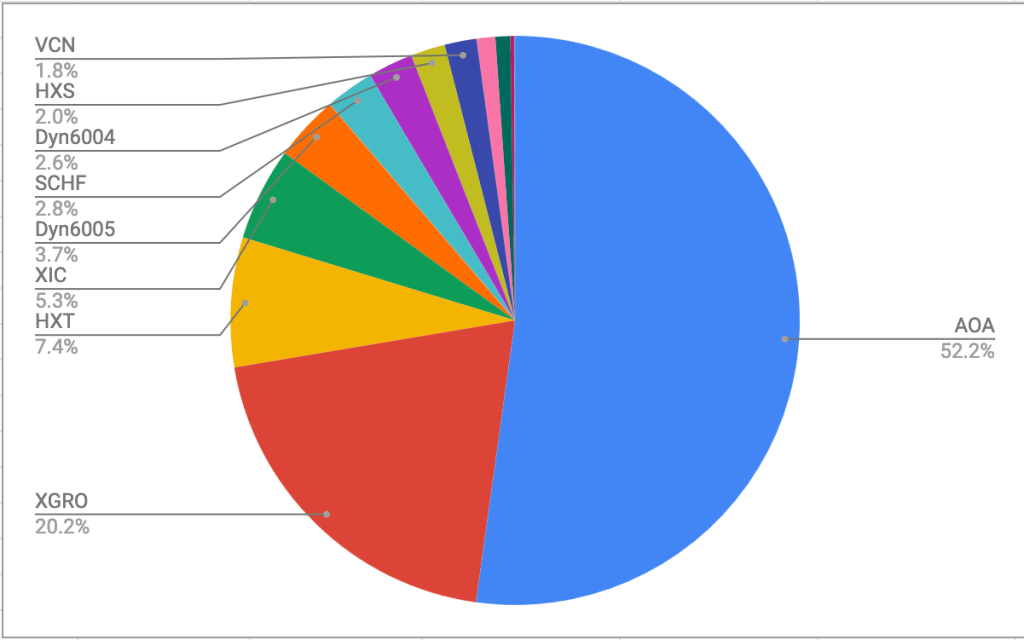
The chart shown below is the summary of all my accounts: personal and spousal RRIFs in CAD and USD, TFSAs for me and my spouse, and non-registered accounts in USD and CAD. It comes pretty close to my target of 80/15/5: 80% equity, 15% bonds, 5% cash. Let’s visit how that comes about.

Summary of funds held in my retirement portfolio

What’s in the pie?

AOA: This is what I call an “All-in-one” ETF that trades on the US stock exchange. It’s an 80/20 fund, 80% equity, 20% bonds. Its US weighting is pretty high, its Canadian weighting is pretty small (about 2.4% by my calculation).

XGRO: This is the Canadian sibling of AOA. An “all-in-one” ETF that trades on the Canadian stock exchange. It’s also an 80/20 fund, with a much stronger tilt to the Canadian equity market.

HXT: Is a fund that I only hold in my non-registered account. Through behind-the-scenes accounting and swap contracts, it provides no-dividend access to the S&P/TSX 60. This is useful from a tax perspective if you’re still earning a salary since it effectively defers any tax impact until you sell shares.

XIC: A variant of the S&P/TSX 60 that caps the contribution of any one company to prevent the “Nortel effect” seen in the late 1990s. I’ve been too lazy to clean this out of the account.

DYN6004/DYN6005: Are Scotiabank HISAs in Canadian and US funds (High Interest Savings Accounts). On my provider’s trading platform, they look like mutual funds, but are just savings accounts that pay a decent interest rate, monthly. They have consistently provided the best rates of all the HISAs available on my provider’s platform.

SCHF: A very low cost equity fund that trades in USD. It provides exposure to international developed markets except the USA. It has about 8.5% weighting for the Canadian equity market. I used to have this in my registered accounts, but dropped it in favor of AOA. It’s still in my non-registered accounts so I don’t have to take an unnecessary capital gain.

HXS: The sibling of HXT, but it covers US markets. Only held in non-registered accounts.

VCN: Provides broad exposure to the Canadian market including smaller companies.

In an ideal world, my portfolio would just hold AOA/DYN6005 for US funds and XGRO/DYN6004 in Canadian funds. Eventually, as I decumulate my holdings, that’s what it will look like. Simple is best.

So why is my portfolio not aligned with my ideal model? Three main reasons:

  • Some of the “extraneous” holdings are in my non-registered accounts and I don’t want to incur a capital gain just to make the portfolio simpler.
  • I want a little bit more Canadian market exposure since I do live and spend money here.
  • No pressing need to. The splits between Canada/US/International equities are fine where they are. I try to trade only when necessary.

I’ll revisit this post from time to time as I go through decumulation to see how it evolves. Prior to hitting the button on retirement, I had a lot more ETFs in the list, basically attempting to build the equivalent of XGRO and AOA through other ETFs. For a small cost, (roughly 0.15%) AOA and XGRO rebalance their holdings quarterly so I can just let them run on autopilot, confident that they will always be close to my desired 80/20 splits. That’s why these two ETFs make up the lion’s share of my retirement portfolio.

Moving from DPSP to RRIF: Cautionary Tale