Death, Taxes and Estates: Part 2

I am not a lawyer, accountant or tax expert. Your situation may be a lot different than mine. Seek professional guidance if needed.

Part 1 of this blog is found here.

I’m still wrapping up the estate of my late mother, who died a little over a year ago, a year and a bit after my father died.

My situation

All my mom’s worldly assets were held with BMO Investorline: RRIF, TFSA and a non-registered account. This was a self-directed account; the relationship with BMO (as I came to learn) was pretty informal. Me and my siblings were named as beneficiaries of the estate, and my Mom had taken steps to name us as beneficiaries for the RRIF and TFSA. More details about how that works were covered in a previous post.

First weeks

I had ready access to estate cash because I was named as a joint account holder on my Mom’s chequing account1. This is a very useful thing to have in place, since it can cover expenses incurred after death: funeral costs, moving expenses are two that come to mind. I treated this account as part of the estate, but it allowed me to spend the estate’s money instead of my own for these things.

DIY Estate Handling

Informing BMO Investorline2 of my mother’s death was required, and that took a single call to the general help desk. After about a week I had an initial meeting with their estate department.

Once I provided proof of death, all accounts were frozen and I could no longer even see what was in them. BMOI correctly noted that we were the beneficiaries of the TFSA and RRIF and we started the paper-intensive3work of liquidating and distributing the assets held in those accounts. I checked my notes — it took about 2 months for that step to be fully completed.

What was unexpected was that BMOI gave us ALL the money in the RRIF, with no taxes withheld. From a tax perspective, a RRIF is treated as income in the hands of the deceased on the day they die. For most people, that means a substantial tax bill for that tax year. So as an executor4, I had to be VERY sure that my Mom’s non-registered account could cover the tax bill that would eventually come. Using a tax calculator helped a lot.

The non-registered account, where the bulk of the assets lay, would require a probated will, as I expected. This account remained locked and frozen.

Probate and probate fees

In the very simplest terms, probate means getting a court to certify a will as accurate. And when you think about it, it makes sense that financial services companies want to be VERY sure that the executor (aka estate trustee) is in fact the correct person.

After doing a bit of reading (mostly this source) I decided I could tackle it on my own. This was made significantly easier by the fact that I lived in the same city as my mother, and I had access to a courthouse were I could take my completed forms.

When filing your probate papers, you also have to pay probate fees (aka Estate Administration Tax), which means you have to know the total value of the estate on the day of death. BMOI was able to provide me statements up to that day so I had a to-the-penny accurate assessment of the value held there. BMOI was also able to write a cheque to the Ontario Minister of Finance for these fees using funds available5 in the non-registered account. This meant I wouldn’t have to front the money myself.

Probate fees, in my Mom’s case, were not particularly large (not compared to the estimated tax bill), and since RRIF and TFSA were not part of the estate, they were also lower than they could have been.

After filing, the wait for the court-certified document began. I had very low expectations (I had conservatively estimated a 6 month delay here), but I actually had the probated will arrive in the mail a month later, which was about 4 months after my mother’s death.

Using the Probated Will

With a probated will in hand, I could now unlock the non-registered funds in my Mom’s estate. This required me to open an estate account with BMOI and then transfer the non-registered funds to it. After all that paperwork, I once again had full access to the assets that were formerly held in my Mom’s non-registered account — I could log in to the portal, see the holdings, and most importantly, perform transactions myself at the usual self-directed transaction fees.

I sold all the assets (mostly ETFs, naturally) and partially distributed them to the beneficiaries. Distributing the assets was admittedly (again) more challenging than I thought. Since I was quite familiar with how BMOI worked, I requested AccountLink cheques for the estate account, figuring this would be the easiest way to distribute the funds6. This resulted in a bit of a runaround, but eventually I got a box of cheques sent to me. I held some money back7 so I could pay the 2025 tax bill; this money I invested in a HISA.

Preparing for Tax Season

In late 2024, I removed the remainder of the estate from the HISA account. This was done so as to not have any income generated by the estate in 2025. This simplifies the tax filing considerably.

After doing a bunch of reading, I gave up on the idea of attempting to do the taxes myself. I knew there would have to be both a Final Return (for my Mom) and an Estate Return (aka a T3 return) but I wasn’t really sure about all the steps, and of course CRA’s website isn’t really designed for the layperson to figure this stuff out easily. There was also the matter of filing a CRA clearance certificate. I hired a pro to figure all this stuff out. As it turns out, my Mom’s estate qualified as a GRE Trust, which is, as I understand it, pretty typical. That would appear to offer some potential tax benefits, but I’ll have to wait and see and this point.

  1. It didn’t hold a significant amount of money. Larger sums could conceivably attract the attention of CRA as a bare trust. ↩︎
  2. Hereafter referred to as “BMOI”. Laziness. ↩︎
  3. Actually, mostly filling out PDFs and sending them back over secure messaging ↩︎
  4. If the estate can’t pay the taxes, then the executor is legally obligated to pay ↩︎
  5. Like all matters estate-related, this took a lot of effort. Having sufficient funds when my mother was alive was a very simple process: log on to the portal, sell some shares, wait a few days, get the money. In an estate scenario you have to write a letter of direction to indicate what, exactly, to sell. Then you wait a week or two. Then you get angry at the fact that they charged you $40/trade. Then you write another letter of direction to indicate who to write the cheque to. Then you wait a week for the cheque to arrive. ↩︎
  6. I’m not really sure how the mechanics would work with a broker that doesn’t have bank services. EFT I guess? ↩︎
  7. Probably more than I needed to hold back, but I wasn’t taking chances. ↩︎

What’s in my retirement portfolio (March 2025)

This is a (hopefully monthly) look at what’s in my retirement portfolio. The original post is here. Last month’s is here.

Portfolio Construction

The retirement portfolio is spread across a bunch of accounts1:

  • 7 RRIF accounts (3 for me, 3 for my spouse, 1 at an alternative provider as a test)
  • 2 TFSA accounts
  • 5 non-registered accounts, (2 for me 1 for my spouse, 2 joint)

The target for the overall portfolio is unchanged:

  • 80% equity, spread across Canadian, US and global markets for maximum diversification
  • 15% Bond funds, from a variety of Canadian, US and global markets
  • 5% cash, held in savings-like ETFs.

The view as of this morning

As of this morning, this is what the overall portfolio looks like:
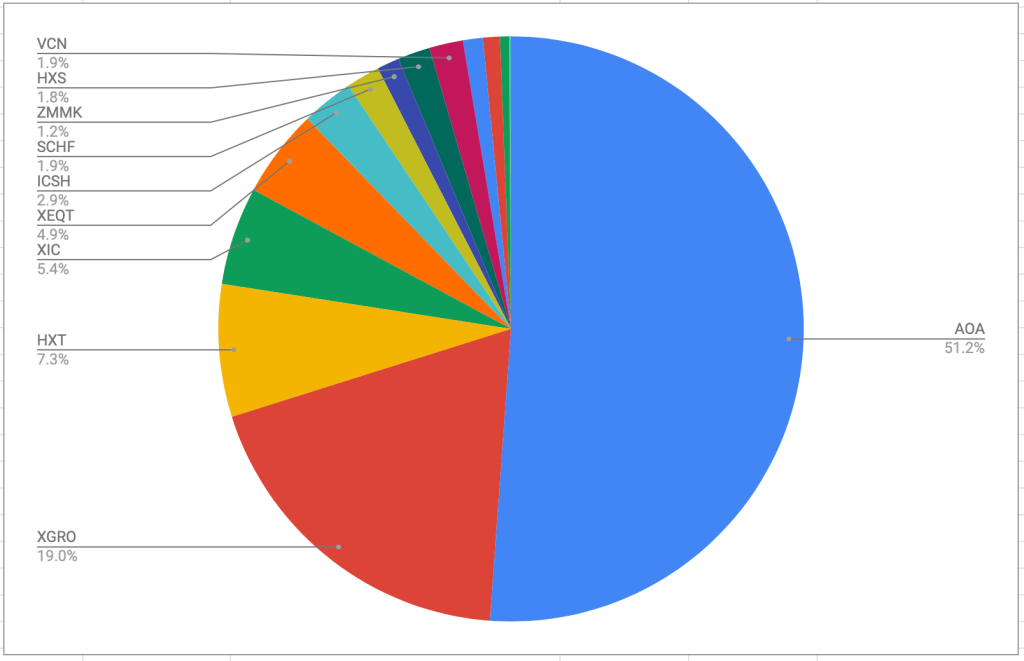
Overall retirement portfolio by holding, March 2025

The portfolio, as always, is dominated by AOA and XGRO which are 80/20 asset allocation funds in USD and CAD, respectively. The rest are primarily either cash-like holdings in two ETFs: ZMMK2 in CAD and ICSH3 in USD) or residual ETFs held in non-registered accounts for which I don’t want to create unnecessary capital gains just for the sake of holding AOA or XGRO.

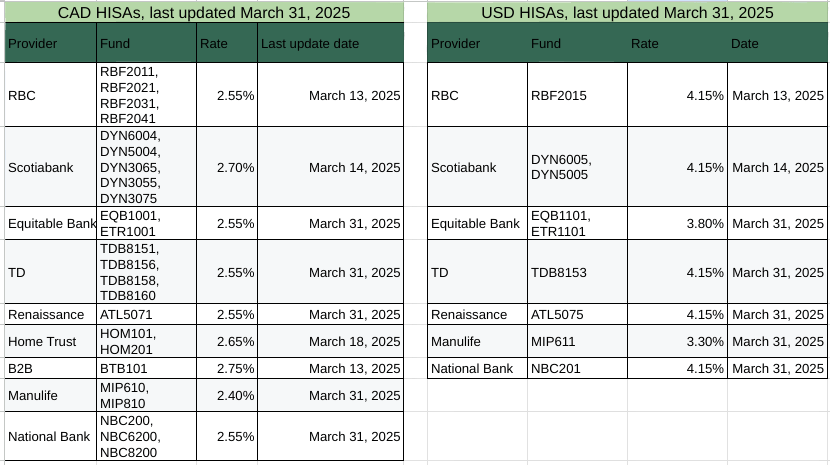
The biggest month over month change is due to switching brokers. My old broker (QTrade) allowed the purchase of HISAs, but my new broker (Questrade) doesn’t seem to offer them4. So I replaced DYN6004 with ZMMK and DYN6005 with ICSH. I made these changes in my QTrade account to avoid any problems with doing an “in-kind” transfer to Questrade.

I’m still in need of USD to pay off some vacation bills, so there is a small hit to SCHF to help out.

Plan for the next month

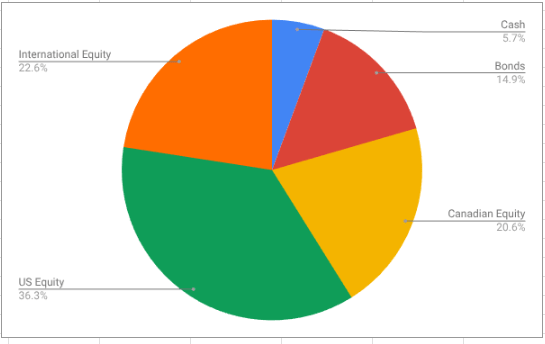
The asset-class split looks like this
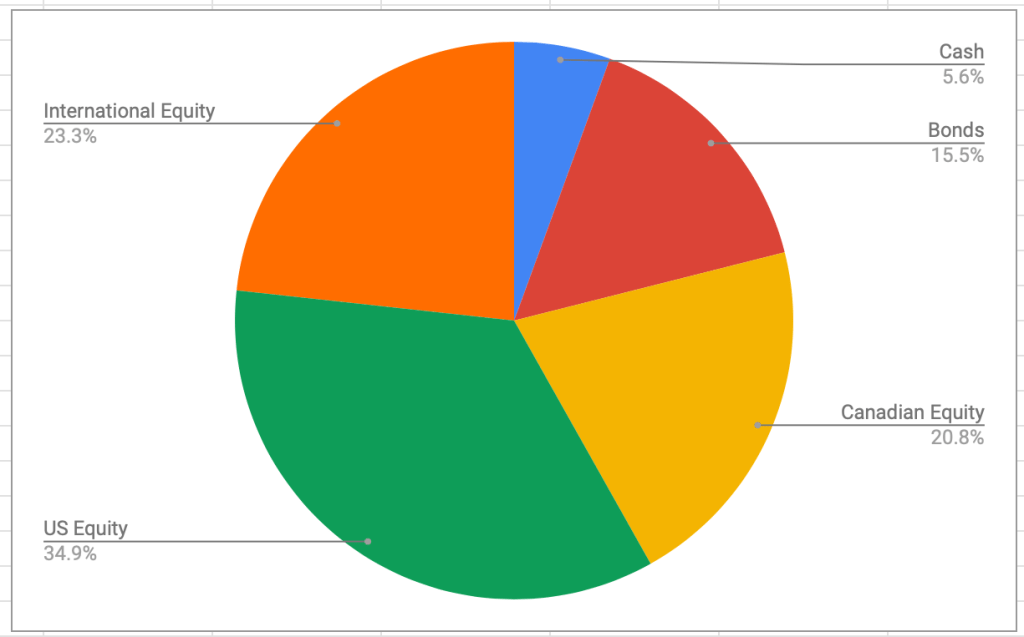
Overall retirement portfolio by market, March 2025

The international equity percentage is below my target of 24%, and so I’ll have to fix that5. VEU looks like it provides exposure to both developed and emerging markets at a rock-bottom price6. XEF would be a perfect fit in the Canadian market, although I should probably also consider XEC to get some emerging markets exposure.The cash position is artificially high because I already did the necessary transactions to get paid out of my RRIF and non-registered accounts (if I did this exercise at the beginning of the month, rather than mid-month, that would disappear). That extra cash will flow to my bank account in the coming days.

A quarterly activity that I’ll be performing this month7 is to shift some of my USD RRIF holdings into my CAD RRIF. I do this to make sure I’m not overexposed to changes in the CAD/USD exchange rate. My current provider reportedly allows me to make RRIF payments natively in USD, so that may be another option to consider. I’ll make an attempt at some point!

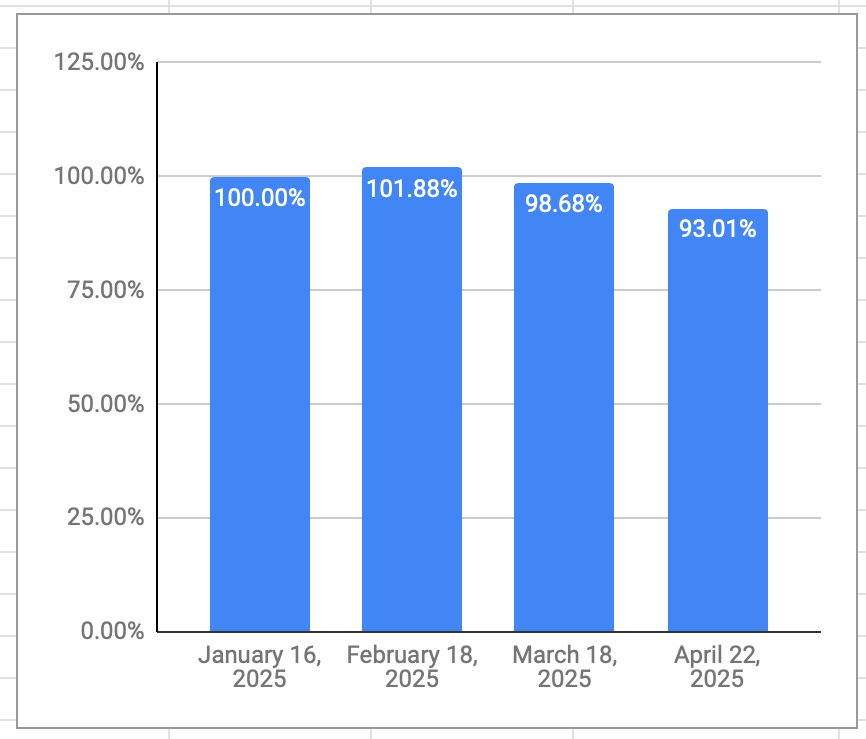
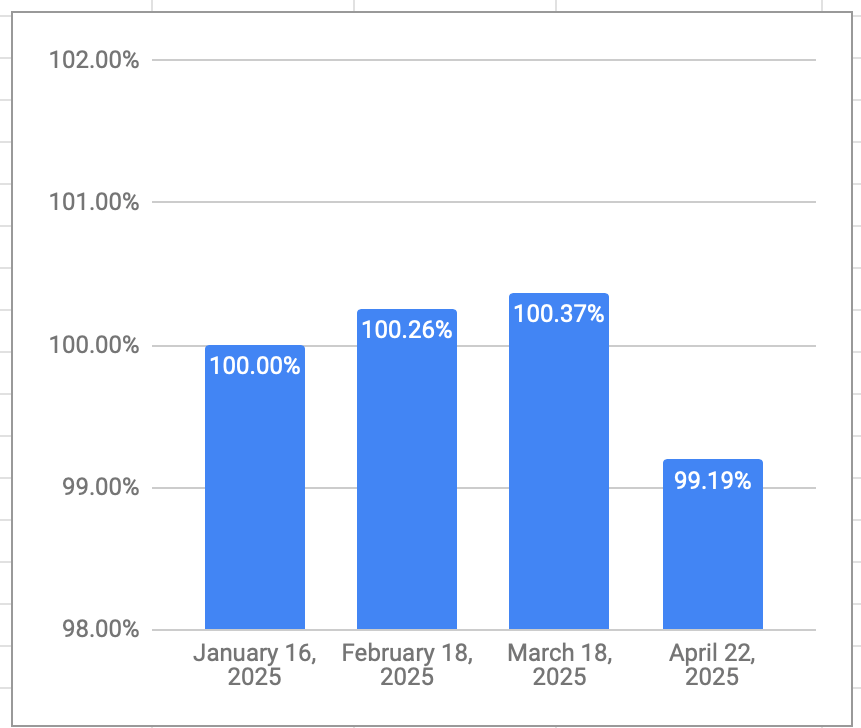
One final note: my retirement savings declined 3%8 over the month due to the wild (mostly downward) swings in the stock market, but this leaves me roughly even since my retirement started at the beginning of the year. Here’s the monthly returns for the 2 ETFs that make up the lion’s share of my portfolio9.

XGRO and AOA monthly returns so far
  1. The list is sort-of accurate. I’m in the middle of changing online brokers and since Questrade combines USD and CAD assets in one account, the number of accounts is diminishing. ↩︎
  2. Current 12-month yield: 3.6% ↩︎
  3. Current 30-day SEC yield: 4.61% ↩︎
  4. This specific topic addressed at https://www.financialwisdomforum.org/forum/viewtopic.php?t=125308. ↩︎
  5. The observant reader will note I also said this LAST month. That was before I decided to switch brokers. Once my holdings settle at Questrade, I’ll revisit. ↩︎
  6. MER = 0.04%. VEU has some Canadian exposure too, which isn’t ideal, but I don’t think there’s a USD ETF that excludes both Canada and the USA. ↩︎
  7. And should have done last month, sorry. ↩︎
  8. It would have been worse, except the USD also went up versus the Canadian dollar in the time period. Diversification works 🙂 ↩︎
  9. “Without dividends reinvested” since these two ETFs only pay out quarterly. There haven’t been any yet — next month! ↩︎

Death, Taxes and Estates: Part 1

I am not a lawyer, accountant or tax expert. Your situation may be a lot different than mine. Seek professional guidance if needed.

What happens to our investments when we die? Having lost both my parents in the past 2 years, I’ve (regrettably) had a lot of exposure to the ins of outs of estates and how they work.

Being Ready for the Inevitable

Fact: we’re all going to die. Pretending this isn’t true isn’t helpful to your survivors. So there are some concrete things you should have in place before that happens.

  • Have a will. Whether DIY, software-assisted1, or prepared by a suit, just get it done — here’s a nice step-by-step guide. And if you do have one, is it up to date? Take a look.
  • Have the will name exactly one executor, with alternate executors in the event your first pick isn’t available . Hearing multiple stories from multiple sources about how much extra work and delay having joint executors causes, I cannot recommend this all-too-common approach. You’re not “playing favourites” by naming one person2.
  • Make sure your executor knows how to get a hold of the will. Be very specific, and repeat this information frequently so it’s top-of-mind.
  • Make sure your RRIFs/RRSPs/TFSAs name successors and/or beneficiaries. I covered that topic in more detail here.
  • Make sure any life insurance policies name a beneficiary
  • Make sure your workplace pension3 names a survivor4.
  • Prepare a death binder5 with all assets clearly specified — provider name, account numbers, name on the account. Is the list really long? Maybe it’s time to trim that list down. Every provider on that list will create work for your executor. So if you want to be kind, keep the list of providers small. Make sure your executor knows where to find it.
  • Have a month or two of expenses in cash that is accessible by those who survive you, like in a joint chequing account. Assets held solely in your name will be frozen when you’re dead, possibly for weeks or months.
  • Set up someone (your executor, for example) as your authorized representative with CRA. This makes dealing with taxes much easier for those that you leave behind. How? Read here.

My Situation

My parents held no real estate, and all their assets were held in DIY investments (RRIF, TFSA and non-registered accounts). They each had a will and named the other as the executor with me as the alternate. They dealt with two providers — one for their DIY investments (BMO Investorline) and one for their day-to-day banking (CIBC). So in terms of complexity I think I had it pretty easy.

Dealing with the death of the first parent

My Dad’s death was not a surprise, and because of this I was able to maximize his TFSA contributions before he died. Dad did hate paying taxes.

Although my Mom was legally the executor, I did almost all the work involved. Most providers seemed to be pretty good about dealing with me once they got confirmation from my Mom. The key documents and facts you’ll be asked for in almost every encounter are the same, so have these ready each and every time:

  • Date and place of birth of the deceased
  • Date and place of death of the deceased
  • SIN number of the deceased
  • A death certificate (this is issued by the funeral home, typically)
  • The will
  • Funeral home invoice (if applying for a death benefit)

Dealing with the bank was easy. One 30 minute meeting6 and all was sorted.

As many DIY financial services providers don’t have brick and mortar locations, high quality digital versions7 are also generally accepted. In the case of BMO Investorline, I had to visit a BMO branch8 with the documents so they could send them as “true copies”. How a provider with no affiliation with a bank does this, no idea9.

In the case of any DIY investment held in the deceased’s name — those assets get frozen upon notifying the provider. This can be problematic if one is relying on those assets to say, pay rent, or pay for funeral arrangements.

The unexpected complication arose from the non-registered joint account — it didn’t just “convert” to removing one person’s name from the account — you have to open a new, individual account, involving all the same paperwork as though you were a new client, and then transfer the joint assets “in kind” to the new account. During this time, the funds were not accessible. This is beyond annoying, but I suspect this is the same regardless of who your provider is. My mom lost access to her joint account for about 6 weeks while this was settled.

Taxes for the death of the first parent

The tax return you file for a person who has died in this scenario is called (ominously) the Final Return. A person who dies is treated as though they sold all their assets on the day of death. I did not file a T3 Return10 return for my Dad, since all the assets passed through to my Mom. If he had had non-registered assets held solely in his name, I think I would have had to.

  • For a RRIF or RRSP, this means CRA assumes you sold all the holdings on the day you died and recognized it as income11
  • For a non-registered account held solely in one name, CRA assumes you sold all the holdings on the day of death and recognized any capital gains at that time.

I was able to successfully file the Final Return for my Dad using Wealthsimple’s tax software12. The Final Return cannot be eFiled — you have to print it and send it using snail mail.

Adjustments after the death of the first parent

After my Dad died and my Mom had all the combined TFSA/RRIF assets in place, we updated her TFSA and RRIF to name me and my siblings as beneficiaries by filling out a form. This proved to be helpful in reducing the tax bill a bit when she died. More on that in a future post.

  1. “willful.” seems to be a trendy option nowadays: https://www.willful.co/ ↩︎
  2. One could argue the opposite — just give the duties to your least favourite relative as a last vengeful act ↩︎
  3. Some workplace pensions provide death benefits and/or an ongoing survivor pension, but only if you take the trouble to name a survivor in that pension. ↩︎
  4. And if you do, I’m envious 😉 ↩︎
  5. Paper is probably less trouble than trying to provide a file location/passwords, but YMMV. ↩︎
  6. Prearranged online of course. You can’t just walk into a branch to do anything these days. ↩︎
  7. You’ll get good at this workflow or go crazy trying. Take photo on phone, airdrop to laptop, compress/convert image so it can get through email… ↩︎
  8. Do NOT assume that the brokerage has anything to do with the bank with whom they share a logo. I learned this the hard way with BMO/BMO Investorline. ↩︎
  9. Maybe notarized documents? Let me know at comments@moneyengineer.ca. ↩︎
  10. AKA “Estate Return”. A person who dies becomes a new tax entity, typically named Estate of <dead person> ↩︎
  11. Which is why you name a successor for your RRIF — this tax penalty is thereby avoided ↩︎
  12. It was because Intuit Quicktax could not handle this scenario that I ended my decades-long relationship with them. ↩︎

ETFs for parking your money safely

Since my new DIY broker (Questrade) does not support the purchase of high interest savings accounts (HISAs), I need to find a free-to-trade alternative. 5% of my retirement portfolio is invested in what is characterized as “cash”, but I expect that money to earn some sort of return with essentially zero risk. (Another 15% of my portfolio is in the bond market, which, as we all learned in the last few years, has its downsides1.)

Questrade (like Wealthsimple) offers free trades of all ETFs. So it makes sense for me to go looking for ETFs that invest in safe havens. Here’s what I turned up for investments in Canadian dollars, based on some Google searches and some reading of similar questions posted in the public domain. Not all of them are what I would call “equivalent” to a HISA.

Fund SymbolFund CompanyWhat it invests inMERCurrent annual yield2Commentary
CASHGlobal X“high-interest deposit accounts with one or more Canadian chartered banks”0.11%2.68%This invests in the HISAs I currently invest in
CBILGlobal X“short-term Government of Canada T-Bills”0.11%2.88%Not a HISA but a safe investment
HISAEvolve“high-interest deposit accounts”0.15%2.71%Equivalent to CASH but with a higher MER
MCADEvolve“Canadian dollar high-quality short term debt securities (with a term to maturity of 365 days or less)”0.20%3.17%Very short term bond fund. 18% of holdings have due dates of less than 30 days
ZMMKBMO“high-quality money market instruments issued by governments and corporations in Canada, including treasury bills, bankers’ acceptances, and commercial paper. 0.13%3.6%Not a HISA but a very short term bond fund3. 31% of holdings have due dates of less than 30 days.
CAD ETF Candidates for investing Canadian dollars

Based on this quick analysis, ZMMK looks pretty attractive — a lot of very short term (and hence safer) debt as compared to MCAD, excellent returns. It is clearly a riskier investment than something like CASH or HISA. Between CASH and HISA I lean to smaller MERs every time, so CASH wins. CBIL might be a sort of happy middle ground…a T-Bill ought to be as good as a bank. All of these ETFs have a pretty stable NAV, either $50 or $100 per unit, so there should be little to worry about in terms of capital gains.

Since I hold a lot of USD, (not convinced this is a good idea), I need to do the same exercise for USD safe havens.

Fund SymbolFund CompanyWhat it invests inMERCurrent Annual Yield4Commentary
HISUEvolve“primarily in high interest US dollar deposit accounts”0.11%4.05%This invests in the HISAs I currently invest in
HSUVGlobal X“primarily in high interest U.S. dollar deposit accounts with Canadian banks…not currently expected to make any regular distributions”0.2%n/aGlobal X “corporate class” ETFs convert interest payments into capital gains. This sort of ETF makes sense in a non-registered account to minimize taxes.
ICSHBlackRock“broad range of short term U.S. dollar-denominated investment-grade fixed- and floating-rate debt securities and money market instruments”0.08%4.31%Not HISA but 46% is invested in debt with less than 30 days maturity
MUSDEvolve“primarily in U.S. dollar-denominated high-quality short term debt securities (with a term to maturity of 365 days or less).”0.20%3.49%Similar in strategy to ICSH, but only 20% in debt with 30 days maturity and only 40 holdings.
UCSHGlobal X“primarily invests in high-interest U.S. dollar deposit accounts, which provide a higher interest rate than a traditional USD savings account.”0.16%4.08%HISA-like, based on term deposits
USD ETF Candidates for investing US dollars

ICSH is the clear winner in terms of return, but, like ZMMK, a little riskier than a simple bank account. It has a nice broad portfolio (363 individual holdings) which makes it feel safer. HISU looks like the straight-up HISA replacement.

What ETFs do you use to park your cash? Let me know at comments@moneyengineer.ca.

  1. Excellent graphic of historical returns available at https://themeasureofaplan.com/investment-returns-by-asset-class/ ↩︎
  2. Take the latest monthly distribution, divide by the unit price, multiply by 12. If BoC holds their interest rates steady for the year, you could expect to achieve this rate for the next year. As of March 3, 2025. ↩︎
  3. “Commerical paper” refers to very short term debts, 30 days average maturity. Like a credit card debt, maybe. ↩︎
  4. US based funds like this one report a “30 day SEC yield”, it represents “interest earned after deducting the fund’s expenses during the most recent 30-day period by the average investor in the fund”. ↩︎

Changing your online broker: a guide

I have succumbed to the offer of free money and am in the process of breaking up with QTrade in favor of Questrade1.

I had no illusions about making the switch; I knew it was going to be a bunch of work to get it done. But as a retiree with no other sources of income, I figured I could spare the time2.

Switching DIY brokers, on the face of it, isn’t terribly complicated:

  1. Create a login on the new provider
  2. Open appropriate accounts on the new provider
  3. Fill out transfer forms to move accounts with the former provider to the new provider
  4. Set up ways and means of moving money in/out of your new provider
  5. For RRIFs and TFSAs, make sure the successor/beneficiary information is accurate3.
  6. Wait for step 3 to complete
  7. Resume investing and/or decumulating

Here are the things I needed to complete each of the above tasks as I went through the process of opening ten (yes, 10!) accounts4 on Questrade.

Step 1: Creating the login(s)

You’ll want a unique and strong password to do that, and using a password keeper of some kind is the best way to do that. Most providers also offer (or require) two factor authentication, and they usually require a cell phone number 5that they can text. Do set that up at the same time, this stuff is important to protect as best as you can.

If your spouse is joining in on the fun, you’ll need a second login for that.

Step 2: Opening the accounts

There will be some series of provider-dependent steps you will need to go through to identify what kind of account you want, and who will own it. And in order to do that, you’re going to need to have a full understanding of what kind of accounts are at your old provider — what vehicle (e.g. RRIF, RRSP, TFSA) and what owner (me, my spouse, or joint) ?

The owner(s) of a given account are easy enough to determine if you refer to your (monthly, quarterly, annual) statements: the name of the owner will be right up on top. In the case of a joint account6, both of your names will be visible. I’m not aware of any way to change the ownership of an account in the process of a transfer.

This step will be rather tedious. Lots of repetitive form filling, and depending on the sophistication of your provider (and, I think, your province of residence matters), you may have to print (!) and sign — with a pen — documents. In my case, the amount of printing was minimal at this step because Questrade makes good use of DocuSign. But other providers may make you print/sign/take pictures/upload7 instead.

Step 3: Fill out transfer forms

There is usually some delay — a day or two — between step 2 and step 3 since there’s usually some sort of back-office approval process involved8. This will give you the time to make a list of all the account numbers associated with the existing accounts and their rough market value. You’ll need those for the forms.

For me, this step involved a lot of download/print/sign/take pictures/upload9. So make sure you have a working printer, sufficient paper, a way to get forms back to your computer, and patience.

You will have to make an important choice at this step: whether to move the funds as cash, or whether to move them in-kind. “Cash” means you’re authorizing the receiving institution to sell your stuff at your old provider before moving it10. “In-kind” means you’re wanting to keep exactly what’s in the old account already. You can also choose to do a partial transfer at this step, but that’s not something applicable to me.

I chose in-kind since I hate being in a cash position for any period of time. But if you hold GICs or mutual funds (I do not), you should really check to make sure you are able to move those in-kind; many providers have restrictions on that sort of thing.

After the fact, I discovered that Questrade does not support HISA accounts. I am hoping that this does not create unintended consequences or delays.

Step 4: Set up ways and means to move money in/out of your accounts

Different providers do this differently. In my experience, most support online bill pay to get money into the accounts (like, for example, to make a TFSA or RRSP contribution), and EFT to get money out (like, for example, a RRIF payment, something rather important to me).

To set up an EFT transfer, you’ll need your banking details (institution number, transit number, account number) and a void cheque. Most banks have a way to do this directly online, no need for an actual physical cheque, if anyone still uses those.

An increasing number of providers11 seem to support direct credential connection between their platform and your banking platform using a third party like Plaid. I freely admit this sort of thing gives me serious heebie-jeebies, and will default to using upload of void cheques whenever possible.

Step 5: Make sure successors and beneficiaries are named for RRIF/RRSP/TFSA accounts

This will make the life of your heirs much easier and deny the government some of the $$$ associated with estate administration fees since properly documented successors and beneficiaries are NOT considered part of the estate. Read all about it in my previous post.

Step 6: Wait

The claim I am getting from Questrade is to allow 20 days for assets to move. This seems totally ridiculous on the face of it. I’ll report back on how long it actually takes. 1-2 weeks is more typical in my limited experience.

While waiting, I’ll complete the forms to make sure I have trading authority over my spouse’s accounts. This should allow me to see all the accounts she owns from my login. This is handy, since I’m the one who does most of the mechanics of making this whole “getting paid in retirement” thing work.

Step 7: Resume investing/decumulating

After making sure everything moved from your old provider to your new provider, as expected, of course.

You’ll probably want to ask your new provider to refund you any transfer-out fees charged by the old provider at this step.

Given Questrade doesn’t support HISAs, I’ll have to find an ETF alternative, which, thankfully, are plentiful. Other than that, I’m not anticipating big changes in the portfolio or the approach.

At this point, I’ll also have to (probably) close out the QTrade accounts and figure out how I’ll get my tax slips from them next year.

All this probably took 8 hours over the course of a few days. So not a trivial amount of time, but the promotional bonus will make it worthwhile12.

  1. And while both brokers start with the letter “Q” and are frequently confused with one another, I can assure you they are different. ↩︎
  2. And the resultant hourly rate if all goes well is better than what I made when I was paid a salary… ↩︎
  3. I covered that topic in this post. ↩︎
  4. For me: Investment account, RRIF account, Spousal RRIF account, TFSA. Same for my spouse. And then there’s one more joint firewalled investment account that we use for VPW’s cash cushion. That retirement decumulation strategy was covered in a previous post. And a family RESP. ↩︎
  5. Not the most secure or even convenient option; Questrade also offered using a standalone app like Microsoft Authenticator, which made me happy. ↩︎
  6. Here I hit a bit of a wrinkle: QTrade has joint non-registered accounts, but Questrade only has joint non-registered margin accounts. I am hopeful (but unsure) that I can successfully transmogrify one to the other. ↩︎
  7. My workflow for this: take picture on iPhone, Airdrop to Macbook, convert .HEIC files to pdf (and possibly, re-export to reduce file size), upload. This step alone would defeat many folks. ↩︎
  8. In my case, TFSA/non-registered was almost immediate, but 2 days in, I’m still waiting for the RRIFs to be approved. There are some extra regulations involved with registered accounts, it seems. ↩︎
  9. This is probably dependent on both providers involved as well as the type of account involved. The RESP transfer requires some CRA form to be filled out. ↩︎
  10. Possibly attracting high transaction charges — you may want to liquidate the assets yourself instead. ↩︎
  11. Questrade and Wealthsimple to name two ↩︎
  12. Note to the political class — maybe it’s time to take a look at the regulations here to streamline this process? Eight hours of effort to change a provider does not seem like it’s in the consumer’s best interest ↩︎