Cautionary Tale: changing brokers when you have a RRIF

Summary: If you’re changing online providers with an active RRIF, the old provider is (apparently) obligated to pay out the ENTIRE RRIF amount for the current year before releasing your funds.

As you may have read previously, I’m (still) in the middle of changing online brokers from QTrade to Questrade1. Things are moving along…glacially2. I’m at step 6 of the guide.

Background

If you’re not that familiar with RRIFs, you may want to give Demystifying RRIFs a read.

At QTrade, I had 3 separate RRIF accounts:

  • One individual RRIF in CAD
  • One individual RRIF in USD
  • One spousal RRIF in CAD

QTrade makes you have different accounts for CAD and USD, whereas Questrade does not (hooray)3.

The individual and spousal RRIFs are set up to pay out RRIF minimum on a monthly basis, on the last day of the month. I expect this is a little unusual, since a lot of people seem to take their payments annually. In a weird QTrade wrinkle, one can only make payments from a CAD RRIF account, even though the USD RRIF account is used to calculate RRIF minimums4.

The RRIF transfer-out requests were initiated the instant the RRIF account was approved by Questrade, in the opening days of March (March 2 or March 3), a day or two after my February RRIF payment was processed by QTrade. Plenty of time, I figured.

Trouble Afoot?

About 2 weeks ago now, I got a cryptic email indicating that my RRIF transfer out request had been rejected by QTrade due to having “insufficient funds for RRIF payout”. Looking at my QTrade account, it looked to me like the US RRIF was moving (QTrade had already kindly charged me the $150 transfer-out fee), but the CAD RRIFs showed no signs of a transfer being initiated.

Thinking a little about it, I realized that perhaps QTrade wouldn’t release the RRIF assets to Questrade unless they could be sure Questrade could make the monthly RRIF minimum payment, which strikes me as silly, but I expect there’s some regulation that makes this mandatory. And so I immediately sold a few shares of XGRO in each of the RRIF accounts to ensure enough cash existed to cover the RRIF minimum payments and re-initiated the transfer out request.

But again, rejection. What?

But that, apparently, was not fully correct.

Current State of Play, and Some Advice

Today, I was informed by QTrade that no, they are obligated to pay out the ENTIRE RRIF payment for the year before they hand off the account to Questrade. Given the state of the market, I’m not exactly jumping up and down at the thought of having to sell 9 months worth of RRIF payments all at once. (This was, after all, EXACTLY why I set up the RRIFs to pay out monthly.)

So, I’ve decided to leave the QTrade RRIFs alone for the time being. This is far from ideal (multiple providers breaks all my rules about retirement investments being simple), but I take solace in the fact that

  • I will fix this at the end of the year, once most of my RRIF has been paid out
  • Maybe there will be another promotion before then 🙂

All this to say that make sure you have sufficient funds to cover any anticipated RRIF payouts BEFORE initiating a transfer-out request!

  1. And in what may be a minor miracle, I had BOTH providers call ME ON THE SAME DAY without prompting. ↩︎
  2. Most of the account transfer requests are 20+ days old at this point. I did struggle with completing the RESP transfer form correctly. The TFSAs moved quickly. The individual investment account moved quickly. The joint investment accounts are taking a lot longer. And the RRIFs longer still. The RESP, no idea. ↩︎
  3. Having filled out 14 different account transfer requests, ANYTHING that will reduce my account count is welcome. ↩︎
  4. This weird treatment was one of the reasons I started looking at other providers. QTrade claimed they could allow USD RRIF payments, but rejected my initial efforts to make that happen. The day before I started moving everything to Questrade, and two months after I complained about it, QTrade support contacted me to tell me that, oops, sorry, you can withdraw USD from your RRIF. Too late! ↩︎

Buying US Stocks or ETFs? Save money on US dollar foreign exchange.

I have a lot of US dollar assets in my retirement portfolio. I’m not really convinced it’s a good idea, but it has taught me the ins and outs of USD foreign exchange rates. Here I’m talking about getting access to (or changing from) US funds for the purposes of investing in your brokerage account. Getting access to US funds to buy things is a different1 animal, one that I covered in a previous post.

Here’s a few things I’ve learned.

Google is your friend for real time foreign exchange (FX) rates

“1000 USD in CAD” is a terrific search term to get an instant FX rate. (also: Euro, GBP, THB…). This is as close as you’ll get for the absolute best FX rate and should serve as your target.

For most brokerages, foreign exchange is a profit center

Meaning: They’re making money every time you convert one currency to another, usually on the order of 1.5% a transaction. Some providers seem to go to great lengths to hide what rate they are using on any given transaction. (I’m looking at you, QTrade2).

There are exceptions in the brokerage community, to be sure.

  • Interactive Brokers comes very close to the ideal rate for any sizable transaction3 and is the big winner when it comes to converting currency for investing purposes45
  • Wealthsimple recently introduced a tiered FX rate depending on how much you’re converting6:
    • Under $10k, 1.5%
    • Up to $25k, 1%
    • Up to $100k, 0.5%
    • Over $100k, 0%

The cheapest way to convert at most brokerages is to use Norbert’s Gambit

Norbert’s Gambit, in a nutshell, involves the following steps.

I must say at this point that although the steps are reasonably straightforward, there are usually delays introduced at each step. For example, you probably have to wait a day for the initial trade to settle before making the journaling request. And journaling may not be instantaneous either11.

With no guarantee that any of these are accurate, here are the specific steps to do the Gambit on a number of popular platforms.

  1. For most people. Since I am a CIBC USD savings account client, using Norbert’s Gambit is also a way for me to fund my USD shopping purchases. ↩︎
  2. When attempting to buy a USD ETF from my Canadian account, the only indication I’m about to get fleeced is the warning message “The account funds do not match the market currency. Currency conversion and foreign exchange rates will apply.” No indication of what the exchange rate they are using. ↩︎
  3. Their posted rates are very close to the google ideal, but there is a small (very small) minimum charge of $2 per trade per https://www.interactivebrokers.com/en/pricing/commissions-spot-currencies.php ↩︎
  4. It’s not ideal for getting cash access for shopping since they have very long hold periods where you cannot withdraw your money. See https://www.interactivebrokers.com/campus/glossary-terms/withdrawable-cash-subject-to-origination-restriction/ for the details. ↩︎
  5. But that web interface, wow is it ever complicated ↩︎
  6. See https://www.wealthsimple.com/en-ca/legal/fees/trade for the details. You’ll need a Wealthsimple USD account to pull this off, of course, and the only kind of USD account Wealthsimple offers is non-registered. ↩︎
  7. Did this at BMO Investorline since you cannot buy DLR online. Apparently you can buy it if you call in your order. At BMO using RY, I was able to get USD on the same day. ↩︎
  8. HOW to do this will vary considerably depending on who your broker is. Best to Google for specific instructions involving your broker. ↩︎
  9. Possibly for buying and selling the ETF, possibly a fee imposed for journaling, something Questrade is doing starting April 1, 2025. ↩︎
  10. And minus (or plus) any changes in the price of the thing you bought. Depending on your broker, each step in the process may take a day or two. If you do the Gambit often enough, I figure this sort of thing just averages out. Sometimes you win, sometimes you lose. ↩︎
  11. Per https://www.questrade.com/learning/investment-concepts/dual-listed-securities/journaling-shares it can take five (!) business days. ↩︎

QTrade versus Questrade unboxing

I’m in the middle of my transition from QTrade to Questrade. With 11 different accounts to migrate, most of my time has been spent with their new account setup screens, but I have already taken note of a few differences that I’ve noticed between the two in my first week of using Questrade.

Trading fees on stocks and ETFs

Questrade recently announced that they were eliminating commissions on the buying and selling of all stocks and ETFs. QTrade has a decent list of free to trade ETFs, but obviously Questrade is the winner here.

Personally, I don’t think this will make a huge difference for me since my retirement portfolio is mostly based on QTrade’s “free” list (most notably XGRO and AOA), but it’s not fully in that camp. I’ll save a few bucks over the course of the year thanks to this.

Support

Those of you who read my mini-review of QTrade will know that I don’t consider their support a strong suit1.

I encountered quite a few snags2 along the way with Questrade’s account opening process, and as a result I have spent some time dealing with their support team.

One big difference you see right away is that they seem to rely exclusively on chat, with very clear (if sometimes disheartening3) queue position metrics. I myself am a fan of chat, especially one that makes it very clear where you are in the queue. Compared with QTrade, no contest — I’ll take keeping a window open on a computer I’m using over having to listen to highly compressed and repetitive hold music any day of the week!

A technical quibble I have with Questrade’s chat is that it is inconsistently persistent as you navigate the Questrade screens4. On more than one occasion I had my chat closed accidentally because I navigated to the “wrong” screen. Compared to other support chat platforms I’ve used (Rogers, for one), it’s decidedly feature-light.

The support I eventually got was uneven. I suppose last week may not have been the best week to attempt calling Questrade5, but all the same, sometimes the answers I got made no sense or were just flat out wrong.

US Dollar Account Support

Both companies are strong in this regard, allowing USD holdings in various accounts. Personally, I hold USD-denominated assets in my RRIF and my non-registered accounts. (I also used to hold USD assets in my TFSA, but because of the non-preferred tax treatment of dividends held in TFSAs, I got rid of those a few years ago).

The big difference that’s obvious immediately is while QTrade keeps the USD and CAD accounts separate — different account numbers, different screens to navigate — Questrade combines CAD and USD assets in one account. This has the pleasant side-effect of reducing the total number of accounts I have.

I haven’t investigated (yet) how values of accounts and portfolios are reported in Questrade6. I’m expecting that they will allow you to see your account and portfolio values in either USD or CAD7.

One of the irritants I had with QTrade is that they never, ever showed the USD/CAD exchange rate they were using to display the overall CAD value of the portfolio. It appeared they were using a rate that was consistently 1.5% below the spot rate.

And another irritant I had with QTrade is that I could not get RRIF payments natively in USD, something I was told was possible before I opened the RRIF in the first place8. Questrade claims they allow this on their public website, so I’m hopeful. More to come at the end of this month, hopefully.

HISA support

High Interest Savings accounts are an important part of my portfolio holdings since my decumulation strategy depends on them. QTrade has an extensive list of free to trade HISAs (I covered them here) but Questrade doesn’t provide access to this class of product. Instead I have to use ETFs. But since all ETFs are free to trade on Questrade, this shouldn’t really make a big deal of difference. In some ways, it’s better because QTrade restricted HISA purchases to a minimum of $1000, whereas most of the cash-oriented ETFs have an entry price of either $50 or $100 per unit.

I find it difficult to get answers to super-specific questions about various platforms, so if you have questions about any of the platforms I use/ have used (namely, BMO Investorline, Interactive Brokers, Wealthsimple, QTrade and Questrade), then feel free to ask away at comments@moneyengineer.ca.

  1. For an example of coherent and attentive customer support, you’d have to look at Wealthsimple ↩︎
  2. Their website appeared to be getting crushed at times…weird sporadic and non-repeatable error messages ↩︎
  3. Last week on one of my calls, I started at position 370 or so. That was a 90 minute wait. But at least I could write blogs while I waited, something that is really irritating to do when you have to listen to hold music. ↩︎
  4. Possibly browser-related, but c’mon, it’s 2025 and I was using OSX Safari! ↩︎
  5. RRSP season, and their generous promo ending… ↩︎
  6. I have accounts, but until the in-kind asset transfer completes, I have no assets. ↩︎
  7. Taking a peek at the mobile app while I write this, I see options for account balances to be reported as “Combined in CAD”, “Combined in USD”, “CAD” and “USD” so it appears my expectations will be met. ↩︎
  8. After two months (!) of back and forth with QTrade, I was told — last week — that this is possible using the exact same method I unsuccessfully attempted in January. ↩︎

Changing your online broker: a guide

I have succumbed to the offer of free money and am in the process of breaking up with QTrade in favor of Questrade1.

I had no illusions about making the switch; I knew it was going to be a bunch of work to get it done. But as a retiree with no other sources of income, I figured I could spare the time2.

Switching DIY brokers, on the face of it, isn’t terribly complicated:

  1. Create a login on the new provider
  2. Open appropriate accounts on the new provider
  3. Fill out transfer forms to move accounts with the former provider to the new provider
  4. Set up ways and means of moving money in/out of your new provider
  5. For RRIFs and TFSAs, make sure the successor/beneficiary information is accurate3.
  6. Wait for step 3 to complete
  7. Resume investing and/or decumulating

Here are the things I needed to complete each of the above tasks as I went through the process of opening ten (yes, 10!) accounts4 on Questrade.

Step 1: Creating the login(s)

You’ll want a unique and strong password to do that, and using a password keeper of some kind is the best way to do that. Most providers also offer (or require) two factor authentication, and they usually require a cell phone number 5that they can text. Do set that up at the same time, this stuff is important to protect as best as you can.

If your spouse is joining in on the fun, you’ll need a second login for that.

Step 2: Opening the accounts

There will be some series of provider-dependent steps you will need to go through to identify what kind of account you want, and who will own it. And in order to do that, you’re going to need to have a full understanding of what kind of accounts are at your old provider — what vehicle (e.g. RRIF, RRSP, TFSA) and what owner (me, my spouse, or joint) ?

The owner(s) of a given account are easy enough to determine if you refer to your (monthly, quarterly, annual) statements: the name of the owner will be right up on top. In the case of a joint account6, both of your names will be visible. I’m not aware of any way to change the ownership of an account in the process of a transfer.

This step will be rather tedious. Lots of repetitive form filling, and depending on the sophistication of your provider (and, I think, your province of residence matters), you may have to print (!) and sign — with a pen — documents. In my case, the amount of printing was minimal at this step because Questrade makes good use of DocuSign. But other providers may make you print/sign/take pictures/upload7 instead.

Step 3: Fill out transfer forms

There is usually some delay — a day or two — between step 2 and step 3 since there’s usually some sort of back-office approval process involved8. This will give you the time to make a list of all the account numbers associated with the existing accounts and their rough market value. You’ll need those for the forms.

For me, this step involved a lot of download/print/sign/take pictures/upload9. So make sure you have a working printer, sufficient paper, a way to get forms back to your computer, and patience.

You will have to make an important choice at this step: whether to move the funds as cash, or whether to move them in-kind. “Cash” means you’re authorizing the receiving institution to sell your stuff at your old provider before moving it10. “In-kind” means you’re wanting to keep exactly what’s in the old account already. You can also choose to do a partial transfer at this step, but that’s not something applicable to me.

I chose in-kind since I hate being in a cash position for any period of time. But if you hold GICs or mutual funds (I do not), you should really check to make sure you are able to move those in-kind; many providers have restrictions on that sort of thing.

After the fact, I discovered that Questrade does not support HISA accounts. I am hoping that this does not create unintended consequences or delays.

Step 4: Set up ways and means to move money in/out of your accounts

Different providers do this differently. In my experience, most support online bill pay to get money into the accounts (like, for example, to make a TFSA or RRSP contribution), and EFT to get money out (like, for example, a RRIF payment, something rather important to me).

To set up an EFT transfer, you’ll need your banking details (institution number, transit number, account number) and a void cheque. Most banks have a way to do this directly online, no need for an actual physical cheque, if anyone still uses those.

An increasing number of providers11 seem to support direct credential connection between their platform and your banking platform using a third party like Plaid. I freely admit this sort of thing gives me serious heebie-jeebies, and will default to using upload of void cheques whenever possible.

Step 5: Make sure successors and beneficiaries are named for RRIF/RRSP/TFSA accounts

This will make the life of your heirs much easier and deny the government some of the $$$ associated with estate administration fees since properly documented successors and beneficiaries are NOT considered part of the estate. Read all about it in my previous post.

Step 6: Wait

The claim I am getting from Questrade is to allow 20 days for assets to move. This seems totally ridiculous on the face of it. I’ll report back on how long it actually takes. 1-2 weeks is more typical in my limited experience.

While waiting, I’ll complete the forms to make sure I have trading authority over my spouse’s accounts. This should allow me to see all the accounts she owns from my login. This is handy, since I’m the one who does most of the mechanics of making this whole “getting paid in retirement” thing work.

Step 7: Resume investing/decumulating

After making sure everything moved from your old provider to your new provider, as expected, of course.

You’ll probably want to ask your new provider to refund you any transfer-out fees charged by the old provider at this step.

Given Questrade doesn’t support HISAs, I’ll have to find an ETF alternative, which, thankfully, are plentiful. Other than that, I’m not anticipating big changes in the portfolio or the approach.

At this point, I’ll also have to (probably) close out the QTrade accounts and figure out how I’ll get my tax slips from them next year.

All this probably took 8 hours over the course of a few days. So not a trivial amount of time, but the promotional bonus will make it worthwhile12.

  1. And while both brokers start with the letter “Q” and are frequently confused with one another, I can assure you they are different. ↩︎
  2. And the resultant hourly rate if all goes well is better than what I made when I was paid a salary… ↩︎
  3. I covered that topic in this post. ↩︎
  4. For me: Investment account, RRIF account, Spousal RRIF account, TFSA. Same for my spouse. And then there’s one more joint firewalled investment account that we use for VPW’s cash cushion. That retirement decumulation strategy was covered in a previous post. And a family RESP. ↩︎
  5. Not the most secure or even convenient option; Questrade also offered using a standalone app like Microsoft Authenticator, which made me happy. ↩︎
  6. Here I hit a bit of a wrinkle: QTrade has joint non-registered accounts, but Questrade only has joint non-registered margin accounts. I am hopeful (but unsure) that I can successfully transmogrify one to the other. ↩︎
  7. My workflow for this: take picture on iPhone, Airdrop to Macbook, convert .HEIC files to pdf (and possibly, re-export to reduce file size), upload. This step alone would defeat many folks. ↩︎
  8. In my case, TFSA/non-registered was almost immediate, but 2 days in, I’m still waiting for the RRIFs to be approved. There are some extra regulations involved with registered accounts, it seems. ↩︎
  9. This is probably dependent on both providers involved as well as the type of account involved. The RESP transfer requires some CRA form to be filled out. ↩︎
  10. Possibly attracting high transaction charges — you may want to liquidate the assets yourself instead. ↩︎
  11. Questrade and Wealthsimple to name two ↩︎
  12. Note to the political class — maybe it’s time to take a look at the regulations here to streamline this process? Eight hours of effort to change a provider does not seem like it’s in the consumer’s best interest ↩︎

Earn money with your cash: The HISA table February 2025

Summary: High Interest Savings Accounts (HISAs) are a way for cash to earn half-decent, risk-free interest. These “Series F” HISAs are likely available through your online broker, but you may have to ask how to get at them, exactly.

The high interest savings account (HISA1) is a different animal than the bank accounts offered by the likes of Simplii, Tangerine, EQ, or Wealthsimple2. The bank accounts are more intended for very short term savings for day to day use. They frequently offer attractive promotional rates for new clients. And while these are all good ways to earn a few extra bucks on cash in your account, it’s not the focus here.

The HISAs I’m talking about are usually only offered via a broker, and many of the DIY brokers3 allow you to purchase the so-called “Series F” version of these, which do not have any hidden trailer fees. They are “special” bank accounts insured by CDIC4 that pay rates that are tied to the overnight rates. When those change, expect the HISA rates to follow suit.

There was a mini-explosion in ETFs that invested in HISAs: CASH and HISA are two examples5. I never bothered with these since they weren’t free to trade on QTrade and trading costs would be a significant drag on the ROI.

Part of my investment philosophy is to have 5% of my overall holdings in cash (as for the rest, it’s 15% in bonds, 80% in Equity). And so I’m quite motivated to have some sort of real return6 from my cash position since it is a measurable part of my net worth.

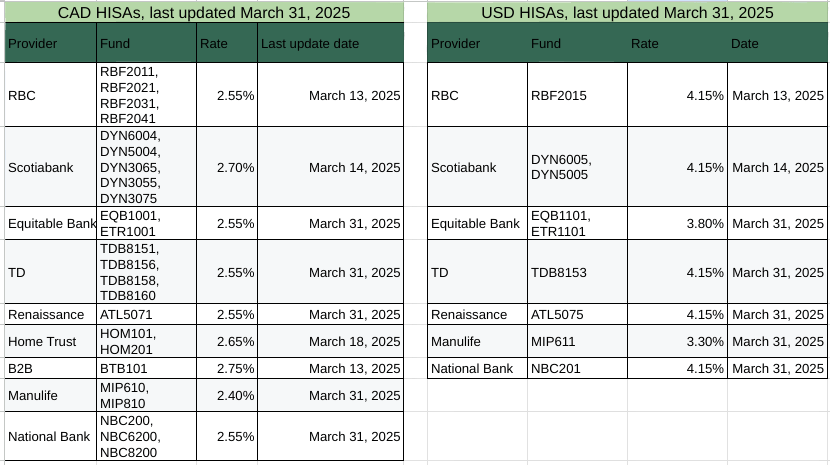
So I do pay attention to the ups and downs of the HISA rates. And I figured I’d share them with you:

Current HISA rates for HISAs available via QTrade

There’s also a Google Sheets version with a bit more detail (source links) if you prefer.

Hopefully most of the fields are self-explanatory. The “fund” column shows the identifier you would need to use to actually trade the HISA on your trading platform. How to access it will vary by provider. QTrade hides their HISAs in the “Mutual Fund” tab which is incorrect; these are not mutual funds, but are often modeled that way in the DIY platforms.

For Canadian Dollar HISAs, Scotiabank7 has been usurped! They have long been the highest-paying provider but the title now falls to B2B bank: https://b2bbank.com/advisor-broker-rates/banking-rates.

For those of you who hold US cash in your brokerage accounts, you can benefit from the much higher US interest rates8, and you have multiple choices since multiple providers are paying the same rate.

Before taking the leap and trading in HISAs, I was surprised by how they were handled on QTrade. There were a few differences possibly specific to QTrade, but pay attention to how your provider handles HISA trades:

  • QTrade considers holdings in HISAs part of your cash position for the purposes of buying stocks and ETFs9. If you successfully complete a trade that exceeds your ACTUAL cash position (i.e. cash NOT in the HISA) you will also have to sell the correct amount of your HISA to get rid of the negative cash balance in your account and avoid interest fees
  • HISA trades are not tracked in the “orders” tab of QTrade10 so be careful that you don’t inadvertently trade the same thing twice
  • QTrade limits all HISA purchases to $1000 minimum; there are no restrictions on sales, and there are no fees for either buying or selling HISAs.

Does your DIY broker give you access to other funds? Let me know about them at comments@moneyengineer.ca!

  1. An aside about the image chosen for this post…I pronounce the acronym HISA….and it’s on a TABLE, get it? ↩︎
  2. Looking at these websites, I may have to consider breaking up with CIBC for my day to day banking… ↩︎
  3. QTrade and iTrade definitely allow you to purchase these. Wealthsimple and BMO Investorline do not. Wealthsimple as a matter of course offers pretty competitive rates for any cash floating around in your account, especially if you have over $500k with them. BMO Investorline has high interest savings too, but you access to their product only (BMT104). ↩︎
  4. My personal bias is that I don’t much pay attention to CDIC-insured or not. I figure if major Canadian banks start failing, I had better make like Survivorman, because no insurance is going to save me. Perhaps that’s naive. ↩︎
  5. Great names for both, by the way ↩︎
  6. That’s return above the current inflation rate. Hiding money under a pillow would typically earn a negative real return, equal in magnitude to the current inflation rate. ↩︎
  7. All my cash holdings are in DYN6004 or DYN6005. ↩︎
  8. US Fed has not been as aggressive in cutting interest rates as compared to Bank of Canada. ↩︎
  9. Since I don’t have a margin account, if I try to buy something I don’t have the money for, I’m normally strongly discouraged from doing so with a clear warning. ↩︎
  10. BMO Investorline is the king of confusing handling of cash positions in your account. ↩︎