
ETFs for parking your money safely

Since my new DIY broker (Questrade) does not support the purchase of high interest savings accounts (HISAs), I need to find a free-to-trade alternative. 5% of my retirement portfolio is invested in what is characterized as “cash”, but I expect that money to earn some sort of return with essentially zero risk. (Another 15% of my portfolio is in the bond market, which, as we all learned in the last few years, has its downsides1.)

Questrade (like Wealthsimple) offers free trades of all ETFs. So it makes sense for me to go looking for ETFs that invest in safe havens. Here’s what I turned up for investments in Canadian dollars, based on some Google searches and some reading of similar questions posted in the public domain. Not all of them are what I would call “equivalent” to a HISA.

Fund SymbolFund CompanyWhat it invests inMERCurrent annual yield2Commentary
CASHGlobal X“high-interest deposit accounts with one or more Canadian chartered banks”0.11%2.68%This invests in the HISAs I currently invest in
CBILGlobal X“short-term Government of Canada T-Bills”0.11%2.88%Not a HISA but a safe investment
HISAEvolve“high-interest deposit accounts”0.15%2.71%Equivalent to CASH but with a higher MER
MCADEvolve“Canadian dollar high-quality short term debt securities (with a term to maturity of 365 days or less)”0.20%3.17%Very short term bond fund. 18% of holdings have due dates of less than 30 days
ZMMKBMO“high-quality money market instruments issued by governments and corporations in Canada, including treasury bills, bankers’ acceptances, and commercial paper. 0.13%3.6%Not a HISA but a very short term bond fund3. 31% of holdings have due dates of less than 30 days.
CAD ETF Candidates for investing Canadian dollars

Based on this quick analysis, ZMMK looks pretty attractive — a lot of very short term (and hence safer) debt as compared to MCAD, excellent returns. It is clearly a riskier investment than something like CASH or HISA. Between CASH and HISA I lean to smaller MERs every time, so CASH wins. CBIL might be a sort of happy middle ground…a T-Bill ought to be as good as a bank. All of these ETFs have a pretty stable NAV, either $50 or $100 per unit, so there should be little to worry about in terms of capital gains.

Since I hold a lot of USD, (not convinced this is a good idea), I need to do the same exercise for USD safe havens.

Fund SymbolFund CompanyWhat it invests inMERCurrent Annual Yield4Commentary
HISUEvolve“primarily in high interest US dollar deposit accounts”0.11%4.05%This invests in the HISAs I currently invest in
HSUVGlobal X“primarily in high interest U.S. dollar deposit accounts with Canadian banks…not currently expected to make any regular distributions”0.2%n/aGlobal X “corporate class” ETFs convert interest payments into capital gains. This sort of ETF makes sense in a non-registered account to minimize taxes.
ICSHBlackRock“broad range of short term U.S. dollar-denominated investment-grade fixed- and floating-rate debt securities and money market instruments”0.08%4.31%Not HISA but 46% is invested in debt with less than 30 days maturity
MUSDEvolve“primarily in U.S. dollar-denominated high-quality short term debt securities (with a term to maturity of 365 days or less).”0.20%3.49%Similar in strategy to ICSH, but only 20% in debt with 30 days maturity and only 40 holdings.
UCSHGlobal X“primarily invests in high-interest U.S. dollar deposit accounts, which provide a higher interest rate than a traditional USD savings account.”0.16%4.08%HISA-like, based on term deposits
USD ETF Candidates for investing US dollars

ICSH is the clear winner in terms of return, but, like ZMMK, a little riskier than a simple bank account. It has a nice broad portfolio (363 individual holdings) which makes it feel safer. HISU looks like the straight-up HISA replacement.

What ETFs do you use to park your cash? Let me know at comments@moneyengineer.ca.

  1. Excellent graphic of historical returns available at https://themeasureofaplan.com/investment-returns-by-asset-class/ ↩︎
  2. Take the latest monthly distribution, divide by the unit price, multiply by 12. If BoC holds their interest rates steady for the year, you could expect to achieve this rate for the next year. As of March 3, 2025. ↩︎
  3. “Commerical paper” refers to very short term debts, 30 days average maturity. Like a credit card debt, maybe. ↩︎
  4. US based funds like this one report a “30 day SEC yield”, it represents “interest earned after deducting the fund’s expenses during the most recent 30-day period by the average investor in the fund”. ↩︎

Changing your online broker: a guide

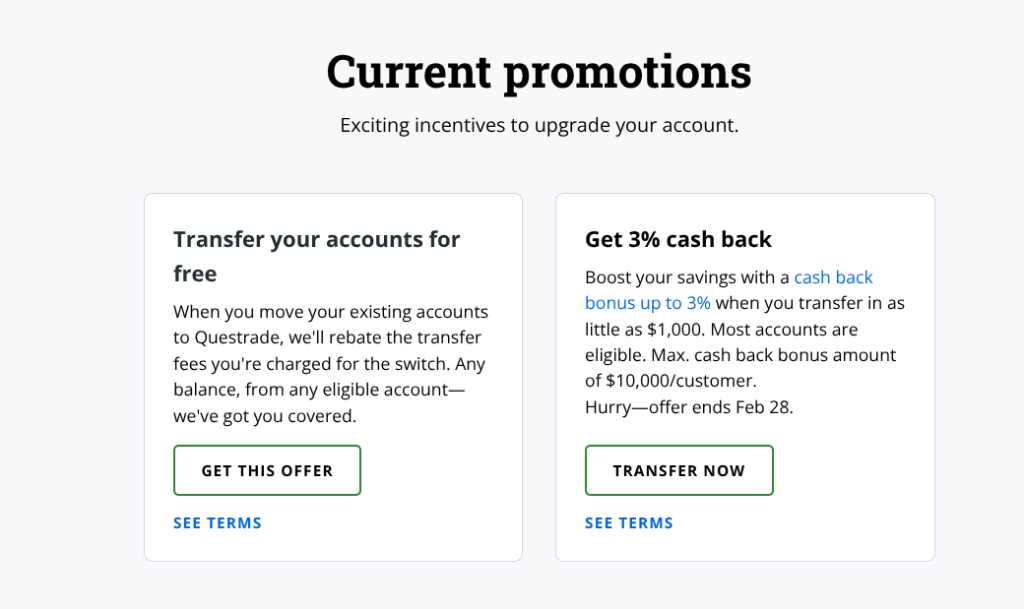
I have succumbed to the offer of free money and am in the process of breaking up with QTrade in favor of Questrade1.

I had no illusions about making the switch; I knew it was going to be a bunch of work to get it done. But as a retiree with no other sources of income, I figured I could spare the time2.

Switching DIY brokers, on the face of it, isn’t terribly complicated:

  1. Create a login on the new provider
  2. Open appropriate accounts on the new provider
  3. Fill out transfer forms to move accounts with the former provider to the new provider
  4. Set up ways and means of moving money in/out of your new provider
  5. For RRIFs and TFSAs, make sure the successor/beneficiary information is accurate3.
  6. Wait for step 3 to complete
  7. Resume investing and/or decumulating

Here are the things I needed to complete each of the above tasks as I went through the process of opening ten (yes, 10!) accounts4 on Questrade.

Step 1: Creating the login(s)

You’ll want a unique and strong password to do that, and using a password keeper of some kind is the best way to do that. Most providers also offer (or require) two factor authentication, and they usually require a cell phone number 5that they can text. Do set that up at the same time, this stuff is important to protect as best as you can.

If your spouse is joining in on the fun, you’ll need a second login for that.

Step 2: Opening the accounts

There will be some series of provider-dependent steps you will need to go through to identify what kind of account you want, and who will own it. And in order to do that, you’re going to need to have a full understanding of what kind of accounts are at your old provider — what vehicle (e.g. RRIF, RRSP, TFSA) and what owner (me, my spouse, or joint) ?

The owner(s) of a given account are easy enough to determine if you refer to your (monthly, quarterly, annual) statements: the name of the owner will be right up on top. In the case of a joint account6, both of your names will be visible. I’m not aware of any way to change the ownership of an account in the process of a transfer.

This step will be rather tedious. Lots of repetitive form filling, and depending on the sophistication of your provider (and, I think, your province of residence matters), you may have to print (!) and sign — with a pen — documents. In my case, the amount of printing was minimal at this step because Questrade makes good use of DocuSign. But other providers may make you print/sign/take pictures/upload7 instead.

Step 3: Fill out transfer forms

There is usually some delay — a day or two — between step 2 and step 3 since there’s usually some sort of back-office approval process involved8. This will give you the time to make a list of all the account numbers associated with the existing accounts and their rough market value. You’ll need those for the forms.

For me, this step involved a lot of download/print/sign/take pictures/upload9. So make sure you have a working printer, sufficient paper, a way to get forms back to your computer, and patience.

You will have to make an important choice at this step: whether to move the funds as cash, or whether to move them in-kind. “Cash” means you’re authorizing the receiving institution to sell your stuff at your old provider before moving it10. “In-kind” means you’re wanting to keep exactly what’s in the old account already. You can also choose to do a partial transfer at this step, but that’s not something applicable to me.

I chose in-kind since I hate being in a cash position for any period of time. But if you hold GICs or mutual funds (I do not), you should really check to make sure you are able to move those in-kind; many providers have restrictions on that sort of thing.

After the fact, I discovered that Questrade does not support HISA accounts. I am hoping that this does not create unintended consequences or delays.

Step 4: Set up ways and means to move money in/out of your accounts

Different providers do this differently. In my experience, most support online bill pay to get money into the accounts (like, for example, to make a TFSA or RRSP contribution), and EFT to get money out (like, for example, a RRIF payment, something rather important to me).

To set up an EFT transfer, you’ll need your banking details (institution number, transit number, account number) and a void cheque. Most banks have a way to do this directly online, no need for an actual physical cheque, if anyone still uses those.

An increasing number of providers11 seem to support direct credential connection between their platform and your banking platform using a third party like Plaid. I freely admit this sort of thing gives me serious heebie-jeebies, and will default to using upload of void cheques whenever possible.

Step 5: Make sure successors and beneficiaries are named for RRIF/RRSP/TFSA accounts

This will make the life of your heirs much easier and deny the government some of the $$$ associated with estate administration fees since properly documented successors and beneficiaries are NOT considered part of the estate. Read all about it in my previous post.

Step 6: Wait

The claim I am getting from Questrade is to allow 20 days for assets to move. This seems totally ridiculous on the face of it. I’ll report back on how long it actually takes. 1-2 weeks is more typical in my limited experience.

While waiting, I’ll complete the forms to make sure I have trading authority over my spouse’s accounts. This should allow me to see all the accounts she owns from my login. This is handy, since I’m the one who does most of the mechanics of making this whole “getting paid in retirement” thing work.

Step 7: Resume investing/decumulating

After making sure everything moved from your old provider to your new provider, as expected, of course.

You’ll probably want to ask your new provider to refund you any transfer-out fees charged by the old provider at this step.

Given Questrade doesn’t support HISAs, I’ll have to find an ETF alternative, which, thankfully, are plentiful. Other than that, I’m not anticipating big changes in the portfolio or the approach.

At this point, I’ll also have to (probably) close out the QTrade accounts and figure out how I’ll get my tax slips from them next year.

All this probably took 8 hours over the course of a few days. So not a trivial amount of time, but the promotional bonus will make it worthwhile12.

  1. And while both brokers start with the letter “Q” and are frequently confused with one another, I can assure you they are different. ↩︎
  2. And the resultant hourly rate if all goes well is better than what I made when I was paid a salary… ↩︎
  3. I covered that topic in this post. ↩︎
  4. For me: Investment account, RRIF account, Spousal RRIF account, TFSA. Same for my spouse. And then there’s one more joint firewalled investment account that we use for VPW’s cash cushion. That retirement decumulation strategy was covered in a previous post. And a family RESP. ↩︎
  5. Not the most secure or even convenient option; Questrade also offered using a standalone app like Microsoft Authenticator, which made me happy. ↩︎
  6. Here I hit a bit of a wrinkle: QTrade has joint non-registered accounts, but Questrade only has joint non-registered margin accounts. I am hopeful (but unsure) that I can successfully transmogrify one to the other. ↩︎
  7. My workflow for this: take picture on iPhone, Airdrop to Macbook, convert .HEIC files to pdf (and possibly, re-export to reduce file size), upload. This step alone would defeat many folks. ↩︎
  8. In my case, TFSA/non-registered was almost immediate, but 2 days in, I’m still waiting for the RRIFs to be approved. There are some extra regulations involved with registered accounts, it seems. ↩︎
  9. This is probably dependent on both providers involved as well as the type of account involved. The RESP transfer requires some CRA form to be filled out. ↩︎
  10. Possibly attracting high transaction charges — you may want to liquidate the assets yourself instead. ↩︎
  11. Questrade and Wealthsimple to name two ↩︎
  12. Note to the political class — maybe it’s time to take a look at the regulations here to streamline this process? Eight hours of effort to change a provider does not seem like it’s in the consumer’s best interest ↩︎

What broker(s) do you deal with?

I hang out a bit on Reddit1 to see what people are talking about. Often times, the post reads something like

“I am new to investing, I have $x to invest, who should I use ?”.

The crux of every 5th question posted to r/PersonalFinanceCanada

Personally, I find this kind of question a bit odd. “Investing” is a noble pursuit but it’s a term that means a lot of things to a lot of people. For me, “investing” is reserved for retirement savings since the timelines are long and I don’t need immediate access to the funds therein. A lot of people who ask this question want very near term access to the money, and to me that’s not investing. It’s saving. Timeline matters. The answer I’d give to a saver2 is a lot different than the answer I’d give to an investor.

I suppose the amount of money involved may influence the decision of platform provider (especially if there are freebies associated with having a balance above a certain amount, a common-enough practice), but it’s not the first thing I’d have in mind. Here are the main things I think about when it comes to choosing a financial provider, either for the first time, or if you’re thinking about making a change.

Does the provider have the account types you want?

Any provider I use has to offer Investment accounts, RESP, TFSA, RRIFs and spousal RRIFs. USD options for Investment accounts and RRIFs would be useful to me as well. Your own circumstances will offer up a different list. But don’t dismiss the RRIF if you’re nearing retirement. You may want one sooner than you think!

Does the provider have the products you want?

My needs here are really simple. I need access to trade a handful of ETFs on the US and Canadian markets, and I need a way to get a good interest rate on cash holdings. My assumption is that every major provider has a way to accomplish this. I don’t need access to bond markets3, options trading, fractional trading, margin trading or crypto. You might.

What fees that matter to you are charged by the provider?

The list of fees for any provider can get pretty long, but I only consider the things that impact me in my normal usage of the platform. The things I look for and expect are:

  • They don’t charge anything for “account maintenance”
  • The don’t charge fees for trading the ETFs I care about4
  • They need to offer a way to access daily interest rates in the neighborhood of the Bank of Canada overnight rates (some do this by paying good rates on any cash lying around your accounts, some do this by offering access to purchase HISAs, and as a last resort, there are ETFs that buy HISAs, too5)
  • They need a “much more generous than the bank”6 way of doing forex7

I’ve used QTrade8 as my main provider for the last 15 years or so. They offer the things I need. But for the first time, I’m seriously considering making a switch to Wealthsimple9. I’m test driving them now with part of my retirement portfolio, but I’ve found at least one show-stopper that make them unsuitable for me — they don’t offer spousal RRIFs10 in their self-directed product offering!

Switching providers can be quite onerous, so it’s not something I take lightly, especially since my holdings are paying my monthly salary! The DIY market is getting more competitive, so it can pay to take a look around. What do you like/dislike about your current provider? Drop me a line at comments@moneyengineer.ca.

  1. Specifically, r/PersonalFinanceCanada mostly ↩︎
  2. Put your money in the highest interest rate savings account you can find, or buy a GIC. ↩︎
  3. Beyond bond ETFs. I don’t need to own individual bonds. ↩︎
  4. Had I written this phrase 5 years ago, I would have said “low fees”. However, in today’s competitive landscape, many brokers charge nothing to buy and/or sell ETFs. If yours does, maybe it’s time to take a look around. ↩︎
  5. e.g. CASH by GlobalX, HISA by Evolve ↩︎
  6. Most banks happily tack on 1.5% to spot rates on currency exchanges, just like most credit cards do ↩︎
  7. Norbert’s gambit would apply here, although it’s somewhat cumbersome. I’ll cover forex in some future post. ↩︎
  8. But I’m also somewhat familiar with BMO Investorline, Interactive Brokers and Wealthsimple. ↩︎
  9. Free ETF trading, good interest rates for cash holdings, just-launched zero fee FX transactions for amounts over $100k, and their currently running promo are all rather attractive features. ↩︎
  10. And, as I write this, I get a friendly email from Wealthsimple support confirming this, with a promise to let the development team know about it. ↩︎